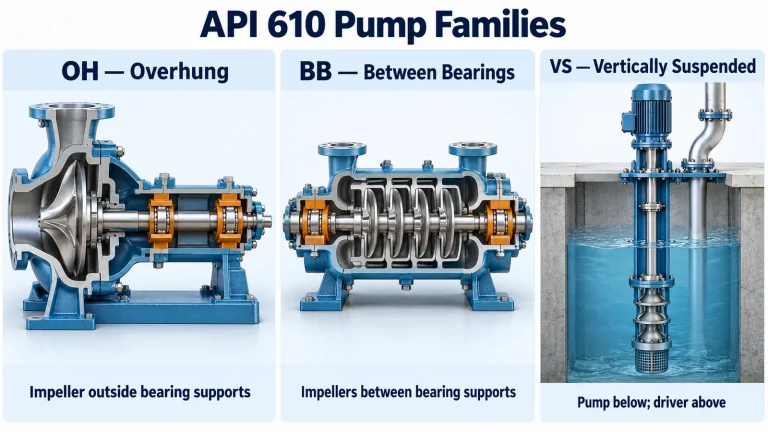

Image note: The hero image is an AI-generated editorial illustration, not an actual plant inspection or installation record.
What ASME B73.1 Interchangeability Establishes
ASME B73.1 is a design and dimensional framework for applicable horizontal, end-suction, single-stage, centerline-discharge chemical-process pumps. ASME describes dimensional interchangeability for pumps with the same standard dimension designation in relation to defined interfaces, including mounting dimensions, suction and discharge nozzle size and location, input shafts, baseplates and foundation-bolt relationships.
Use the designation as the start of an installation review. Confirm the applicable edition, pump size and configuration against the approved dimensional drawing and the equipment installed at the site. A standard designation does not establish that two pumps share the same hydraulic curve, impeller geometry, seal chamber, power end, materials or internal spare parts.
For the broader standard context, see our ASME B73.1 dimensions and interchangeability guide.
Installation Fit and Component Compatibility Are Separate Decisions
“Will it fit the installation?” and “Can these parts work together?” require different evidence. A pump can match defined installation interfaces while its shaft, impeller, seal chamber, power end or hydraulic performance still needs model-specific review.
Review the equipment in sequence: confirm the applicable designation and external interfaces; identify the exact model, size and configuration; compare controlled component drawings and revisions; then verify duty, material and sealing requirements. Record the scope reviewed and any exclusions or site checks that remain.
This distinction is especially important when a supplier uses “ANSI” or “B73.1” as a general compatibility claim. The standards framework can inform the dimensional review, but it is not a cross-reference for every internal component.
Six Checks Before Approving a Replacement
- Configuration identity: Record manufacturer, exact model, size, frame or group, equipment tag and installed options.
- Dimensional interfaces: Compare the applicable designation, approved GA and baseplate drawings, nozzle locations, shaft interface and actual site conditions.
- Mechanical interfaces: Verify shaft, key, bearings, coupling, casing registers, seal chamber and other mating dimensions using controlled drawings and revisions.
- Hydraulic duty: Check the curve for the actual model, speed and impeller configuration, including flow, head, power and NPSH requirements.
- Materials and sealing: Confirm wetted-part specifications, process-fluid data, temperature, seal arrangement and applicable material records.
- Operating conditions: Review pressure, viscosity, solids, control range, startup conditions and known field modifications.
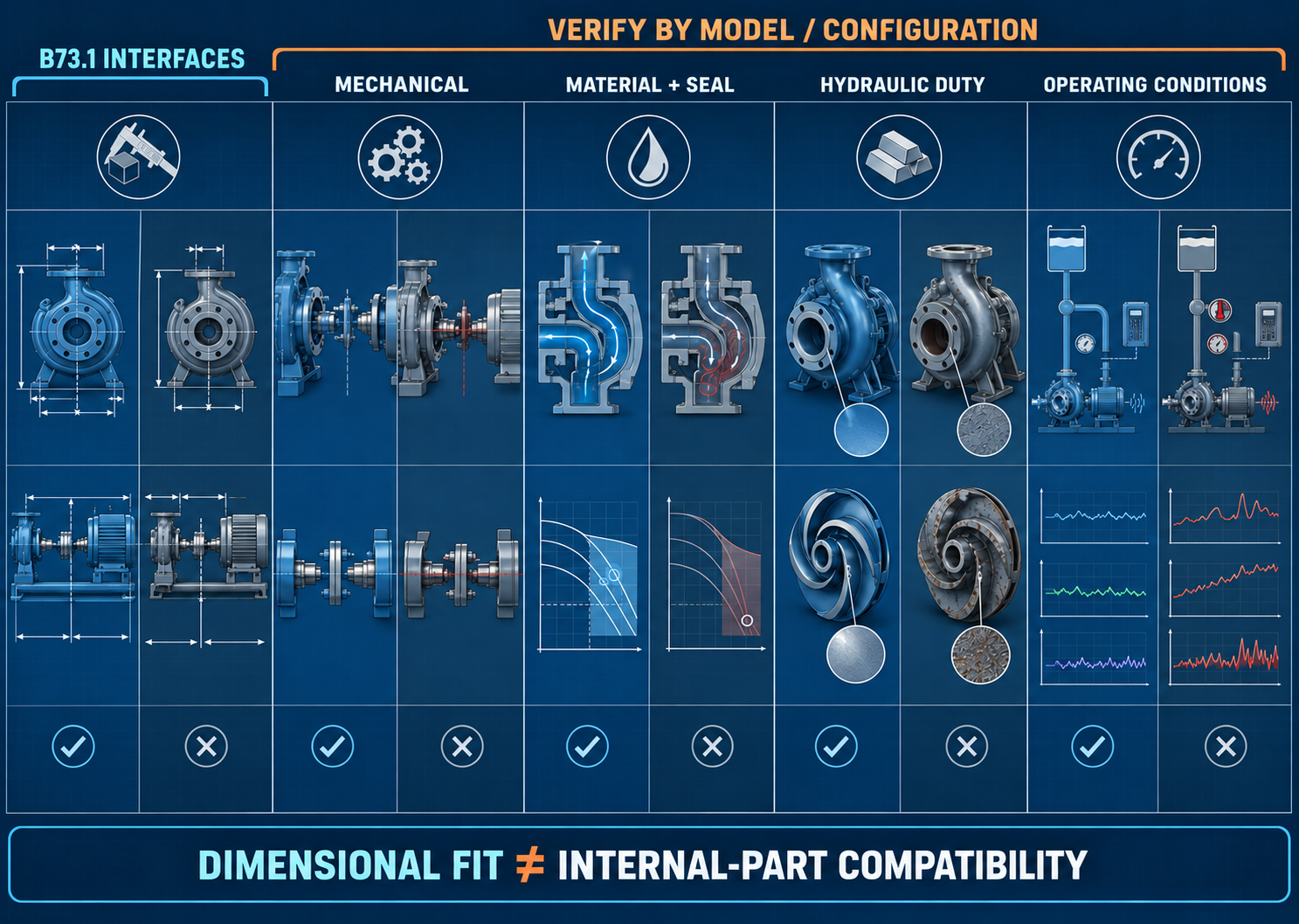
A part-number cross-reference is evidence to review, not blanket approval. It should identify the relevant configuration and component scope and point to the records supporting the match.
Match the Evidence to the Decision
| Review area | Useful evidence | What it does not prove alone |
|---|---|---|
| Installation dimensions | Applicable B73.1 designation, approved GA/baseplate drawing and site measurements | Internal compatibility or equal performance |
| Mechanical interfaces | Controlled component drawings, part numbers, revisions and dimensional inspection | Hydraulic or material suitability |
| Hydraulic duty | Curve for the actual model, speed and impeller configuration | Mechanical fit or drop-in installation |
| Materials and seals | Material records, fluid data and seal-arrangement documentation | Suitability for process conditions that were not reviewed |
| Final fitment decision | Written statement listing the scope, configuration, documents and exclusions | Unrecorded field changes or conditions outside that scope |
Tie every record to the exact installed size, frame or group and drawing revision. A family name by itself does not identify the assembly being replaced.
Why a Shared Standard Does Not Make Every Part Universal
Internal parts depend on their mating geometry and configuration. An impeller may depend on the shaft end, key or thread, axial setting, casing clearance and hydraulic trim. A mechanical seal depends on chamber dimensions and arrangement. A power end depends on its frame, bearings, lubrication and interfaces.
For Goulds 3196 or Durco Mark III replacement work, identify whether the scope is a complete pump, wet end, rotating assembly, power end or individual part. Use the manual and drawings for the exact model and configuration; do not transfer an adjustment dimension or procedure between platforms without supporting documentation.
See the focused Goulds 3196 and Durco Mark III impeller-adjustment comparison or our Goulds 3196 vs. Durco Mark III comparison.
What a Defensible Fitment Statement Includes
A useful fitment statement describes the exact conclusion supported by the review. Include:
- the existing and proposed pump model, size, frame or group and configuration;
- whether the scope covers a complete pump, wet end, rotating assembly, power end or named part;
- the external and internal interfaces actually checked;
- drawing numbers and revisions, measurements, performance data and material records reviewed;
- required modifications, exclusions, unresolved items and site checks; and
- the reviewer and the configuration covered by the approval.
A conclusion should say what was verified. Avoid universal “100% interchangeable” wording when the evidence supports only selected interfaces or configurations.
Choose the Next Step for Your Replacement Scope
If you are evaluating a component cross-reference, use the ANSI pump interchangeability verification workflow to organize dimensional, mechanical, hydraulic and material evidence. If you are evaluating a complete pump, review the relevant Goulds 3196 replacement or Durco Mark III replacement scope alongside the actual duty and configuration.
For a technical fitment review, provide the nameplate, model and size, replacement scope, available drawings or photos, operating duty, fluid and temperature, and any known modifications. Include part numbers, seal details and material requirements where available.
ANSI B73.1 Compatibility FAQ
Does ASME B73.1 make all ANSI pump parts interchangeable?
No. Its dimensional interchangeability intent concerns applicable pumps with the same standard dimension designation and defined installation relationships. Internal parts, duty, materials and sealing still need separate verification.
Does a matching flange prove a replacement pump will work?
No. Confirm all applicable dimensions, mechanical configuration, performance curve, materials, seals and service conditions. A flange match covers only one interface.
Can parts from Goulds 3196 and Durco Mark III pumps be mixed?
Do not assume they can. Review the exact component, model, size, configuration and mating interfaces against controlled drawings and the applicable manufacturer instructions.
What information is needed for a fitment review?
Start with the exact model, size and frame or group, the replacement scope, drawings or photos, operating duty, fluid and temperature. Add part numbers, material records and seal details where available.
When should a replacement decision remain on hold?
Keep the decision on hold when a critical interface, configuration, hydraulic basis or material requirement is unknown or supported only by an unqualified family-level cross-reference.
Technical Sources
- ASME — Specification for Horizontal End Suction Centrifugal Pumps for Chemical Process (B73.1)
- ITT Goulds — NM 3196 i-FRAME Installation, Operation and Maintenance Manual
- Flowserve — Durco Mark 3 ISO product information
- ANSI Pumps Pro — B73.1 dimensions guide
- ANSI Pumps Pro — Interchangeability verification workflow
Use the applicable licensed standard, controlled drawings, manufacturer instructions and project requirements for final fitment decisions.