
By Miya Zhang — Senior Application Engineer at ANSI Pumps Pro, with 10+ years specializing in ANSI B73.1 pump interchangeability and aftermarket replacement parts.
What Does It Cost to Own an ANSI Process Pump?
The purchase quote is only one part of pump ownership cost. A useful lifecycle comparison includes the costs required to install, operate, maintain and eventually retire the pumping system, together with production losses where a failure affects process output.
There is no single cost split that fits every plant. Run hours, actual electrical input, tariff structure, liquid, maintenance history, spare-parts strategy and the consequence of an outage can change which cost categories dominate.
Use the same boundary for every option
Before comparing repair, component replacement and a complete pump, define the evaluation period, system boundary, operating profile, included equipment, cost basis and treatment of future costs. Label estimates separately from measured or quoted values.
Include the Full Set of Relevant Cost Categories
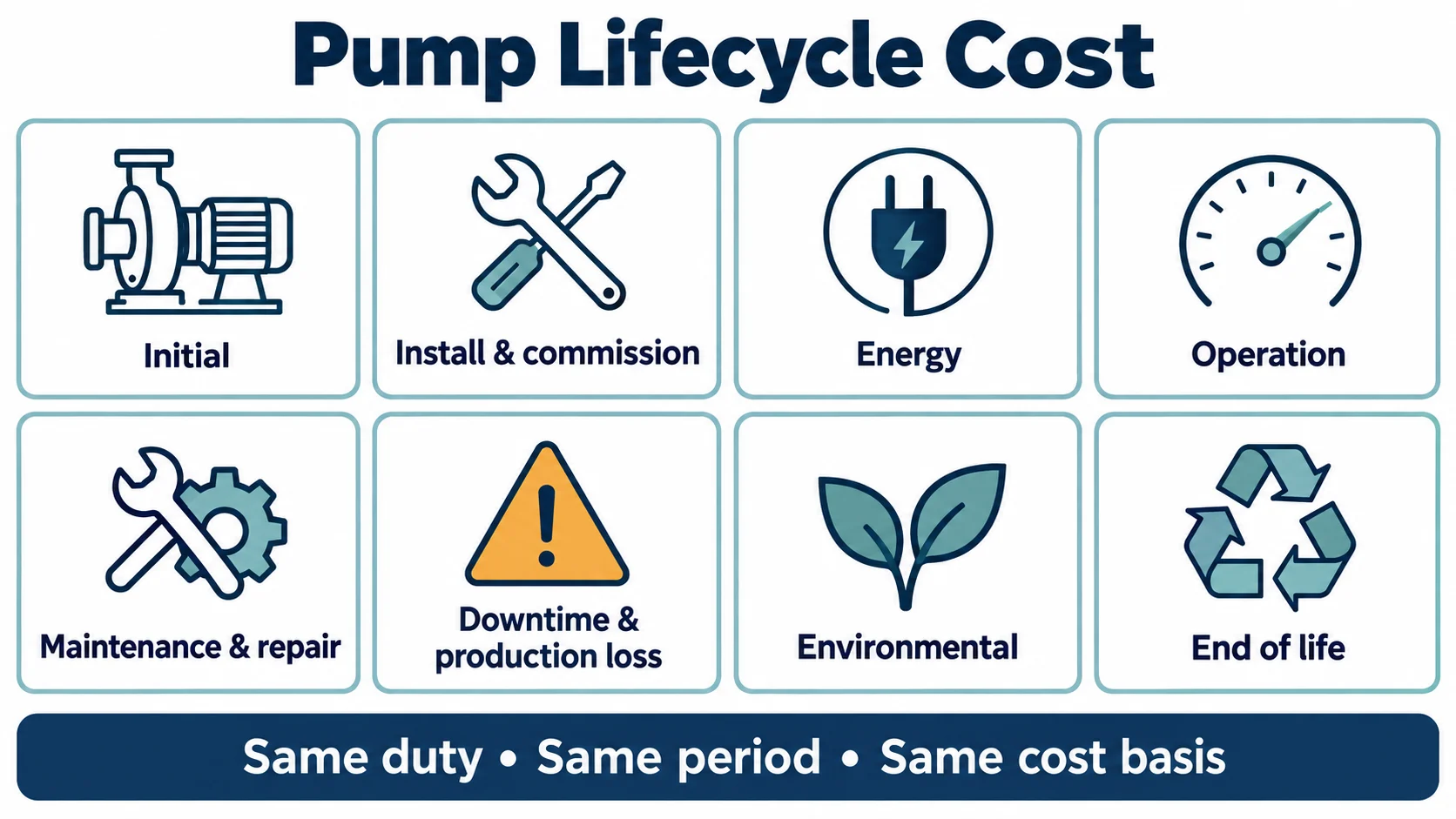
The Hydraulic Institute / Europump life-cycle cost guide presents LCC as eight cost categories. The equation below is a category framework; it is not a rule to add future cash flows at face value.
Eight Cost Categories, One Comparable Basis
The diagram shows lifecycle cost scope, not a universal cost split or ranking.
Financial basis: For a multi-year comparison, apply the project-approved evaluation period and financial method, such as present value with stated discount and price-escalation assumptions. Include financing, tax or depreciation treatment when required by the decision method. Label an undiscounted comparison as screening only.
| Cost element | Include in the estimate | Useful evidence |
|---|---|---|
| Initial (Cic) | Pump or component, driver, controls and specified accessories. | Comparable quotations and an explicit supply scope. |
| Installation (Cin) | Removal, foundation or piping work, alignment, commissioning and acceptance testing. | Site labor estimates, drawings and planned outage scope. |
| Energy (Ce) | Electricity used across representative operating states. | Measured input kW, operating hours and applicable tariff. |
| Operation (Co) | Routine operator attention and system supervision where material. | Work records, staffing assumptions and site procedures. |
| Maintenance (Cm) | Planned service, parts, repair labor, inspection and repair logistics. | Asset history, work orders, repair quotations and task plans. |
| Downtime (Cs) | Lost production or other documented consequences during an outage. | Outage duration, redundancy, recovery time and site-approved cost basis. |
| Environmental (Cenv) | Containment, leakage, cleanup, compliance or waste-handling costs attributable to environmental impacts; do not repeat costs assigned to end-of-life disposal. | Process hazard review and site/environmental records. |
| End of life (Cd) | Decommissioning, equipment removal and disposal, less documented residual value; do not repeat costs assigned to Cenv. | Site disposal requirements and documented salvage assumptions. |
Start With the Actual Duty and Operating Profile
A nameplate or motor horsepower rating describes equipment capability; it does not establish the pump’s actual electrical demand. Record representative operating conditions and keep the measurement boundary clear.
Do not turn a motor rating into an energy bill
For an installed pump, measured electrical input is generally a stronger basis for energy cost than motor nameplate power. If input power is calculated instead, distinguish hydraulic power, pump shaft power and electrical input, and state every efficiency assumption.
For the electrical-cost calculation and variable-duty method, see the pump energy cost guide. For a preliminary duty-to-power calculation, use the Pump Power & Motor Sizing Calculator and verify the result against the applicable curve and project data.
Calculate Energy From Representative Operating States
When real electrical input is available, calculate the energy cost for each operating state and add the states together. Do not multiply one convenient reading by the full year unless it represents the full operating profile.
Capture the baseline
Pair power with flow, head, speed and process state.
Separate duty states
Record representative hours and rates for each state.
Use the same service
Compare options at the required duty and boundary.
State uncertainty
Show assumptions, ranges and missing data.
Check after changes
Use comparable operating conditions for follow-up readings.
For broader loss diagnosis and implementation planning, see the pump system optimization guide. An energy assessment is system-wide; a pump replacement decision should not be reduced to an assumed efficiency percentage.
Compare Repair, Component Replacement and a Complete Pump
There is no universal repair-cost threshold that decides every case. Compare technically acceptable alternatives using the same evaluation period, required duty, installation scope, acceptance criteria, maintenance assumptions and outage basis.
| Alternative | Questions to answer | Evidence to compare |
|---|---|---|
| Repair the installed pump | Can the root cause be corrected? Are casing condition, materials and hydraulic duty still suitable? | Inspection findings, repair scope, measured clearances, repair cost, expected service assumptions and test plan. |
| Replace a defined assembly or component | Can a wet end, rotating assembly or power end address the identified issue while retaining the rest of the installation? | Exact model, size, frame/group, interfaces, materials, duty, assembly scope, fit-up records and acceptance tests. |
| Replace the complete pump | Have service conditions changed, or can the existing pressure boundary, material or hydraulic duty no longer meet requirements? | Required duty, system interfaces, material review, installation work, curve evidence, commissioning and total outage plan. |
Separate fit from performance
ASME B73.1 dimensional relationships do not by themselves prove that every internal component, material choice or hydraulic curve is interchangeable. Verify the exact installed configuration and the proposed replacement scope.
For a specific replacement, use the ANSI pump interchangeability verification workflow. For a Goulds 3196 or Durco Mark III application, the dedicated 3196 replacement and Mark III replacement pages are starting points for model-specific review, not a substitute for confirming fit and duty.
Make the Assumptions Traceable
Every material input should be identified as measured, quoted, taken from an asset record, or assumed for screening. Keep uncertainty visible so a preliminary comparison is not mistaken for a guaranteed saving or service-life prediction.
| Input | Preferred basis | If unavailable |
|---|---|---|
| Power and duty | Representative measured input kW paired with flow, head and speed. | Calculate a range from documented efficiencies and the applicable performance data. |
| Maintenance | Work orders, part invoices, labor and repair history for this service. | Use a clearly labeled estimate and sensitivity range; do not invent universal seal or bearing intervals. |
| Downtime | Actual restoration time, production impact and standby/recovery records. | Show a scenario range with the plant’s validation required. |
| Future costs | Project-approved evaluation period, tariff assumptions and financial method. | State whether the comparison is undiscounted screening or discounted lifecycle analysis. |
A Practical Lifecycle Cost Review
Set scope and period
Describe the system boundary, service and evaluation basis.
Build the evidence set
Gather duty, power, hours, maintenance, quotations and outage data.
Cost each alternative
Use consistent categories and state uncertainty explicitly.
Compare cost and risk
Check duty, fit, materials, outage and acceptance requirements together.
Record the outcome
Confirm the installed result and update the equipment history.
What to assemble for a review
Pump and motor identification, duty range, measured power, operating hours and tariff, maintenance history, failure reports, spare-parts scope, drawings, materials, quotations and required acceptance tests.
If the review identifies an energy or control opportunity, continue with the system-level optimization workflow. If it identifies a specific replacement requirement, verify the model and interfaces before requesting a quotation.
ANSI Pump Lifecycle Cost FAQ
What is included in pump lifecycle cost?
Depending on the system boundary, include initial purchase, installation and commissioning, energy, operation, maintenance and repair, downtime, environmental costs, and end-of-life costs.
Can one percentage split describe every pump’s lifecycle cost?
No. Cost shares depend on duty, operating hours, energy tariff, maintenance history, system conditions and the consequence of downtime. Use applicable industry guidance as context and site data for the decision.
Should I use motor nameplate horsepower to calculate annual pump energy cost?
Not as a direct substitute for actual electrical demand. Use representative measured input kW where possible. If calculating power, keep hydraulic, pump shaft and electrical input boundaries distinct.
When is replacement more economical than repair?
Compare technically acceptable repair, component-replacement and complete-pump options on the same duty, evaluation period, maintenance basis, acceptance requirements and outage assumptions. No single repair-price threshold applies to every service.
Does an ANSI or ASME B73.1 designation prove a replacement is fully interchangeable?
No. The applicable standard establishes defined dimensional relationships. Confirm the exact model and configuration, mechanical interfaces, materials, hydraulic duty and documentation for the replacement scope.
Technical Sources
- Hydraulic Institute / Europump — Pump Life Cycle Costs: A Guide to LCC Analysis for Pumping Systems, 2nd Edition
- Hydraulic Institute — Lifecycle Cost Analysis overview
- U.S. Department of Energy / Hydraulic Institute — Pump Life Cycle Costs: A Guide to LCC Analysis for Pumping Systems (Executive Summary)
- ISO/ASME 14414:2019 — Pump System Energy Assessment