
Start With the Installed System
Pump piping can reduce inlet pressure, disturb flow into the impeller, or transmit external loads to the casing. Before changing a pump or its parts, review the installed pipework under the actual operating conditions and separate a piping problem from a pump condition or a changed process duty.
This guide is a field-review sequence for process, maintenance, and reliability teams. It does not replace a project hydraulic calculation, the applicable pump-piping standard, the pump manufacturer’s instructions, or an engineering review of applied nozzle loads.
Keep the evidence together
Record the pump model and configuration, liquid and temperature, actual flow and speed, suction and discharge readings, source level or pressure, valve and strainer condition, recent piping changes, and the symptom timing. Compare readings taken at the same duty before drawing a conclusion.
Confirm the Suction Line Can Supply the Actual Duty
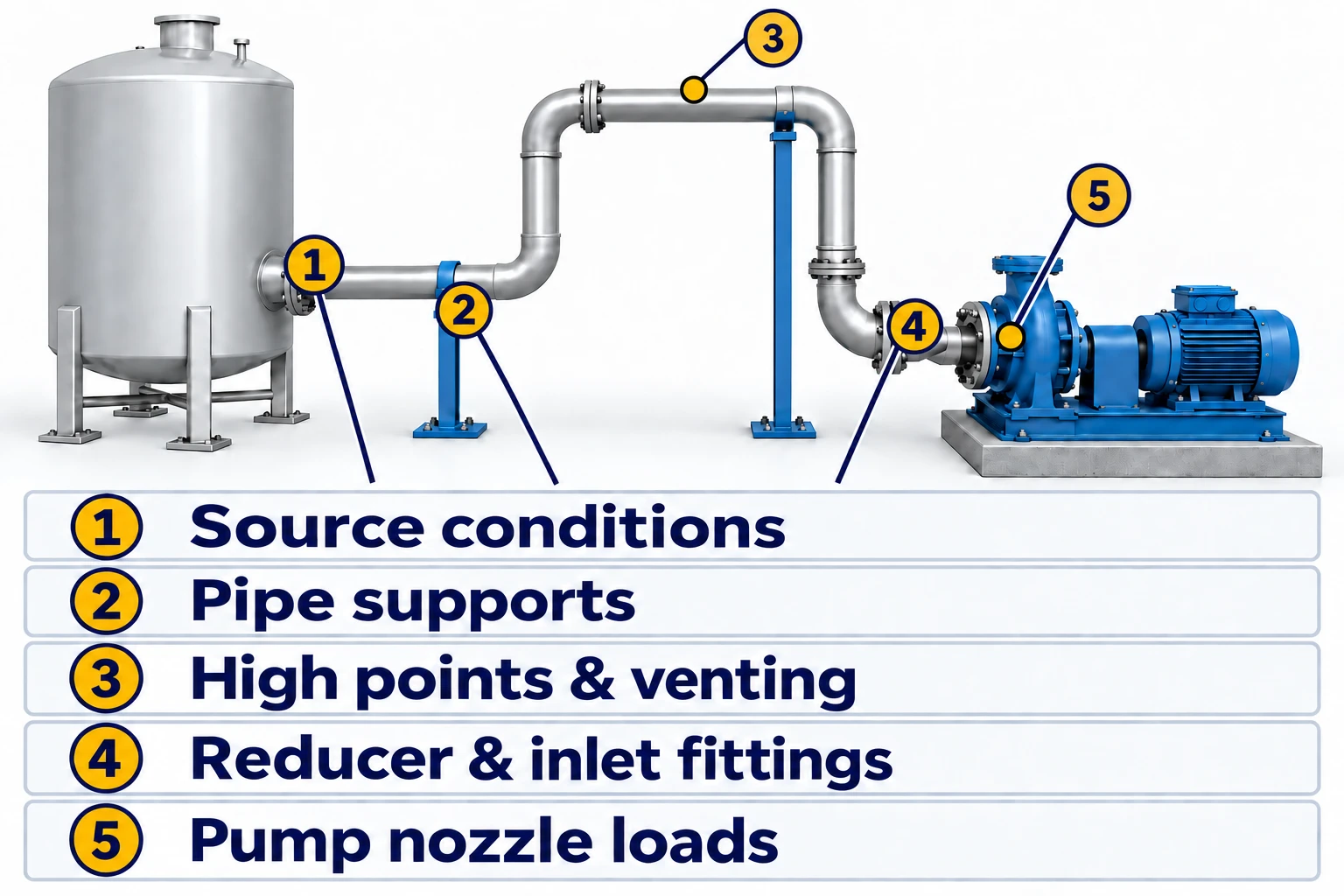
The nominal suction-flange size alone does not establish whether the installed line is suitable. Review the flow path from the source to the pump, including pipe inside diameter, length, fittings, valves, strainers, liquid properties, minimum source level, vapor pressure, and operating range.
Use measured flow and pressure, the system boundary, and the pump’s published curve to determine whether the inlet condition is consistent with the required duty. A larger line may reduce friction in one arrangement, but its size must be assessed with the full system and transition geometry. Do not prescribe a fixed number of pipe sizes for every installation.
When pipe segments, fittings, elevation, and fluid properties need to be evaluated together, use the Pump System Hydraulic Calculator. It supports the calculation; it does not replace confirmation of the actual pump duty or project design basis.
Look for Air Pockets, Leaks, and Incomplete Filling
Trace the suction line from the source to the pump and mark high points, changes in slope, vents, instruments, valves, and connections. A line that cannot fill or vent as intended can admit or retain gas, interrupt priming, or produce unstable inlet conditions.
Noise, loss of prime, or fluctuating flow can have more than one cause. Compare the conditions with the pump history and use the cavitation and suction-condition guide when symptoms suggest gas ingestion or insufficient NPSH.
Choose Reducer Orientation From the Actual Geometry
An eccentric reducer is often used in a horizontal suction line where the arrangement must avoid a gas-collecting pocket. Its orientation is not a stand-alone rule: the correct arrangement depends on flow direction, pipe slope, source location, venting path, pump orientation, and the manufacturer’s installation guidance.
Review the drawing and walk the installed line in the direction of flow. Confirm that the transition does not create an unintended high point or abrupt approach condition. Do not assume that “flat on top” or “flat on bottom” is correct for every service, including solids-bearing service; the complete line geometry and operating conditions must govern.
ANSI/HI 9.6.6 gives configuration-dependent pump-piping guidance, including reducer and straight-run considerations. Use the current edition and the pump manufacturer’s instructions for the specific arrangement rather than copying a detail from an unrelated installation.
Review Elbows, Tees, Valves, and Other Flow-Disturbing Fittings
Nearby fittings can create swirl or a nonuniform velocity profile at the pump inlet. Depending on the pump and arrangement, disturbed approach flow may affect head, available suction conditions, vibration, noise, or component life.
Do not treat a fixed 5D or 10D straight-run statement as a universal acceptance rule. ANSI/HI 9.6.6-2022 sets configuration-specific guidance; the required length can depend on the fitting type and orientation, adjacent fittings, and the pump inlet arrangement. Check the current standard, the applicable pump IOM, and project requirements. If the installed space cannot meet the applicable arrangement, have the deviation evaluated rather than adding a flow-straightening device by default.
For a broader review of forces and moments transmitted through pump nozzles, see the pump nozzle-load and piping-force guide.
Evaluate Pressure Loss and NPSH at the Operating Condition
Include the suction pipe, fittings, valves, strainer, elevation, source pressure, liquid temperature, vapor pressure, and relevant fluid properties in the system review. A clean-water assumption may not represent a viscous, solids-bearing, hot, or gas-releasing process liquid.
Compare NPSH available with the manufacturer’s NPSH required at the actual flow, speed, and pump configuration. The required margin is application-specific; do not insert a single fixed metre or foot value as a universal safe limit. Use the current ANSI/HI 9.6.1 NPSH margin guide and the relevant manufacturer curve for that decision.
Keep calculations in their lane
This article explains what to check and how to interpret the result. Use the hydraulic calculator for system calculations and the pump’s documented performance curve for pump-specific head, power, efficiency, and NPSHr. Do not infer a pump performance number from a generic piping rule.
Check Pipe Supports and External Loads at the Pump
Support the piping independently so the pump flanges are not used to carry pipe weight or pull misaligned piping into place. Consider the installed support arrangement, valves and inline equipment, anchors and guides, and expected thermal movement. Cold alignment alone may not describe the operating condition where the piping moves as it heats or cools.
For a field check, document alignment before and after connecting the pipe, note whether the condition changes as flange bolts are tightened, and inspect supports, guides, and anchors. Do not apply an unsourced universal shaft-movement limit. Acceptance criteria must come from the applicable installation procedure, pump manufacturer, project specification, and engineering assessment.
For applied pump-nozzle-load evaluation, use ANSI/HI 9.6.2 and the pump supplier’s configuration-specific data. The ASME B73.1 dimensional framework does not, by itself, approve every external piping load.
Use Symptoms to Choose the Next Measurement
A symptom is a clue, not proof of a root cause. Compare repeatable field data with the operating history, pump curve, and piping condition before opening the pump or changing the system.
Field diagnosis sequence
Follow the evidence from the operating condition toward the next engineering decision.
Capture the duty
Log flow, pressure, speed, liquid, source condition, and symptom timing together.
Check the suction path
Review filling, air entry, restrictions, high points, and flow-disturbing fittings.
Check support and fit-up
Review pipe supports, alignment records, flange fit, and changes after piping work.
Use the right curve
Compare the measured duty with the correct pump configuration and curve revision.
Select the next check
Correct the system, inspect the pump, or verify replacement fitment only when evidence supports it.
Next evidence: suction pressure, source condition, and venting or priming record.
Next evidence: flow and pressure readings at a known operating condition.
Next evidence: before/after alignment, support inspection, and vibration trend.
Next evidence: actual flow, suction/discharge readings, speed, and the correct pump curve.
If the question is how measured duty compares with head, efficiency, power, and NPSHr, consult the pump-curve guide and the verified data in Technical Resources.
Complete a Piping Review Before Returning the Pump to Service
If the review points to a system-wide energy or control opportunity, continue with the separate pump system optimization decision guide. If measurements instead indicate that a replacement pump may be necessary, verify the installed configuration and interfaces before requesting a quote. See the relevant Goulds 3196 replacement or Durco Mark III replacement review where applicable.
Frequently Asked Questions
Does the suction pipe always need to be larger than the pump suction nozzle?
No single nominal-size rule applies to every installation. Evaluate flow, pipe length, fittings, fluid properties, pressure loss, NPSH, and the pump manufacturer’s requirements for the actual system.
Should an eccentric reducer always be installed flat on top?
No. Orientation depends on the actual pipe direction, slope, source, pump arrangement, and potential gas-collection path. Check the full layout and applicable pump instructions.
Is 5D or 10D enough straight pipe before every pump?
That is not a universal acceptance rule. The applicable straight-run guidance depends on the flow-disturbing fitting and the pump-piping configuration. Consult the current ANSI/HI 9.6.6 edition and pump IOM.
What NPSH margin should the system have?
Use the application-specific guidance in ANSI/HI 9.6.1 and compare the system NPSHa with the manufacturer’s NPSHr at the actual duty. A single fixed margin should not be applied to every pump and service.
Can flange bolts be used to pull the pipe into alignment?
No. Do not use the pump connection to force a misaligned pipe into place. Review fit-up, supports, alignment, and external nozzle loads under the applicable installation and project procedures.