
What Does HI 40.6 Pump Efficiency Testing Measure?
When a supplier reports pump efficiency, the percentage is only useful when the measured duty and the pump configuration are clear. ANSI/HI 40.6 provides a common framework for determining and reporting rotodynamic pump efficiency. It does not, by itself, tell a buyer whether a particular offer meets every project requirement.
For a meaningful review, connect the reported result to the tested pump, impeller, speed, flow, head, fluid, power measurement and test basis. Ask the supplier to identify the edition and any project-specific additions or departures used for the test. Check the official HI 40.6-2021 listing and confirm the edition required by the project.
Buyer’s decision
Use the test report to understand measured performance. Use the purchase specification and the agreed acceptance basis to decide whether the tested pump is acceptable.
Check where the test is performed
HI describes HI 40.6 as an efficiency-testing method for pump test facilities or laboratories; it is not a field efficiency-test method. HI also says the standard is not intended for production pump testing. For production acceptance, specify the applicable acceptance standard separately: ANSI/HI 14.6 for rotodynamic pumps or ANSI/HI 11.6 for submersible pump mechanical and electrical acceptance testing.
See the Hydraulic Institute explanation of HI 40.6 scope and confirm the governing standard and edition in the purchase documents.
HI 40.6 and HI 14.6 Answer Different Questions
A frequent source of confusion is treating an efficiency test method as though it also defines the contractual pass/fail tolerance. Keep the standard, the project specification and the acceptance decision visible as separate parts of the test request.
| Reference | Question it helps answer | Buyer action |
|---|---|---|
| ANSI/HI 40.6 | How is rotodynamic pump efficiency tested and reported under the stated test basis? | Request the edition, tested configuration, conditions, measured results and calculation basis. |
| ANSI/HI 14.6 | What hydraulic performance acceptance test basis applies to the pump order? | Name the agreed acceptance standard, grade and contractual tolerance in the purchase documents. See the HI 14.6 acceptance-test guide for the separate topic. |
| ANSI/HI 11.6 | What mechanical and electrical acceptance test basis applies to a submersible pump? | Identify the applicable submersible-pump standard and contract requirements; do not substitute HI 40.6 for production acceptance testing. |
| Project specification and purchase order | Which requirements govern this specific supply and its disposition? | Resolve the applicable test, acceptance criteria, deviations and approval authority before the test. |
This distinction matters commercially: a test can be conducted and reported without the report alone deciding contractual acceptance. Do not infer a tolerance, guarantee or compliance status from an efficiency value unless the governing document says so.
When Can Two Pump Efficiency Results Be Compared?
First confirm that each result describes a comparable duty and pump configuration. A percentage detached from its test conditions is not enough to establish that one pump is more efficient for your service.
Do not compare unlike power values
Hydraulic power transferred to the liquid, pump shaft input and motor electrical input are different quantities. State which boundary each number represents before comparing efficiency or motor loading.
How Efficiency Connects to Power at the Duty Point
At a defined flow and head, hydraulic power depends on the liquid density as well as the duty. Pump shaft power also depends on pump efficiency. These relationships explain why the test result, the measured power boundary and the actual service fluid must be read together.
where \(P_{hyd}\) is hydraulic power transferred to the liquid, \(\rho\) is fluid density, \(g\) is gravitational acceleration, \(Q\) is volumetric flow rate, and \(H\) is total dynamic head.
Then:
where \(\eta_{pump}\) is pump efficiency on a shaft-power basis; \(P_{shaft}\) is the mechanical input at the pump shaft. Use the definition and measurement boundary required by the specified test procedure.
These equations explain the quantities; they do not replace the standard’s test procedure, uncertainty requirements or a project acceptance specification. For duty calculations, use the site’s Pump Power and Motor Sizing Calculator and review its inputs and stated limits.
A water test and a process-fluid duty are not automatically interchangeable. Specific gravity affects power, while viscosity can affect pump performance and may require a separate correction method. Use the appropriate source and input data for the actual liquid; see the related guide on specific gravity and centrifugal pump power. Do not apply a universal correction without verifying the fluid properties and method.
Connect the Test Report to the Pump Curve and Service
Use the submitted performance curve to locate the specified duty, review the tested configuration and understand what the report does—and does not—establish. A curve is pump-specific evidence; it is not a substitute for matching the test report to the supplied impeller, speed and configuration.
From test evidence to a purchase decision
Keep each handoff tied to the project documents and the actual pump configuration.
Define the basis
Identify the specified test method, edition and contractual acceptance documents.
Verify the record
Match pump configuration, duty, fluid and measured input boundary.
Compare the curve
Check the documented curve and duty against the supplied equipment.
Resolve differences
Document deviations and obtain the required technical approval.
For curve interpretation, use the site’s Pump Performance Curves resource. For chemical process service, begin with the actual fluid, operating range and specified materials on the ANSI process pump page; a standard designation by itself does not verify a particular application.
Check DOE Coverage Before Making a PEI Claim
DOE pump requirements apply to equipment that meets the regulatory definitions and scope in the applicable rule. Do not assume that every industrial centrifugal pump, every ANSI B73.1 process pump or every pump tested for efficiency is subject to the same PEI requirement.
The Hydraulic Institute describes the DOE rule as applying to specified pump categories, not every pump used in industry. When U.S. regulatory compliance is part of the purchase, verify both coverage and the applicable test procedure in 10 CFR Part 431, Subpart Y, including §431.463 and Appendix A. DOE’s procedure incorporates HI 40.6-2021 with specified exceptions; where a referenced standard conflicts with the regulation, the regulation controls. Do not treat the unmodified HI standard alone as proof of DOE compliance. See DOE’s current pumps standards and test-procedure page and its commercial and industrial pumps test-procedure rule, as well as the HI overview of pump energy-efficiency regulations.
What to Include in a Pump Efficiency Test Request
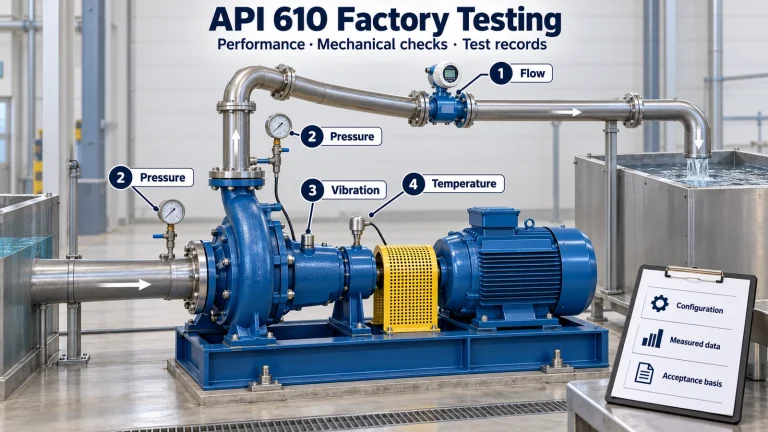
Before a factory test, make the required evidence and decision authority explicit in the purchase package. Ask the supplier to confirm the following against the specified pump and test basis:
A favorable efficiency test result does not establish replacement fit or material compatibility. If the application is a Goulds 3196 or Durco Mark III replacement, use the corresponding Goulds 3196 replacement or Durco Mark III replacement information, then verify the approved dimensional drawing, mounting and piping interfaces, seal arrangement, wetted materials and duty against the project records.
For a technical review, submit the pump nameplate, specified duty, fluid data, submitted curve, test report and the acceptance documents through the engineering review contact page.
Frequently Asked Questions
Does HI 40.6 define the acceptance tolerance for a pump order?
Do not assume so. Identify the separate acceptance test basis and tolerance agreed in the purchase documents. ANSI/HI 14.6 is the Hydraulic Institute’s rotodynamic pump hydraulic performance acceptance-test standard; the applicable edition and contractual requirements must be stated for the order.
Can HI 40.6 be used for field tests or production pump acceptance?
HI describes HI 40.6 for efficiency testing at pump test facilities or laboratories and says field testing is not permitted as a method under the standard. HI also says it is not intended for production pump testing. Specify the applicable production acceptance standard separately: ANSI/HI 14.6 for rotodynamic pumps or ANSI/HI 11.6 for submersible pump mechanical and electrical acceptance testing.
Can I compare two reported pump efficiency values directly?
Only after confirming that the duty, tested configuration, speed, fluid, power measurement boundary and reporting basis are comparable. If any of these differ, resolve the difference before drawing a purchasing conclusion.
Does DOE’s PEI requirement apply to every ANSI process pump?
No blanket assumption is appropriate. Check the applicable DOE equipment definitions and scope in the current regulation before making a compliance claim.
What records should I request after a pump efficiency test?
Request the test basis, pump configuration, operating conditions, measured flow/head/power, calculation boundary, calibration and uncertainty information required by the test basis, corresponding curve and documented deviations.
Sources and Related Engineering Resources
- Hydraulic Institute — HI 40.6-2021 Methods for Rotodynamic Pump Efficiency Testing. Verify the edition specified for the project and consult the complete standard for detailed test requirements.
- Hydraulic Institute — HI 40.6, a Proven Standard for Uniform Pump Efficiency Tests. Explains the test-facility scope, field-testing boundary and distinction from acceptance criteria.
- U.S. Department of Energy — Pumps: Current Standards and Test Procedures. Provides DOE’s current reference points for coverage and the applicable test procedure.
- U.S. Department of Energy — Test Procedure for Commercial and Industrial Pumps. See the incorporated HI 40.6-2021 provisions and the stated regulatory exceptions.
- Electronic Code of Federal Regulations — 10 CFR Part 431, Subpart Y. Verify DOE scope and current requirements for the equipment being specified.
- Hydraulic Institute — Pump Energy Efficiency Regulations. The overview identifies the program as covering certain clean water pumps and describes HI 40.6’s role in the DOE test procedure.
- ANSI Pumps Pro — ANSI/HI 14.6 acceptance-test guide.
- ANSI Pumps Pro — Pump Power and Motor Sizing Calculator.
- ANSI Pumps Pro — Pump Performance Curves.