
When Standard Seals Cannot Handle the Heat
High-temperature pumping applications present a unique challenge for mechanical seals. Above 200°C (392°F), the standard seal designs and piping plans used on ANSI process pumps begin to reach their limits. The traditional approach — cool the fluid before it reaches the seal — introduces additional heat exchangers, pumps, and controls that add capital cost and ongoing maintenance burden. But advances in high-temperature seal technology are making it possible to eliminate these auxiliary cooling systems entirely, simplifying the pump skid, reducing installation cost, and eliminating the energy penalty of cooling and reheating the process fluid.
Case Study: ROI in Under Two Months
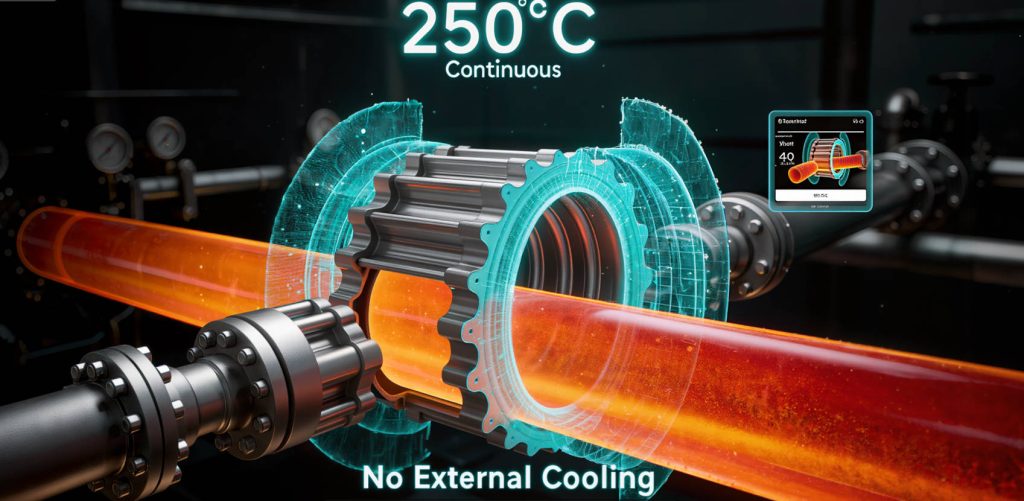
A chemical plant was specifying a pump to transfer a heat transfer fluid at 210°C (410°F). The conventional approach required a seal flush system with a shell-and-tube heat exchanger (cooling the flush fluid to 80°C), a separate cooling water pump, and a reheating system to bring the fluid back to process temperature before it entered the downstream vessel. The alternative approach used a high-temperature bellows seal rated for continuous operation at 250°C, with no external cooling. The high-temperature seal added $8,500 to the pump cost, but eliminated $32,000 in heat exchanger, pump, piping, and controls costs — a net savings of $23,500 on a $45,000 pump package. The ongoing energy savings from avoiding the cooldown-reheat cycle added approximately $6,800 per year. Payback was less than two months.
Why High Temperature Creates Seal Problems
Mechanical seals fail at elevated temperatures for four primary reasons:
1. Vaporization at the Seal Faces
The liquid film between the rotating and stationary seal faces is only a few microns thick. Above the fluid’s boiling point at the seal chamber pressure, this film vaporizes — a condition called “flashing.” When the film flashes, the seal faces run dry, friction spikes, and temperatures at the faces can rise hundreds of degrees in seconds. The seal either cracks from thermal shock or wears catastrophically within hours.
2. Coking and Solids Formation
Many high-temperature fluids — heat transfer oils, heavy hydrocarbons, polymers — form carbon deposits (coke) or solid precipitates at elevated temperatures. These solids accumulate in the seal’s dynamic O-ring groove, preventing the seal face from tracking shaft movement. The faces open, the seal leaks, and the leakage cokes at the atmospheric side of the faces, accelerating wear.
3. Differential Thermal Expansion
The seal components — typically a combination of carbon, silicon carbide, tungsten carbide, stainless steel, and an elastomer or metal bellows — expand at different rates as temperature changes. During startup, the seal faces, holder, and sleeve grow at different rates, changing the face loading. A seal that is flat and tight at ambient temperature can become distorted at 250°C, causing leakage at startup — the most thermally stressful moment in the pump’s operating cycle.
4. Elastomer Degradation
Standard fluoroelastomer (FKM/Viton) O-rings are typically rated to 200°C. Perfluoroelastomers (FFKM) extend the range to 250-300°C but cost 10-20× more per O-ring. Above 300°C, elastomers are no longer viable, and the seal design must switch to a metal bellows that eliminates the dynamic secondary seal entirely.
Seal Technologies for High-Temperature Service
| Technology | Max Temperature | Key Advantage | Key Limitation |
|---|---|---|---|
| Standard cartridge seal with API Plan 23 (cooled flush) | 200°C fluid temperature | Lowest seal cost, well proven | Requires heat exchanger and cooling water; reheating penalties |
| High-temperature cartridge seal with FFKM O-rings | 250°C | Eliminates Plan 23; simpler installation | FFKM O-rings are expensive and can still degrade with thermal cycling |
| Metal bellows seal with stationary bellows | 300°C | No dynamic elastomer; handles thermal cycling well | Bellows fatigue life limits operating cycles; more sensitive to solids accumulation |
| Dual pressurized seal with barrier fluid system | 350°C+ | Cool, clean barrier fluid at seal faces; process fluid never reaches the seal | Requires a reliable barrier fluid supply system; higher operating cost |
| Gas-lubricated seal (dry-running) | 350°C+ | No liquid at seal faces; zero process leakage; no cooling system needed | Requires clean, dry nitrogen supply; higher initial cost; fewer suppliers |
When a High-Temperature Seal Eliminates the Cooling System
The decision to use a high-temperature seal as a substitute for a cooled auxiliary system depends on four factors:
1. Fluid Temperature vs. Seal Rating
The seal must be rated for continuous operation at a temperature that exceeds the maximum expected fluid temperature, including any temperature spikes during startup or process upsets. A 250°C-rated seal is appropriate for a fluid at 210°C with a 20°C startup overshoot margin. If the fluid temperature routinely exceeds 80% of the seal’s rated limit, move to the next seal technology tier.
2. Fluid Vapor Pressure at Seal Chamber Conditions
The critical factor is not the bulk fluid temperature but the margin between the seal chamber pressure and the fluid’s vapor pressure at the seal face temperature. The seal chamber must operate at a pressure that provides at least 3.5 bar (50 psi) of margin above the vapor pressure at the seal face temperature. If the seal chamber pressure is marginal, either increase the seal chamber pressure (via a throat bushing or a higher suction pressure) or use a dual pressurized seal.
3. Fluid Cleanliness
High-temperature seals are less tolerant of solids than cooled seals because the cooler flush in a conventional system helps sweep particles away from the seal faces. If the process fluid contains solids above 500 ppm, a cyclone separator or a dual seal with a clean barrier fluid may be more appropriate than an uncooled single seal.
4. Thermal Cycling Frequency
If the pump starts and stops frequently (more than twice per day), the thermal cycling between ambient and operating temperature stresses every seal component. Metal bellows seals handle this better than pusher seals with elastomer secondary seals, because the bellows flex without the stick-slip behavior that dynamic O-rings exhibit as they thermally age.
Need a High-Temperature Seal Recommendation for Your ANSI Pump?
Our application engineers can review your process conditions (fluid, temperature, pressure) and recommend the appropriate seal technology — whether it is a high-temperature single seal, a metal bellows, or a dual seal with a barrier fluid system. We will also calculate the cost trade-off between a premium seal and a conventional cooled seal system.
The Energy Economics of Eliminating Seal Cooling
Beyond the capital cost savings from eliminating the heat exchanger and auxiliary cooling system, removing seal cooling delivers ongoing energy savings that are often overlooked. Consider a pump handling a heat transfer fluid at 210°C:
- The conventional Plan 23 seal flush system extracts approximately 1.5-3 kW of heat from the seal chamber
- This heat is rejected to a cooling water system, where it is lost
- The cooled process fluid (now at 80°C at the seal) must be reheated to 210°C before entering the downstream process — requiring 2-5 kW of additional heat input depending on the flush flow rate
- The combined energy penalty: 3.5-8 kW, or roughly $2,500-$5,700 per year at $0.085/kWh for a continuously operating pump
- Additionally, the cooling water pump itself consumes 1-2 kW
Over a 10-year pump service life, eliminating seal cooling can save $30,000-$70,000 in energy costs — far exceeding the incremental cost of a high-temperature seal.
Installation Best Practices for High-Temperature Seals
Installing a high-temperature seal requires more care than a standard seal:
- Pre-heat the pump casing before startup. Introducing 210°C process fluid into a cold pump casing creates thermal shock that can crack seal faces and distort seal chamber dimensions. Use steam tracing, electric heat tracing, or a warm-up bypass to bring the pump casing to within 30°C of the process temperature before opening the suction valve.
- Use a stationary bellows design. Rotating bellows seals subject the bellows to centrifugal stress, which limits their maximum speed and diameter. Stationary bellows designs eliminate this limitation and handle higher temperatures and pressures more reliably.
- Specify positive-drive seal faces. At high temperatures, differential thermal expansion can cause the seal face to slip relative to its holder. A positive drive mechanism (pins, slots, or tabs) ensures the face rotates with the shaft regardless of thermal growth.
- Verify the seal chamber concentricity. The ANSI B73.1 standard specifies seal chamber concentricity within 0.005 inches TIR relative to the shaft. On a high-temperature pump, verify this dimension after the pump reaches operating temperature, because differential expansion between the casing and bearing housing can shift the alignment.
Key Takeaways
- High-temperature seals (FFKM O-rings, metal bellows, or dual pressurized designs) can eliminate the need for seal cooling systems on pumps handling fluids up to 350°C.
- Eliminating seal cooling reduces capital cost by removing the heat exchanger, cooling water pump, and associated piping — savings that often exceed the incremental cost of the premium seal.
- The ongoing energy penalty of cooling and reheating process fluid for seal protection can add $3,000-$7,000 per year per pump — exceeding the initial seal cost difference within the first year of operation.
- Match the seal technology tier to the fluid temperature: standard cartridge to 200°C, FFKM pusher to 250°C, metal bellows to 300°C, dual or gas-lubricated above 300°C.
- Pre-heat the pump casing before admitting hot process fluid — thermal shock during startup is the leading cause of high-temperature seal failure.