
Before Reading the Curve, Confirm Its Basis
A pump curve is only useful when you know which pump configuration it represents. Before comparing a duty point or two replacement curves, confirm the pump size, speed, impeller diameter, units and liquid/test basis.
Curve-reading rule
Do not compare two pump curves until speed, impeller diameter, units and liquid/test basis are compatible.
Read the H-Q Curve First—Then Add Efficiency, Power and NPSHr
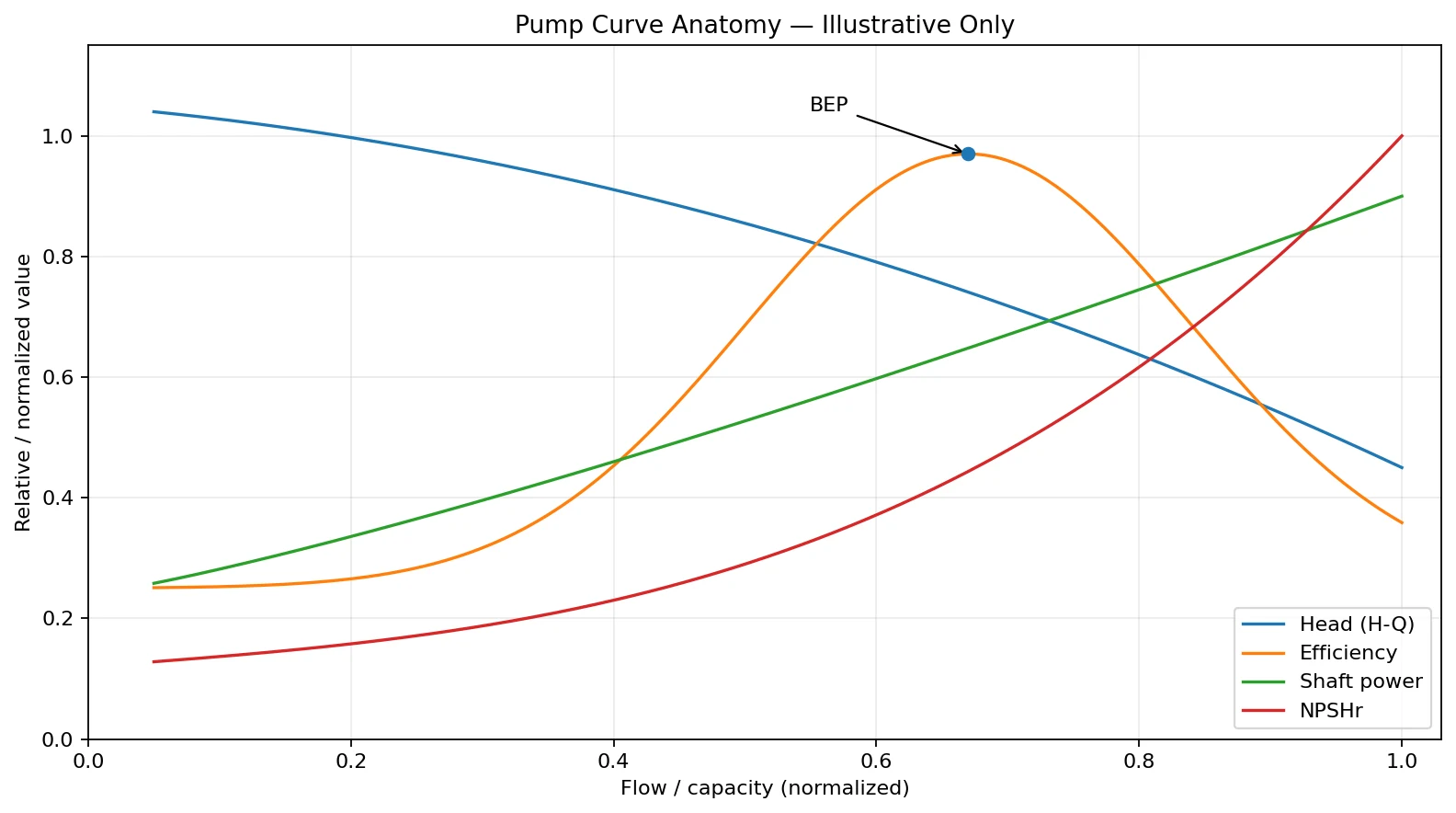
The horizontal axis is capacity or flow. The vertical axis is pump total head. A family of impeller-diameter curves shows how the same pump size changes as the impeller trim changes. Efficiency, shaft-power and NPSHr information are then read at the same operating flow.
Pump Curve Anatomy
A normalized teaching diagram showing the direction of the main quantities. It is not pump-selection data.
Head is not the same thing as pressure
For the same pump geometry and speed under comparable low-viscosity conditions, the pump head curve is not simply multiplied by specific gravity. The corresponding pressure and required power do change with liquid density.
The Pump Curve and System Curve Determine the Operating Point
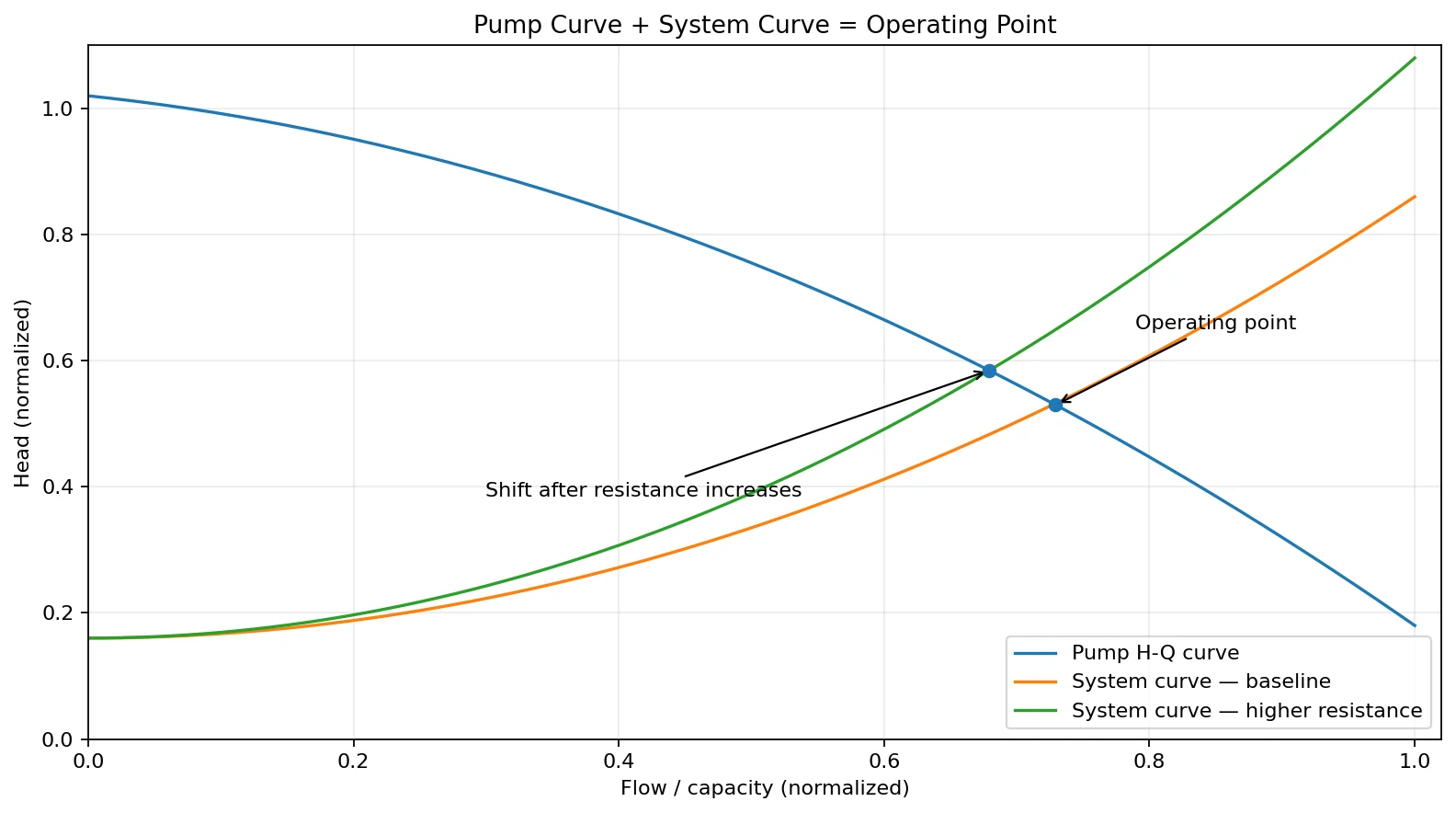
The actual operating point is where the pump can produce exactly the head demanded by the system at the same flow. A valve position, pipe loss, static elevation or process change can move the system curve and therefore move the operating point even when the pump itself has not changed.
Pump Curve + System Curve
Increasing system resistance moves the intersection toward lower flow and higher pump head.
BEP Is One Point; POR and AOR Are Operating Regions
| Term | Engineering meaning | How to use it |
|---|---|---|
| BEP | Best Efficiency Point at the stated pump configuration. | Use it as a hydraulic reference point, not as the only point where the pump may operate. |
| POR | Preferred Operating Region around BEP where hydraulic and reliability behavior is generally preferred. | Use the applicable manufacturer / ANSI-HI guidance for the actual pump; do not assume one percentage band fits every pump. |
| AOR | Allowable Operating Region, normally wider than POR. | Check hydraulic loading, vibration, temperature rise, recirculation, NPSH and manufacturer limits before relying on the outer region. |
No universal 70–120% BEP rule
POR/AOR depend on pump type, specific speed, design and application. A generic colored “safe zone” should not replace the actual curve and current operating-region guidance.
For the dedicated operating-region and suction-side discussion, see the NPSHa, NPSHr, POR, AOR & BEP selection guide.
Read Efficiency and Power at the Same Duty Point
After locating the operating point, read the efficiency contour and power information at that same flow/head condition. Specific gravity affects required pump input power even when the hydraulic head remains the same.
Use the Pump Power & Motor Sizing Calculator for a transparent power check, then confirm motor selection against the actual pump curve, maximum absorbed power, starting/control method and project requirements.
Read NPSHr From the Pump Curve; Calculate NPSHa From the System
Use the NPSHa Calculator to audit the system-side terms. For field symptoms, see the centrifugal-pump cavitation field checklist.
Use Affinity Relationships as an Estimate—Not as the Final Trim Curve
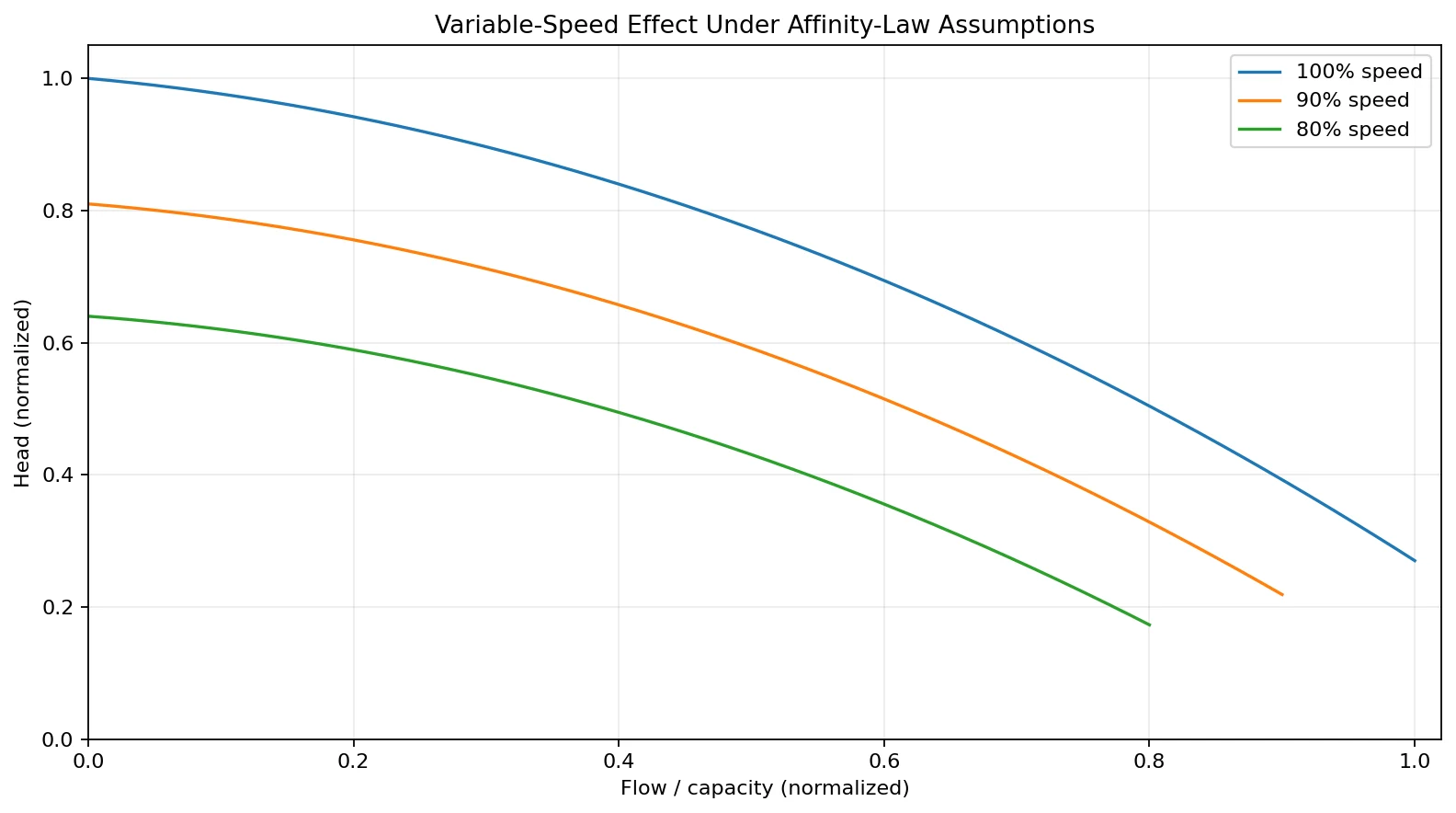
Changing Speed Reshapes the Pump Curve
| Speed ratio | Approx. reference flow | Approx. reference head | Approx. reference power |
|---|---|---|---|
| 100% | 100% | 100% | 100% |
| 90% | 90% | 81% | 73% |
| 80% | 80% | 64% | 51% |
Normalized Speed Curves
The curve moves left/down as speed is reduced. The actual duty still depends on the system curve.
For quick screening, use the Pump Affinity Laws & VFD Calculator.
Specific Gravity Changes Power; Viscosity Can Change the Curve Itself
| Property | What it changes | Engineering consequence |
|---|---|---|
| Specific gravity / density | Pressure corresponding to a given head and required power | Do not size power from water horsepower without applying the actual SG/density. |
| Viscosity | Can change flow, head, efficiency and required power relative to water performance | A viscous-liquid review is not the same as multiplying a water curve by SG. |
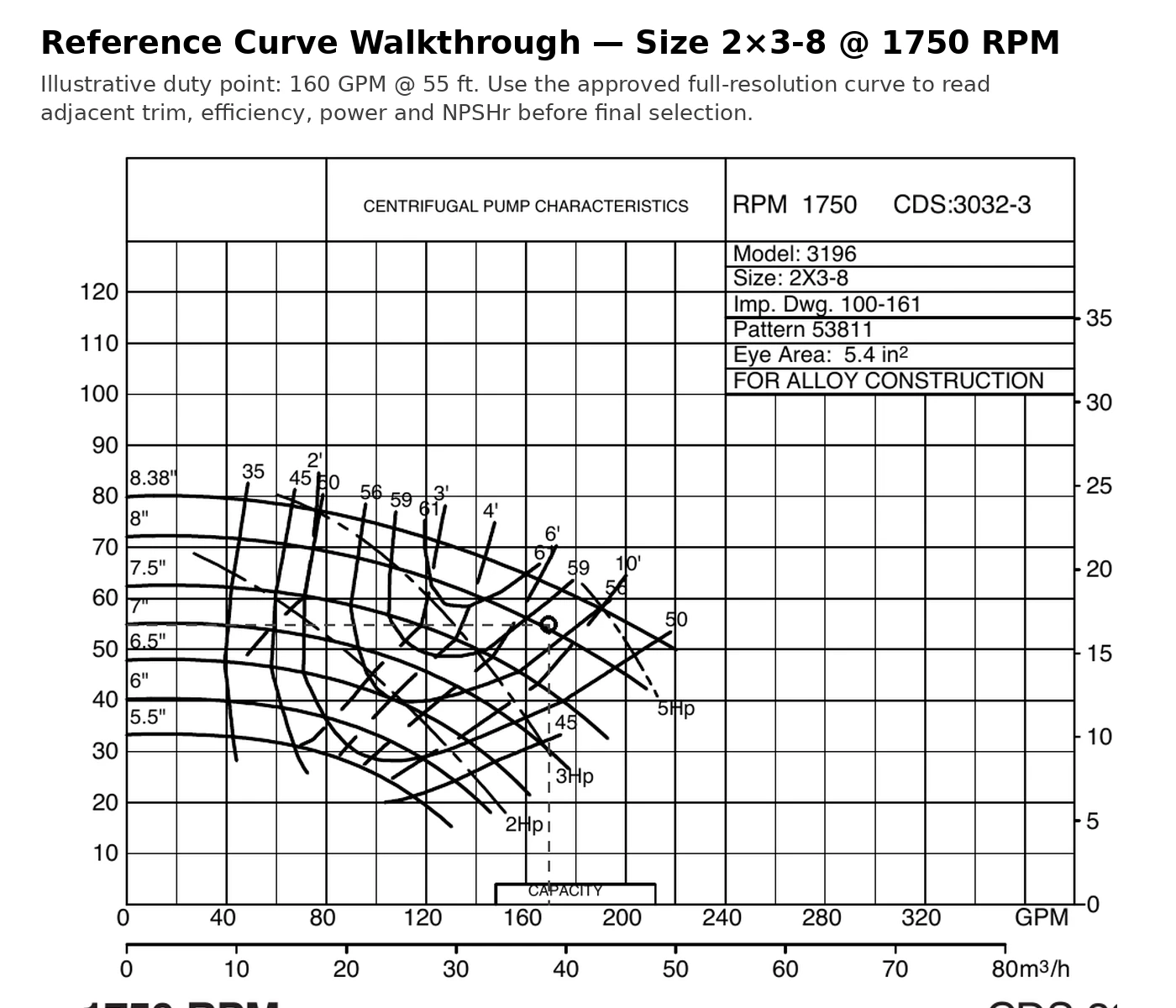
Worked Example: Read an Actual 2×3-8 Curve at 1750 RPM
The approved performance-curve PDF contains a 2×3-8 curve at 1750 RPM with multiple impeller trims, efficiency contours, horsepower contours and NPSHr contours. The figure below is extracted from that approved PDF at high resolution rather than recreated by AI.
Reference Duty Walkthrough
Illustrative duty: 160 GPM at 55 ft. The point falls between adjacent impeller-trim curves, which is why the full trim family must be read before a trim decision.
Confirm size & RPM
2×3-8 at 1750 RPM in the approved curve set.
Plot Q and H
Use the required flow and total head on the same axes.
Read adjacent trims
If the point lies between trim curves, treat interpolation as a screening step—not a machining instruction.
Read η at duty
Use the efficiency contour crossing or nearest the operating point.
Check HP/kW
Read the power contour and cross-check the formula using actual SG.
Read NPSHr
Read NPSHr at the same flow/speed; compare it with system NPSHa and the required margin.
For additional sizes and curves, use the pump performance curves library. The curve—not an approximate affinity calculation—should remain the primary hydraulic reference for the selected configuration.
Validate the Curve With Field Measurements
When an installed pump no longer behaves as expected, compare measured operating data with the correct curve before ordering parts or increasing motor size.
Use the Total Dynamic Head Calculator when elevation and line losses must be included in the duty reconstruction.
Calculated Example: Turn Pressure Readings Into a Curve Point
Assume a pump handling water at 20 °C at a fixed speed of 2,900 rpm. The readings and curve values below are assumed teaching inputs for a complete calculation sequence.
| Input | Value and reference |
|---|---|
| Flow | 100 m³/h (0.027778 m³/s) |
| Suction / discharge pressure | 0.30 / 2.80 barg; both gauge readings use the same reference |
| Internal diameter at the taps | 100 mm suction; 80 mm discharge |
| Tap elevation | Discharge tap is 0.40 m above the suction tap |
| Properties and gravity | ρ = 998 kg/m³; g = 9.80665 m/s² |
| NPSHa basis | Atmospheric pressure 101,325 Pa; vapor pressure 2,340 Pa; NPSH datum at the suction tap |
| Illustrative curve readings | Pump efficiency 72%; NPSHr 3.2 m at the evaluated duty |
1. Convert the readings to total pump head
Total head between pressure taps
p: Pa; ρ: kg/m³; g: m/s²; z and H: m; v: m/s; Q: m³/s; A: m². d: discharge; s: suction.
The stated internal diameters give vs = 3.537 m/s and vd = 5.526 m/s. Total head is 26.86 m. Pressure difference contributes 25.54 m; elevation and velocity supply the remaining terms. The taps are assumed to be at the pump reference sections.
2. Plot the duty and read power and suction data
Plot Q = 100 m³/h and H = 26.86 m on the curve for the documented impeller at 2,900 rpm. With the assumed 72% efficiency, hydraulic power is 7.30 kW and pump shaft power is 10.14 kW.
Hydraulic, shaft and electrical power
P: kW; Q: m³/s; H: m; ρ: kg/m³. ηp: pump efficiency; ηm: motor efficiency, expressed as fractions.
At an assumed motor efficiency of 92%, electrical input would be 11.03 kW for this example without a drive. Include VFD losses when applicable.
NPSHa at the suction datum
Pressures: Pa; pv: vapor pressure; vs: mean velocity at the suction tap; NPSHa: m.
With the assumed NPSH datum at the suction tap, NPSHa is 13.82 m. Compare it with the 3.2 m curve requirement at the same flow and the manufacturer/project margin. Include the appropriate elevation term when the datum differs.

3. Use any deviation to choose the next check
A measured point on the applicable pump curve directs the next review toward system resistance and process demand when flow is insufficient. A point below that curve at the same speed calls for checks of instruments, rotation, impeller configuration, liquid properties and internal condition. Match the configuration and process conditions before comparing points.
Keep the required system head calculation distinct from head developed between the pump taps. Cross-check shaft power and use the NPSHa calculator for the suction-side calculation.
Request a duty-point review with the curve, RPM, impeller diameter, flow and pressure-tap locations.
Technical basis: Hydraulic Institute: System Curves; KSB: Head; KSB: Power input, pump efficiency and power measurement; KSB: NPSH.
A Matching Hydraulic Curve Does Not Prove a Drop-In Replacement
| Verification layer | What still has to be checked |
|---|---|
| Hydraulic | Q-H, efficiency, power, NPSHr and expected operating region |
| Dimensional | Nozzles, mounting, shaft interface, baseplate/foundation relationship |
| Mechanical | Impeller/shaft interfaces, seal chamber, coupling/rotation and configuration |
| Process | Materials, viscosity, temperature, solids and seal arrangement |
For a replacement review, see the Goulds 3196 replacement and Durco Mark III replacement pages after the hydraulic duty has been confirmed.
Common Pump-Curve Reading Errors
What to Send for a Pump-Curve Review
Start with what you have.
A curve screenshot plus actual flow, pressure, speed and liquid properties is often enough to identify the next engineering check.
Centrifugal Pump Curve FAQ
Confirm the pump size, speed, impeller diameter, units and liquid/test basis, then plot the required flow and head on the correct curve.
BEP is one best-efficiency point at a stated pump configuration. POR and AOR are operating regions. Their limits depend on the pump design, specific speed, manufacturer data and application rather than one universal percentage.
Not by simply multiplying the head curve by SG under comparable low-viscosity conditions. Specific gravity changes the corresponding pressure and the power required to deliver the same flow and head.
There is no single universal margin for every pump and service. Compare system NPSHa with pump-specific NPSHr at the actual duty, then use the applicable manufacturer, project and ANSI/HI guidance for the required margin.
No. Hydraulic matching is only one layer. Dimensional interfaces, mechanical configuration, materials, seal arrangement and the actual operating range still require verification.
Use the pressure difference divided by density and gravity, then add the elevation and velocity-head differences between the defined measurement sections. Record pressure reference, internal diameters and tap locations.
Technical Sources
- Hydraulic Institute — ANSI/HI 9.6.3 Rotodynamic Pumps Guideline for Operating Regions
- Hydraulic Institute — ANSI/HI 9.6.1 Rotodynamic Pumps Guideline for NPSH Margin
- Hydraulic Institute — ANSI/HI 9.6.7 Effects of Liquid Viscosity on Performance
- Hydraulic Institute Data Tool — Pump Curves and Affinity Relationships
- ANSI Pumps Pro — Pump Performance Curves