
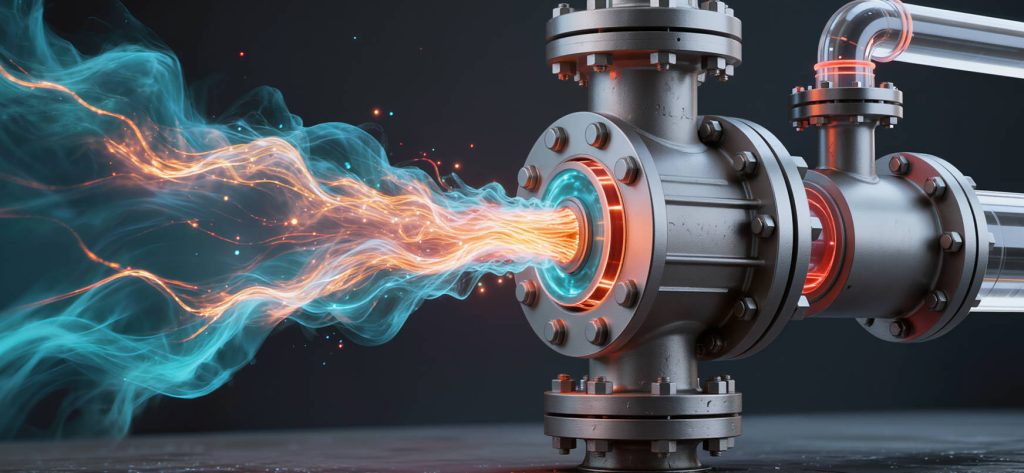
The Destructive Force You Cannot See Coming
Water hammer—also called hydraulic surge or transient pressure—is one of the most destructive forces in industrial pumping systems, yet it remains poorly understood outside of specialized engineering circles. When a column of liquid undergoes a sudden change in velocity, the kinetic energy converts to a pressure wave that travels through the piping at the speed of sound in that fluid—typically 3,000-4,500 ft/s in water. The resulting pressure spike can exceed the steady-state system pressure by a factor of 2-10×, instantly damaging pump casings, bursting piping, shattering valve bodies, and destroying mechanical seals.
What Causes Water Hammer?
Any event that rapidly changes fluid velocity can trigger water hammer: sudden pump startup or shutdown (especially without a soft starter or VFD), rapid closure of a check valve or control valve, power failure causing an abrupt pump stop, or the rapid opening or closing of an isolation valve. The common element is speed—the faster the velocity change, the larger the pressure spike.
How Water Hammer Damages ANSI Process Pumps
For an ANSI B73.1 process pump, water hammer manifests in several damaging ways:
- Casing overpressure: The pressure spike can momentarily exceed the pump casing’s maximum allowable working pressure (MAWP). While ANSI pump casings are hydrotested at 1.5× MAWP, repeated water hammer events can cause fatigue cracking at stress concentrations—particularly at the volute cutwater, flange fillets, and drain/tap connections.
- Seal failure: The sudden pressure reversal during a water hammer event can cause the mechanical seal faces to separate momentarily, allowing solids or debris to enter the gap. When the faces re-close, the entrapped particles score the seal faces—shortening seal life from years to months.
- Check valve slam: When a pump stops suddenly (power failure or emergency shutdown), the discharge check valve slams shut as the column reverses direction. The valve closure itself generates a secondary water hammer pulse that propagates back toward the pump. This is often the most damaging event in the entire transient sequence.
- Shaft and coupling damage: The rapid deceleration of the pump rotor during a water hammer event can generate torque spikes that exceed the coupling’s rated capacity or momentarily reverse the shaft torque, damaging keyways and coupling elements.
Proven Mitigation Strategies
1. Slow Down the Velocity Change
The simplest and most effective mitigation: extend the time over which velocity changes occur. A pump started with a VFD ramp time of 10-15 seconds creates a gradual velocity increase that produces negligible water hammer, compared to an across-the-line start that accelerates the fluid column from zero to full velocity in under one second. Similarly, a slow-closing check valve (dashpot or oil-controlled) prevents the violent closure that generates the most damaging secondary pressure spike.
2. Install Surge Protection Devices
Surge tanks (pressurized vessels partially filled with air or nitrogen), surge relief valves, and air/vacuum release valves all provide compliance in the system—a place for the pressure wave to dissipate its energy without overloading the pump or piping. A properly sized surge tank on the discharge header can reduce water hammer pressure spikes by 50-70%.
3. Design the Piping Layout for Surge Control
Eliminate high points in the discharge piping where column separation can occur during a pump trip. When the column separates (the liquid pulls apart at a high point), the subsequent rejoining of the columns when flow reverses is one of the most violent water hammer events possible. If a high point is unavoidable, install an air/vacuum valve to prevent the vacuum that allows column separation to occur.
4. Use Flywheel or Inertia on the Pump Rotor
For critical large pumps, adding rotational inertia to the pump shaft (via a flywheel or oversized coupling) extends the coast-down time during a power failure, reducing the rate of velocity change and the magnitude of the resulting water hammer. This is common on large cooling water pumps in power plants and refinery services.
Experiencing Water Hammer in Your Pump System?
Our engineers can help you assess your system’s surge vulnerability and recommend cost-effective mitigation measures. Provide your piping layout and pump data—we will help you identify the most likely source of damaging transients.
Key Takeaways
- Water hammer pressure spikes can reach 2-10× the normal system pressure—enough to damage pump casings, seals, piping, and valves in a single event.
- The most effective mitigation is also the simplest: slow down the rate of velocity change by using VFD soft-start/stop, slow-closing check valves, and controlled valve closure times.
- For systems with long discharge piping (>500 feet), a surge analysis is recommended—the risk and magnitude of water hammer increase with pipe length.
- Check valve slam during pump trip is the most common source of damaging water hammer in process pump systems. Use a spring-loaded, dashpot-controlled, or silent check valve in these applications.