
Why NPSH Is the Single Most Misunderstood Concept in Pump Specification
If there is one term that causes more confusion among pump buyers and maintenance teams than any other, it is NPSH. Net Positive Suction Head sounds abstract — and that abstraction leads to pumps selected with inadequate margins, operating in continuous cavitation, and failing years before their design life. This article explains NPSH and pump operating regions in plain language that any plant engineer, maintenance supervisor, or procurement professional can use to make better pump decisions.
NPSH Explained Without the Textbook Jargon
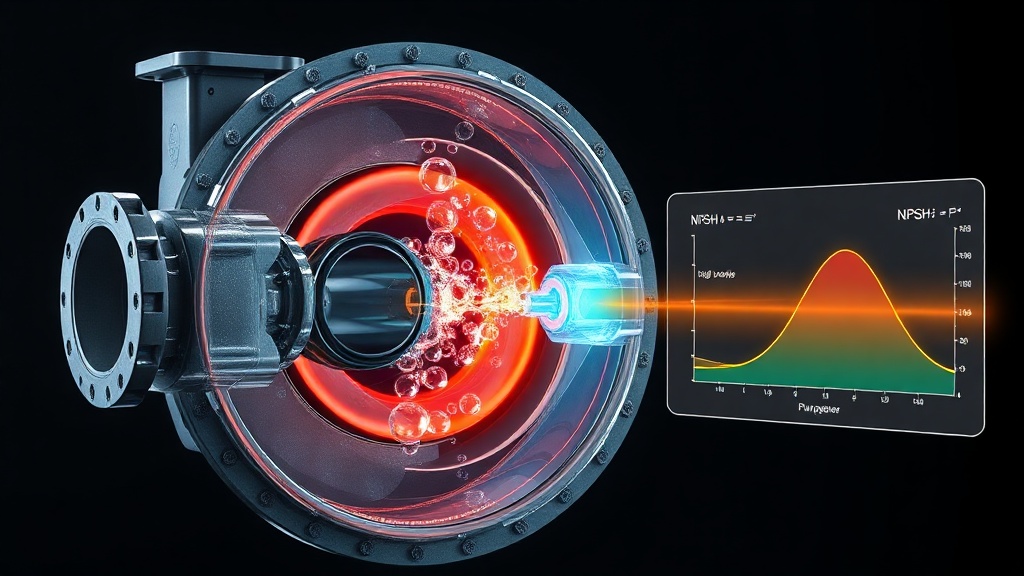
Think of NPSH this way: every centrifugal pump needs a certain amount of pressure at its suction inlet to function properly. If the pressure is too low, the liquid inside the pump partially vaporizes — it boils at room temperature because the local pressure drops below its vapor pressure. Those vapor bubbles collapse violently when they reach a higher-pressure region inside the impeller, generating shock waves that pit the metal, destroy seals, and hammer bearings.
That is cavitation. And NPSH is the engineering language we use to prevent it.
NPSHa vs. NPSHr — The Fundamental Distinction
NPSHa (available) is what your system gives the pump. It equals the pressure at the pump suction flange (converted to feet of liquid) minus the fluid’s vapor pressure. It is a property of your tank elevation, pipe size, fluid temperature, and atmospheric pressure.
NPSHr (required) is what the pump demands. It is measured by the manufacturer as the suction pressure at which the developed head drops by 3%. It is a property of the pump’s internal hydraulic design.
The rule is simple: NPSHa must exceed NPSHr by a sufficient margin — at all operating conditions.
What Determines NPSHr? The Pump Designer’s Levers
NPSHr is not a fixed property of a pump model — it is a design choice that reflects trade-offs between suction performance, efficiency, and cost. The three primary levers the pump designer controls are:
1. Impeller Eye Diameter
Larger impeller eye = lower liquid velocity entering the impeller = lower NPSHr. This is why low-NPSH pumps have noticeably larger suction nozzles relative to their discharge. The trade-off: larger eye diameters reduce hydraulic efficiency at BEP. A standard ANSI pump with a normal eye might have an NPSHr of 8 feet at rated flow; a low-NPSH version of the same pump with an enlarged eye might reduce that to 5 feet, but at a 2-3% efficiency penalty.
2. Number of Impeller Vanes
More vanes = better flow guidance and lower NPSHr, but also narrower passages that clog more easily. Standard ANSI process pump impellers typically have 5-7 vanes. Slurry-handling pumps often reduce to 3-4 vanes, accepting higher NPSHr in exchange for better solids passage.
3. Suction Specific Speed (Nss)
Nss is the single best number to compare suction performance across pumps. It is calculated as:
Nss = N × √Q / NPSHr0.75
Where N is speed in rpm and Q is flow in GPM (at BEP, for a single-suction impeller). Higher Nss = better suction performance (lower NPSHr for a given flow and speed). But Nss above 11,000-12,000 (US units) carries a penalty: the pump’s stable operating range narrows, and it becomes more sensitive to operation away from BEP. Most ANSI process pumps fall in the 8,500-10,500 Nss range.
Understanding Pump Operating Regions: POR and AOR
Every pump curve has boundaries. The terms POR (Preferred Operating Region) and AOR (Allowable Operating Region) define where the pump should and can operate reliably:
| Region | Definition | Typical Flow Range | Consequences of Exceeding |
|---|---|---|---|
| POR (Preferred) | Where the pump achieves its best reliability, efficiency, and lowest vibration | 70% – 110% of BEP flow | Outside POR: reduced bearing life, elevated vibration, higher energy cost |
| AOR (Allowable) | Where the pump can operate without immediate damage, though long-term reliability decreases | Minimum continuous stable flow to ~120% of BEP | Outside AOR: suction/discharge recirculation, cavitation, excessive shaft deflection, rapid seal failure |
The most common mistake in ANSI pump specification: selecting a pump whose BEP is at 500 GPM when the process actually runs at 200-300 GPM most of the time. The pump operates permanently to the left of POR in the low-flow region, experiences suction recirculation and high radial loads, and the maintenance team cannot figure out why seals last only 9 months.
The Low-Flow Danger Zone: Suction and Discharge Recirculation
Operation at low flow — typically below 50-60% of BEP for most ANSI pump designs — triggers two damaging phenomena:
Suction Recirculation
At low flow, the liquid entering the impeller eye does not fill the passage evenly. Some liquid reverses direction and exits the eye, creating a rotating stall pattern at the impeller inlet. This localized recirculation causes pressure pulsations and cavitation-like damage at the impeller vane tips — even when NPSHa exceeds NPSHr. Suction recirculation damage looks like cavitation damage but cannot be solved by increasing NPSHa. The only fix is increasing flow into the POR.
Discharge Recirculation
A similar phenomenon occurs at the impeller discharge: at very low flow, a portion of the liquid reverses through the impeller passages, creating damaging pressure pulsations at the cutwater and discharge nozzle. Discharge recirculation typically begins at approximately 30-40% of BEP flow.
Is Your Pump Operating in the Right Region?
If you are experiencing unexplained seal failures, bearing replacements every 12-18 months, or impeller pitting that looks like cavitation but occurs despite adequate NPSHa, your pump may be running outside its POR. We can help you confirm the operating region and recommend a correction — whether it is impeller trimming, a VFD, or a different pump selection.
How to Read a Pump’s NPSHr Curve Correctly
The NPSHr curve on a manufacturer’s datasheet is not a flat line — it typically rises as flow increases. A pump with NPSHr of 6 feet at BEP (500 GPM) may have NPSHr of 4 feet at 250 GPM and 10 feet at 600 GPM. Yet many specifications only check NPSH margin at the design point. If the pump occasionally runs at higher flows — during tank filling, for example — the NPSHr at maximum flow may exceed the NPSHa, triggering cavitation only under those specific conditions.
Best practice: check NPSH margin at three points — minimum continuous stable flow, BEP, and maximum rated flow. If any of the three fails the margin requirement, address it before the pump is ordered.
Key Takeaways
- NPSHa must exceed NPSHr by the required margin at ALL operating points, not just the design point. Check the extremes.
- NPSHr is a design trade-off: lower NPSHr (higher Nss) generally means narrower stable operating range.
- POR (Preferred Operating Region) is 70-110% of BEP. Operate outside this range and expect accelerated wear.
- Suction and discharge recirculation at low flow cause cavitation-like damage that cannot be fixed by increasing NPSHa — only by increasing flow into the POR.
- Specify your required NPSH margin at all three critical points: minimum flow, BEP, and maximum flow.