
What a Pump Casing Hydrostatic Test Proves — and What It Does Not
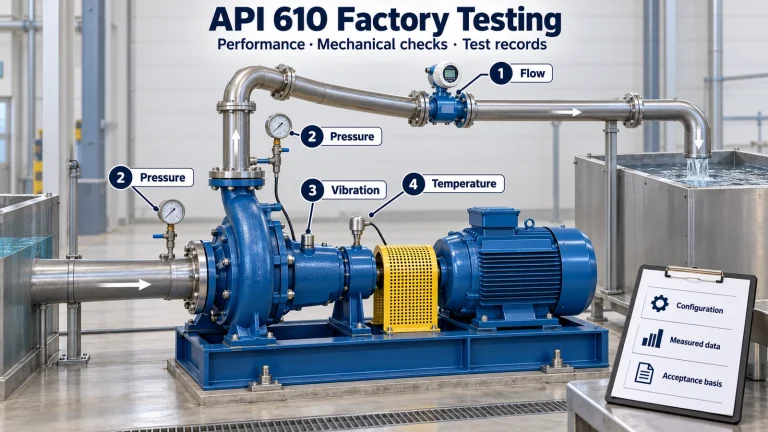
A pump casing hydrostatic test applies liquid pressure to a defined pressure-containing boundary under a defined procedure, pressure basis and hold condition. Its purpose is to support an acceptance decision for that boundary. It is one part of a quality package, not a substitute for hydraulic, material or installed-system verification.
Buyer rule
Do not approve a report because it contains a pressure number and a PASS stamp. The report should identify the actual casing, the tested boundary, the pressure basis, the instrument set, the hold evidence, the acceptance criteria and the final disposition.
How Better Hydrotest Process Control Reduces Scrap, Rework and Retesting
Cost reduction in hydrostatic testing should come from removing avoidable process waste—not from lowering the required test pressure, shortening a specified hold period or weakening acceptance criteria. The strongest savings opportunities are usually better boundary definition, better sequencing and better traceability.
Hydraulic Institute example: test the intended boundary
A Hydraulic Institute case study describes a casing hydrotest process in which a priming valve could be retained in the test arrangement while the intended pressure boundary was tested with an appropriate pressure-rated closure. The engineering lesson is broader than one valve: understand the boundary before scrapping a component or repeating a test.
Do not publish generic claims such as “65% lower test cost” or a fixed dollar saving unless the number comes from your own measured production data or a traceable case study with the same process scope.
ASME B73.1, API 610, ANSI/HI 14.6 and EN 12162 Do Not Use One Universal Hydrotest Rule
The purchased standard edition, project specification, datasheet and approved test procedure control the actual order. Do not transfer a pressure multiplier, hold time or terminology from one pump standard to another simply because the equipment is a centrifugal pump.
| Reference | Hydrotest context | Buyer / QA action |
|---|---|---|
| ASME B73.1 | Chemical-process pump pressure-containing components. The cited B73.1 requirements use the applicable component maximum design-pressure basis rather than API 610 MAWP terminology. | Verify the purchased edition and approved order procedure before releasing a numeric test requirement. |
| API 610 / ISO 13709 | Petroleum, petrochemical and natural-gas process-pump projects. The cited API 610 12th-edition requirement uses a minimum test pressure of 1.5 × MAWP and a 30-minute leakage/seepage acceptance period for pressure-containing components and joints. | Apply API requirements only when the project invokes API 610 / ISO 13709 or the purchase specification explicitly adopts them. |
| ANSI/HI 14.6 | Rotodynamic-pump test procedures, including performance acceptance plus hydrostatic pressure testing and data-recording/reporting provisions. | Use the applicable HI requirement when it is part of the purchase/test specification; do not treat a B73.1 claim as a substitute. |
| EN 12162 | Hydrostatic testing of liquid-pump pressure-containing parts. Its pressure basis uses factors defined by the standard and pump specification rather than one universal “1.5 × PN” rule. | Use the project-invoked edition and component classification. Do not simplify it into a universal ANSI/API formula. |
Do not combine B73.1 and API 610 terminology
For B73.1 content, use the design-pressure terminology supported by the governing B73.1 edition and project documents. For API 610 content, use the applicable MAWP terminology. They should not be rewritten as though the standards use identical definitions.
Define the Pressure Boundary, Openings and Exclusions
Before filling the casing, identify every pressure-containing part and every opening that is included, isolated, blanked, vented, drained or excluded. The test boundary may include the casing, cover, seal chamber or stuffing-box area, nozzles, drains, vents and temporary test connections depending on the approved procedure.
Pump Casing Hydrotest Boundary Map
Use the approved procedure and job drawing to convert each item below from an assumption into a documented test condition.
Identify the casing
Part/casting/serial ID, drawing revision, material and heat/traceability reference where required.
Close pressure openings
Suction, discharge and auxiliary openings use the approved blinds, plugs, gaskets or closures.
Vent high points
Remove trapped air before the test is accepted as a liquid-pressure test.
Locate instruments
Record the gauge/transducer position, range, resolution and calibration status.
Document exclusions
State any valve, seal, accessory or temporary item that is outside the intended acceptance boundary.
Do not assume that a casing test covers the complete pump assembly. If the purchased scope contains multiple pressure-containing components, the procedure should state whether they are tested separately or as an assembly and how each result is linked to the delivered equipment.
Test Setup, Venting, Instruments and Pressure-Time Evidence
Illustrative Pressure-Time Record
This sequence is a record-keeping concept, not a universal pressure-step requirement.
Fill
Fill the defined boundary with the specified liquid.
Vent
Confirm trapped air/high points have been addressed.
Pressurize
Raise pressure according to the approved procedure.
Stabilize / hold
Record the required test interval and inspect the defined boundary.
Release / disposition
Depressurize safely, document results and record accept/retest/repair disposition.
Digital logging is useful evidence, not a universal requirement
A digital pressure-time trace can improve auditability and reduce disputes on witnessed orders. Where the project requires a recorder, preserve the native record or a traceable export. Do not describe a PDF pressure curve as universally mandatory under API 610.
Test Liquid, Chlorides, Draining and Material-Specific Procedures
Hydrotest liquid quality and post-test handling matter because the test itself can introduce contamination or retained liquid into a pressure-containing component. The required control depends on the material, governing standard and project procedure.
| Material / condition | Hydrotest consideration | Release evidence |
|---|---|---|
| WCB / carbon steel | Use the specified clean test liquid; drain and protect the component according to the approved manufacturing/storage procedure. | Procedure, test record and preservation status where required. |
| 316SS / CF8M austenitic stainless | For the cited API 610 12th-edition requirement, liquid used to test austenitic stainless-steel materials is limited to 100 ppm chloride. Project specifications may be stricter. | Test-liquid control where specified plus draining/removal of residual liquid. |
| Duplex / super duplex | Follow the actual project/manufacturer procedure; do not automatically copy the austenitic-stainless chloride number or an arbitrary 25 ppm limit. | Applicable procedure plus material/heat traceability where required. |
| Alloy 20 / Ni-Cr-Mo / Nickel / Titanium | Use the specified medium, cleanliness and post-test handling for the project. Do not invent one universal chloride limit for all corrosion-resistant alloys. | Project/manufacturer procedure and material-specific inspection requirements. |
A stricter project limit is not automatically the standard limit
A project may specify 50 ppm, 25 ppm or another tighter test-water limit. If so, identify it as the project or purchaser requirement rather than attributing it to API 610 or ASME B73.1 unless the governing standard text supports that exact value.
Common Conditions That Make the Hydrotest Record Insufficient
These conditions do not automatically prove that the casing is unusable. They mean the existing record may be insufficient to support release until the responsible engineering or quality authority determines the disposition under the approved procedure.
Repair Acceptance Requires More Than a Successful Re-Hydrotest
Repair acceptance depends on the material, repair method, defect location, pressure-boundary geometry, service conditions, design basis and the governing manufacturing/project procedure. Passing a hydrotest does not erase the need for an approved repair disposition.
Repair-to-Release Evidence Path
The exact steps vary by material and project, but the disposition should remain traceable from defect discovery through final release.
Defect identified
Record the location, type and affected pressure-containing area.
Engineering disposition
Determine whether repair is permitted and which qualified procedure applies.
Repair executed
Use the approved repair/welding procedure and qualified personnel as required.
Inspection / heat treatment
Complete NDE, heat treatment and dimensional review when the procedure requires them.
Re-test / release
Complete the required re-hydrotest and close the repair/deviation record before shipment release.
What to request for a repaired casing
Request the repair map or defect record, approved repair disposition, applicable NDE results, heat-treatment record where required, material/heat traceability, dimensional status, re-hydrotest result and any purchaser/TPI deviation approval required by the order.
12 Items to Verify Before Accepting a Pump Casing Hydrotest Report
A pressure number alone is not a complete hydrotest record
If the document only says “tested at ___ bar — PASS,” request the missing casing identity, boundary, procedure/pressure basis, instrument/calibration data, hold evidence and acceptance criteria before treating it as release evidence.
Hydrostatic Test vs. Hydraulic Performance Test vs. Field Commissioning
| Activity | Primary question | Typical evidence |
|---|---|---|
| Hydrostatic test | Does the defined pressure boundary withstand the specified liquid-pressure condition? | Boundary, pressure basis, medium, instruments, hold record and acceptance result. |
| Hydraulic performance test | Does the pump produce the specified flow/head/power/efficiency result under the defined test condition? | Flow, head, speed, impeller basis, power/efficiency, instrument data and curve comparison. |
| Field commissioning | Does the installed pump operate correctly in the actual piping, control and process system? | Installed duty, suction/discharge condition, controls, vibration, temperature, leakage and process state. |
A casing hydrotest cannot replace a pump performance curve or site commissioning evidence. If the purchase order requires more than one acceptance activity, keep the acceptance criteria and records separate.
For hydraulic evidence, review the Pump Performance Curves resource and define the required curve/test basis separately from the casing hydrotest.
What to Send When Requesting a Replacement Casing or Complete Pump
A technical article should not turn ANSI Pumps Pro into a third-party report-review service. The commercial handoff should connect the hydrotest evidence back to the replacement component or complete pump being purchased.
For existing reference numbers, start with the OEM Part Number Cross-Reference. For complete-pump replacement, review the Goulds 3196 replacement or Durco Mark III replacement engineering paths as applicable.
Claim-control rule
Do not state that every replacement casing is “100% tested at 1.5 × MAWP with certified records” unless the actual manufacturing QA procedure and order documentation support that exact universal claim. Define required hydrotest, material and inspection documentation with the quotation and purchase specification.
Pump Casing Hydrostatic Testing FAQ
What does a pump casing hydrostatic test prove?
It provides evidence that the defined pressure-containing boundary withstands the specified liquid-pressure test condition under the stated acceptance criteria. It does not prove hydraulic performance, NPSHR, seal life, corrosion suitability or field commissioning performance.
What pressure should be used for an ASME B73.1 pump casing hydrotest?
Use the purchased B73.1 edition, project specification and approved manufacturer/test procedure that govern the order. The cited B73.1 requirements use the applicable component maximum design-pressure basis. Do not automatically rewrite that requirement using API 610 MAWP terminology.
How long is an API 610 pressure-casing hydrotest held?
For the cited API 610 12th-edition requirement, pressure-containing components and joints are evaluated for 30 minutes without leakage or seepage. The project specification can impose additional requirements.
What chloride limit applies to API 610 hydrotest liquid for austenitic stainless steel?
The cited API 610 12th-edition requirement limits chloride in liquid used to test austenitic stainless-steel materials to 100 ppm (100 mg/kg). A purchaser or project specification may require a lower value.
Is a digital pressure-time curve always required?
No. A traceable digital record is useful and may be required by a project, ITP or approved procedure, but it should not be presented as a universal API 610 requirement. Record the evidence actually required by the governing purchase/test documents.
Can a repaired casing be accepted after it passes a hydrotest?
Not automatically. The repair still requires the applicable engineering disposition, qualified repair procedure, inspection/NDE, heat treatment where required, dimensional review, traceability and any required re-test or purchaser approval.
What should a buyer request in a hydrotest report?
Request the casing identity, drawing/revision, material reference, defined pressure boundary, test liquid, pressure basis, procedure revision, instrument IDs and calibration, pressure/hold evidence, acceptance result, repair/deviation references and final disposition.
Technical Sources
- ASME — B73.1, Specification for Horizontal End Suction Centrifugal Pumps for Chemical Process
- Hydraulic Institute — ANSI/HI 14.6, Rotodynamic Pumps for Hydraulic Performance Acceptance Tests
- Hydraulic Institute — Optimizing Hydrostatic Testing Procedures for Pump Casings
- API 610 / ISO 13709 — use the purchased edition governing the project for contractual pressure-casing hydrotest requirements.
- EN 12162 — use the project-invoked edition governing hydrostatic testing of liquid-pump pressure-containing parts.