
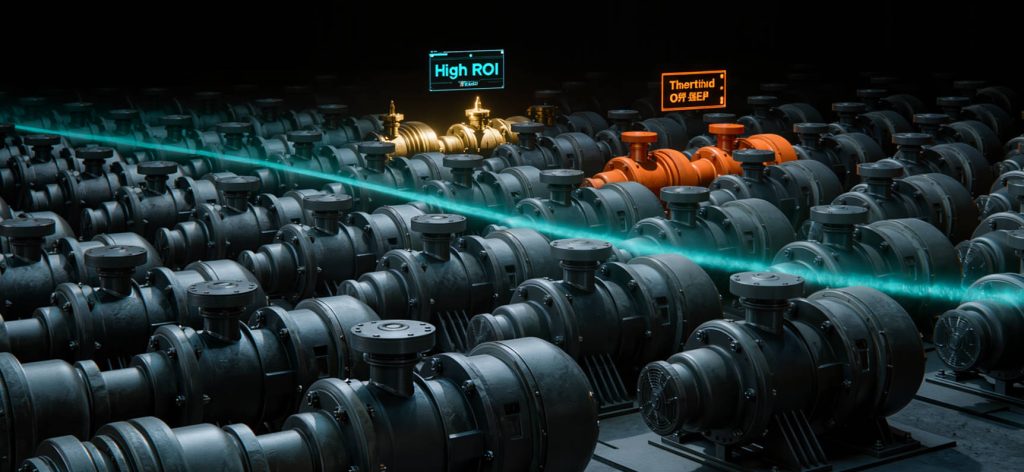
When You Have Hundreds of Pumps, Where Do You Start?
Most industrial plants operate hundreds—sometimes thousands—of pumps. A full system assessment of every pump is impractical. Prescreening is the structured process of identifying which pumps offer the greatest optimization opportunity so that assessment and engineering resources are directed where they will produce the highest return on investment.
The Prescreening Framework: Four Filters
Filter 1: Size and Energy Consumption
Start with the biggest energy consumers. Pumps above 25 hp typically account for 80-90% of a plant’s total pump energy consumption, even though they may represent only 20-30% of the pump population. List all pumps above 25 hp, ranked by estimated annual energy consumption (motor hp × load factor × hours/year × 0.746 kW/hp × electricity rate). The top 20% of this list is your initial target group.
Filter 2: Control Method
For each pump in the target group, identify the flow control method. Pumps controlled by throttling valves (discharge valve partially closed at normal operation) are the highest-priority candidates for optimization because the valve is literally wasting energy. Pumps with bypass lines (recirculating flow back to suction) waste even more energy—the pump does the work of moving the fluid, and the bypass sends it back to the starting point. Pumps with VFDs are likely already optimized (though VFD speed setpoints should be verified).
Filter 3: Maintenance History
Pull the work order history for the past 3-5 years. Look for pumps with:
- Three or more seal replacements in a 24-month period
- Bearing replacements at intervals shorter than 30,000 hours
- Impeller replacements due to cavitation damage
- Repeated coupling failures
These pumps are telling you something is wrong with the system. The maintenance cost of these repeat offenders often exceeds the energy cost—and system optimization frequently solves both problems simultaneously.
Filter 4: Operating Point vs. BEP
Estimate (or measure) the actual operating flow for each remaining candidate. If the pump operates at less than 50% or more than 120% of its BEP flow for the majority of its operating hours, it is a strong optimization candidate. Common indicators of off-BEP operation: high vibration, noisy operation, throttled discharge valve, and—counterintuitively—a motor drawing significantly less than nameplate FLA (the pump is oversized and running at low flow).
Prioritization: The ROI Scorecard
Score each candidate pump on a simple 1-5 scale for each factor:
| Factor | 1 (Low Priority) | 3 (Medium) | 5 (High Priority) |
|---|---|---|---|
| Motor size | <10 hp | 25-50 hp | >100 hp |
| Annual hours | <2,000 | 4,000-6,000 | >8,000 |
| Control method | VFD (optimized) | On/off control | Throttled valve or bypass |
| Maintenance history | No failures in 3 years | 1-2 seal/bearing replacements | 3+ replacements in 2 years |
| Off-BEP operation | 70-110% BEP | 50-70% or 110-130% | <50% or >130% BEP |
Pumps scoring 20-25 points are your highest-priority optimization candidates and should be assessed first.
Key Takeaways
- Prescreening directs assessment resources to the 10-20% of pumps that will deliver 80% of the potential savings.
- Throttled valves and bypass control are the strongest single indicators of optimization potential—they represent energy being actively wasted.
- Maintenance history is an underutilized prescreening tool. Repeat failures signal a system problem that optimization can correct.
- A simple 1-5 scoring system across five factors provides an objective, defensible prioritization.