
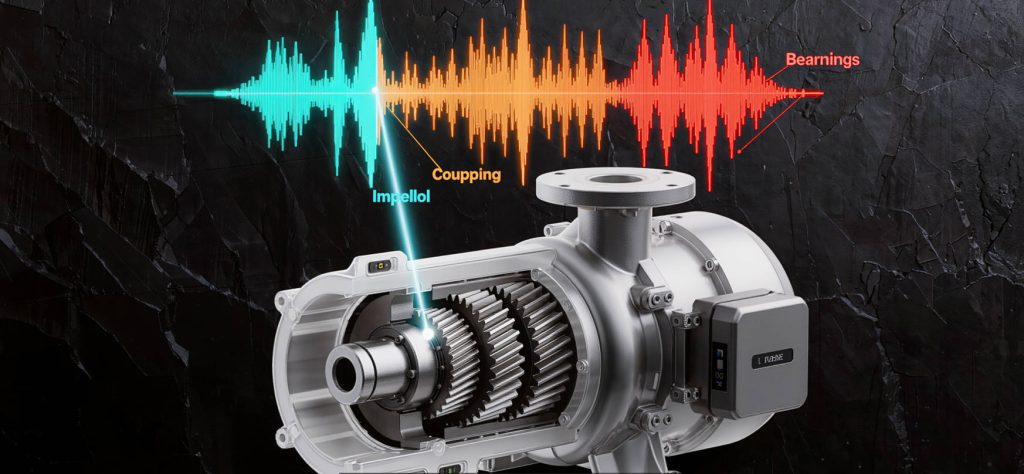
Why Vibration Analysis Is the Quickest Path to Diagnosing ANSI Pump Problems
Vibration is the pump’s way of telling you something is wrong — before the seal leaks, before the bearing seizes, before the shaft breaks. A structured approach to vibration analysis lets you identify the root cause of pump problems while they are still correctable with a planned maintenance window instead of an emergency shutdown. This two-part guide covers the most common vibration signatures in ANSI process pumps and how to troubleshoot each one.
The Vibration Baseline: What Is Normal?
Before diagnosing a problem, you need to know what constitutes acceptable vibration. ANSI/HI 9.6.4 defines vibration limits for rotodynamic pumps based on pump category and power. For a typical ANSI B73.1 process pump (Category II, 10-200 hp), the overall vibration limit is:
| Condition | Overall Vibration (mm/s RMS) | Action Required |
|---|---|---|
| Newly commissioned | < 3.0 | Acceptable — document as baseline |
| Normal operation | 3.0 – 4.5 | Monitor — trend over time |
| Marginal | 4.5 – 7.1 | Investigate — schedule corrective action |
| Unacceptable | > 7.1 | Shut down — repair before restart |
These are overall (broadband) limits. The real diagnostic value comes from breaking down the vibration by frequency — a technique called spectral analysis.
The Five Classic Vibration Signatures and Their Root Causes
Signature #1: High 1× Running Speed — Unbalance
What You See: A dominant peak at 1× running speed (e.g., 29.5 Hz for a 1,770 rpm pump) in the radial direction. The amplitude is proportional to speed squared — vibration increases dramatically as the pump accelerates and drops when it decelerates. The waveform is a clean sine wave.
Root Cause: Mass unbalance of the rotating assembly — the impeller, shaft, and coupling. Common causes include uneven wear or corrosion of the impeller, product buildup on one side of the impeller (especially in slurry or scaling services), or a coupling that was not balanced after assembly.
Correction: Clean the impeller first (product buildup is the most common cause and the cheapest to fix). If vibration persists, remove the rotating assembly and have it dynamically balanced to ISO 1940 G6.3 or better (G2.5 is recommended for pumps above 3,600 rpm).
Signature #2: High 1× and 2× — Misalignment
What You See: Elevated peaks at both 1× and 2× running speed, with 2× often exceeding 1× in the axial direction. The axial measurement is the key differentiator: unbalance rarely produces significant axial vibration, while angular misalignment produces strong axial 1× and 2× components.
Root Cause: The pump and motor shafts are not collinear. This can be parallel misalignment (shafts offset but parallel), angular misalignment (shafts intersect at an angle), or a combination of both. In ANSI pumps, a common aggravating factor is pipe strain — the suction or discharge piping puts a load on the pump casing, distorting the alignment after the initial alignment was completed with the piping disconnected.
Correction: Perform a precision laser alignment with the piping fully connected and the pump at operating temperature. The alignment tolerance for a pump running at 1,800-3,600 rpm should be within 0.002 inches total indicated runout (TIR) at the coupling. Re-check alignment after the pump has run for 24 hours at operating temperature — thermal growth of the pump casing and motor frame can shift the alignment by 0.005-0.010 inches.
Signature #3: Vane-Pass Frequency — Hydraulic Forces
What You See: A dominant peak at the vane-pass frequency (number of impeller vanes × running speed) and its harmonics. For a 1,770 rpm pump (29.5 Hz) with a 5-vane impeller, this appears at 147.5 Hz, 295 Hz, and 442.5 Hz. The amplitude increases as flow moves away from BEP in either direction.
Root Cause: The impeller vanes pass the cutwater (volute tongue) with each rotation, generating a pressure pulse. At BEP, the liquid velocity at the impeller discharge approximately matches the volute throat velocity, and the pulse is small. Away from BEP, the velocity mismatch creates larger pressure pulsations that excite the pump structure.
Correction: If the vane-pass amplitude is acceptable at BEP but elevated at your normal operating flow, the pump is operating outside its POR. Trim the impeller, change the pump speed via VFD, or replace the pump with one whose BEP matches the required duty. If vane-pass vibration is high even at BEP, the cutwater-to-impeller gap may be too small — typically a manufacturing issue that requires volute modifications.
Quick Diagnostic Tip
To distinguish vane-pass vibration from bearing defect frequencies: vane-pass frequency changes proportionally with pump speed (VFD), while bearing defect frequencies are fixed ratios of the shaft speed (BPFO ≈ 0.4×N×number of rolling elements, BPFI ≈ 0.6×N×number of rolling elements). Run the pump at two different speeds — if the mystery frequency tracks with speed proportionally, it is vane-pass or another hydraulic phenomenon.
Signature #4: Sub-Synchronous Broadband — Cavitation
What You See: Broadband noise (random vibration) primarily in the high-frequency range (2,000-10,000 Hz), often accompanied by a characteristic crackling or “gravel passing through the pump” sound. The vibration envelope (demodulated spectrum) shows elevated floor levels without distinct peaks. Sub-synchronous components below 1× may be present due to the chaotic bubble collapse.
Root Cause: Cavitation — vapor bubbles forming in the low-pressure region at the impeller eye and collapsing as they move into higher-pressure areas. Three types: (1) classic NPSHr cavitation (NPSHa < NPSHr), (2) suction recirculation cavitation at low flow, and (3) vane-tip clearance cavitation (often called "tip vortex cavitation").
Correction: For NPSHr cavitation: increase NPSHa (raise suction vessel level, reduce suction piping losses, cool the fluid to reduce vapor pressure) or reduce NPSHr (install an inducer, select a pump with lower NPSHr). For recirculation cavitation: increase flow into the POR, install a bypass line, or use a VFD to match pump speed to demand. For tip clearance cavitation: restore impeller wear ring clearances to the manufacturer’s specified range.
Signature #5: Impacting at Ball-Pass Frequencies — Bearing Defects
What You See: Distinct peaks at the bearing defect frequencies (BPFO, BPFI, BSF, FTF) in the high-frequency acceleration spectrum. These are non-synchronous — they do not follow integer multiples of running speed. As the defect progresses, the peaks become more pronounced and harmonics appear. In the late stage, the overall vibration floor rises and shock pulse measurements spike.
Root Cause: Damage to the rolling elements or raceways — typically initiated by contamination, inadequate lubrication, excessive load (from misalignment, belt tension, or off-BEP hydraulic loads), or stray electrical currents passing through the bearing (EDM damage in VFD-driven motors without insulated bearings or shaft grounding).
Correction: Replace the bearing before catastrophic failure — bearing defects are progressive and never self-correct. If the root cause was contamination, improve the bearing isolator or lip seal. If lubrication-related, verify the correct grease type, quantity, and regreasing interval. If electrical damage, install a shaft grounding ring or insulated bearing at the non-drive end.
Part 2: Advanced Troubleshooting — Beyond the Obvious
Structural Resonance: When the Pump Is Fine but the Baseplate Isn’t
A common trap: the vibration signature points to unbalance, but balancing the impeller does not reduce the vibration. The real problem is that a structural natural frequency of the baseplate, foundation, or pedestal coincides with the pump’s running speed or vane-pass frequency.
How to detect: Perform an impact test (bump test) on the stationary pump — strike the bearing housing with a modal hammer and measure the frequency response. If the first structural natural frequency is within ±10% of running speed or vane-pass, you have a resonance problem. The fix: add stiffness (ribs, gussets) or mass to shift the natural frequency away from the excitation frequency.
Recirculation vs. Cavitation: Telling Them Apart
Both suction recirculation and classic cavitation damage the impeller vane tips, and both create elevated high-frequency vibration. The key distinction: cavitation responds to changes in NPSHa; recirculation responds to changes in flow. If increasing the suction pressure (by raising tank level) reduces the vibration, it is classic cavitation. If opening the discharge valve (increasing flow toward BEP) reduces the vibration, it is recirculation. If neither helps, the impeller may already be damaged to the point that hydraulic performance is compromised — pull the pump and inspect.
Need Help Diagnosing Your Pump Vibration Problem?
Our technical team can help you interpret vibration spectra from your ANSI process pumps and recommend targeted corrective actions. Send us your vibration data (spectrum and waveform) and pump nameplate information — we will provide a diagnostic report and corrective action plan.
Key Takeaways
- Break down vibration into frequency components — 1× indicates unbalance, 2× axial indicates misalignment, vane-pass indicates hydraulic forces, high-frequency broadband indicates cavitation, and ball-pass frequencies indicate bearing defects.
- Misalignment is the most common cause of elevated vibration in ANSI pumps, and pipe strain is the most common cause of misalignment — always check piping loads before re-aligning.
- Structural resonance can mimic unbalance — if balancing does not reduce 1× vibration, perform a bump test to check for natural frequencies near running speed.
- Distinguish cavitation from recirculation by changing NPSHa versus changing flow — cavitation responds to NPSHa changes, recirculation responds to flow changes.
- Bearing defect frequencies are non-synchronous and progressive — they never self-correct. Plan the bearing change at the first clear indication, not when the noise becomes audible.