
Reviewed and updated: August 29, 2026. Use this guide as a planning framework. Confirm safety controls, limits, lubricant requirements, seal procedures and overhaul criteria against the applicable IOM and project requirements.

A Practical Pump Maintenance Plan in Four Tiers
Each tier has a different purpose, owner and evidence trail. The tiers complement one another; they do not prescribe a mandatory daily, quarterly or annual frequency for every ANSI process pump.
| Tier | Purpose | Typical evidence |
|---|---|---|
| Operator rounds | Detect changes early | Leakage, noise, pressure, temperature and oil level |
| Planned preventive maintenance | Restore or inspect known wear items | Lubrication, coupling, fasteners, seals and work order |
| Predictive / condition monitoring | Trend degradation | Vibration spectrum, temperature, power/current and oil condition |
| Planned outage / overhaul | Inspect internal condition | Impeller, shaft, clearances, bearings, casing and seal chamber |
Set the practical interval from the OEM IOM, service severity, criticality, run hours, failure history, process changes and the consequence of an unsafe or unavailable pump. Reassess the interval after a significant failure or modification.
What to Record on Every Pump Route
- Pump ID, asset status and current duty or operating mode.
- Suction and discharge pressure, flow where available, speed, valve position and motor current/power.
- Bearing temperature, vibration overall value and spectrum where applicable.
- Seal or packing leakage, flush/quench/cooling condition and lubricant level or condition.
- Liquid temperature, process state, unusual noise, recent changes and the action taken.
A route entry should make change visible. A pressure change with a dirty strainer, rising bearing temperature with low lubricant, or vibration that changes with flow each suggests a different investigation path.
Daily and Routine Operator Checks
Operator rounds should compare the current pump with its established normal condition rather than rely on memory. Look for changes in leakage, noise, vibration, temperature, suction/discharge pressure, flow, lubricant, seal support, fasteners, guards, baseplate, strainers, valves, recirculation and instrumentation.
Record the operating condition with each observation. A single reading without speed, flow or process state is difficult to trend and can lead to unnecessary part replacement.
Preventive Maintenance vs Predictive Maintenance
| Approach | Trigger | Example | Record |
|---|---|---|---|
| Preventive maintenance | Time-, usage- or task-based schedule | Planned lubrication, coupling inspection or seal work | Work order, date, parts, findings and next task |
| Predictive / condition-based maintenance | Measured condition or trend | Vibration or bearing-temperature change leads to inspection | Trend, diagnosis, work order and acceptance reading |
Preventive maintenance controls known wear mechanisms. Predictive maintenance helps time the intervention from equipment condition. They are complementary: a scheduled inspection can collect the data that makes the next task condition-based.
Condition Monitoring for Critical Process Pumps
ANSI/HI 9.6.5-2022 provides condition-monitoring guidance for rotodynamic pumps. A practical pump condition monitoring program may consider power, temperature, corrosion, leakage, pressure, vibration, lubricant, flow, speed and bearing wear, tied to operating condition and measurement method.
For critical assets, establish a baseline after commissioning or overhaul and trend at repeatable locations. Do not copy a generic vibration or temperature threshold into every asset record. A condition alert should lead to documented review against the applicable standard, manufacturer data, installation and service—not automatic part replacement.
For a deeper diagnosis workflow, see the pump vibration analysis and troubleshooting guide.
Pump Maintenance Checklist Before a Planned Outage
- Confirm the pump model, size, frame/group, impeller, materials, seal arrangement and latest drawing revision.
- Review duty history, vibration/temperature trends, leakage, lubricant condition, motor current and recent process changes.
- Define isolation, depressurization, drainage, flushing, lifting and hazardous-service controls before opening the pump.
- Record the proposed outage scope: bearings, shaft, sleeve, impeller, casing, wear clearances, seal chamber, coupling and base.
- Prepare inspection criteria, required replacement parts, material certificates, balance/alignment checks and commissioning readings.
The outage scope should be based on condition and failure consequence. Do not turn a checklist into a blanket requirement to replace every wear item at a fixed interval.
Hydraulic, Mechanical, Sealing and Documentation Checks
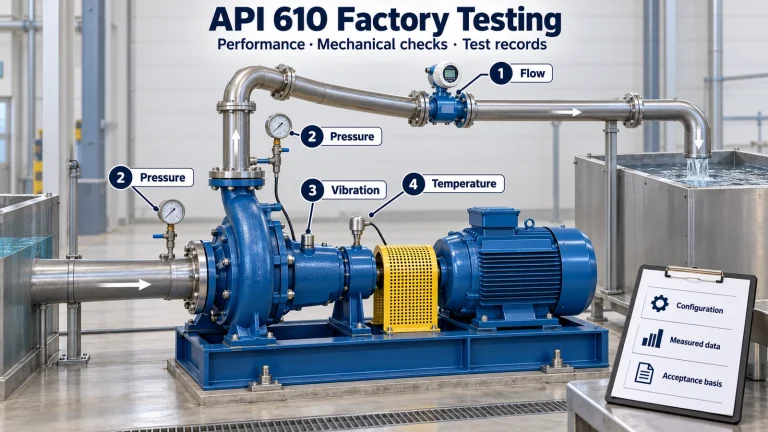
- Hydraulic: compare measured flow, suction/discharge pressure, valve/bypass condition, minimum flow, NPSH margin and liquid properties with the expected duty.
- Mechanical: inspect coupling, alignment, soft foot, foundation, pipe strain, fasteners, shaft runout, bearings, impeller and clearances.
- Sealing: record leakage, flush/quench condition, seal chamber configuration and elastomer/face/gasket requirements.
- Documentation: keep rounds, work orders, drawings, inspection reports, certificates, failure photos and commissioning readings with the asset.
When Maintenance Data Should Trigger Engineering Review
Request engineering review when there is repeated seal failure without a confirmed cause, a rising vibration trend, persistent bearing-temperature increase, off-design or unstable minimum-flow operation, recurring cavitation symptoms, corrosion/erosion/cracking, modified equipment, unavailable OEM parts or uncertain replacement fitment.
The review should separate hydraulic, mechanical, material, sealing and operating causes. A replacement that matches a nominal size is not automatically the correct answer.
How to Build a Pump Reliability Improvement Loop
- Baseline the installed pump, duty, condition and failure consequence.
- Trend route data at repeatable locations and correlate it with flow, pressure, speed and temperature.
- Use planned work to verify suspected causes and update the asset record.
- Capture inspection findings, parts evidence, deviations, acceptance readings and lessons learned.
- Adjust the maintenance task or engineering scope when the evidence changes.
Use the site’s technical resources and pump calculators to frame operating-point checks. For overhaul or replacement parts, compare the actual configuration through aftermarket solutions.
What to Send for a Pump Repair or Replacement Review
- Pump model, size, nameplate photograph, current impeller diameter and seal arrangement.
- Required and measured flow, suction/discharge pressure, speed, motor data and operating hours.
- Fluid identity, concentration, temperature, viscosity, specific gravity, solids and suction information.
- Failure history, photos, vibration/temperature trends, leakage observations and recent maintenance work.
- Drawings, OEM part numbers, material requirements and required inspection or test scope.
Request a Pump Maintenance Review
Send the pump model, recent vibration and temperature readings, photos, failed-part information and operating duty for an engineering review of the maintenance or replacement scope.
Frequently Asked Questions
How often should a centrifugal pump be maintained?
Frequency follows criticality, service severity, run hours, manufacturer IOM, site history and failure consequence. Use a tiered plan and revise it when evidence changes.
What should be included in a pump maintenance checklist?
Include operator observations, duty readings, lubrication and sealing checks, vibration and temperature trends, mechanical alignment, outage inspection, documentation and the action required when a value changes.
What is the difference between preventive and predictive pump maintenance?
Preventive maintenance is scheduled by time or use. Predictive maintenance uses measured condition data and trends to decide when an intervention is warranted. They work together.
Which pump readings should be trended?
Depending on the asset, trend flow, suction/discharge pressure, speed, motor current or power, bearing temperature, vibration, leakage, lubricant condition and relevant liquid or process conditions.
When should an ANSI process pump be overhauled?
Use condition, failure consequence, inspection findings, manufacturer guidance and planned outage needs. Overhaul when evidence shows internal wear, damage, seal or bearing risk, or when a controlled inspection is needed—not only because a generic calendar date arrived.