
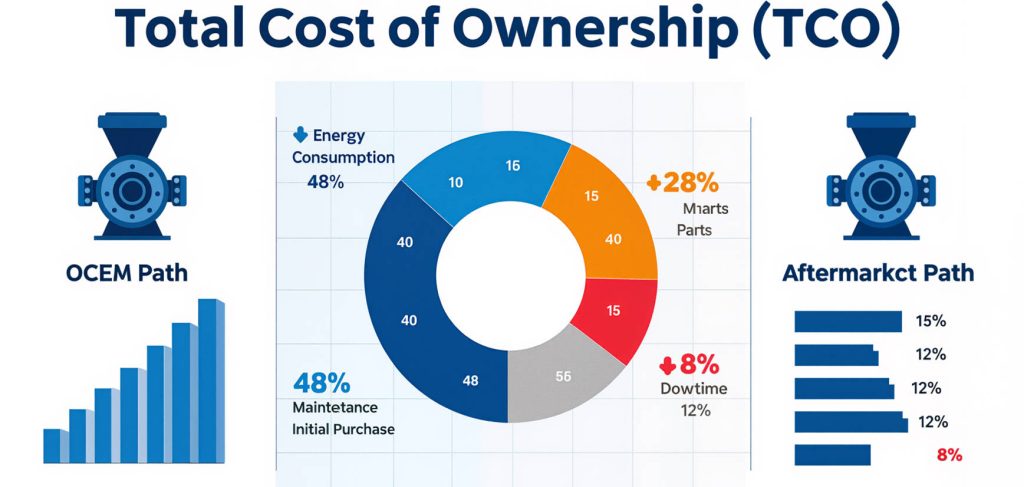
Procurement price tells you what a pump costs to buy. Total Cost of Ownership (TCO) tells you what it costs to own. For industrial pump maintenance providers and the plants you serve, the difference between these two numbers determines whether a refurbishment project generates profit or erodes it.
This article breaks down the real TCO of ANSI process pumps, shows where aftermarket replacement components from qualified Chinese manufacturers reduce TCO by 20-40%, and provides a framework you can use to build the business case for your end-user clients.
Breaking Down ANSI Pump Lifecycle Costs
For a typical Goulds 3196 MT size pump in continuous chemical service over a 15-year lifecycle, the cost breakdown looks like this:
| Cost Category | 15-Year Total (OEM Parts) | % of TCO | Aftermarket Potential Savings |
|---|---|---|---|
| Initial pump purchase | $18,000 | 12% | 20-30% on replacement unit |
| Energy consumption | $72,000 | 48% | 5-10% (hydraulic efficiency matching) |
| Planned maintenance parts (wet-end replacements x3) | $42,000 | 28% | 20-40% per replacement cycle |
| Unplanned downtime (4 events x 3 days) | $12,000 | 8% | 50% reduction potential via faster parts delivery |
| Inventory carrying cost (spare parts) | $6,000 | 4% | Eliminated with just-in-time delivery |
| TOTAL 15-Year TCO | $150,000 | 100% | $30,000-$60,000 (20-40%) |
The Hidden Cost: Downtime Is More Expensive Than Parts
In a mid-size chemical plant, one day of unplanned downtime on a critical process line costs between $25,000 and $150,000 in lost production. The exact cost of a pump part becomes almost irrelevant when compared to the cost of not having it.
This is where lead time becomes a TCO factor that dwarfs unit price:
| Scenario | OEM Lead Time | Aftermarket Lead Time | Downtime Cost Saved |
|---|---|---|---|
| Planned overhaul (wet-end kit) | 18 weeks (plan ahead) | 8 weeks | Minimal (planned) |
| Unexpected impeller failure | 12-16 weeks (expedited) | 6-8 weeks | $50,000-$200,000 |
| Emergency casing crack (exotic alloy) | 24-32 weeks | 10-16 weeks | $100,000-$500,000 |
| Startup spare parts kit | 16-20 weeks | 8-10 weeks | Enables faster commissioning |
The math is straightforward: if cutting 10 weeks off an emergency delivery saves 10 weeks of potential downtime, and each week of downtime costs $25,000, the lead time reduction alone is worth $250,000. The parts cost is secondary.
5 TCO Optimization Strategies for Pump Maintenance Providers
1. Standardize on a Limited Number of Qualified Suppliers
Developing a relationship with 2-3 qualified aftermarket pump parts manufacturers gives you supply chain redundancy without the overhead of managing dozens of vendor relationships. For each supplier, verify:
- ISO 9001:2015 certification (minimum)
- ASTM material certification capabilities (MTR per EN 10204 3.1)
- CNC machining capability for ANSI B73.1 dimensional tolerances
- Documented quality control process with dimensional inspection reports
- Consistent lead time track record (ask for references)
2. Stock Strategically, Not Defensively
The OEM model encourages customers to stock expensive spare parts inventory as insurance against long lead times. With a reliable aftermarket supplier offering 8-12 week delivery, you can:
- Reduce on-site spare parts inventory by 50-70%
- Free up working capital tied up in spare parts storage
- Eliminate the risk of stored parts deteriorating (corrosion, seal aging)
- Order parts just-in-time for planned maintenance windows
3. Bundle Wet-End Packages Instead of Ordering Individual Parts
When refurbishing a pump, the most cost-effective approach is usually a complete wet-end package rather than individual parts. Bundling reduces per-part cost, ensures all components are manufactured from the same material heat (consistent chemistry), and simplifies logistics. A typical wet-end package includes:
- Impeller (trimmed to specified diameter)
- Casing / Volute
- Stuffing box cover
- Shaft sleeve
- Wear rings (casing and impeller)
- Gasket set
4. Use Lifecycle Analysis to Win End-User Trust
When presenting an aftermarket replacement option to a plant manager, lead with the TCO analysis, not the parts price. The conversation should be:
“The OEM wet-end kit is $18,000 with a 22-week lead time. Our kit is $11,500 with a 10-week lead time. Both are manufactured to ANSI B73.1, both come with full MTR documentation. The $6,500 parts savings is real, but the 12 weeks of schedule certainty is what keeps your plant running. Here are three references from other chemical plants using these parts.”
5. Verify Hydraulic Performance, Not Just Dimensions
The most sophisticated TCO analysis falls apart if the replacement impeller does not deliver the same head and flow as the original. Always confirm with your supplier that hydraulic performance curves are available and verified. A reputable manufacturer will have:
- Hydraulic performance test data for each impeller pattern
- Coordinate measuring machine (CMM) dimensional reports
- Dynamic balancing certification (ISO 1940 G6.3 or better)
- Material test reports with heat number traceability
TCO Comparison: OEM vs ANSI Pumps Pro Over 15 Years
| Cost Element | OEM Path | Aftermarket Path | Savings |
|---|---|---|---|
| Initial pump purchase (316SS) | $18,000 | $12,600 | $5,400 |
| Wet-end replacement cycle 1 (year 5) | $14,000 | $9,000 | $5,000 |
| Wet-end replacement cycle 2 (year 10) | $14,000 | $9,000 | $5,000 |
| Wet-end replacement cycle 3 (year 13) | $14,000 | $9,000 | $5,000 |
| Emergency spare impeller (year 7) | $6,500 | $4,200 | $2,300 |
| Downtime reduction (12 weeks faster total) | $0 | $0 (avoided cost benefit) | $25,000-$100,000 |
| TOTAL (excluding energy) | $66,500 | $43,800 | $22,700 (34%) |
The savings are significant even before accounting for the value of reduced downtime. For a plant running 5-10 ANSI pumps, the cumulative savings multiply quickly.
How to Calculate TCO for Your Specific Application
Use this formula to build a client-specific TCO analysis:
C_acq = Acquisition cost (pump + installation + commissioning)
C_maint = Cost per rebuild (parts + labor)
N_rebuilds = Number of planned rebuilds over lifecycle
C_energy = Annual energy cost (motor kW x hours/year x electricity rate)
C_downtime = Cost per unplanned failure (lost production + emergency labor)
N_failures = Expected unplanned failures over lifecycle
The aftermarket advantage shows up in three terms:
- C_acq: 20-40% lower parts cost
- C_maint: 20-40% lower per-rebuild parts cost
- C_downtime: Reduced probability of extended downtime due to shorter parts lead time
Want a Custom TCO Analysis for Your Pump Fleet?
Send us your pump specifications and operating conditions. We will prepare a detailed TCO comparison showing the savings from switching to high-compatibility aftermarket parts, including parts cost, lead time, and lifecycle projections.
WhatsApp: +86-186 5910 6155 | miya_zhang@ansipumpspro.com