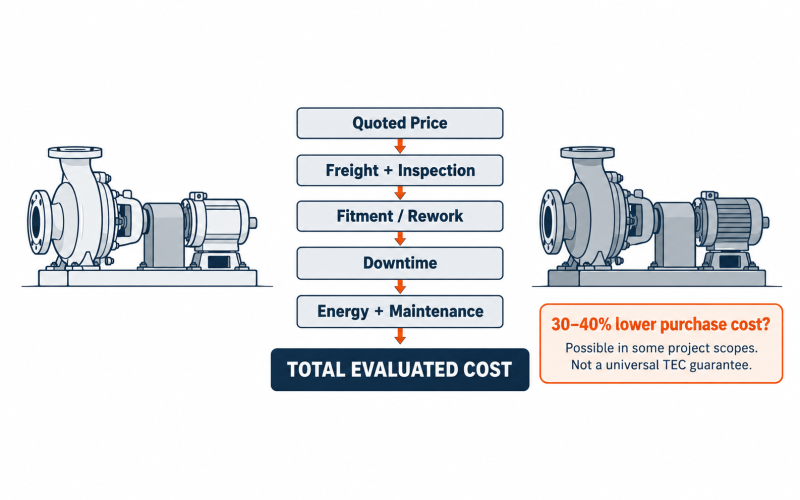
Short answer: An aftermarket ANSI process pump can reduce the quoted purchase price in some project scopes, but a lower quote is not automatically a lower total cost. Compare new, rebuild and independent aftermarket routes against the same fitment, hydraulic, material, inspection, downtime, energy and maintenance assumptions.
Can an aftermarket ANSI pump really reduce cost by 30–40%?
| Purchase Price | Fitment Risk | Total Evaluated Cost |
|---|---|---|
| A lower quoted purchase price may be possible depending on size, configuration, material, scope, documentation and delivery. | Any source change must be verified against required dimensions, hydraulic duty, materials and acceptance criteria. | TEC must account for freight, inspection, modification, downtime, energy and maintenance. |
Treat 30–40% as a project-specific quotation outcome when supported by actual quotes—not as a universal saving assumption.
01 What Determines ANSI Process Pump Price?
Price depends on more than the pump casing. Pump size, materials, seal arrangement, impeller configuration, driver boundary, documentation, inspection, delivery, spares and required acceptance records can all change the quoted scope. A valid comparison starts by fixing the technical and commercial boundary for every route.
Compare a Goulds 3196 replacement or Durco Mark III replacement against the installed duty and evidence package—not against a generic catalog price.
02 Why Purchase Price Alone Is the Wrong Comparison
The lowest purchase quote can become the highest project cost if the source change creates rework, missed delivery, extra inspection, unsuitable materials, downtime or a hydraulic mismatch. Keep supplier quotation, user assumptions and contingency separate so the comparison remains auditable.
DOE guidance treats pumping as a system-level decision: pump performance, motor performance, controls and changing demand all affect energy use. A pump selection that fits physically but misses the operating point can undermine the expected commercial result.
03 Build a Total Evaluated Cost
TOTAL EVALUATED COST
TEC = Purchase + Freight + Inspection + Fitment / Rework + Downtime + Energy + Maintenance
Not every project requires every term to be converted into a precise dollar value. Separate supplier quotations, user assumptions and contingency so the comparison remains auditable.
Use the same evaluation period, motor and supply boundary, duty assumptions and documentation basis for each option. Energy and maintenance should remain assumptions or calculated values tied to the project data, never invented market numbers.
04 Worked Example: Comparing New, Rebuild and Aftermarket ANSI Pump Cost
This is a methodology example, not a market quotation. Use the same scope for each column and enter project values only when the source is documented.
| Cost input | New pump | Rebuild | Independent aftermarket |
|---|---|---|---|
| Quoted equipment / parts | Project quote | Project quote | Project quote |
| Freight | Enter value | Enter value | Enter value |
| Inspection / documentation | Enter value | Enter value | Enter value |
| Machining / modification | Enter value | Enter value | Enter value |
| Planned downtime | Estimate | Estimate | Estimate |
| Energy | Calculated | Calculated | Calculated |
| Expected maintenance | Assumption | Assumption | Assumption |
| 3-year TEC | Calculated | Calculated | Calculated |
Do not populate this structure with fictional values. A useful comparison is one where another engineer can trace every input back to a quote, drawing, measurement, duty point or stated assumption.
05 OEM vs Independent Aftermarket Decision Matrix
| Decision factor | OEM route | Independent aftermarket route | Evidence required |
|---|---|---|---|
| Exact proprietary requirement | Use when controlled proprietary geometry or documentation is required. | Confirm whether the requirement is actually proprietary. | Specification, drawing or owner standard |
| Standardized replacement opportunity | May provide a direct documented route. | May be viable when interfaces and duty are verified. | Applicable standard and fitment record |
| Lead-time requirement | Check current manufacturing and delivery commitment. | Check source, inspection and delivery commitment. | Written delivery basis |
| Material verification | Confirm exact grade and records. | Confirm exact grade and records. | MTR, PMI or other specified evidence |
| Dimensional verification | Use approved GA and configuration records. | Use approved GA and field evidence. | Drawing revision and measurements |
| Hydraulic verification | Confirm curve and operating region. | Confirm curve and operating region. | Curve, duty and NPSHr basis |
| Documentation / inspection | Match the project specification. | Define the inspection and documentation package. | Inspection and acceptance plan |
| Acceptance criteria | Confirm applicable owner or project requirements. | Confirm applicable owner or project requirements. | Written acceptance basis |
06 Where Energy Belongs in the Calculation
Energy belongs in TEC when the options have different efficiency, speed, impeller trim, operating region or control requirements. Use the actual duty point, run hours, power cost and evaluation period. DOE’s MEASUR platform includes PSAT and related pumping-system tools for evaluating potential savings from field-measured data and “what-if” system changes.
Review the relevant ANSI pump performance curves and verify that the selected pump serves the same system duty. Do not use a fixed energy percentage or claim savings without project inputs.
07 Before Switching ANSI Pump Source
- 01 IDENTIFY
Model, size, serial and drawing revision. - 02 VERIFY FIT
Critical dimensions and mating interfaces. - 03 VERIFY MATERIAL
Material grade, certification, MTR or PMI where specified. - 04 VERIFY HYDRAULICS
Flow, head, speed, impeller and operating point. - 05 DEFINE ACCEPTANCE
Balance, hydrostatic test, dimensional inspection and documentation requirements. - 06 COMPARE TEC
Quote, freight, downtime, modification, energy and maintenance.
Use OEM/product-family terminology precisely. For example, write “Goulds 3196 MTX frame designation” when that is the documented product-family term. Do not call MTX, STX, LTX or XLTX universal ASME B73.1 frame groups.
ANSI Pump TEC Comparison Worksheet
Compare new, rebuild and independent aftermarket options using the same technical and commercial scope.
- Pump identity
- Hydraulic duty
- Material
- Supplier quote
- Freight
- Inspection
- Modification
- Downtime
- Energy
- Maintenance
- 1 / 3 / 5-year TEC
TEC Worksheet — Coming Next
08 How ANSI Pumps Pro Positions the Offer
The offer should be compared on a defined technical and commercial scope: installed identity, replacement fit, hydraulic duty, materials, inspection requirements, delivery risk and lifecycle assumptions. The goal is not to label one route universally best or cheapest; it is to document the route that is supportable for the project.
Technical Review
ANSI Pumps Pro Engineering Team
ASME B73.1 dimensional review · hydraulic replacement evaluation · materials · inspection documentation
09 Frequently Asked Questions
What determines ANSI process pump price?
Size, materials, configuration, seal arrangement, driver boundary, documentation, inspection, delivery and the required replacement scope all affect price.
Can an aftermarket ANSI pump cost less?
It may have a lower quoted purchase price in some scopes. The project still needs to verify fitment, hydraulics, materials, documentation, downtime, energy and maintenance before treating the result as a saving.
Is a rebuild cheaper than a new pump?
Sometimes, depending on casing condition, available parts, machining, seal requirements, inspection and outage duration. Use the same TEC boundary for both options.
Can I assume a fixed 30–40% saving?
No. Treat 30–40% as a project-specific quotation outcome only when supported by actual comparable quotes and documented assumptions. It is not a universal TEC guarantee.
What information is needed for a meaningful ANSI pump cost comparison?
Start with the installed model or nameplate, operating duty, fluid and materials, replacement scope, available drawings, delivery requirement and the supplier quotations being compared.
10 Sources
[1] ASME B73.1
Horizontal end-suction centrifugal pump dimensional/interchangeability reference.
[2] U.S. Department of Energy Pump Systems
Pump-system and energy assessment reference.
[3] DOE MEASUR
Pump System Assessment Tool and pumping-system analysis methodology.
[4] DOE Pumping System Sourcebook
Improving Pumping System Performance: A Sourcebook for Industry.