
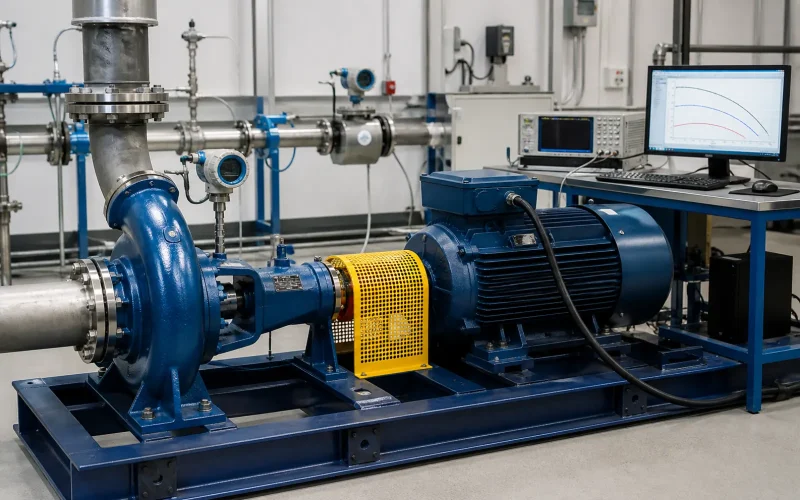
At the same flow, pump head and efficiency, a liquid with higher specific gravity requires proportionally more hydraulic and pump shaft power. The same head also represents a greater pressure rise in the denser liquid. This comparison is a screening principle: actual chemical-service performance still depends on the fluid properties, operating point and selected pump curve.
Specific Gravity and Density Are Related, but Not Interchangeable Inputs
Specific gravity (SG) is a ratio of a liquid density to a stated reference density; it has no units. Density has units such as kg/m³. Pump-power calculations can use SG when the equation is on a water-density basis, but the value must match the actual concentration and temperature being reviewed.
For a chemical mixture, record the source and reference condition for the density or SG. Do not treat “sulfuric acid” or “50% caustic” as a complete property specification. The property source, concentration basis, temperature and product grade can all matter.
Does Specific Gravity Change Centrifugal Pump Head?
For the same pump geometry and speed, and for liquids with comparable viscosity, the pump head is treated as energy per unit weight of liquid. Head is not simply multiplied by SG. The pressure rise associated with a given head does depend on liquid density, so the same head corresponds to a greater differential pressure in a denser liquid.
| Quantity | Effect of higher SG at an otherwise comparable duty | Engineering check |
|---|---|---|
| Head | Remains a head quantity; do not multiply the pump head curve by SG. | Confirm the actual operating point and whether viscosity changes the curve. |
| Differential pressure | Increases for the same head as liquid density increases. | Use a consistent density, pressure reference and measurement basis. |
| Hydraulic power | Increases with density when flow and head are held constant. | Distinguish power delivered to the liquid from pump shaft power. |
| Pump shaft power | Increases with density if flow, head and pump efficiency remain the same. | Use the applicable pump curve and efficiency at the actual duty. |
The qualification matters: a viscosity change or a different system operating point can alter flow, head and efficiency. A density-only comparison does not predict those changes.
How Specific Gravity Affects Pump Power
Hydraulic power is the rate of energy transferred to the liquid. Pump shaft power is higher because the pump is not perfectly efficient. For a fixed flow and head, increasing liquid density increases the hydraulic-power term; pump efficiency then determines the corresponding shaft-power estimate.
When using a water-basis SG formula, calculate with the pump efficiency at the relevant operating point—not an unrelated catalogue value. Use the Pump Power & Motor Sizing Calculator for the calculation, then verify its inputs and result against the actual curve and operating range.
What the Sulfuric Acid and Caustic Soda Examples Show
The ratios below isolate the density term only. They compare power at identical flow, head and pump efficiency; they do not represent a measured pump curve, a selected duty or a motor recommendation.
| Reference liquid | SG used | Relative power factor | Interpretation at the same Q, H and efficiency |
|---|---|---|---|
| Water baseline | 1.0000 | 1.0000× | Comparison reference only. |
| 50 wt% diaphragm-grade NaOH at 60°F | 1.5372 | 1.5372× | About 53.7% above the water-basis power term under the stated fixed-duty assumptions. |
| 98.0 wt% H2SO4 at 60/60°F basis | 1.8437 | 1.8437× | About 84.4% above the water-basis power term under the stated fixed-duty assumptions. |
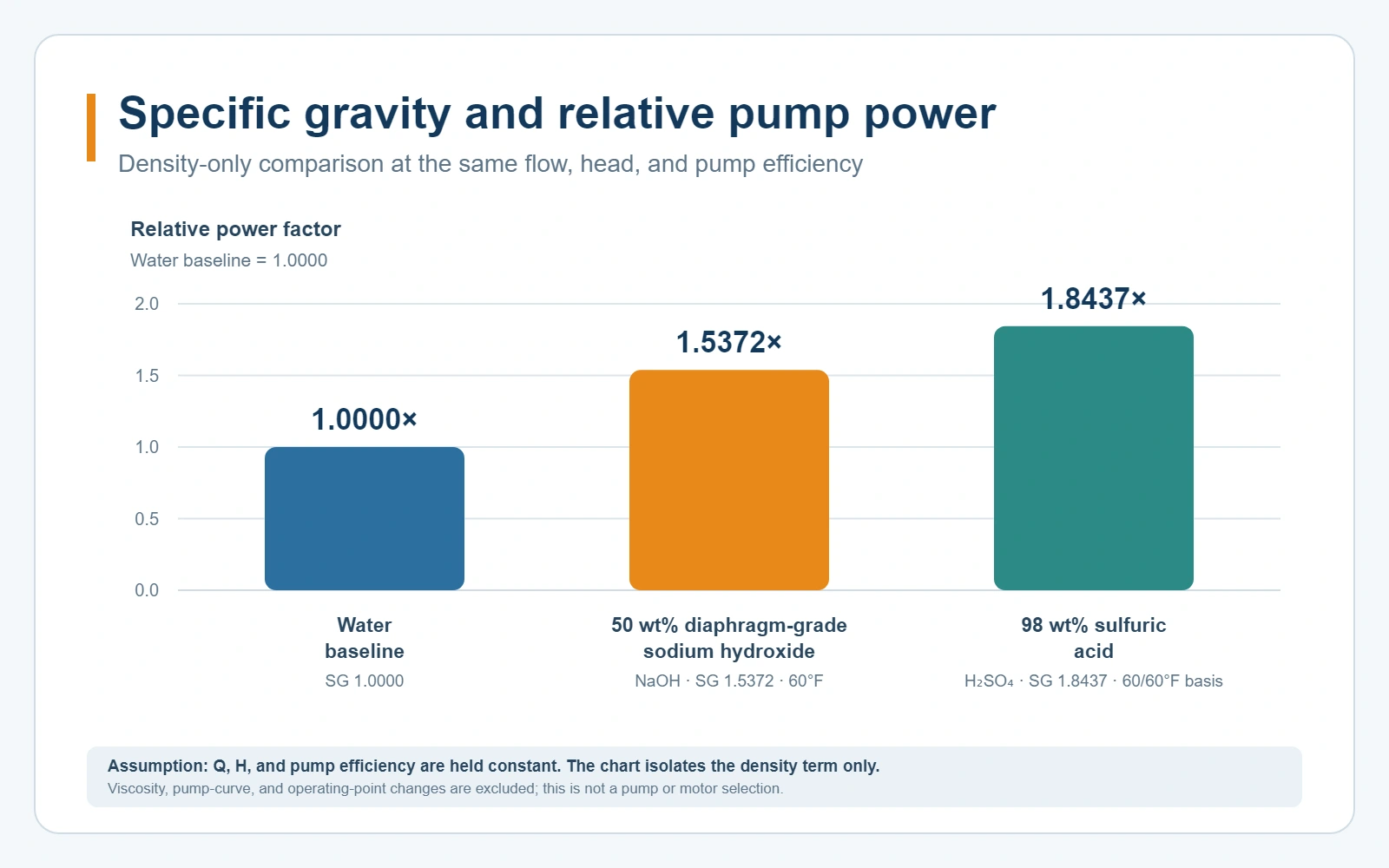
Property basis: the NaOH example uses OxyChem’s 50 wt% diaphragm-grade solution value from its density table at 60°F. The sulfuric-acid value is from Veolia’s specific-gravity table on a 60/60°F basis. Do not apply either value to another concentration, grade or temperature without checking the corresponding property data.
Why Caustic Soda Requires a Separate Viscosity Check
Specific gravity and viscosity describe different fluid properties. A density multiplier does not correct a water pump curve for a more viscous liquid. Where viscosity differs materially from water, obtain the process viscosity at the relevant operating and startup temperatures, then review the corrected flow, head, efficiency, absorbed power and NPSH using the applicable method and pump data.
OxyChem publishes separate density, viscosity and solidification information for aqueous caustic soda solutions. Use process-specific data rather than a generic “50% caustic” number. For the correction method and its limits, see the ANSI/HI 9.6.7 pump viscosity correction guide.
For the proposed pump, confirm head, efficiency, absorbed power and NPSHr on the curve for the stated speed and impeller condition. The pump-curve guide explains how to read those values; the Technical Resources hub links to available curve and engineering resources.
What a Water Test Can—and Cannot—Prove
A water test may document performance on water under the test conditions. If the process liquid has higher density, a same-duty comparison predicts a higher density-related power term. But a water test alone does not establish the final chemical-service shaft load when viscosity, operating point, efficiency, speed or system resistance differ.
If motor current or power changes after a process-fluid switch, compare synchronized readings with the pump curve and process data before assigning a cause. Review actual flow, head or suction/discharge pressures, speed, fluid concentration and temperature, viscosity, motor nameplate and electrical supply. A trip is a symptom that needs evidence; it is not proof that SG alone caused the overload.
For cost questions after the operating power is established, continue to pump energy and lifecycle-cost calculation. That topic uses representative electrical input and the applicable tariff; it is separate from this SG comparison.
Verify the Duty Before Approving a Pump Replacement
A matching connection or pump standard does not establish hydraulic suitability. Before approving a replacement, confirm the existing pump identity and configuration, the required duty range, liquid properties, proposed curve, absorbed power, NPSH and the applicable material and seal requirements.
For chemical-service material questions, use the condition-specific sulfuric acid and caustic soda impeller-material guide. For a replacement selection review, provide the available pump model, nameplate, duty data and curve through ANSI Pump Selection & Replacement. If you have an OEM model or part number, start with the OEM part-number cross-reference.
A useful review package includes the chemical and concentration, operating temperature range, SG or density source, viscosity, normal/minimum/maximum flow and head, speed, impeller diameter, existing and proposed pump curves, motor information and any known process changes.
Frequently Asked Questions
Does specific gravity change centrifugal pump head?
For the same pump geometry and speed, and for liquids with comparable viscosity, head remains a head quantity and is not simply multiplied by SG. Density changes the pressure represented by that head. Confirm the actual operating point and fluid viscosity.
How does specific gravity affect centrifugal pump power?
At the same flow, head and pump efficiency, hydraulic and shaft power scale with liquid density. This is a controlled comparison; it does not replace the actual pump curve or motor review.
Can I use a water test to select a motor for chemical service?
A water test alone does not establish the chemical-service shaft load. Check actual liquid density and viscosity, required duty range, pump efficiency and absorbed-power curve, then review driver and project requirements.
Does a specific-gravity factor account for caustic soda viscosity?
No. SG represents relative density, while viscosity is a separate property that can change pump performance. Use viscosity data at the relevant temperatures and apply the appropriate correction method to the applicable pump curve.
What information is needed to verify chemical-service motor load?
Provide fluid composition and concentration, temperature, SG or density source, viscosity, required flow and head range, pump speed and impeller condition, the applicable performance curve, motor data and relevant system conditions.
Technical Sources
- KSB Centrifugal Pump Lexicon — Head.
- OxyChem — Caustic Soda Handbook. Use the concentration, grade and reference basis applicable to the process fluid.
- Veolia — Sulfuric Acid Technical Information. The cited SG example is from the 60/60°F table basis.
- Hydraulic Institute — ANSI/HI 9.6.7, Effects of Liquid Viscosity on Rotodynamic Pump Performance.
- ANSI Pumps Pro — Pump Power & Motor Sizing Calculator.
This article explains how density relates to pump head, pressure and power. The numerical ratios are controlled comparisons, not pump performance data, a motor recommendation or a project-specific selection.