Aurora 3550 Discontinued: Replacement Pump, Parts & Fitment Options
Pentair currently lists the Aurora 3550 ASME/ANSI B73.1 industrial process pump as discontinued. For plants that still have 3550 units in service, the practical question is not simply whether the model is discontinued — it is what must be verified before replacing the complete pump, wet end, power end, or an individual component.
A safe replacement review starts with the installed equipment. Record the frame, pump size, serial number when available, impeller diameter, operating speed, flow, head, material, seal arrangement, and any existing drawings or parts lists. Then compare the proposed replacement against the actual installation and operating duty.
Send Pump Details
Explore Replacement Options
Engineering source review · Replacement-data workflow · Updated Sep 2026
Is the Aurora 3550 Discontinued?
An installed process pump is part of a larger system. The pump interfaces with suction and discharge piping, the baseplate, motor, coupling, mechanical seal system, utilities, instrumentation, and the process itself.
If those interfaces remain suitable, a replacement project may be able to preserve much of the existing installation. But that decision must be based on verified dimensions and operating data.
The risk is at both extremes:
- Replacing too little can leave a damaged power end, unsuitable seal arrangement, or worn baseplate in service.
- Replacing too much can create unnecessary piping, coupling, foundation, and commissioning work when only a wet end or individual component needs attention.
The right scope depends on condition, fit, duty, material, schedule, and the quality of the available identification data.
A useful first question is:
What part of the existing pump system is actually causing the maintenance or reliability problem?
If the answer is unclear, inspect and document the existing unit before issuing the RFQ.
Depending on the installed condition and project scope, the practical path may be a complete pump, wet end, power end or individual replacement part rather than a full system redesign.
Yes. Pentair currently identifies the Aurora 3550 ASME/ANSI B73.1 as a discontinued industrial process pump. Pentair’s current product information identifies three historical frame groups:
- Model 3550-S
- Model 3550-M/L
- Model 3550-XL
Pentair also continues to provide an OEM parts-and-service route for Aurora equipment. Therefore, “discontinued” should not be interpreted as “no support exists” or “every installed pump must immediately be replaced.”
For an MRO team, discontinued status changes the sourcing question. Instead of assuming one path, evaluate the installed unit and decide whether the lower-risk scope is:
- a complete replacement pump,
- a wet-end assembly,
- a power-end assembly,
- one identified replacement component,
- or continued repair with available OEM or aftermarket support.
Key takeaway: Treat the 3550 as a legacy installed-base engineering problem, not as a model-name substitution exercise.
—
Identify the Exact Aurora 3550 Configuration
Pentair’s historical Aurora documentation records many of the same identification fields, including pump size, serial number, impeller diameter, RPM, flow, head, seal type and material. These records provide a practical minimum data set when reviewing a legacy 3550 installation.
“Aurora 3550” identifies a product family. It does not identify one universal pump configuration.
Before requesting a replacement, collect as much of the following information as possible:
| Information | Why it matters |
|---|---|
| Full model and pump size | Establishes the starting configuration |
| Frame — S, M/L or XL | Narrows the power-end and dimensional envelope |
| Serial number | Helps trace the installed build when records exist |
| Impeller diameter | Needed for hydraulic and mechanical review |
| Operating speed / RPM | Required for curve, power and mechanical checks |
| Flow and head | Defines the required duty point |
| Material of construction | Prevents accidental metallurgy downgrade |
| Mechanical seal type | Affects seal-chamber and shaft/sleeve compatibility |
| Shaft / sleeve arrangement | Required for rotating-component fit |
| Motor and coupling | Needed when reusing the existing driver |
| Existing GA drawing | Best reference for installation dimensions |
| Parts list / OEM numbers | Useful for component identification |
| Installation photographs | Reveal field modifications not shown on old drawings |
The historical Aurora 3550 IOM manual itself provides record fields for pump size, serial number, impeller diameter, flow, application, mechanical seal type, model, RPM, head, and material of construction. That is a good indication of the information maintenance teams should preserve when supporting an aging installed base.
If the nameplate is incomplete
Do not guess the pump from appearance alone.
Send:
- clear photographs of the complete pump,
- suction and discharge flange orientation,
- bearing frame and frame-foot area,
- coupling and guard,
- seal chamber or stuffing box,
- baseplate,
- any casting marks or part numbers,
- available centerline and mounting measurements,
- and the known operating duty.
A field-modified installation can differ from an original catalog configuration.
Aurora 3550 Pump Size and ANSI Designation Cross-Reference
Use this table as a historical identification aid—not as a substitute for a drawing-based fit check. Confirm the nameplate, GA drawing, installed base and operating duty before quoting a replacement.
| Aurora 3550 Pump Size | Historical Frame | ANSI Designation | Replacement Review Route | Verify Before Quote |
|---|---|---|---|---|
| 1 × 1.5 – 6 | S | AA | Aurora 3550 ANSI replacement review | Verify GA fit, duty, seal and material |
| 1.5 × 3 – 6 | S | AB | Aurora 3550 ANSI replacement review | Verify GA fit, duty, seal and material |
| 2 × 3 – 6 | S | AC | Aurora 3550 ANSI replacement review | Verify GA fit, duty, seal and material |
| 1 × 1.5 – 8 | S | AA | Aurora 3550 ANSI replacement review | Verify GA fit, duty, seal and material |
| 1.5 × 3 – 8 | S | AB | Aurora 3550 ANSI replacement review | Verify GA fit, duty, seal and material |
| 2 × 3 – 8 | M | A60 | Aurora 3550 ANSI replacement review | Verify GA fit, duty, seal and material |
| 3 × 4 – 8 | M | A70 | Aurora 3550 ANSI replacement review | Verify GA fit, duty, seal and material |
| 3 × 4 – 8G | M | A70 | Aurora 3550 ANSI replacement review | Verify GA fit, duty, seal and material |
| 1 × 2 – 10 | M or L | A05 | Aurora 3550 ANSI replacement review | Verify GA fit, duty, seal and material |
| 1.5 × 3 – 10 | M or L | A50 | Aurora 3550 ANSI replacement review | Verify GA fit, duty, seal and material |
| 2 × 3 – 10 | M or L | A60 | Aurora 3550 ANSI replacement review | Verify GA fit, duty, seal and material |
| 3 × 4 – 10 | M or L | A70 | Aurora 3550 ANSI replacement review | Verify GA fit, duty, seal and material |
| 3 × 4 – 10H | M or L | A40 | Aurora 3550 ANSI replacement review | Verify GA fit, duty, seal and material |
| 4 × 6 – 10G | M or L | A80 | Aurora 3550 ANSI replacement review | Verify GA fit, duty, seal and material |
| 4 × 6 – 10H | M or L | A80 | Aurora 3550 ANSI replacement review | Verify GA fit, duty, seal and material |
| 1.5 × 3 – 13 | M or L | A20 | Aurora 3550 ANSI replacement review | Verify GA fit, duty, seal and material |
| 2 × 3 – 13 | M or L | A30 | Aurora 3550 ANSI replacement review | Verify GA fit, duty, seal and material |
| 3 × 4 – 13 | M or L | A40 | Aurora 3550 ANSI replacement review | Verify GA fit, duty, seal and material |
| 4 × 6 – 13 | M or L | A80 | Aurora 3550 ANSI replacement review | Verify GA fit, duty, seal and material |
| 6 × 8 – 13 | XL | A90 | Aurora 3550 ANSI replacement review | Verify GA fit, duty, seal and material |
| 8 × 10 – 13 | XL | A100 | Aurora 3550 ANSI replacement review | Verify GA fit, duty, seal and material |
| 6 × 8 – 15 | XL | A110 | Aurora 3550 ANSI replacement review | Verify GA fit, duty, seal and material |
| 8 × 10 – 15 | XL | A120 | Aurora 3550 ANSI replacement review | Verify GA fit, duty, seal and material |
| 8 × 10 – 15G | XL | A120 | Aurora 3550 ANSI replacement review | Verify GA fit, duty, seal and material |
Historical note: Pentair’s modular/interchangeability illustration also showed a 3 × 4 – 7 / A70 entry marked as being in the developmental stage. It is not included in the 24 pump-size rows above.
Source: Pentair’s historical Aurora 3500 Series / Model 3550 documentation.
Need a Fit Check for Your Installed Aurora 3550?
Send the nameplate, GA drawing, operating point and seal/material requirements. We can review whether the installed pump is best matched by a complete replacement, wet end, power end or individual parts.
View Aurora 3550 Replacement Pump Send Nameplate / GA Drawing
—
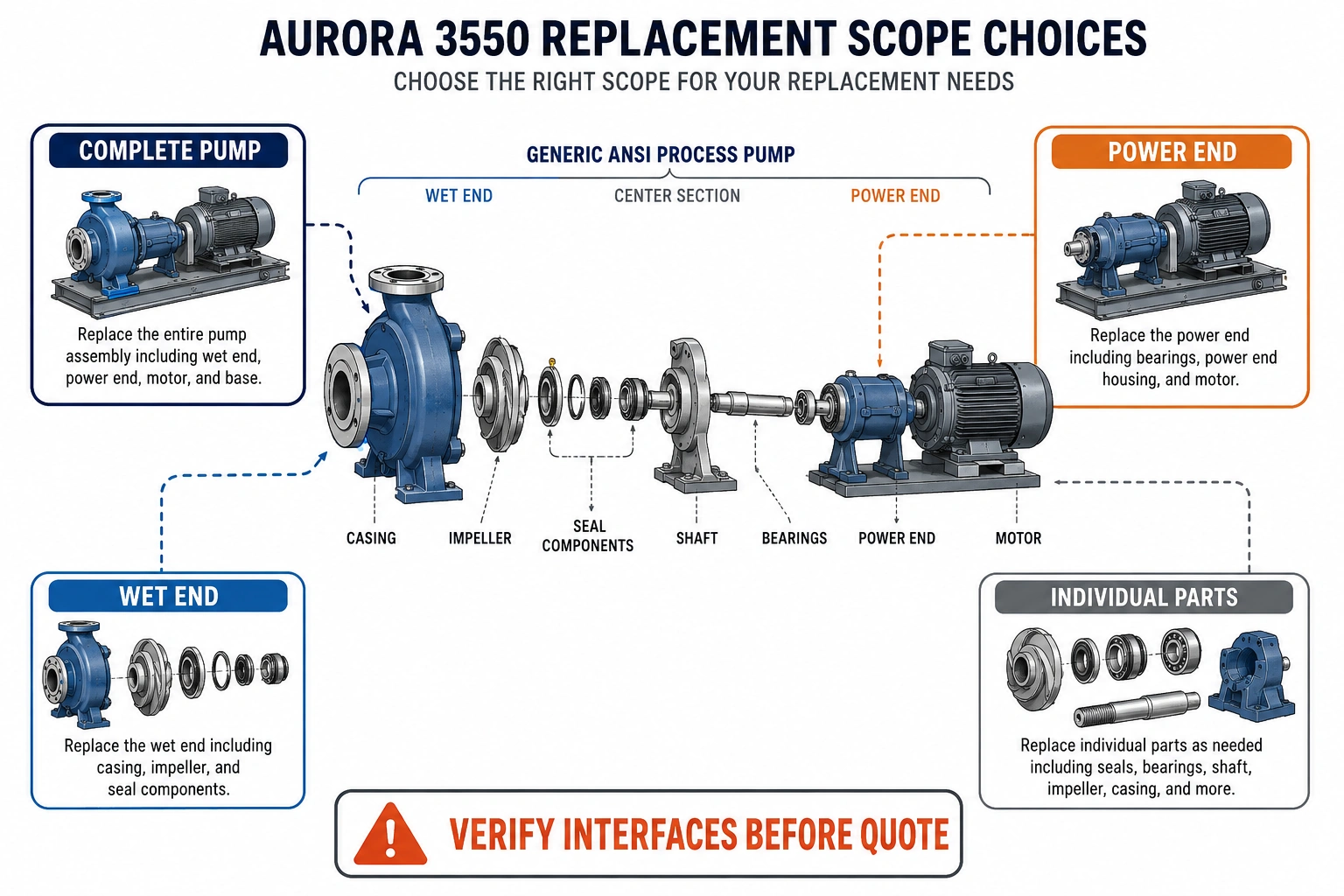
Complete Pump, Wet End, Power End or Individual Parts?
Legacy Aurora 3550 Replacement Parts
For parts-only projects, identify the exact pump size, frame, material and component reference before procurement. Common legacy review items include impellers, shafts, shaft sleeves, casing/stuffing-box components and bearing-frame parts.
The first commercial decision should be the replacement scope, not the brand name.
| Existing condition | Possible scope to review | What must still be verified |
|---|---|---|
| Complete pump is aged or repeatedly unreliable | Complete replacement pump | Installation dimensions, duty, material, seal, motor/coupling |
| Casing, impeller or cover is corroded while power end remains serviceable | Wet-end replacement | Casing-to-frame interface, impeller/shaft connection, seal arrangement, hydraulics |
| Bearing frame, shaft or bearings are the main problem | Power-end review | Frame, shaft/coupling interface, wet-end connection, rotation, seal geometry |
| One component is clearly identified and damaged | Individual part | Part number, dimensions, material, revision/configuration |
| Process duty has changed | Complete hydraulic review | New flow/head, NPSH, power, speed, material and operating range |
| Existing condition is uncertain | Engineering inspection/review | Nameplate, photos, drawing, measurements and operating history |

Complete replacement pump
A complete pump review is appropriate when the existing unit has broad mechanical deterioration, the hydraulic requirement has changed, the existing base/coupling arrangement is being replaced, or multiple assemblies need work.
Confirm at minimum:
- suction and discharge interfaces,
- pump centerline and mounting,
- baseplate arrangement,
- shaft and coupling position,
- motor interface,
- required flow and head,
- speed,
- impeller selection,
- materials,
- seal arrangement,
- auxiliary connections,
- and project documentation.
Wet-end replacement
A wet-end replacement may be useful when the bearing frame and driver remain suitable but the wetted components have suffered corrosion, erosion, or other damage.
Depending on the exact design, a wet-end scope may involve the casing, impeller, stuffing-box cover or seal chamber, gaskets, shaft sleeve, and related hardware.
The exact package must be stated in the quotation. “Wet end” should not be treated as a universal bill of materials.
Power-end replacement
A power-end review focuses on the bearing frame, shaft, bearings, housing, seals/isolators, frame foot, and related rotating or support components.
The replacement must be checked against both sides of the assembly:
1. the existing coupling/driver side, and 2. the wet-end / seal side.
Individual components
For an impeller, casing, shaft, shaft sleeve, cover, or other part, request a component-specific fitment review. A family name alone is not enough to release a part for production.
—
What ASME B73.1 Means for an Aurora 3550 Replacement
What B73.1 Helps Standardize
The current edition is ASME B73.1-2026, a design and specification standard for horizontal end-suction, single-stage, centerline-discharge chemical process pumps.
ASME describes the intent of B73.1 dimensional interchangeability as applying to pumps of the same standard dimension designation with respect to items such as:
- mounting dimensions,
- suction and discharge nozzle size and location,
- input shafts,
- baseplates,
- and foundation bolt holes.
This standardization is extremely useful when screening a legacy pump replacement because it creates common installation references.
For an Aurora 3550 replacement project, B73.1 can therefore support the external installation review. It can help the engineering team ask whether the proposed replacement can preserve the existing piping, base, shaft-centerline, and foundation arrangement.
But B73.1 is only one part of the review.
—
What Still Requires Verification
Do not turn “ASME B73.1” into a blanket internal-parts interchangeability statement.
The standard does not, by itself, prove that two pumps from different manufacturers have identical:
- impeller vane geometry,
- casing hydraulic passages,
- internal registers,
- shaft threads,
- shaft-sleeve details,
- bearing-frame internals,
- seal-chamber geometry,
- impeller adjustment mechanism,
- auxiliary connection positions,
- materials,
- or hydraulic curves.
Two pumps may satisfy the same general ANSI/ASME process-pump dimensional framework and still require detailed project-specific checks.
Engineering rule:
Use the B73.1 designation to start the installation review. Use drawings, measurements, pump curves, material specifications, and component data to finish it.
—
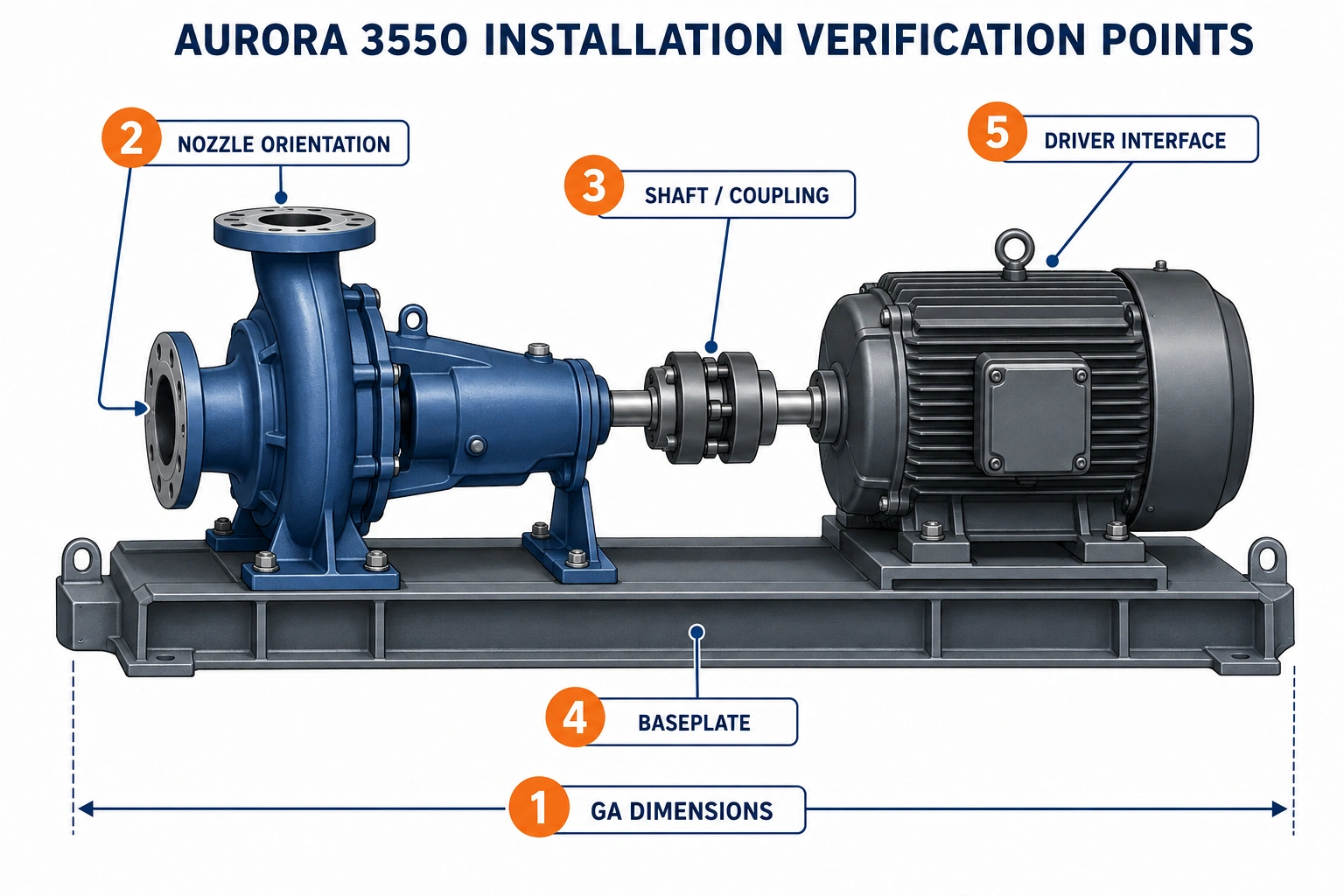
Dimensions and Interfaces to Verify Before Replacement
A replacement should be checked systematically rather than visually.

1. Suction and discharge interfaces
Verify:
- flange size,
- pressure class,
- facing,
- nozzle orientation,
- suction centerline,
- discharge centerline,
- face-to-centerline dimensions,
- and available piping flexibility.
Do not pull misaligned piping into place using flange bolts. Existing piping strain or previous field modifications can make a nominally correct replacement difficult to install.
2. Pump feet and mounting
Confirm:
- foot locations,
- bolt-hole pattern,
- mounting surface,
- shaft centerline height,
- baseplate geometry,
- anchor-bolt relationship,
- and maintenance clearances.
If the existing baseplate is being retained, inspect it for corrosion, distortion, cracked grout, soft foot, and evidence of previous modifications.
3. Shaft and coupling position
Check:
- shaft extension diameter,
- keyway,
- shaft-end length,
- coupling hub bore,
- coupling spacer,
- distance between shaft ends,
- guard clearance,
- and required axial position.
A pump can match the piping while still requiring coupling changes.
4. Seal chamber / stuffing-box interface
Verify:
- shaft or sleeve diameter,
- chamber bore,
- chamber depth,
- gland pilot,
- bolt pattern,
- flush-port size,
- flush-port orientation,
- vent and drain provisions,
- and the operating length required by the installed seal.
5. Maintenance access
Confirm that the replacement still allows practical access for:
- coupling service,
- seal removal,
- bearing-frame maintenance,
- impeller adjustment,
- and back-pull-out maintenance where applicable.
—
Hydraulic Compatibility
Dimensional fit does not guarantee hydraulic suitability.
Pentair’s historical Aurora 3550 product page lists a broad series envelope reaching up to approximately 4,200 GPM, 725 ft of head, 650°F, and 375 psig. Those are family-level historical product specifications, not a replacement selection for an individual installed pump.
For an actual replacement, confirm the specific operating point:
- normal flow,
- minimum and maximum expected flow,
- total dynamic head,
- static head,
- system resistance,
- speed,
- fluid specific gravity,
- viscosity,
- vapor pressure,
- temperature,
- solids or entrained gas,
- NPSH available,
- motor power,
- and control method.
Then review the proposed pump curve.
Need help translating an installed Aurora 3550 duty point into an ANSI replacement review? Start with the selection workflow, then send the nameplate and operating data for confirmation.
Do not use the old catalog maximum as the duty point
A 3550 installed at one plant may operate far below the published family maximum. The correct replacement is selected from the actual duty and installation, not from the largest number shown in a historical brochure.
If the process has changed
Treat the job as a new hydraulic selection.
Examples include:
- increased production rate,
- changed tank level,
- modified piping,
- higher temperature,
- new chemical concentration,
- more solids,
- throttling problems,
- repeated cavitation,
- or an oversized motor that allowed the old pump to operate away from its intended range.
—
Mechanical Seal and Stuffing-Box Compatibility
A replacement can match the external pump dimensions and still fail at the seal interface.
Before planning to reuse an existing mechanical seal, record:
- seal manufacturer and model,
- single or dual arrangement,
- cartridge or component seal,
- shaft/sleeve diameter,
- setting dimension,
- chamber bore and depth,
- gland pilot,
- bolt pattern,
- flush or quench connection,
- barrier/buffer system when used,
- and any plant-specific seal plan.
The historical 3550 documentation includes packing/stuffing-box and seal-related configurations. That makes the seal arrangement an important part of legacy-pump identification.
If the old seal system has a history of leakage or short life, do not automatically reproduce it. Review whether the problem is caused by:
- misalignment,
- shaft runout,
- bearing condition,
- dry running,
- solids,
- inadequate flush,
- vaporization,
- incorrect elastomer/material selection,
- or the seal chamber itself.
A replacement project is an opportunity to correct a recurring interface problem — but only after the process and seal requirements are understood.
—
Material Review for Chemical-Process Service
The historical Aurora 3550 parts-and-material documentation shows that the series was supplied in multiple metallurgy combinations, including configurations using:
- ductile iron,
- 316 stainless steel,
- Alloy 20,
- CD4MCu,
- titanium,
- and Hastelloy-family materials.
The same historical material table shows that material can vary by component. For example, casing, impeller, shaft, sleeve, stuffing box, frame adapter, and bearing-frame parts do not necessarily use the same alloy.
That leads to an important replacement rule:
Do not specify “stainless” or “Hastelloy” as the complete material requirement. Identify the exact wetted component and required grade.
For material review, provide:
- chemical name and full composition,
- normal concentration,
- upset concentration,
- temperature,
- pH where useful,
- chloride level,
- solids,
- abrasiveness,
- aeration or oxidizing conditions,
- cleaning chemicals,
- existing material,
- observed corrosion pattern,
- and expected documentation.
ANSI Pumps Pro material options may include CF8M / 316SS, CD4M / CD4MCuN, CN7M / Alloy 20, Hastelloy-type alloys, titanium, nickel alloys, and other specified materials subject to component geometry and engineering review.
Do not select an upgrade from alloy name alone. The best material depends on the complete process environment.
Check Material Compatibility Before Specifying the Replacement
Material selection depends on the actual chemical service, concentration, temperature, solids and seal environment. Use the guide as a screening resource, then confirm the final metallurgy and elastomers against the current process conditions.
—
Historical Aurora Identification Records
The historical Aurora IOM manual is useful for a reason beyond maintenance instructions: it shows the information the OEM considered important for identifying future spare parts.
Its equipment-record section asks for information including:
- pump size,
- serial number,
- impeller diameter,
- flow,
- application,
- mechanical seal type,
- model,
- RPM,
- head,
- and material of construction.
For a discontinued installed base, these fields should be treated as an MRO data set.
Recommended plant record
Create one internal record for each 3550 asset containing:
1. Equipment tag 2. Pump model and size 3. Frame 4. Serial number 5. Impeller diameter 6. RPM 7. Flow and head 8. Fluid and temperature 9. Material by key wetted component 10. Seal model and arrangement 11. Motor and coupling 12. GA drawing 13. Parts list 14. Last overhaul date 15. Known field modifications 16. Critical spare-parts status
This record makes future repair and replacement decisions faster and reduces the risk of ordering from an incomplete model description.
—
Aurora 3550 Replacement Verification Checklist
- 01 Identify — Nameplate, pump size, frame and available drawings.
- 02 Define Scope — Complete pump, wet end, power end or individual part.
- 03 Verify GA — Nozzles, mounting, shaft/coupling position and base interface.
- 04 Check Duty — Flow, head, RPM, impeller/curve and NPSH requirements.
- 05 Confirm Seal & Material — Seal arrangement, chamber/interface and metallurgy/service conditions.
- 06 Define QA / Documentation — Inspection, test and documentation requirements appropriate to the project.
- 07 Issue Project-Specific Quote — Quote only after the required fit, duty, material and supply-scope inputs are identified.
Avoid These Common Replacement Mistakes
- Wrong pump size or frame identified
- Field-modified installation not recorded
- Nozzle fit checked but coupling/base relationship missed
- Seal fit assumed without verifying the installed arrangement
- Dimensional fit treated as hydraulic fit
- RFQ submitted without identifying reused equipment / supply scope
What to Send for an Aurora 3550 RFQ
For the fastest useful review, send one package containing:
Pump identity
- Nameplate photograph
- Full model
- Pump size
- Frame: S, M/L or XL
- Serial number, if readable
Hydraulic data
- Flow
- Head
- RPM
- Fluid
- Temperature
- Specific gravity when relevant
- Impeller diameter, if known
Mechanical / installation data
- Existing GA drawing
- Suction and discharge photographs
- Baseplate photograph
- Coupling arrangement
- Motor details
- Seal or stuffing-box details
- Available site measurements
Material
- Existing casing material
- Existing impeller material
- Shaft / sleeve material
- Required material upgrade, if any
- Process composition and concentration
Supply scope
State whether you need:
- complete pump,
- bare pump,
- wet end,
- power end,
- individual part,
- or an engineering review because the scope is uncertain.
Delivery requirement
Provide the planned shutdown or required-on-site date.
Request an Aurora 3550 Replacement Review
Send the existing nameplate, drawing, duty and required scope. ANSI Pumps Pro can review the supplied information and identify the dimensional, hydraulic, material and seal checks required before quotation.
—
Frequently Asked Questions
Is the Aurora 3550 discontinued?
Yes. Pentair currently lists the Aurora 3550 ASME/ANSI B73.1 industrial process pump as discontinued. Pentair also continues to provide an OEM parts-and-service route for Aurora equipment.
What frame sizes were used on the Aurora 3550?
Pentair’s current legacy product information identifies Model 3550-S, 3550-M/L and 3550-XL. The historical IOM manual also identifies S, M, L and XL frames. Confirm the actual installed frame from the nameplate, drawings or physical configuration before ordering.
Can another ANSI B73.1 pump replace an Aurora 3550 without repiping?
Potentially, but not from the standard designation alone. The applicable nozzle positions, mounting dimensions, shaft/base interfaces and actual site arrangement must match. Hydraulic duty, seal arrangement and materials also require separate verification.
Are Aurora 3550 wet-end parts interchangeable with other ANSI B73.1 pumps?
Not automatically. ASME/ANSI B73.1 alignment helps define selected envelope and interface expectations, but wet-end parts still require confirmation against the applicable manufacturer drawing, dimensions, materials, seal arrangement and part references.
Can I replace only the wet end?
Potentially, when the existing power end, driver, coupling and installation remain suitable and the wet-end interfaces can be verified. The exact casing, impeller, cover/seal chamber, shaft/sleeve and hydraulic relationships still need review.
Do I need to change the baseplate when replacing an Aurora 3550?
Not always. Reuse depends on the verified GA dimensions, shaft/coupling position, mounting and baseplate details, driver arrangement and operating duty. Treat baseplate reuse as a fit-check outcome, not a default assumption.
Can I reuse the existing mechanical seal?
Only after confirming the shaft/sleeve diameter, seal chamber or stuffing-box geometry, gland pilot, bolt pattern, operating length, and required flush/barrier arrangement.
What information is most useful if the nameplate is damaged?
Send clear pump photographs, flange orientation, frame and bearing-frame photos, coupling and seal-area photos, any casting/part numbers, available measurements, operating duty, and historical drawings or maintenance records.
What materials were historically available on the Aurora 3550?
Pentair’s historical 3550 documentation lists multiple construction options that included ductile iron, 316 stainless steel, Alloy 20, CD4MCu, titanium and Hastelloy-family materials for selected components. That historical list should be used for identification, not as an automatic material recommendation for a new project.
What documentation should I request with a replacement?
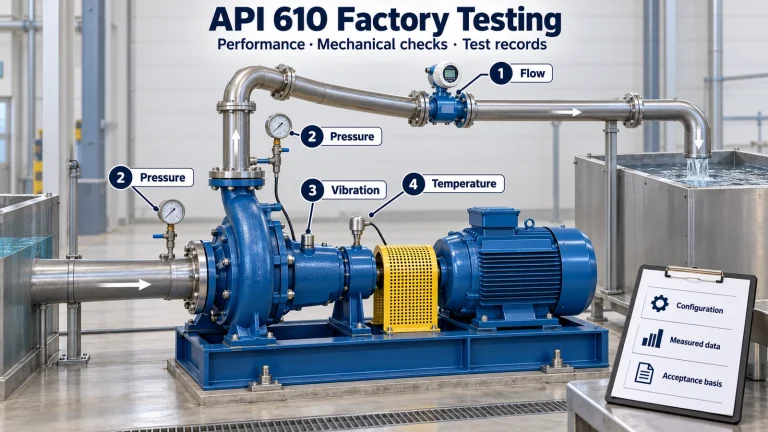
The required documentation depends on the project. It may include drawings, material certificates, PMI records, dimensional inspection, pressure testing, performance testing and other project-specific inspection records. State those requirements in the RFQ.
—
Related Engineering Resources
- Competitor Replacements — Review other installed ANSI process-pump families and replacement routes.
- ANSI B73.1 Interchangeability vs Component Compatibility — Understand what the standard does and does not prove.
- ANSI Pump Wet End Replacement Packages — Decide when a wet-end package is appropriate.
- Chemical Resistance Guide — Prepare material-selection inputs for chemical service.
- OEM Part Number Cross-Reference — Use the existing Goulds 3196 / Durco Mark III tool where applicable; other OEM references can be submitted for manual review.
—
Technical Sources & Review Basis
This guide was prepared using:
- Pentair’s current Aurora 3550 ASME/ANSI B73.1 legacy product page, which identifies the model as discontinued and lists the S, M/L and XL frame families.
- Pentair’s Aurora 3500 Series / Model 3550 instruction, installation, maintenance and repair manual, including the equipment-record fields, cross-sectional references, parts/material table and recommended spare-parts information.
- ASME’s current B73.1-2026 scope and dimensional-interchangeability description.
- ANSI Pumps Pro’s existing replacement-data workflow used in current Engineering Insights articles.
Final replacement compatibility must be confirmed for the specific installed pump, site interfaces, operating duty, seal arrangement, material and proposed supply scope.
—
Trademark Disclaimer: Pentair, Aurora and Aurora 3550 are trademarks or product designations of their respective owner and are used here only to identify installed equipment and discuss aftermarket replacement engineering. ANSI Pumps Pro / Jinan Yingsiman Machinery Co., Ltd. is an independent aftermarket manufacturer and is not affiliated with, sponsored by or endorsed by Pentair.