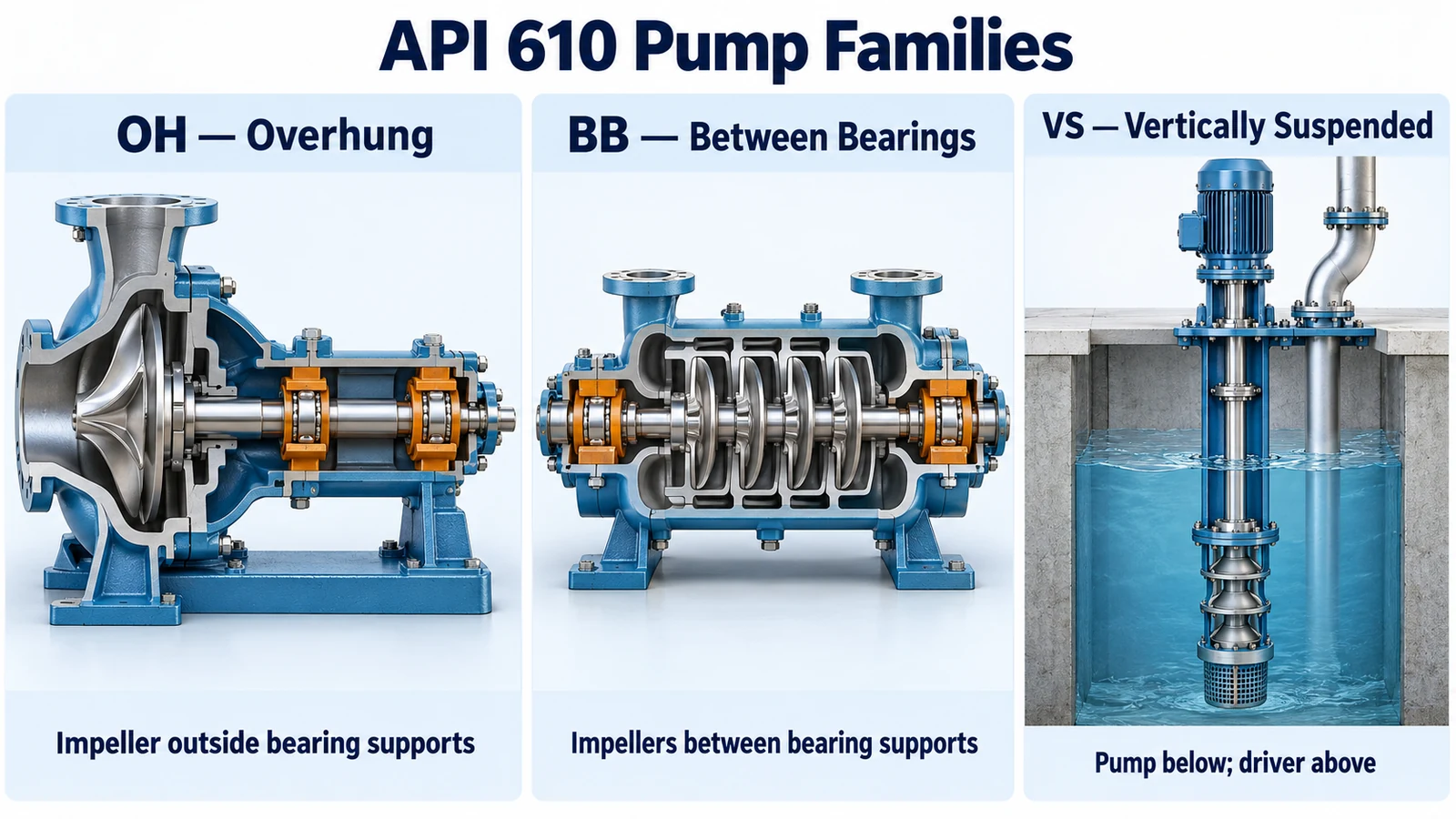
API 610 organizes centrifugal pumps into three families: OH, BB and VS. This guide explains their 18 construction codes and connects each arrangement to duty, suction conditions, maintenance and the evidence needed for purchase.
What OH, BB and VS describe
API 610 pump types identify the mechanical arrangement. OH means overhung: the impeller projects beyond its bearing support. BB means between bearings: the impeller group sits between supports. VS means vertically suspended: a vertical shaft connects the driver above to the pumping assembly below.
| Family | Construction decision | Typical selection questions |
|---|---|---|
| OH: OH1–OH6 | Cantilevered impeller and its mounting/drive arrangement. | Can one stage meet the duty with acceptable power, suction conditions and rotor loading? |
| BB: BB1–BB5 | Impellers supported from both sides; split direction and casing count distinguish types. | What flow, stage count, pressure boundary and maintenance access does the service need? |
| VS: VS1–VS7 | Vertical pumping assembly; hydraulic form, discharge route and casing arrangement distinguish types. | Where is the first stage, what is the lowest liquid level, and how will the assembly be lifted? |
Use the classification to organize a proposal review. Hydraulic suitability still comes from the selected size, speed, impeller and liquid. A high-head duty can lead to several candidate arrangements; compare their actual curves and complete packages.
OH1–OH6: overhung pump types
OH1 vs OH2: OH1 uses foot mounting; OH2 supports the casing at its centerline. Centerline mounting helps manage the shaft-centerline movement associated with casing temperature changes. OH3, OH4 and OH5 distinguish vertical in-line bearing and coupling arrangements. OH6 incorporates a gear stage into the pump assembly.
| Type | How to identify it | Check before selection |
|---|---|---|
| OH1 | Horizontal, foot mounted; separate pump bearings and flexible coupling. | Support arrangement and thermal movement. |
| OH2 | Horizontal, centerline mounted; separate pump bearings and flexible coupling. | Thermal growth, bearing frame and back-pull-out access. |
| OH3 | Vertical in-line with a separate bearing bracket and flexible coupling. | Pump bearing arrangement, seal access and piping support. |
| OH4 | Vertical in-line with rigid coupling. | Motor/pump shaft alignment and rotor support. |
| OH5 | Vertical in-line, close coupled; impeller mounted on the driver shaft. | Driver bearings, seal service and supplied motor configuration. |
| OH6 | Single-stage overhung pump with an integral speed-increasing gear. | Gear, lubrication and complete drive-package requirements. |
For this site’s new-project OH2 route, use the API 610 OH2 process-pump page. For an installed 3700, begin with the Goulds 3700 replacement review and record the existing size, duty, materials, seal and installation interfaces.
BB1–BB5: between-bearings pump types
Axially split means that the principal casing joint follows the shaft axis. Radially split means that the principal joint is transverse to it. A double casing adds an outer pressure-containing shell around the internal pumping assembly. These features affect pressure containment, inspection access and the work required to remove the rotor.
| Type | How to identify it | Check before selection |
|---|---|---|
| BB1 | One or two stages; axially split casing. | Split-joint access, suction arrangement and rotor lifting. |
| BB2 | One or two stages; radially split casing. | Pressure boundary, thermal support and seal access. |
| BB3 | Multistage; axially split casing. | Stage arrangement, casing joint and rotor dynamics. |
| BB4 | Multistage; radially split, single casing, commonly ring-section construction. | Section joints, tie rods, pressure containment and dismantling. |
| BB5 | Multistage; radially split, double casing with an outer barrel. | Barrel closure, inner assembly and cartridge removal space. |
Stage count alone cannot identify the BB type. BB2 includes one- and two-stage arrangements; BB3, BB4 and BB5 have different multistage casing constructions. Match the proposal cross-section to the designation and list the dismantling space on the general arrangement drawing.
VS1–VS7: vertically suspended pump types
For vertical pumps, read the section drawing from the intake upward. Identify the hydraulic element, the shaft support, the discharge path and the pressure-containing can, where supplied. VS4 has submerged lineshaft supports; VS5 uses a cantilever arrangement. A can-type VS6/VS7 can place the first stage lower relative to a closed source vessel, subject to the complete suction calculation.
| Type | How to identify it | Check before selection |
|---|---|---|
| VS1 | Single casing, diffuser construction; discharge through the column. | Intake geometry, submergence and column/shaft arrangement. |
| VS2 | Single casing, volute construction; discharge through the column. | Volute arrangement, intake and shaft support. |
| VS3 | Single casing, axial-flow construction; discharge through the column. | High-flow intake behavior and hydraulic operating range. |
| VS4 | Single casing, separate discharge pipe and lineshaft bearings. | Submerged bearing material, lubrication and minimum liquid level. |
| VS5 | Single casing, separate discharge pipe and cantilevered shaft. | Unsupported shaft length, stiffness and permitted duty. |
| VS6 | Double casing with diffuser construction; commonly a vertical can arrangement. | First-stage elevation, can pressure boundary and suction losses. |
| VS7 | Double casing with volute construction. | Volute arrangement, first-stage elevation and can interfaces. |
Check both NPSH and intake behavior. Minimum liquid level, first-stage datum, suction losses, vapor pressure and entrained gas influence suction performance. Intake submergence, vortices, sump geometry and bearing lubrication add separate design checks. Include the removal height and lifting route in the layout review.
Select a family from the operating cases
- Define the liquid. Record composition, temperature, density, viscosity, vapor pressure, solids and corrosion concerns.
- List the operating cases. Establish minimum, normal, rated and maximum flow with the system curve, pressure and elevation basis.
- Calculate head and suction conditions. Use consistent pressure references and units. Evaluate NPSHA at the most demanding credible suction case.
- Compare actual hydraulic selections. Locate the duty range relative to BEP, POR, AOR, minimum flow, power and NPSH for each proposed configuration.
- Review mechanical construction. Compare casing support, split direction, stages, pressure boundary, shaft support, seals, driver and maintenance access.
- Record the purchase basis. State the governing edition, purchaser requirements, deviations, documents, tests and agreed release criteria.
Start the commercial review through the API 610 engineering hub. It distinguishes current OH2 product routes from project-specific BB and VS review. The existing API 610 / ASME B73.1 selection guide helps decide which standard the project invokes.
Mechanical requirements: the evidence to request
A useful compliance matrix ties each requirement to a document and a decision. Fill the acceptance value and clause from the contractual edition, then check the supplied configuration. The following buyer checklist covers the main questions behind the mechanical requirements.
| Review item | Evidence to obtain | Decision it supports |
|---|---|---|
| Pressure casing | Material, design temperature, MAWP, maximum discharge-pressure cases, casing joint and gasket drawing. | Pressure containment, thermal suitability and any required radial split. |
| Rotor and shaft | Impeller configuration, shaft/rotor calculation, seal-location deflection and applicable dynamic analysis. | Seal loading, rotor stiffness and separation from relevant excitation. |
| Bearings and lubrication | Radial/thrust arrangement, load cases, bearing-life calculation and lubrication/cooling requirements. | Suitability over the operating range and expected utility needs. |
| Seals and auxiliaries | Seal arrangement, chamber details, support plan, fluid conditions and utility specification. | Containment, maintainability and the applicable API 682 scope. |
| Driver and coupling | Absorbed-power curve, density basis, starting case, driver rating and coupling data. | Power and starting capability across the agreed range. |
| Baseplate and nozzles | GA, nozzle orientation, allowable load basis, stiffness/alignment records and installation instructions. | Interface acceptance and installation planning. |
| Vibration | Applicable measurement method, locations, operating points, spectra and acceptance criteria. | A comparable factory baseline for the supplied pump. |
| Materials and quality | Material certificates, heat traceability and the specified inspection/test records. | Traceable acceptance of the pressure boundary and critical components. |
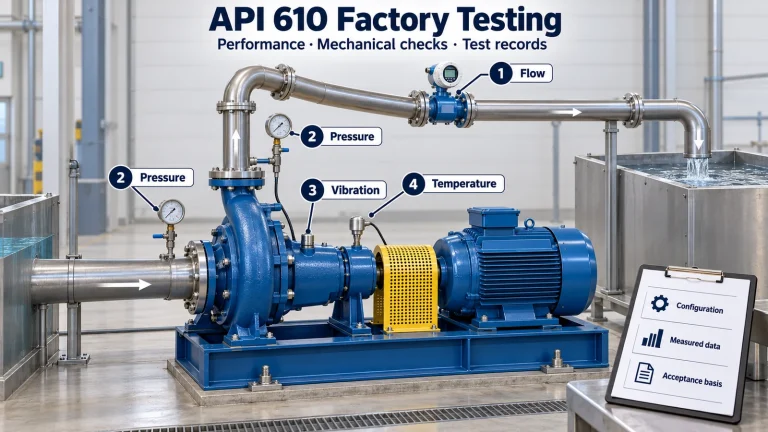
Transfer the accepted requirements into the API 610 factory-test checklist so that each required measurement has an acceptance basis and a report location.
Worked example: calculate head before choosing the arrangement
Consider an illustrative water service at 200 m³/h. A 2.5 bar difference between source and destination pressures contributes approximately 25.5 m of head. Add 20 m static elevation, 14 m suction/discharge piping loss and 13 m equipment/control loss: TDH = 72.5 m.
Using water density 1,000 kg/m³ and pump efficiency 0.80, the estimated shaft power is 49.4 kW. This is a hydraulic estimate; the selected driver must also cover the reviewed operating cases and purchase requirements.
Total differential head
p: pressure in Pa; ρ: density in kg/m³; g: gravitational acceleration in m/s²; z: elevation in m; v: velocity in m/s; hL: total losses in m.
Estimated pump shaft power
Q: flow in m³/h; H: total differential head in m; ρ: density in kg/m³; η: pump efficiency as a decimal.
Worked shaft-power example
Illustrative duty: water at 200 m³/h, total head 72.5 m and pump efficiency 0.80.
The example assumes that the stated pressure and level references are consistent and that the velocity-head difference is negligible. It supplies a duty point for comparing pump curves. Suction margin, liquid temperature, design pressure, installation and owner requirements complete the family decision.
Prepare an API 610 selection request
Pump arrangement and selection worksheet
Frequently asked questions
What are the three API 610 pump families?
OH identifies overhung pumps; BB identifies pumps with the impeller group between bearing supports; VS identifies vertically suspended pumps. Individual codes distinguish support, coupling, casing and hydraulic arrangements.
What is the difference between OH1 and OH2?
OH1 is foot mounted. OH2 is centerline mounted. Selection also requires review of the supplied construction, thermal conditions, hydraulic curve and purchaser requirements.
Does BB2 always mean a multistage pump?
BB2 covers one- and two-stage radially split between-bearings arrangements. BB3, BB4 and BB5 identify other multistage casing constructions.
Does any vertical pump comply with API 610?
Vertical orientation describes only part of the construction. Compliance is established against the contractual edition, proposed configuration, supporting documents and required tests.
What data are needed for API 610 selection?
Send flow, head, liquid, temperature, pressure, suction conditions and the project specification. For a replacement, add the existing model, size, nameplate, curve and available installation drawing.