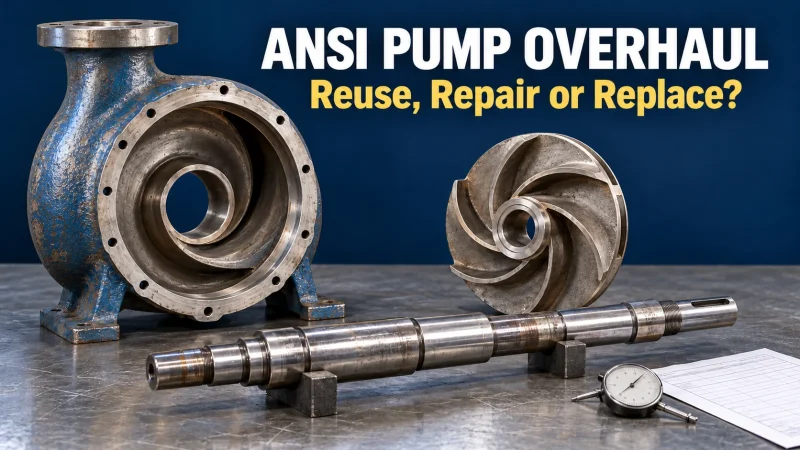
An ANSI pump is open on the workshop bench. The casing has localized pitting, the impeller shows wear, and the shaft has marks near a bearing seat. Which parts can return to service, which need repair, and which should be replaced?
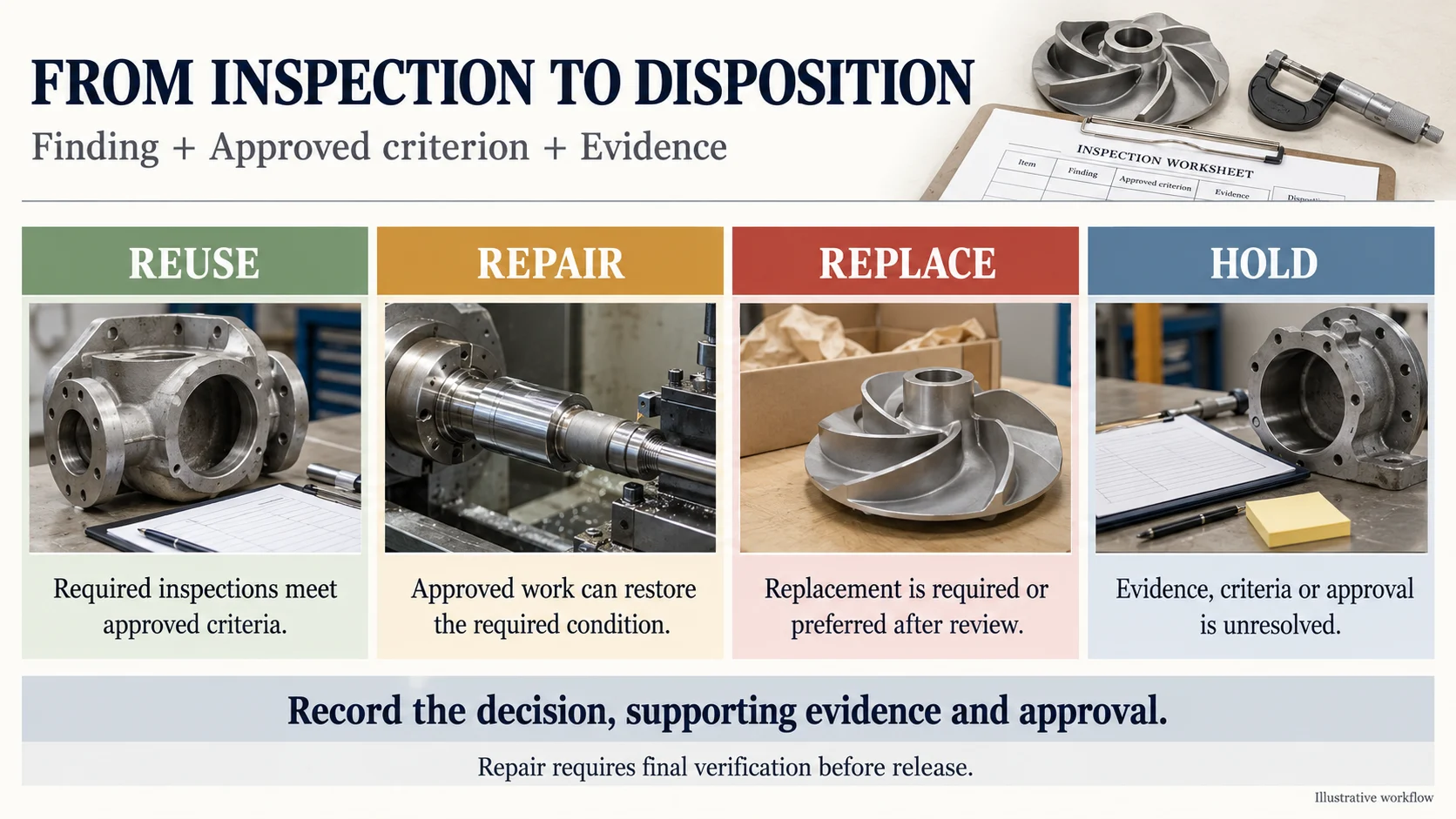
An ANSI pump overhaul inspection should connect each finding to an approved acceptance criterion and a recorded disposition. Reuse a component when the required inspections establish that it meets the applicable requirements. Consider repair when an approved process can restore those requirements and the result can be verified. Select replacement when the component fails a mandatory replacement criterion or an acceptable repair cannot be justified. Use Hold whenever essential evidence or approval is missing.
This guide covers component-level decisions for existing casings, impellers and shafts after disassembly. Use the accompanying editable Excel decision matrix or printable PDF worksheet as an ANSI pump overhaul checklist: record the as-found condition, approved criterion, disposition and evidence for each finding. Keep the completed record with the maintenance review and any resulting parts RFQ.
Why Pump Overhaul Decisions Need Documented Evidence
The cost of replacing serviceable components
Replacing every major part can increase material costs, inspection work and outage exposure. Reusing a part without an adequate inspection can create a different cost: repeat disassembly, leakage, loss of performance or another unplanned shutdown.
A defensible decision accounts for the component's condition, service requirements, repair scope, verification work and delivery date. Purchase price alone does not describe the full consequence of either choice.
Why visible damage alone is not an acceptance criterion
A photograph identifies where to investigate. Measurements and an approved inspection basis establish whether the condition is acceptable. A polished surface may conceal dimensional loss, while a visible surface mark may require further assessment before its significance is known.
The Goulds LF 3196 i-FRAME IOM, for example, includes pre-assembly replacement guidance for casing damage, impeller wear, shafts and sleeves. Its model-specific requirements illustrate why the applicable manual matters. Confirm the document's scope and revision for the installed pump before using any criterion.
Record the controlling drawing, manufacturer installation, operation and maintenance manual (IOM), project specification or approved engineering disposition. If references conflict, obtain a documented resolution before releasing the part.
Establish the As-Found Condition Before Repair
Before opening or handling process-wetted parts, follow the site's isolation, depressurization, drainage and decontamination procedures and the applicable IOM. Preserve useful failure evidence before cleaning or machining changes it.
Record the pump model, size, frame and operating duty
Create one asset record linking the pump and its removed components. Include the equipment tag, manufacturer, model, serial number, size, frame or group, component identifiers, material, impeller trim and seal arrangement.
Record the current duty: flow, head or suction and discharge pressures, speed, liquid, concentration, temperature and solids where relevant. Identify changes since the previous overhaul. A component that suited the original duty may need a fresh review if the process has changed.
Capture failure history, photographs and existing drawings
Photograph the overall assembly and each affected area with orientation and a scale. Give the images identifiers that can be referenced in the inspection matrix. Retain operating trends, leakage history, previous work orders and available drawings.
Separate observations from interpretations. Write “localized material loss at the cutwater, see photo C-03” before assigning a failure mechanism. Record dimensions, locations, units, instrument identification and measurement method alongside the finding.
Identify previous repairs and modifications
Look for weld repairs, coatings, sleeves, restored bearing seats, altered threads, impeller trimming and modified seal arrangements. Compare these with the asset record and approved drawings.
A worn or previously modified component is useful evidence, but it may no longer represent the original geometry. Where repair history or material identity is uncertain, record the uncertainty and the investigation needed.
Inspect the Three Critical Component Groups
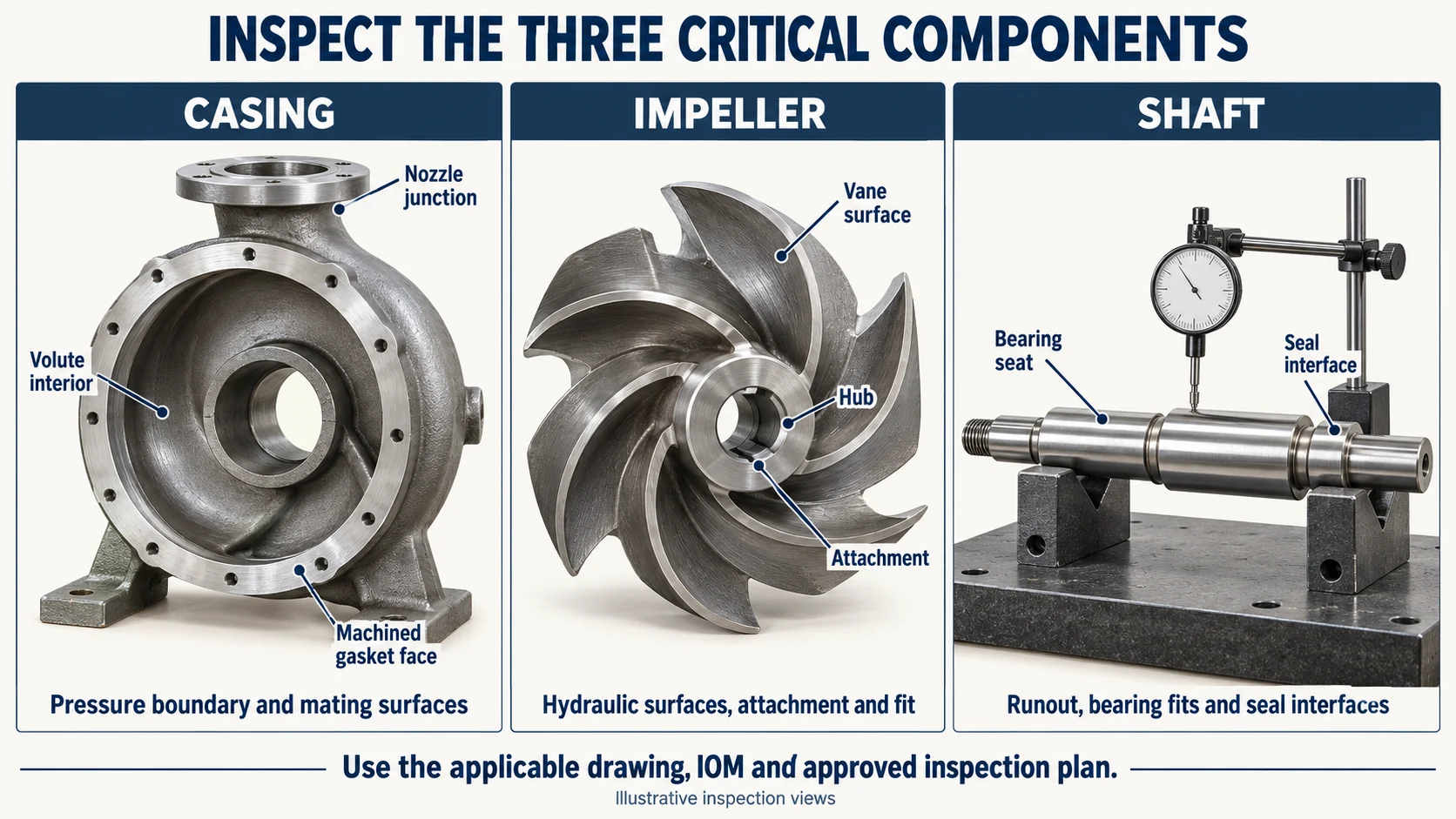
Casing: pressure boundary, corrosion, erosion and mating surfaces
A pump casing damage assessment should establish both the extent of damage and its effect on the required service. Examine accessible internal and external surfaces, the cutwater, nozzle transitions, drain and vent connections, gasket faces, registers and mounting features.
Map localized pitting, erosion, suspected cracking and evidence of leakage. Where the inspection plan calls for thickness measurements or nondestructive examination, record the locations, method and results. Compare remaining dimensions with the approved basis for that casing and duty.
Place a casing with an unresolved crack indication or uncertain remaining pressure-boundary section on Hold for engineering review. A pressure test alone does not establish the remaining service life or explain an active damage mechanism.
For a proposed repair, define how pressure integrity, mating geometry and material suitability will be restored and verified. Include any required post-repair examination and pressure testing in the approved scope.
Impeller: damage, geometry, fit and balance requirements
Pump impeller inspection criteria should cover the hydraulic surfaces and the features that locate and secure the component. Examine vanes, vane edges, the eye, hub, attachment features and front or rear working surfaces as applicable.
Record wear, deformation, rubbing, deposits and suspected cracks. Check the actual trim and relevant geometry against approved records. Inspect threads, bores or keyways according to the installed design. Evaluate whether the specified assembly clearances can still be achieved.
A repair proposal should identify how it preserves the required geometry, fit and hydraulic suitability. If machining or material restoration is proposed, define the required final dimensional inspection and balance verification before work begins. Obtain the balance requirement from the approved job documents rather than assigning one grade to every impeller.
Shaft: runout, bearing fits, keyways and seal interfaces
Inspect the shaft at the bearing seats, shoulders, coupling fit, impeller attachment, keyways, threads and seal or sleeve interfaces. Distinguish damage to a replaceable sleeve from damage to the shaft beneath it.
Record runout using the support arrangement, datums, measurement locations and assembly condition required by the drawing or IOM. Measure relevant diameters and fits as well: one acceptable runout result does not establish that every shaft feature is serviceable.
When deciding when to replace a centrifugal pump shaft, consider the applicable replacement requirements, crack findings, dimensional condition and the feasibility of an approved repair. Straightening or restoring a worn seat requires a defined engineering basis, a qualified process where required, and final verification appropriate to the service.
Build a Reuse, Repair or Replace Decision Matrix
Use one row for each finding. A casing with several different defects may need several rows, each tied to the same component identifier. Keep the inspection finding, approved criterion, decision and supporting evidence together.
| Decision | Basis for the decision | Required record |
|---|---|---|
| Reuse | Required inspections establish compliance with the applicable acceptance criteria. | Measurements, criterion references and authorized release. |
| Repair | An approved repair scope can restore the required condition and includes a method to verify the result. | Repair approval, procedure and final inspection or test records. |
| Replace | A mandatory replacement criterion applies, or an acceptable repair cannot be justified technically or commercially. | Rejection basis and a defined replacement specification. |
| Hold | Evidence, acceptance criteria, damage assessment or approval remains unresolved. | Outstanding question, responsible person and next action. |
Conditions requiring further engineering review
Escalate unresolved crack indications, uncertain pressure-boundary integrity, unknown materials, undocumented previous repairs and damage that may affect structural or hydraulic function. Conflicting drawings or measurements also need resolution.
Hold is a useful disposition when it states what must happen next. “Await review” is incomplete. “Confirm material identity and obtain an approved casing repair assessment; owner: reliability engineer” gives the team an actionable requirement.
Documenting repair feasibility and acceptance criteria
Before authorizing repair, record the affected feature, proposed process, material requirements, final geometry, required examination and acceptance source. Identify who approves the repair and who releases the completed component.
Keep the initial disposition separate from final release. Selecting Repair authorizes the defined work; it does not establish that the finished component passed inspection. Close the row only after the required evidence and approval are recorded.
Illustrative workflow: an impeller has worn vanes and an acceptable attachment fit. Record both findings separately. If the vane criterion is unavailable, the impeller remains on Hold while that requirement is established. The acceptable fit does not resolve the vane assessment. This example describes a decision process, without prescribing a wear limit.
When a replacement component becomes the preferred option
For centrifugal pump repair vs replacement, compare the complete paths: repair preparation, specialist work, inspection, testing, transport, delivery uncertainty and the consequences of unsuccessful repair. Compare these with the documented scope and delivery commitment for a replacement.
Keep technical acceptability as a prerequisite. A lower repair quotation cannot compensate for an unresolved acceptance basis. Where repeated damage suggests a duty or material problem, review that cause alongside the parts decision so the next component is specified for the actual service.
Verify Replacement Parts Before Reassembly
Goulds 3196 and Durco Mark III configuration identification
Record the exact pump family, size, frame or group and installed arrangement. Include the impeller design, seal arrangement and any previous conversion. Brand and nominal size alone provide insufficient detail for an individual parts order.
Flowserve's Durco Mark 3 product information describes several configurations, including low-flow, self-priming and recessed-impeller designs. Identify the installed version and use its applicable instructions when defining the replacement scope.
Use the OEM Part Number Cross-Reference to support identification, then verify the result against the actual equipment and available documents.
Material and dimensional documentation
Specify the component material grade, applicable drawing and revision, critical interfaces and required traceability. State whether the quotation covers a casting, a finished machined component or an assembly. Clarify included gaskets, sleeves and other associated items.
If the failed original is supplied as a sample, identify worn areas and previous repairs. Agree on how the supplier will establish the required nominal dimensions rather than reproduce the damage.
Inspection and testing requirements
Define required dimensional records, material documentation, nondestructive examination, balance verification and pressure or performance testing according to the component and purchase scope. Agree on acceptance criteria and any witness or review points before placing the order.
For the detailed incoming inspection workflow, use How to Verify ANSI Pump Replacement Parts Before Installation. Link its acceptance records to the overhaul matrix so the original rejection and the replacement's release remain traceable.
Prepare an Engineering-Ready Parts RFQ
Information needed for casing, impeller and shaft quotations
Provide the pump model, size, frame or group, equipment tag, nameplate photograph, OEM part number where available, material and quantity. Include operating duty, the required delivery date and available drawings.
Add component-specific information:
- Casing: damage map, pressure and temperature basis, flange and connection details, mating interfaces, material and required inspection scope.
- Impeller: installed design, trim or diameter, rotation, attachment details, relevant curve and speed, damage photographs and required balance documentation.
- Shaft: drawing or dimensional sketch with datums, bearing and coupling fits, seal or sleeve arrangement, attachment details and runout report where available.
Required drawings, photographs and inspection records
Attach the completed matrix, marked photographs, measurement reports, available drawings and approved disposition. Identify missing information explicitly. Ask the supplier to list assumptions, exclusions, proposed deviations and included quality documents in the quotation.
The Aftermarket Solutions page provides a starting point for discussing the required component or assembly scope.
Request a Casing, Impeller or Shaft Replacement Review
Send your pump model, size, component photographs, OEM part number, material requirement and available drawings. Include the as-found inspection findings and required delivery date so the replacement scope can be reviewed against the installed equipment.
Request a Casing, Impeller or Shaft Replacement Review
Frequently Asked Questions
Can a pump casing be reused if it has visible pitting?
The decision depends on the applicable criteria, damage location and extent, remaining section, material and service. Document the assessment and obtain the required approval. Appearance alone cannot establish acceptability.
Does balancing make a damaged impeller acceptable for reuse?
Balance verification addresses the specified unbalance requirement. Geometry, attachment integrity, damage acceptance and hydraulic suitability also need to meet their applicable requirements.
What should I do when the shaft acceptance limit is missing?
Record the measured condition and place the shaft on Hold. Obtain the applicable drawing, IOM requirement or approved engineering criterion before disposition and release.
Does the overhaul matrix contain standard repair limits?
The template leaves acceptance criteria and decisions blank. Enter the approved requirements for the exact equipment, including source and revision. Use the Excel matrix for editable records or the PDF worksheet for a printed inspection meeting.
ANSI Pumps Pro is an independent aftermarket supplier. Third-party names and model designations identify installed equipment and replacement references; they do not imply OEM manufacture or authorization.