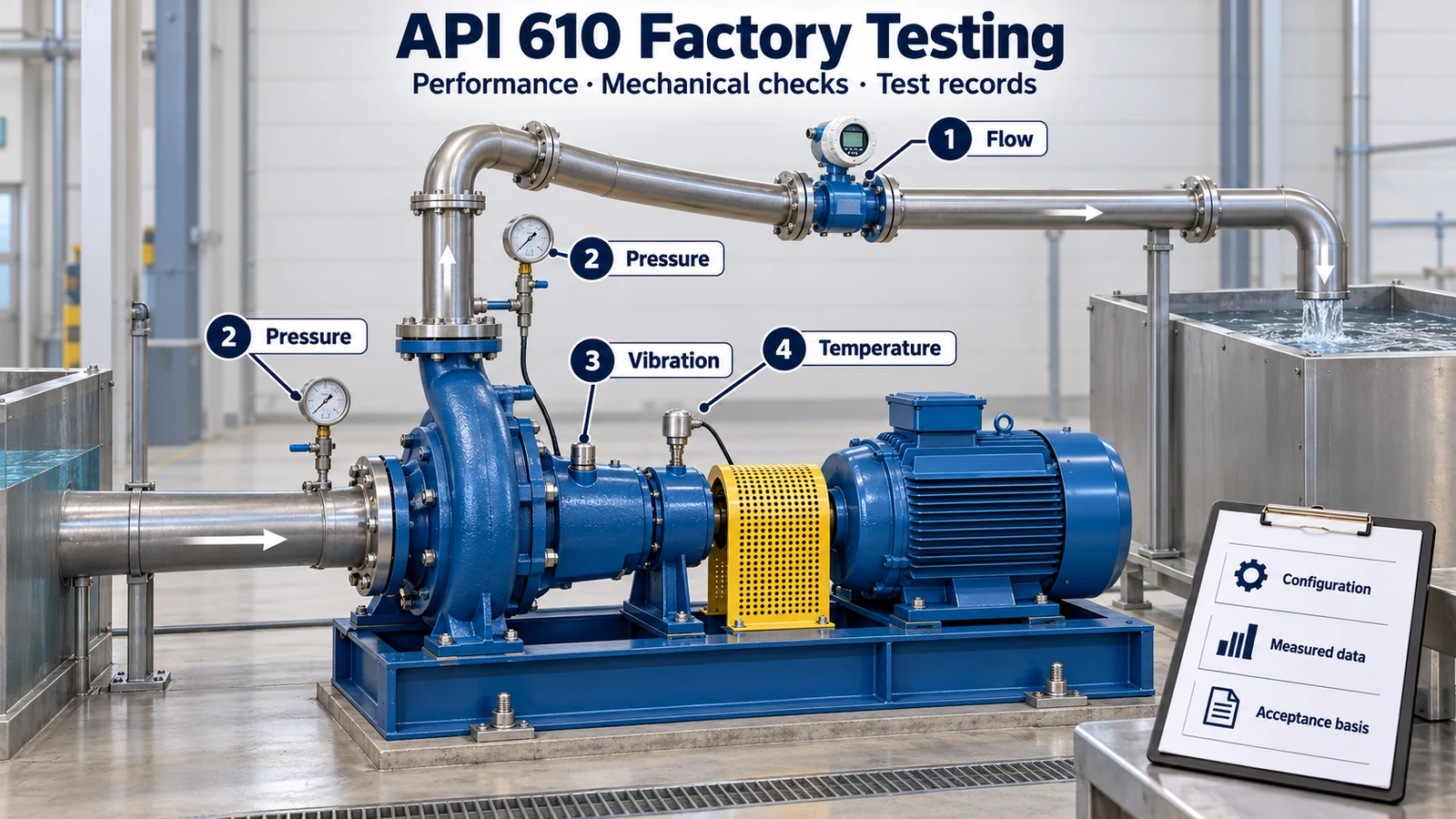
An API 610 pump performance test measures flow, head and the specified power or efficiency for an identified pump configuration. Review the measured points, corrected curve and agreed acceptance criteria, then use the FAT checklist to complete pressure, mechanical, NPSH and release checks.
Performance test: review the measurements and flow schedule
Confirm the contract configuration and test instruments before running. Record the actual impeller, stages, rotation, test speed, liquid temperature/density and bearing/seal arrangement. Link every instrument to its calibration record and the applicable uncertainty basis.
| Flow region | What the approved schedule should resolve | What the report should show |
|---|---|---|
| Shutoff | Whether required, permitted duration and measurements applicable at shutoff. | Head, speed and the specified recorded quantities; identify excluded readings. |
| Minimum stable / lower operating region | Required minimum stable point and intermediate flow points. | Actual flow, head, power and applicable mechanical observations. |
| Preferred-region minimum | Required lower POR point and any points toward rated duty. | The declared region boundary and measurements at the required locations. |
| Near rated flow | Required points bracketing the guarantee condition and permitted positioning. | Measured points supporting the corrected rated-duty result. |
| Upper POR / AOR | Required endpoints, intermediate points and test-stand constraints. | Upper-range behavior and documented limitations or deviations. |
List target flows, positioning tolerance, point spacing, speed tolerance and measurement requirements in the procedure. Reconcile missing points with an approved disposition. A curve image alone leaves the underlying measurements and corrections difficult to audit.
Record suction and discharge pressure/elevation references and any velocity-head correction used for total head. Identify whether power is measured at the shaft or derived from another measurement, including the efficiency assumptions used. Water-to-service-liquid corrections must identify the method and liquid basis.
Acceptance: evaluate the corrected results against the order
Compare each guaranteed quantity with its applicable acceptance rule. Retain measured values, correction inputs, corrected values, applicable tolerance and final disposition in one table. Check head, power, efficiency and NPSH separately when each forms part of the agreed guarantee.
| Quantity | Comparison to record | Common review problem |
|---|---|---|
| Head | Corrected curve at the guarantee flow, plus specified shutoff/curve-shape requirements. | Judging a nearby measured point without the agreed interpolation or correction. |
| Power / efficiency | Specified power or efficiency guarantee, measurement basis and correction method. | Treating every efficiency value as a guaranteed acceptance criterion. |
| NPSH | Specified NPSH3 flow/speed and the agreed acceptance limit. | Using the factory result as an installed-system suction-margin calculation. |
| Vibration / temperatures | Applicable limits, operating region, measurement locations and stable running conditions. | Comparing readings from different locations, directions, speeds or measurement units. |
Illustrative head check: suppose an order explicitly accepts 100 m head at 200 m³/h with a ±3% head band. The head interval is 97–103 m. A corrected head of 98.4 m satisfies that assumed head criterion. Complete the remaining guarantee and mechanical checks before releasing the pump. The example uses an assumed purchase condition, not a reproduced API tolerance table.
Freeze the FAT scope before the purchase order
A factory acceptance test starts with the order. Identify the equipment tag, pump type and configuration, governing API 610 edition, purchaser specification, agreed deviations and inspection/test plan (ITP). Give each test a method, acceptance criterion, witness arrangement and report requirement.
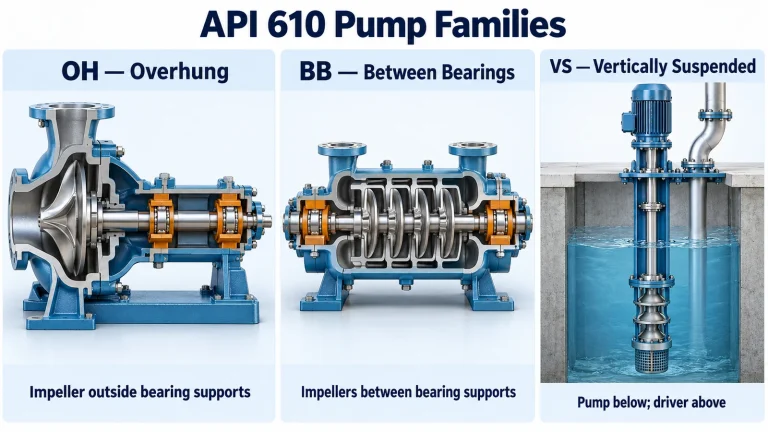
The OH, BB and VS classification guide helps identify the construction being purchased. The API 610 and ASME B73.1 comparison addresses the choice of specification framework. This checklist carries an API pump order from that decision to test release.
| Purchase item | Record before test | Why the record matters |
|---|---|---|
| Configuration | Model/size, serial or order identity, impeller diameter, stages, speed, materials, seal, bearings and supplied auxiliaries. | Connects the results to the unit and package ordered. |
| Guarantee basis | Rated flow/head, speed, liquid properties, power/efficiency guarantees and NPSH requirement where included. | Defines the evaluated duty and corrections. |
| Test selection | Required tests and purchaser-selected tests, durations, sequence and any agreed substitution. | Makes scope, cost and schedule explicit. |
| Acceptance | Edition, clause/table, applicable limits, measurement uncertainty and correction method. | Makes the pass/deviation decision reproducible. |
| Witness and release | Approved procedure, notice period, witness/hold points, signatures and report delivery. | Establishes who can authorize progression and shipment. |
Classify each proposed test against the contractual requirements. Explicitly resolve mechanical running, NPSH, complete-unit, sound, auxiliary-system, resonance and spare-assembly testing in the ITP.
Keep the test purposes distinct
| Test / review | What is being checked | Evidence to retain |
|---|---|---|
| Hydrostatic pressure | Integrity of the defined pressure boundary under the approved pressure-test conditions. | Assembly identity, boundary drawing, pressure, temperature, medium, hold time and leakage result. |
| Hydraulic performance | Measured flow, head and specified power/efficiency over the required points. | Measured and corrected data, speed, impeller, test liquid and fitted curves. |
| Mechanical observations | Vibration, bearing temperatures, lubrication, seals and abnormal behavior during the defined running scope. | Locations, directions, flow/speed, spectra where required, temperature trend and leakage observations. |
| NPSH test | Pump suction performance and the specified head-drop criterion under controlled test conditions. | Flow, speed, NPSH datum, head-drop data and the agreed acceptance result. |
| Additional package tests | Specified driver/gear/auxiliary operation, acoustics, resonance or complete-unit behavior. | Tested configuration, conditions, measurements and agreed limits. |
ANSI/HI 14.6 supplies a hydraulic test framework when invoked by the purchase documents. The HI 14.6 acceptance-grade guide explains grade structures and report interpretation; the API order must also address its mechanical and purchaser requirements.
Hydrostatic test: define the boundary and hold conditions
- Identify the pressure boundary. Mark casing parts, joints, nozzles, plugs and included connections. Identify separately tested jackets or auxiliary passages.
- Verify the pressure basis. Record MAWP/design conditions, material and temperature basis, required test pressure and the governing requirement.
- Approve the assembly. Confirm joint/gasket configuration, temporary closures, test connections and the treatment of mechanical seals and accessories.
- Control the test medium. Record water or other approved medium, temperature, material-specific chemistry requirements, filling/venting and instrument identification.
- Record the result. Retain the pressure and duration record, leakage/seepage observations, witness decision and drying/preservation instructions.
Put pressure, hold time and medium limits into the approved procedure as explicit fields. A flange rating or a valve-test standard alone does not establish the pump-casing test requirement. Resolve accessory ratings and the test boundary before pressurization.
Mechanical run and API 610 vibration limits
Use the agreed running scope to observe bearing temperatures, lubrication, seal condition and vibration. Define the flow, speed, duration and thermal-stability criterion before testing. Record ambient temperature and the relevant bearing/oil temperatures over time so the stabilization decision can be checked.
- Identify bearing-housing and shaft-probe measurement points separately, with direction and measurement units.
- Retain overall vibration and the specified frequency information at the required operating points.
- Verify oil-system pressure/temperature and cooling conditions against the approved limits.
- Record seal leakage, abnormal noise, visible oil leakage and any protective-device checks included in scope.
- For complete-unit testing, identify the actual driver, coupling, gear, baseplate and auxiliary equipment tested.
Acceptance values depend on the pump arrangement and the applicable contractual criteria. Keep housing velocity and shaft displacement results with their own units and limits; the factory baseline should remain traceable to its operating condition.
For an API 610 vibration-limit review, record the governing requirement, pump arrangement, speed, operating region and measurement location beside each result. The HI 9.6.4 vibration measurement guide supplies additional measurement context. Apply the acceptance criteria named by the API order when judging its pump.
NPSH3 test: separate pump performance from site margin
NPSH3 identifies the available suction head at which the measured pump head has fallen by 3% under the test definition; multistage evaluation uses the first-stage head basis. Record flow, speed, reference datum and the head-drop measurement method. Confirm which flows require testing and how the result is compared with the guarantee.
Installed NPSHA comes from the system: source pressure, liquid level, vapor pressure, suction losses and the pump datum. The purchaser evaluates the required margin using the operating cases and project criteria. A satisfactory factory NPSH3 result is one input to that system review.
Changes, retests and final release
Record every change after the initial run: impeller trim, hydraulic modification, seal disturbance, bearing work or replacement of a tested assembly. The disposition should state which results remain applicable and which inspections or tests must be repeated under the contractual rules.
| Release stage | Required record |
|---|---|
| Configuration after changes | Final impeller diameter, stages, speed and final component/assembly identity. |
| Retest decision | Change description, applicable requirement, technical disposition and purchaser approval where required. |
| Final dossier | Certified curves, test sheets, specified calibration/uncertainty evidence, material records and closed deviations. |
| Shipment preparation | Drain/dry/preserve instructions, preservation record, protective covers and release authorization. |
Keep a distinct decision for test acceptance and shipment release. Close outstanding deviations, identify the final as-tested configuration and retain the approved preservation and shipping record.
Use the checklist for an RFQ or an existing FAT report
API 610 factory acceptance worksheet
For the equipment route, use the API 610 engineering hub or the new-project OH2 page.
Frequently asked questions
What does an API 610 pump performance test verify?
It records flow, head and the specified power or efficiency data for an identified pump configuration under defined test conditions. Measured and corrected results are compared with the contractual guarantee and acceptance criteria.
What should an API 610 pump FAT include?
The ITP should identify the configuration, contractual edition and specification, selected tests, guarantees, criteria, instruments, witness points and reports. Record hydraulic performance, pressure testing and mechanical observations within the applicable scope.
Does a hydrostatic test prove pump efficiency?
A hydrostatic test evaluates the defined pressure boundary. Flow, head and efficiency are evaluated through performance measurements under the agreed procedure.
Does every order require a four-hour run?
Resolve the mechanical-running duration and scope against the contractual edition and purchaser specification, then state them explicitly in the approved ITP.
Is NPSH3 the available site suction margin?
NPSH3 is a pump test result associated with a 3% head drop. Site margin also requires the installed-system NPSHA and the project’s margin criteria.
Must a pump be retested after an impeller trim?
Document the change and apply the retest rules in the contractual edition and approved procedure. Retain the original/final diameter, engineering basis and acceptance decision.