
Set the acceptance basis before the test
A useful FAT begins with an agreed duty point, acceptance basis, test scope and reporting requirement. The test should verify the pump that was specified—not redefine the requirement after the data are produced.
Specify Before PO
- Duty point: flow, head and speed.
- Applicable ANSI/HI edition and acceptance grade.
- Performance, NPSH3 and hydrostatic scope as required.
- Witness and documentation requirements.
Verify During FAT
- Pump identity and configuration.
- Impeller, test speed and test-fluid conditions.
- Measured flow, head and specified power/efficiency data.
- Corrections, deviations and final report.
Do Not Assume
- ASME B73.1 fit is not hydraulic acceptance.
- Factory FAT is not field commissioning.
- NPSH3 is not the installed-system NPSH margin.
- A grade name alone is not a complete RFQ requirement.
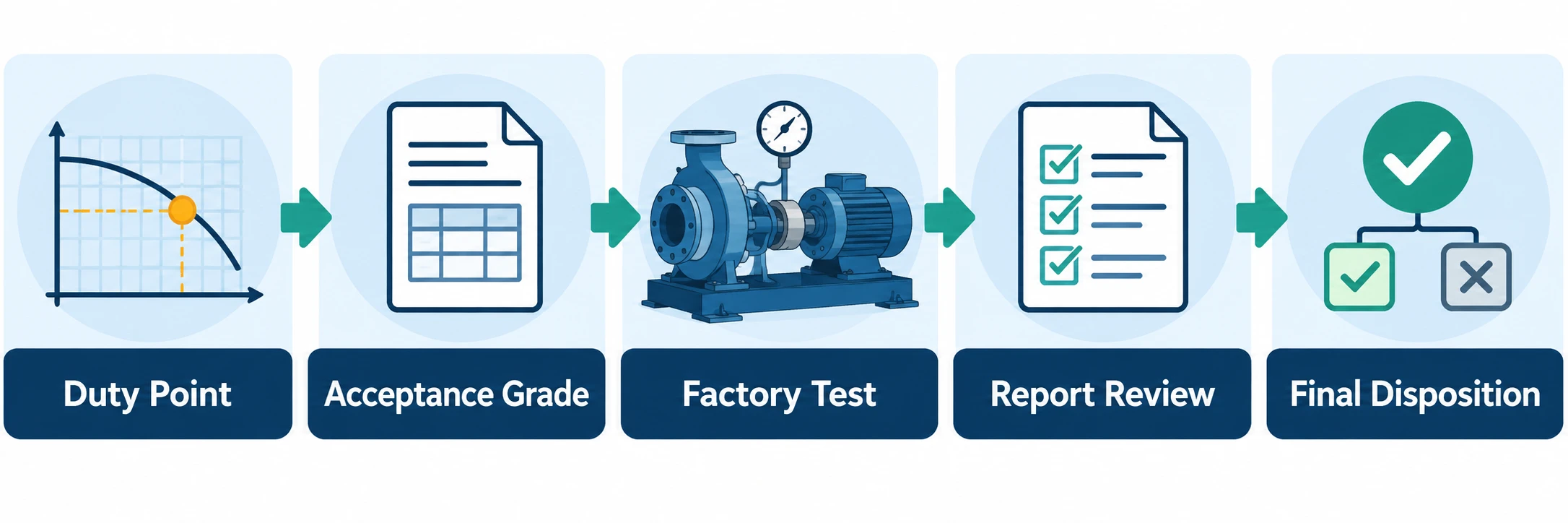
ANSI/HI 14.6 Pump Acceptance Workflow
A buyer can reduce most test-day disputes by defining the acceptance basis before manufacture. The workflow below keeps the duty point, test scope and final disposition connected.
What ANSI/HI 14.6-2022 Covers
ANSI/HI 14.6 addresses rotodynamic-pump acceptance testing, including hydraulic performance-test methods, acceptance grades, NPSH testing, measurement and reporting requirements, and related test procedures. It is primarily a controlled test-facility standard; site commissioning normally has different measurement constraints.
Typical Factory Test Topics
- Flow and total head
- Specified power / efficiency data
- NPSH3 when included in scope
- Hydrostatic testing where applicable
- Measurement, correction and reporting
Not the Same Question
- ASME B73.1 dimensional interchangeability
- Installed-system NPSH margin
- Field commissioning accuracy
- Operating-region suitability
- Project-specific owner acceptance requirements
Six ANSI/HI 14.6 Acceptance Grade Structures
The 2022 standard uses six named grade structures. The grade name identifies an acceptance framework; it does not by itself define the complete purchase requirement. Exact tolerances must be read from the applicable standard tables and project conditions.
| Grade | Structure | Practical buyer interpretation |
|---|---|---|
| 1B | Grade 1 — bilateral | Tighter bilateral acceptance around the specified guarantee basis. |
| 1E | Grade 1 — energy-related | Energy / efficiency-focused acceptance structure; verify exact project criteria. |
| 1U | Grade 1 — unilateral | One-sided acceptance structure intended for defined project needs. |
| 2B | Grade 2 — bilateral | Broader bilateral acceptance than Grade 1; suitability is project-dependent. |
| 2U | Grade 2 — unilateral | Broader one-sided acceptance structure for agreed applications. |
| 3B | Grade 3 — bilateral | Grade 3 bilateral acceptance structure for applicable pump/test scopes. |
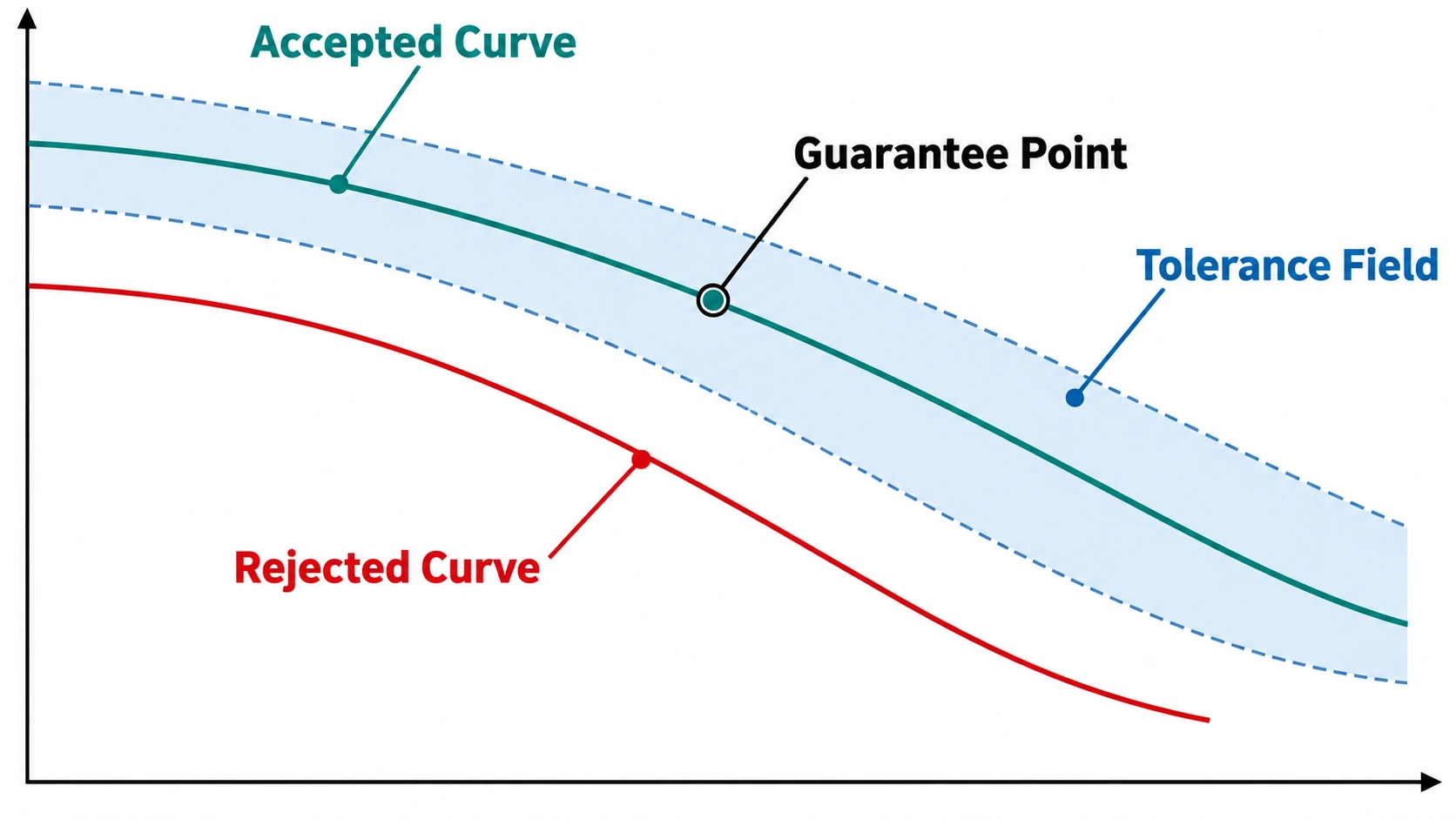
Guarantee Point and Tolerance Field: Think in Terms of an Acceptance Region
The measured curve does not need to pass through a single mathematical point exactly. Acceptance is evaluated against the applicable tolerance structure around the guarantee point. The concept diagram below illustrates the logic without reproducing proprietary standard-table values.
ASME B73.1 and ANSI/HI 14.6 Answer Different Questions
ASME B73.1 deals with the design and dimensional framework for applicable horizontal end-suction chemical-process pumps. ANSI/HI 14.6 addresses hydraulic acceptance testing. A pump can fit the piping and base arrangement yet still require a documented hydraulic acceptance basis.
ASME B73.1
- Mechanical / dimensional specification
- External installation interfaces
- Applicable process-pump design requirements
- Replacement fit does not prove hydraulic equivalence
ANSI/HI 14.6
- Hydraulic acceptance-test framework
- Guarantee point and grade basis
- Measurement and reporting
- NPSH / related test scope when specified
Define the FAT Scope in the RFQ or Purchase Order
| RFQ item | What to define | Why it matters |
|---|---|---|
| Standard / edition | ANSI/HI 14.6-2022 or the project-specified edition. | Prevents different acceptance tables or procedures being applied later. |
| Guarantee point | Required Q, H and operating speed. | Provides the hydraulic basis for acceptance. |
| Acceptance grade | Agreed grade and any owner-specific criteria. | Defines how the measured results are evaluated. |
| Test scope | Performance, NPSH3, hydrostatic or additional tests as applicable. | Controls cost, schedule and the evidence produced. |
| Witness / hold points | Witnessed, reviewed, or report-only. | Avoids test-day approval disputes. |
| Report package | Curve, raw/processed data, corrections, calibration records or other agreed documents. | Defines what the buyer can audit after the test. |
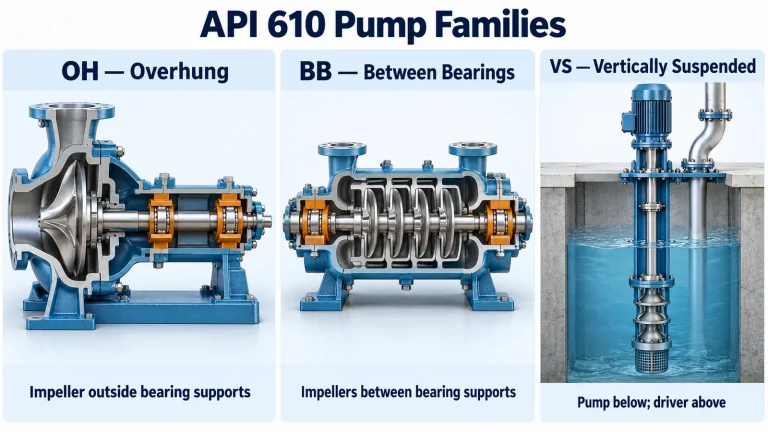
API 610 orders: complete the package review
When the order invokes API 610, connect hydraulic acceptance with mechanical requirements, witness points, deviations and package release.
What a Pump FAT Report Should Let You Verify
| Check | Buyer question |
|---|---|
| Pump identity | Is the tested unit the same model, size and configuration ordered? |
| Impeller / configuration | Does the report identify the installed impeller or controlling configuration? |
| Test speed | Was speed measured and, if corrected, is the correction basis documented? |
| Measured hydraulic data | Are flow and head points sufficient to evaluate the guarantee condition? |
| Power / efficiency | Are these included when they are part of the agreed acceptance scope? |
| NPSH3 | If specified, is the NPSH result clearly separated from installed-system margin? |
| Instrumentation / calibration | Can the report identify the measurement basis and required calibration evidence? |
| Disposition | Does the report state pass, deviation, agreed concession or retest? |
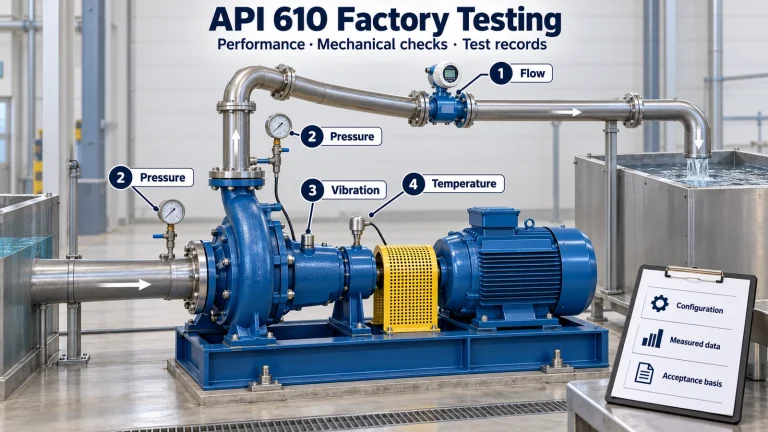
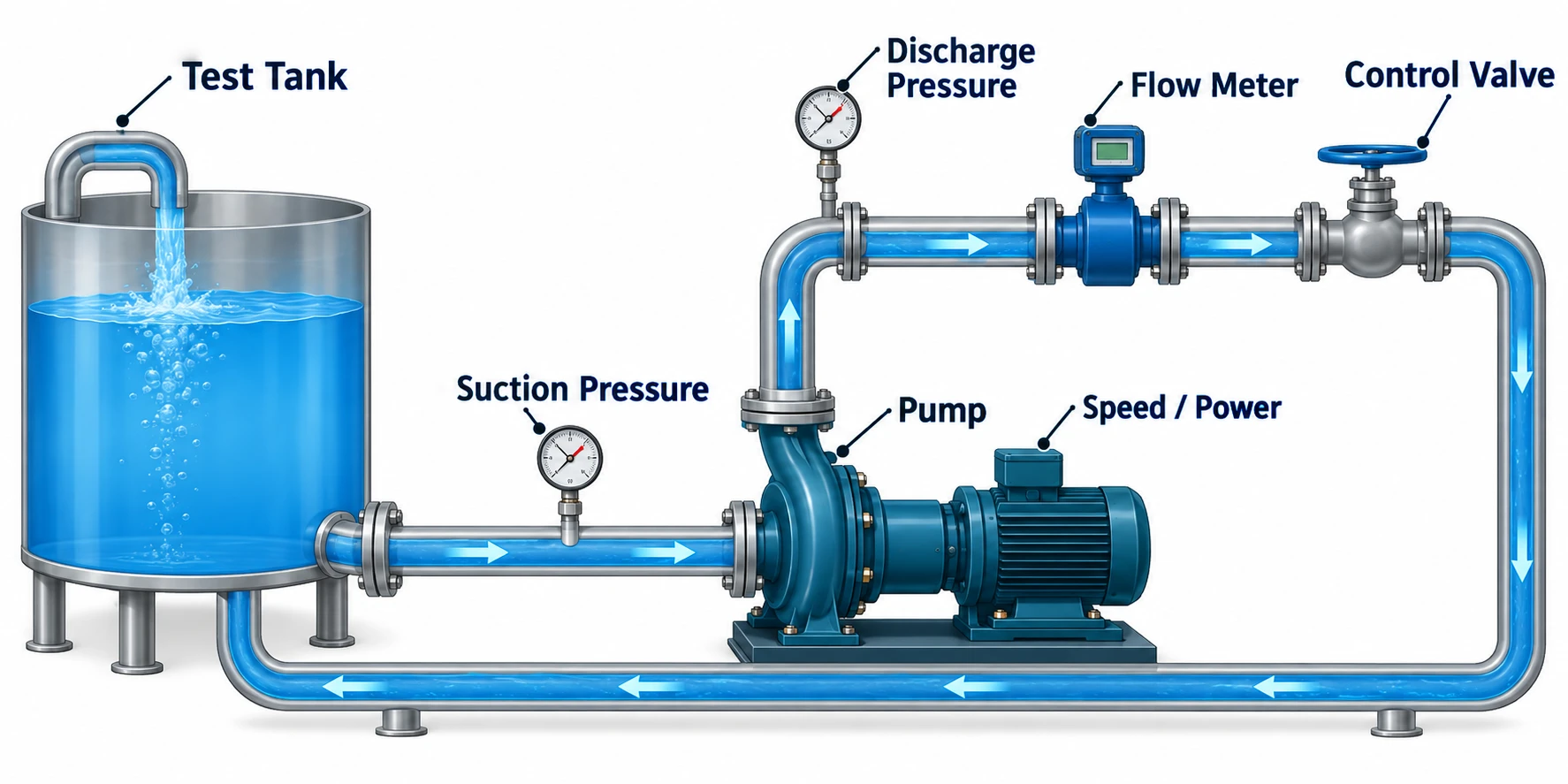
Factory Pump Test Loop: What Is Being Measured?
The exact arrangement depends on the test facility and measurement method. From a buyer’s perspective, the important point is that the report connects the pump, the test fluid, speed, pressure/head measurement, flow measurement, power measurement and recorded data.
Speed Correction: Useful Engineering Relationship, Not Unlimited Curve Scaling
Affinity-law relationships are commonly used to understand how flow, head and power change with speed for similar pump conditions. Any formal test-result correction still needs to follow the limits and method permitted by the applicable test procedure.
Q = flow; H = head; P = power; N = rotational speed.
These relationships explain the engineering trend. Any formal test-result correction must follow the applicable procedure and project specification.
NPSH3 Test Result Is Not the Same as Installed-System NPSH Margin
A factory NPSH3 result is a pump test result under defined test conditions. The margin available in the real system also depends on suction-side system conditions, liquid properties, operating range and the project’s margin philosophy. Do not convert one number into a universal installed-system margin rule.
Hydraulic Equivalence Is More Than Dimensional Fit
When replacing an existing ANSI process pump, dimensional compatibility helps the new unit fit the installation, but hydraulic acceptance still requires an agreed duty and performance basis. This matters for Goulds 3196 and Durco Mark III replacement projects where the buyer wants both mechanical fit and a defensible performance match.
| Replacement check | Evidence to review |
|---|---|
| Existing duty | Required flow/head, operating range and current system information. |
| Reference curve | Existing pump curve or approved duty/selection record. |
| Impeller / speed | Proposed diameter, speed and configuration used for the replacement selection. |
| Power | Driver suitability across the agreed operating window. |
| NPSH | Pump NPSH data plus the installed-system suction conditions. |
| FAT basis | Guarantee point, acceptance grade and report requirements defined before test. |
Review Pump Performance Curves →
Review the Goulds 3196 replacement resource →
Review the Durco Mark III replacement resource →
Factory Acceptance and Field Commissioning Are Different Verification Layers
Factory Acceptance Test
Controlled facility, defined instrumentation, agreed standard/test scope, documented acceptance basis and report.
Field Commissioning
Installed system, real piping and process conditions, site instrumentation and operational constraints. Use site data to verify system performance—not to casually reapply factory tolerances.
Two Ways to Start
I Am Preparing an RFQ
Send the duty point, pump type, required test scope and any owner acceptance requirement. We can help organize the performance-test requirements before quotation.
I Already Have a FAT Report
Send the test curve, FAT sheet, nameplate or existing pump curve. Start with what you have; the goal is to identify what the report proves and what still needs clarification.
Related engineering references: ANSI/HI 40.6 efficiency testing and its separate test scope.
Frequently Asked Questions
Does ANSI/HI 14.6-2022 define only three acceptance grades?
No. The 2022 edition uses six named grade structures: 1B, 1E, 1U, 2B, 2U and 3B. The exact tolerances for the selected grade should be verified from the licensed standard.
Does ASME B73.1 dimensional interchangeability prove hydraulic equivalence?
No. Mechanical/dimensional compatibility and hydraulic acceptance answer different questions. A replacement pump still needs an agreed duty and performance basis.
Is a factory NPSH3 result the same as my system NPSH margin?
No. NPSH3 is a pump test result. Installed margin depends on the actual suction system, liquid, operating range and project margin criteria.
Can I apply factory acceptance tolerances directly to field commissioning data?
Not automatically. Factory acceptance testing is performed under controlled measurement conditions. Field commissioning should be evaluated with the site instrumentation, system conditions and project commissioning criteria.
Sources and Standards to Verify
- Hydraulic Institute — ANSI/HI 14.6-2022 Rotodynamic Pumps for Hydraulic Performance Acceptance Tests.
- Hydraulic Institute — ANSI/HI 14.6-2022 published table of contents / index for grade and test-scope structure.
- ANSI Standards Store — ANSI/HI 14.6-2022 scope and publication information.
- ASME — B73.1 Specification for Horizontal End Suction Centrifugal Pumps for Chemical Process.
For contractual tolerance values and mandatory procedures, use the licensed standard and the project specification rather than a secondary summary.