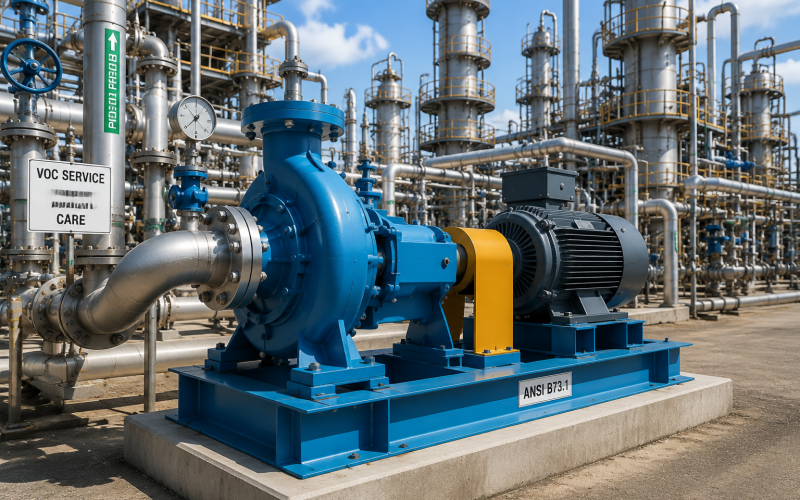
There is no universal “VOC-compliant pump.”
ASME B73.1 defines a pump design and selected dimensional interfaces. Facility emissions obligations depend on the applicable rule or permit, the complete seal system, the process duty, and the site’s monitoring and maintenance program.
For a VOC-containing service, define the facility’s containment objective first. Then verify the pump, seal arrangement, materials, operating conditions, and documentation against the actual service and applicable leak detection and repair (LDAR) requirements.
Start with the applicable VOC and LDAR requirements
“VOC service” is not one universal regulatory category. Requirements can differ by process unit, fluid service, facility permit, federal rule, and state or local program. EPA Method 21 describes a method for detecting VOC leaks from process equipment; the leak definition and monitoring obligations come from the applicable rule or permit. Method 21 readings are not, by themselves, a direct measurement of a component’s mass emission rate.
Identify the rule
Confirm the applicable rule, permit condition, and facility LDAR procedure.
Classify the service
Check the fluid and equipment definitions used by that requirement.
Set the target
Document leak definition, monitoring, repair, and recordkeeping duties.
Select the system
Review pump, seal, support system, monitoring access, and leak routing.
Record evidence
Keep the approved basis, inspection records, and operating requirements together.
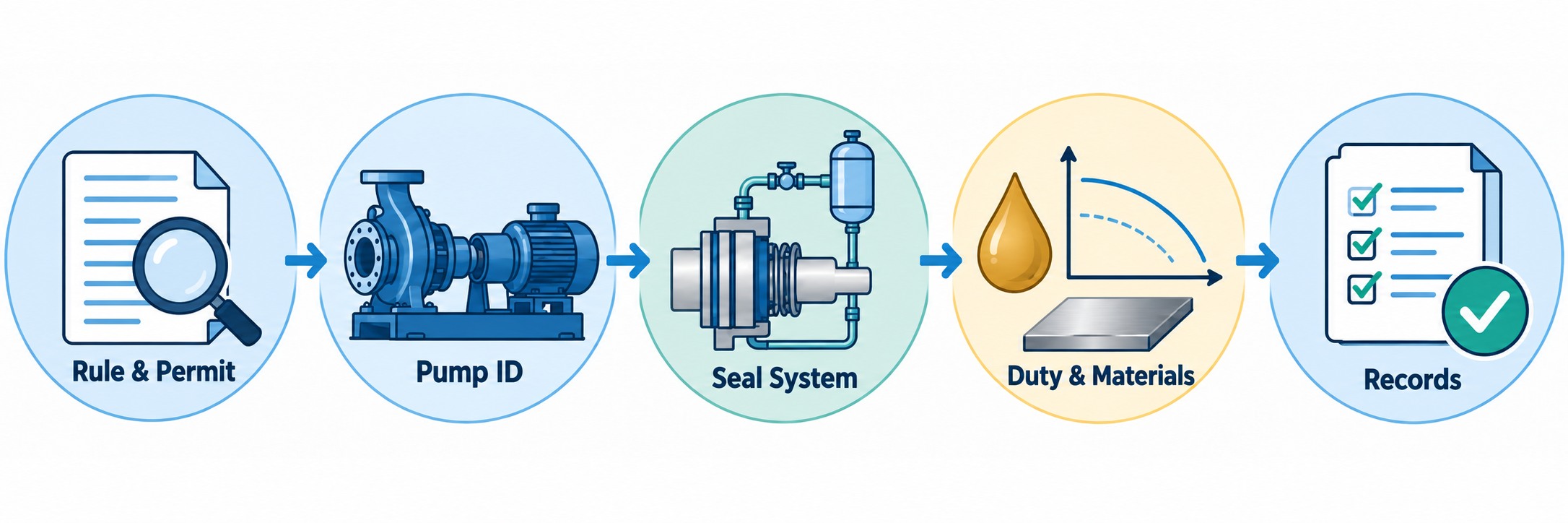
Before specifying equipment, have the facility’s environmental or process-compliance lead confirm the applicable requirements, service classification, monitoring and repair rules, and whether any exception applies.
Regulatory example—not a universal pump specification
40 CFR § 60.482-2 contains requirements for certain pumps in light-liquid service and describes conditions associated with specific dual-mechanical-seal and closed-vent-system provisions. These provisions are not a blanket requirement or exemption for every VOC pump. Confirm the governing subpart and every applicable condition before using them as a design basis.
What ANSI B73.1 does—and does not—establish
ASME B73.1 covers metallic and solid-polymer, horizontal end-suction, single-stage chemical-process pumps of the standard’s specified design. It includes dimensional interchangeability requirements for defined interfaces such as mounting dimensions and nozzle locations. It does not certify a pump for VOC emissions performance or establish that a particular seal arrangement meets a facility’s LDAR obligations.
| Decision | What to verify | What the standard does not prove |
|---|---|---|
| Pump standard and fit | Pump type, size designation, mounting and nozzle interfaces, and installed configuration. | VOC leak rate, seal performance, or regulatory compliance. |
| Seal and emissions control | Seal arrangement, support system, monitoring points, leak destination, and governing rule. | That all B73.1 seal chambers or internal parts are interchangeable. |
| Hydraulics and materials | Pump curve, operating range, wetted materials, and seal materials for the actual fluid. | Hydraulic, material, or service suitability based on dimensions alone. |
A standard dimensional designation does not prove that internal parts, seal chambers, hydraulic performance, materials, or emissions performance are interchangeable. For a replacement pump or component, verify the exact model, size, frame, seal chamber, impeller, materials, and operating duty. See the ANSI process pump range for the applicable pump platform.
Select a sealing arrangement for the rule and the service
The shaft seal is a potential leak path on a conventional centrifugal pump. The appropriate configuration depends on the fluid, pressure, temperature, speed, seal chamber, startup and upset conditions, maintenance practice, and governing emissions requirements. No seal type should be presented as a universal compliance solution.
| Arrangement | Evaluate | Important boundary |
|---|---|---|
| Single mechanical seal | Fluid compatibility, faces and elastomers, chamber geometry, heat removal, vapor pressure, shaft movement, and required leak monitoring. | A mechanical seal can reduce leakage compared with some alternatives, but its presence alone does not establish compliance or a specific emission rate. |
| Dual mechanical seal with barrier-fluid system | Barrier-fluid pressure and condition, circulation, sensors or alarms, leakage detection, fluid destination, inspection, and maintenance duties. | Some rules provide specific provisions when stated conditions are met. Verify each condition; do not assume a general exemption. |
| Seal with closed vent or collection | Collection capacity, routing, backpressure, control-system compatibility, and monitoring and maintenance. | A port or vent connection alone is not evidence that the complete system meets the applicable rule. |
| Sealless pump | Fluid and solids compatibility, temperature and pressure limits, heat management, monitoring, and maintenance capability. | Evaluate the complete technology against the service and rule; it is not a universal drop-in replacement. |
Where the project specifies API 682 or another seal standard, use the edition and arrangement named in the project documents and confirm the seal manufacturer’s application limits. Check chamber, gland, shaft and sleeve dimensions, flush or barrier connections, and instrumentation against the actual pump configuration. A seal that fits the bolt pattern may still be unsuitable for the duty.
For practical examples of seal-related failure causes and checks, see the chemical pump failure troubleshooting guide.
Verify fluid properties, hydraulics, and materials
Do not select wetted materials from the word “VOC” alone. Provide the full fluid composition where available, concentration, contaminants, solids, temperature range, pressure, and cleaning or startup fluids. Review corrosion, erosion, swelling, permeation, and compatibility of metallic and non-metallic parts.
Confirm normal, minimum, maximum, startup, and upset duty. Review flow, differential head, speed, viscosity, vapor pressure, available and required NPSH, motor load, and operating range. A pump that fits dimensionally can still be hydraulically unsuitable or contribute to vibration and seal distress outside its intended range.
Use compatibility charts for screening
The chemical compatibility guide is an initial screening aid, not a substitute for a project-specific materials review. Compatibility depends on actual concentration, temperature, mixture, contaminants, and operating conditions.
Use a documented verification checklist
For a replacement assembly, record exactly what has been reviewed and what remains outside the approved scope. A part-number cross-reference or ANSI dimensional match is a starting point; it does not replace checks of the seal, materials, hydraulics, and regulatory basis.
VOC pump selection FAQ
Does ANSI B73.1 certify a pump for VOC compliance?
No. B73.1 is a pump design and dimensional standard for its defined pump type. VOC emissions obligations depend on the applicable regulations, permit, pump and seal configuration, operating conditions, and facility procedures.
Does installing a mechanical seal make a pump VOC compliant?
No. A mechanical seal is one part of the containment system. Confirm the seal arrangement, materials, support system, monitoring method, and operating conditions against the applicable rule and project requirements.
Is a dual mechanical seal always required for VOC service?
No universal seal arrangement applies to every VOC service. Some regulations describe specific provisions for dual-seal systems when stated conditions are met. Confirm the governing rule and process duty before selecting the arrangement.
Can an ANSI B73.1 pump be replaced by another pump with the same standard size?
The standard provides interchangeability for defined dimensions, but it does not establish universal internal-part, seal-chamber, hydraulic, material, or emissions interchangeability. Verify the actual configuration and duty before approval.
What information is needed for a VOC-service pump review?
Provide the pump nameplate or model and size, process fluid and concentration, flow and head, speed, pressure and temperature range, seal arrangement, applicable facility requirements, and available drawings or photographs.
Technical references
- ASME B73.1 — Specification for Horizontal End Suction Centrifugal Pumps for Chemical Process.
- U.S. EPA Method 21 — Determination of Volatile Organic Compound Leaks.
- 40 CFR § 60.482-2 — Standards for Pumps in Light Liquid Service. Applicability depends on the governing subpart and facility circumstances.
- U.S. EPA — Leak Detection and Repair: A Best Practices Guide.