

ANSI pump compliance is not a single certificate or a claim that a pump “meets ANSI.” A responsible review connects the project duty, applicable standard or specification, pressure boundary, materials, dimensions, performance, safety and traceable inspection records. This 2026 buyer guide helps maintenance engineers and procurement teams define the evidence they should request.

What does compliance mean for an ANSI pump?
Compliance means the supplied pump is evaluated against the requirements that actually apply to the project: design, pressure boundary, materials, dimensions, performance, testing, documentation and site or industry requirements. ASME B73.1 may define important dimensional and design expectations, but it does not make every pump part or hydraulic curve interchangeable.
List the governing project specification and acceptance criteria before comparing quotations.
Separate standard, specification and certificate
A standard describes requirements; a project specification may add requirements; a certificate or report provides evidence for a specific pump. Ask which revision, size, material, test and deviation the document covers.
A generic brochure or a supplier statement without equipment identification is not the same as traceable compliance evidence.

The compliance evidence package
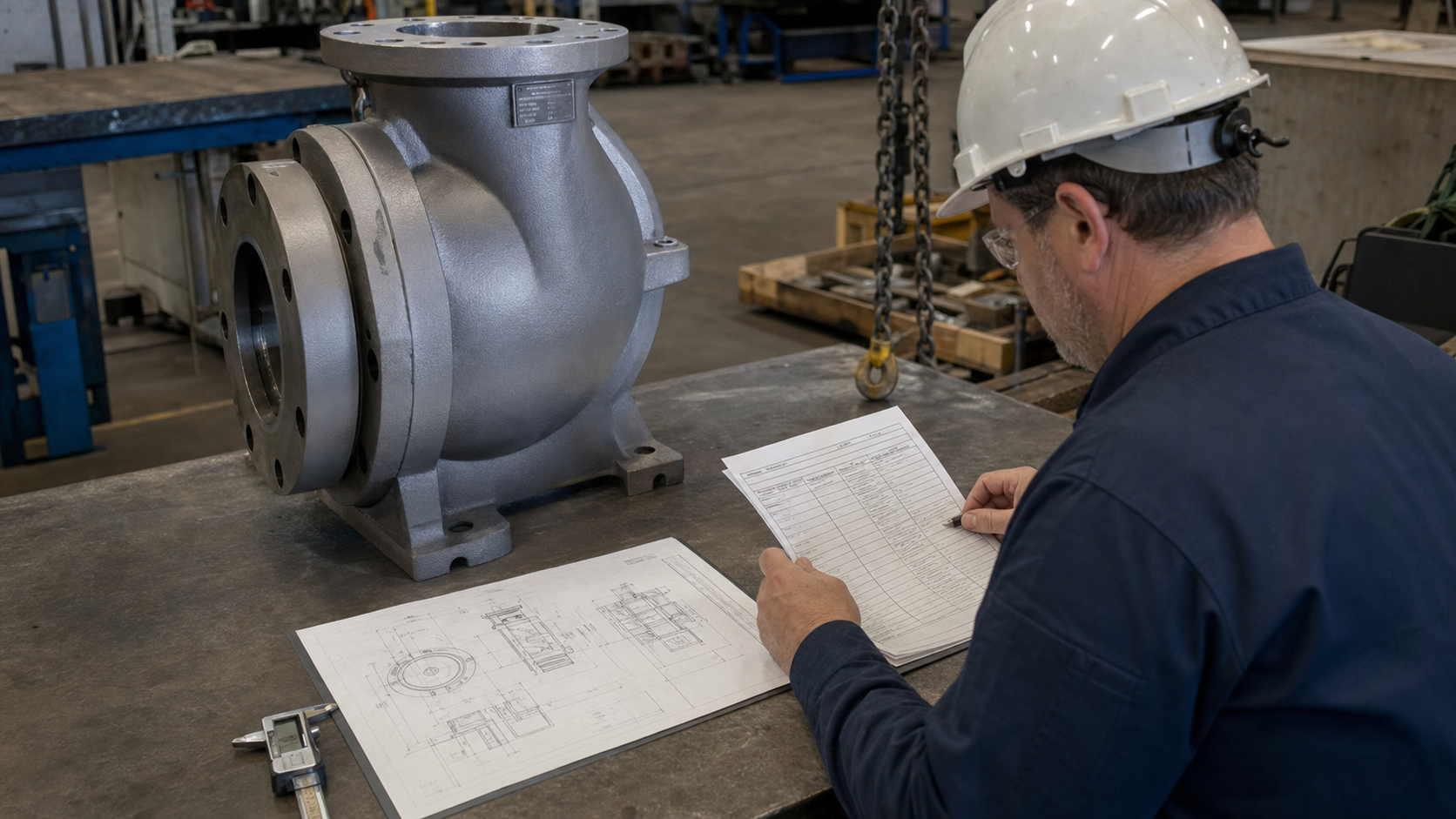
Request an approved or controlled drawing, performance curve, materials list, material certificates or heat-number traceability where required, dimensional inspection, hydrostatic test record, performance test evidence, balance information, seal and bearing details, nameplate data, packing and preservation records and approved deviations.
The exact package should match service criticality and the contract.
Dimensions are only one part of the review
Check flange interfaces, centerline, base, shaft, bearing span, seal chamber, impeller, coupling, motor interface, materials, pressure rating, speed, temperature and duty. A dimensionally similar pump can still be hydraulically or mechanically unsuitable.
For replacement parts, identify the exact model, size, group, frame, shaft arrangement, impeller trim and material.
Compliance checklist
| Area | Buyer evidence |
|---|---|
| Duty | Actual flow, head, speed, liquid and operating range |
| Design | Controlled outline, sectional and interface drawings |
| Materials | Wetted-parts list, grade and traceability documents |
| Pressure boundary | Hydrostatic procedure, calibrated gauges and result |
| Performance | Curve or test evidence for the quoted configuration |
| Inspection | Dimensional, balance, PMI or other required records |
| Exceptions | Approved deviations and clear scope of equivalence |
How to handle deviations
A deviation should identify the requirement, proposed alternative, technical basis, risk, affected parts, approval authority and whether it changes interchangeability or service limits. Do not hide deviations in a general note or treat them as automatically acceptable.
2026 compliance review workflow
- List the service, duty and consequence of failure.
- Identify the applicable standards, project specifications and revision.
- Request the controlled drawing and materials package.
- Define pressure, performance and dimensional acceptance tests.
- Review deviations before manufacture or shipment.
- Match records to the final nameplate and serial or heat traceability.
When to request a technical review
Request review when standards conflict, the project uses an older installed pump, a supplier claims interchangeability, materials change, the pump handles hazardous service, or documents do not identify the exact supplied configuration. A technical review can define what is compliant, what is equivalent and what still requires site confirmation.
What to send for a compliance quotation
Send project specification and revision, pump model or drawing, duty point, liquid properties, materials, pressure and temperature, required tests, inspection plan, documentation list, deviations and delivery or site acceptance requirements.
What to send for a useful quotation or review
Include the pump model or drawing, actual duty range, liquid properties, motor data, operating history, photos, inspection records, materials and required documentation. Clear inputs help separate a repair, component replacement, system correction or complete pump selection.
Need help preparing an ANSI pump compliance review?
ANSI Pumps Pro helps buyers compare ANSI process pump duty, materials, fitment, testing and lifecycle support.
Sources and related reading
Use the applicable manufacturer documentation, project specification and site procedures. For general pumping-system guidance, see the U.S. Department of Energy pumping systems resources and the Hydraulic Institute. Final limits and acceptance criteria remain project-specific.
Frequently asked questions
Does ANSI compliance mean every part is interchangeable?
No. Compliance with a standard does not prove that internal parts, hydraulic curves, shafts, bearings, seals or materials are interchangeable. Those require model-specific verification.
What documents should an ANSI pump buyer request?
Request controlled drawings, performance data, materials and traceability records, pressure and performance test records, dimensional inspection, balance details and approved deviations applicable to the exact pump.
Is a supplier certificate enough to prove compliance?
Only when it identifies the exact pump, configuration, standard or specification, revision, tests and acceptance scope. Generic statements are not traceable evidence.
When should deviations be approved?
Review and approve them before manufacture or shipment when possible, with the affected requirement, technical basis, risk and authorization clearly recorded.