What Does “Dimensionally Interchangeable” Mean for a Goulds 3196?
A dimensional fitment review compares the interfaces that must connect in the replacement scope. For a complete pump, that may include installation dimensions and the driver or coupling arrangement. For a wet end or individual component, it means checking the mating geometry against the retained parts and the installed pump configuration.
The phrase “Goulds 3196 replacement” does not identify one universal configuration. Before accepting an interchangeability claim, define what is being replaced, which components will remain, and which drawing or measured installation is the reference.
Keep the claim tied to its evidence
A dimensional match is evidence about the dimensions that were checked. It does not, by itself, establish equal hydraulic performance, material suitability, seal performance, or fit with unverified components.
| Replacement scope | Dimensional review | Reference evidence |
|---|---|---|
| Complete pump | Installation and driver interfaces included in the project scope | Approved outline drawing, site measurements and project specifications |
| Wet end | Casing, cover, impeller, shaft or sleeve, seal area and retained power end | Section drawing, part references and mating-interface measurements |
| Individual part | Part-specific fits and relationships to the components being retained | Part number, drawing revision and inspection report for the supplied part |

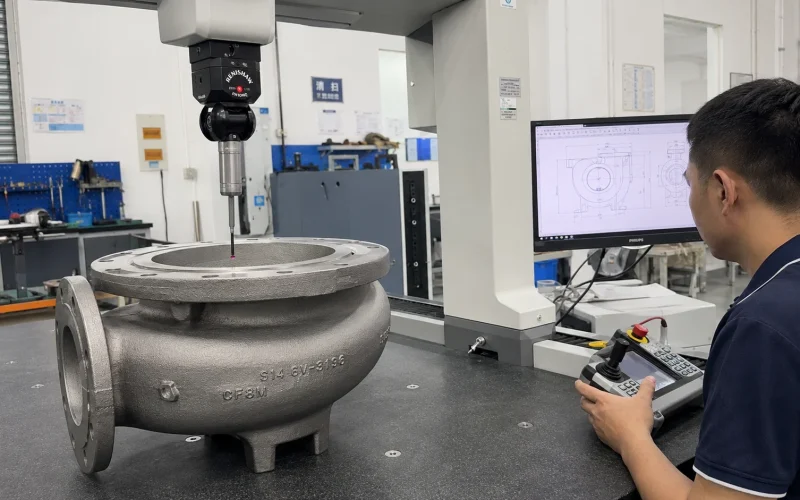
Conceptual dimensional fitment workflow. Use controlled drawings and project criteria; this graphic defines no pump dimensions or tolerances.
What ASME B73.1 Establishes—and What Still Needs Checking
ASME describes B73.1 as a design and specification standard for horizontal end-suction chemical-process pumps. For pumps with the same standard dimension designation, its interchangeability intent covers defined installation relationships, including mounting dimensions, suction and discharge nozzle size and location, input shafts, baseplates and foundation bolt holes. Confirm the applicable designation and project documents for the installation under review.
This standard dimensional basis is not a blanket approval for every internal component or operating condition. A retained shaft, seal chamber, impeller, material specification or hydraulic duty needs its own configuration-specific review. Read the ASME B73.1 scope and the applicable pump documentation together.
Do not turn an interface match into a universal claim
State which dimensions and components were checked, the reference used, and any exclusions. If the replacement claim covers more than dimensional fit, identify the separate hydraulic, material and sealing evidence.
Check the External Dimensions Against the Installed Arrangement
For a complete-pump replacement, compare the proposed outline drawing with the site and the specified connection points. A matching nominal nozzle size alone does not show that the pump will align with the existing piping, baseplate or driver.
| Interface | Compare | Evidence to retain |
|---|---|---|
| Suction and discharge | Nozzle locations and orientation, flange details and mating-pipe arrangement | Approved outline drawing and any required site measurements |
| Mounting and centerline | Pump feet, mounting surfaces, anchor arrangement and shaft-centerline relationship | Drawing dimensions checked against the actual baseplate and installation |
| Driver and coupling | Shaft extension, coupling arrangement, motor position and guard clearance | Pump and driver drawings plus the agreed alignment arrangement |
| Field condition | Previous modifications, baseplate condition, piping support and removal space | Site notes or measurements for conditions not shown on the original drawing |
Record deviations explicitly. If installation changes are accepted, include them in the project scope instead of describing the replacement as an unqualified drop-in.
Verify Internal Fits for the Parts That Will Mate
When replacing a wet end or an individual component, check the proposed part against the parts that will remain in service. A component can appear to assemble and still have a mismatch that affects its position, sealing or operation.
Use the Goulds 3196 frame and power-end guide when frame identification is uncertain. For a specific component, search the OEM part-number cross-reference, then verify the reference against the installed assembly.
Why Seal-Chamber Fit Needs Its Own Review
A seal-chamber name or general style is not enough to establish that an existing mechanical seal can be reused. Review the chamber and gland interfaces alongside the shaft or sleeve and the selected seal’s installation requirements.
| Check | What to confirm |
|---|---|
| Chamber and gland | Bore and depth references, register, bolt pattern and mating-face arrangement on the applicable drawing |
| Shaft-side interface | Shaft or sleeve relationship, seal setting dimensions and the features used by the seal design |
| Auxiliary connections | Port locations, connection details and the piping plan required by the approved seal arrangement |
| Existing seal reuse | Seal manufacturer’s dimensional requirements and compatibility with the complete chamber assembly |
Where the correct chamber variant or drawing revision is unknown, treat seal reuse as unconfirmed until the installed parts and seal data have been identified.
Ask for a Dimensional Report That Can Be Reviewed
A statement such as “100% interchangeable” is difficult to evaluate without a defined scope and measurements. Ask for records that connect the supplied component to its drawing and show how the inspected features were accepted.
Do not substitute one universal tolerance for every feature. Acceptance limits must come from the applicable controlled drawing, specification or approved inspection plan for that component and configuration.
For model-specific maintenance and setting procedures, use the applicable Goulds CV 3196 i-FRAME IOM only when it matches the installed pump variant; confirm the correct manual for other configurations.
Dimensional Fit Is One Part of Replacement Approval
A dimensional report does not establish that the proposed pump will meet the required flow, head, power, NPSH margin or operating range. Review the applicable pump performance curve and duty data separately. Material and seal suitability also depend on the service and configuration.
For the complete replacement decision—including installation, assembly, hydraulics and materials—continue to the Goulds 3196 replacement compatibility guide. When the verified scope points to a replacement platform, review the Goulds 3196 replacement solution and its model-specific documentation.
What to Gather Before Requesting Dimensional Verification
Keep the evidence with the approved scope
Record what was checked, which revision was used, what remains unverified and whether any site modification is part of the plan. This makes the fitment decision reviewable after quotation and during installation.
Goulds 3196 Dimensional Fitment FAQ
Does ASME B73.1 make every Goulds 3196 part interchangeable?
No. ASME describes dimensional interchangeability for pumps with the same standard dimension designation across defined installation relationships. Internal component fit, sealing, materials and hydraulic duty require separate review.
Is matching the pump size enough to confirm a replacement fit?
No. Confirm the installed frame or power-end configuration, part scope, revision and interfaces that must mate. Use the applicable nameplate, drawings, parts references and measurements.
Can I reuse the existing mechanical seal?
Only after confirming the seal’s installation requirements against the chamber, gland, shaft or sleeve and the complete proposed assembly. A chamber name alone does not prove that the seal fits.
What tolerance should I request for a replacement part?
Request the feature-specific acceptance criteria from the applicable controlled drawing, specification or approved inspection plan. There is no single tolerance that applies to every pump feature and configuration.
Does a dimensional match prove the replacement will perform the same?
No. Hydraulic suitability must be checked against the required duty and the proposed pump curve. Dimensional fit and performance are separate approval questions.