There Is No Single Vibration Limit for Every Rotodynamic Pump
A pump vibration value only has meaning when it is tied to the pump arrangement, measurement location, operating condition, test setup and acceptance requirement. ANSI/HI 9.6.4-2022 provides measurement guidance and allowable values for covered rotodynamic pump applications; it does not supply one alarm or shutdown number that can be applied to every pump.
Before comparing a reading with a limit, identify what is being evaluated: a new-equipment acceptance test, a field acceptance test, or an in-service condition-monitoring trend. Those are different engineering questions and should not be treated as interchangeable.
Do not judge a reading by the number alone
First confirm the pump type, test basis, operating point, measurement location and vibration quantity. If any of these are unknown, the reading is not yet ready for a defensible acceptance comparison.
Start With the Pump and Test Condition
Use the applicable licensed standard and the project or purchase specification to identify the acceptance requirement. Gather the following information before selecting a value; do not infer a limit from speed alone.
| Input | What to record | Why it matters |
|---|---|---|
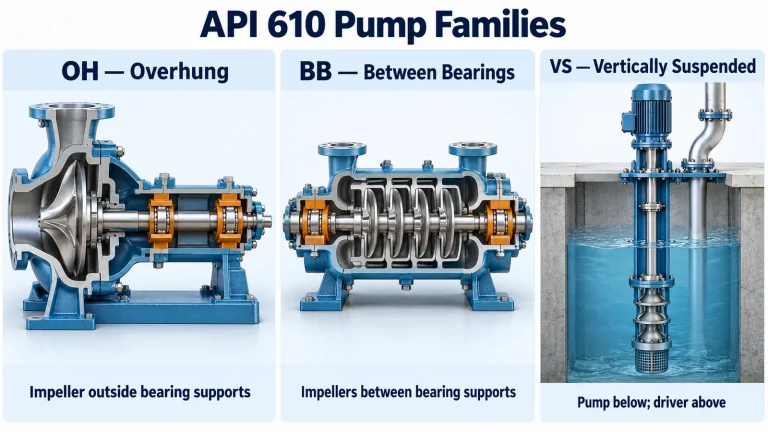
| Pump identity | Pump type, arrangement, model and configuration. | The standard organizes criteria by the covered pump type and measurement arrangement. |
| Test condition | Factory or field test; pump and driver condition; test installation. | Acceptance criteria and test setup are condition-specific. |
| Operating point | Speed, flow and pump power at the measurement condition. | A reading taken at one duty point cannot be assumed to represent another. |
| Measurement | Location, direction, instrument, measured quantity and units. | The acceptance basis must match the physical point and measurement method. |
| Contract basis | Required standard edition, purchase specification, agreed test procedure and report revision. | The contractual requirement determines which criterion the parties agreed to use. |
Then locate the requirement for the identified pump type and test condition in the licensed standard and confirm that the project specification does not add or modify acceptance requirements. ANSI/HI 9.6.4-2022 has a published 2024 erratum; verify that the copy used for a contractual decision includes the correction.
Preferred and allowable operating regions are pump-specific engineering inputs. Use the manufacturer’s declared operating region and the applicable operating-region guidance; do not assume that one percentage band around BEP applies to every pump.
Match the Limit to the Measurement Method
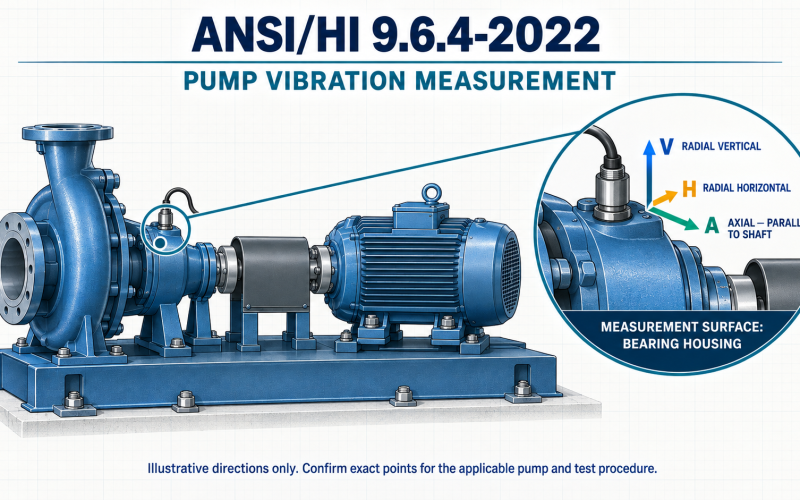
ANSI/HI 9.6.4 evaluates vibration measured on stationary parts associated with bearings, including bearing housings. Record the actual measurement point and direction on the pump or covered structure. A measurement at another location—or an internal shaft-displacement probe reading—is a different measurement and should not be compared as though it were the same quantity.
For the covered acceptance criteria, overall vibration velocity is reported as RMS. The standard also addresses peak-to-peak displacement for applicable pumps operating at 600 rpm or below. Keep the measurement quantity and units attached to every reading; RMS velocity, peak velocity and displacement are not labels that can be dropped during conversion or comparison.
Keep the measurement record reproducible
Record the location, direction, instrument settings, speed, flow, test setup and measured quantity together. Without that context, another engineer cannot reliably reproduce or compare the result.
Acceptance Is Not the Same as Condition Monitoring
An acceptance criterion answers whether a measured value meets an agreed test requirement under defined conditions. Condition monitoring asks whether a machine’s behavior is changing over time and whether that change warrants investigation. An owner’s alarm or shutdown setting is a separate reliability and controls decision.
A change in overall vibration can warrant investigation, but the overall value alone does not identify the source. For broader bearing, seal, hydraulic and operating symptoms, see the centrifugal pump failure and prevention guide.
Do Not Treat HI, ISO and API Values as One Scale
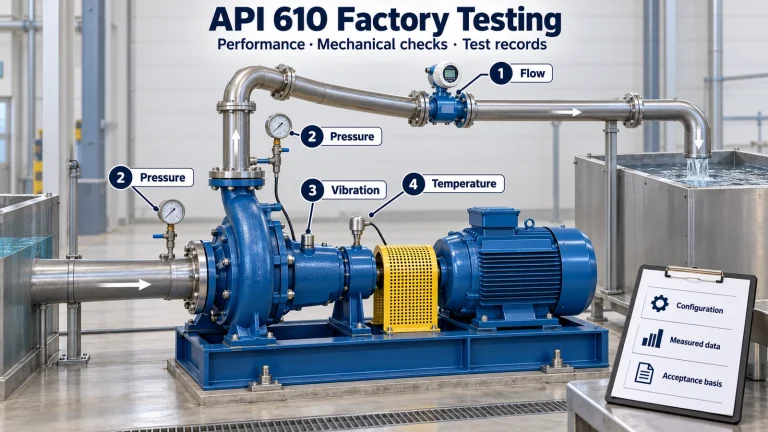
ANSI/HI 9.6.4, ISO pump-vibration guidance and API 610 serve distinct equipment and application contexts. Their measurement scope, acceptance basis and contract role must be checked separately. A value copied from one standard is not automatically an acceptance value under another.
ISO 10816-7:2009 addresses evaluation of industrial rotodynamic pumps, including bearing-housing vibration, and ISO lists that edition as published and to be revised. API 610 addresses centrifugal pumps for petroleum, petrochemical and natural-gas service. For either standard, use the edition and requirements specified for the actual application; do not use a simplified online comparison table as a substitute.
For ANSI/HI 9.6.4, use the current standard and its erratum rather than values copied from an older edition or an unverified secondary chart.
What to Include in a Vibration Acceptance Record
A useful report allows the purchaser, manufacturer and site team to understand what was tested and how the result was evaluated. Keep these items together:
If a value is outside the agreed criterion, first verify the measurement and test context. A repeatable high reading is a reason to follow the project’s investigation process; it is not, by itself, proof of imbalance, misalignment, cavitation or a defective replacement part.
A Vibration Result Does Not Prove Pump Interchangeability
Vibration acceptance and replacement compatibility are separate checks. A vibration result does not establish that a replacement has the required flow, head, materials, dimensions, seal arrangement or interfaces. Likewise, dimensional fit does not prove that a replacement meets the required vibration acceptance basis.
When the engineering decision is to evaluate a replacement, continue with the ANSI pump interchangeability verification workflow and confirm performance against the applicable engineering resources.
ANSI/HI 9.6.4 Pump Vibration Questions
Does ANSI/HI 9.6.4 give one shutdown value for every centrifugal pump?
No. The applicable acceptance value depends on the covered pump type and the specified test and measurement conditions. A plant alarm or shutdown setting is a separate decision.
Can I use a 1750 rpm or 3500 rpm rule of thumb?
Not as a substitute for the applicable acceptance criterion. Confirm the pump type, test condition, operating point, measurement method and contractual standard before judging a value.
Are factory and field acceptance values interchangeable?
No. The standard addresses both factory and field test environments, but the applicable criterion depends on the defined test setup and acceptance basis. Record which condition produced the reading.
Can overall RMS velocity identify the cause of high vibration?
No. Overall vibration can support acceptance or trending when measured consistently. Root-cause diagnosis requires additional evidence and a separate diagnostic method.
What should I send when asking whether a pump passed its vibration test?
Provide the pump identity, speed, flow or operating point, test environment, measurement point and direction, instrument basis, measured quantity and units, applicable requirement, and the complete report.
Technical Sources
- Hydraulic Institute — ANSI/HI 9.6.4 Rotodynamic Pumps for Vibration Measurements and Allowable Values.
- Hydraulic Institute — 2024 Erratum to ANSI/HI 9.6.4-2022.
- Hydraulic Institute — Pump Vibration & Troubleshooting Strategies, Part 2.
- Hydraulic Institute — ANSI/HI 9.6.3 Rotodynamic Pumps Guideline for Operating Regions.
- ISO — ISO 10816-7:2009.
- American Petroleum Institute — API 610 application context.