Current Published Editions
Edition status should be checked against the issuing organization before a quotation or purchase package is released.
| Standard | Current published edition | Primary role | Buyer takeaway |
|---|---|---|---|
| ASME B73.1 | 2026 | Chemical-process pump design/specification and dimensional framework | Check the dimension designation and installed interfaces |
| ISO 2858 | 1975, current confirmed edition | Designation, nominal duty point and principal dimensions | Use as a dimensional reference, not the complete Class II specification |
| ISO 5199 | 2002, current published edition | Class II centrifugal-pump technical specification | Read the technical requirements separately from ISO 2858 |
| API 610 | 13th Edition, 2026 | Petroleum, petrochemical and natural-gas centrifugal pumps | Confirm the exact project specification and edition |
Why “ANSI vs ISO vs API” Is an Oversimplification
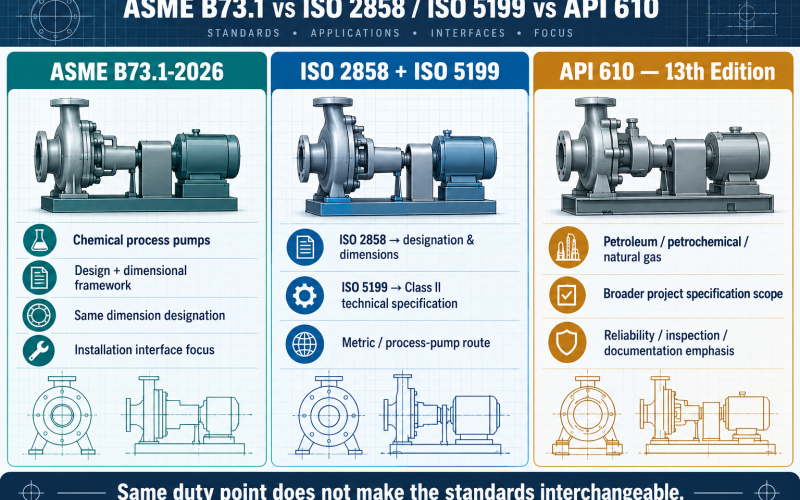
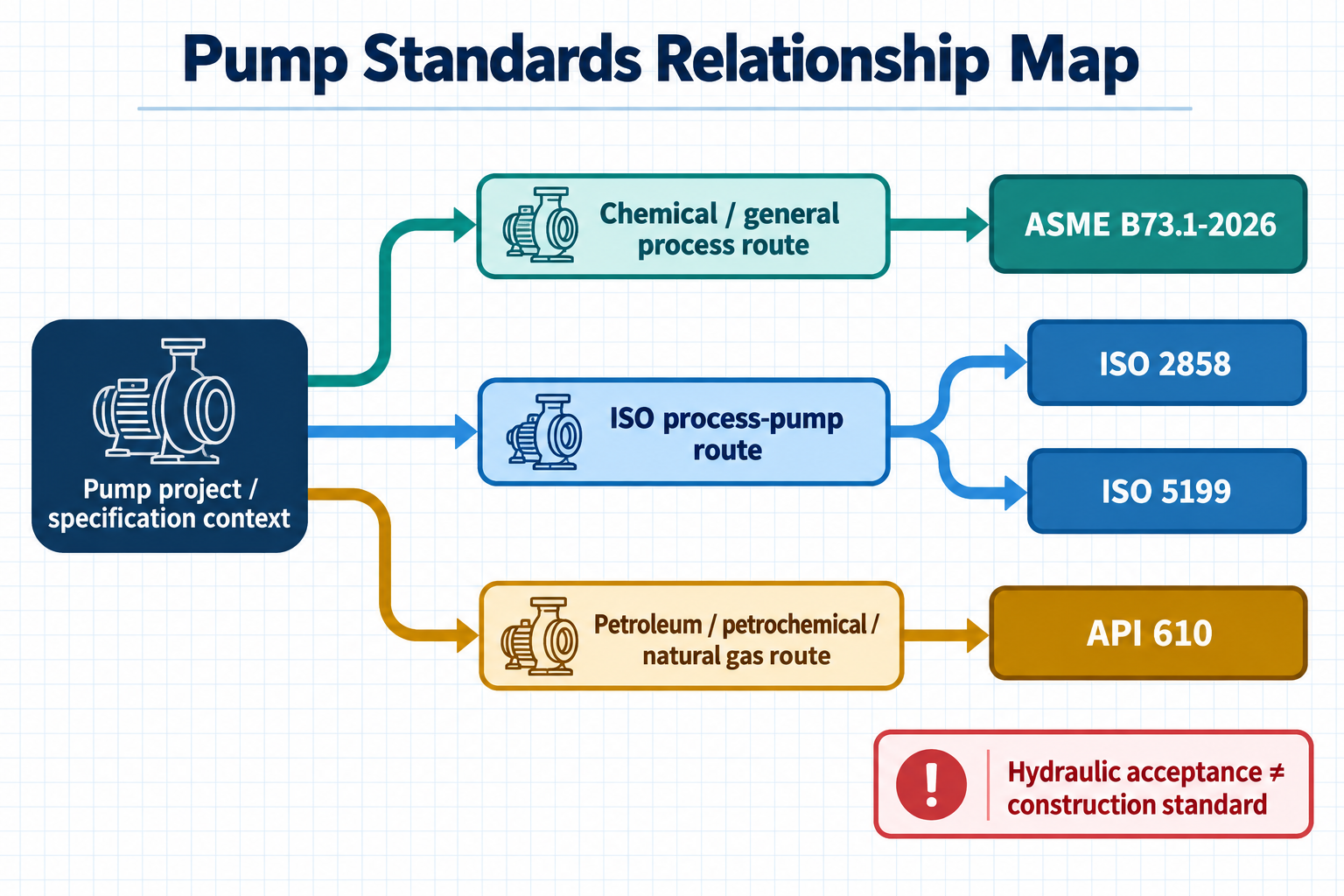
These standards do not perform the same role. ASME B73.1 focuses on a defined chemical-process pump family and includes a dimensional interchangeability framework. ISO 2858 describes designation, nominal duty point and principal dimensions, while ISO 5199 is a Class II technical specification. API 610 addresses centrifugal pumps for petroleum, petrochemical and natural-gas industries in a broader owner/EPC specification environment.
A standard label does not automatically define the installed fit, materials, hydraulic curve, seal arrangement, driver, inspection package or full project requirements. The governing project specification and actual pump records remain decisive.
ASME B73.1-2026
ASME B73.1-2026 is a design and specification standard for metallic and solid-polymer horizontal, end-suction, single-stage, centerline-discharge centrifugal pumps for chemical process service. Its dimensional interchangeability intent applies to pumps with the same standard dimension designation and concerns specified installation interfaces such as mounting, nozzle locations, input shafts, baseplates and foundation bolt holes.
For the dimensional and replacement boundary, review the ASME B73.1 pump dimensions and interchangeability guide. Dimensional conformity still does not prove equal hydraulics, materials, seal chambers or internal architecture.
ISO 2858 vs ISO 5199
ISO 2858 and ISO 5199 are related but distinct. ISO 2858 addresses pump designation, nominal duty point and principal dimensions. ISO 5199 provides the technical specification for Class II centrifugal pumps. ISO 2858 alone should not be treated as a complete process-pump technical specification.
For a deeper comparison, see ANSI B73.1 vs ISO 2858 / ISO 5199.
API Standard 610, 13th Edition
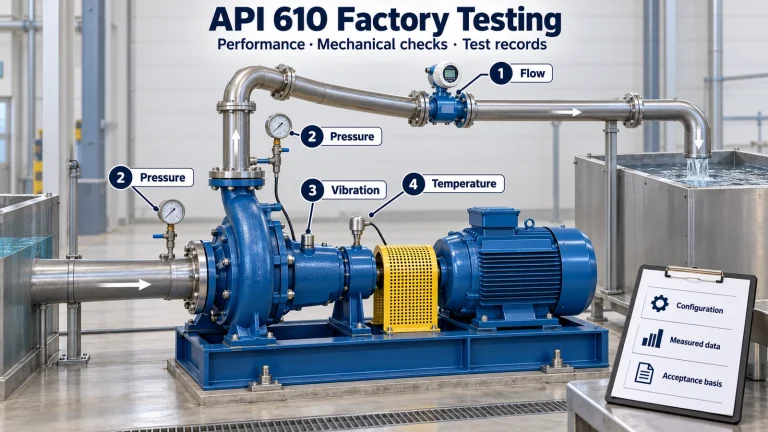
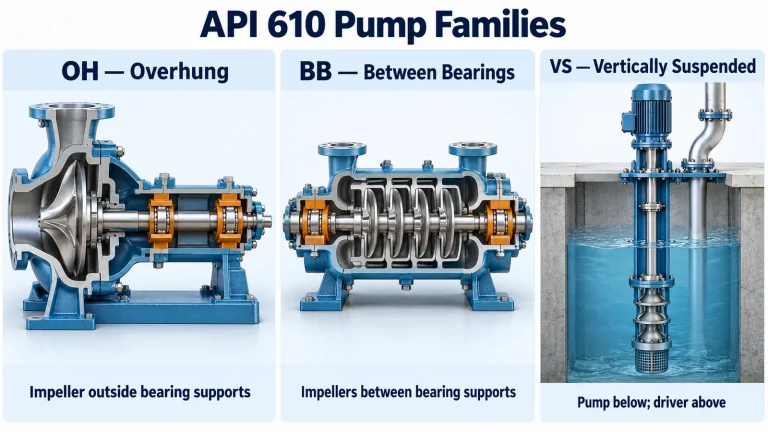
API 610 is for centrifugal pumps used in petroleum, petrochemical and natural-gas industries. It sits within a broader project specification environment where the owner or EPC package may define reliability, inspection, documentation, materials, testing and other requirements. It should not be described as simply “higher” or “better” than another standard; the correct route depends on the service and governing specification.
Where does ISO 13709 fit?
ISO 13709 remains the ISO publication family associated with centrifugal pumps for petroleum, petrochemical and natural-gas industries. API’s own publication history has treated API 610 and ISO 13709 as closely related, but buyers should confirm the exact publication, edition and contractual requirement instead of assuming simple one-to-one equivalence.
For selection context, see the API 610 vs ASME B73.1 pump selection guide.
ANSI vs ISO vs API: Buyer Comparison Matrix
| Standard | Primary role | Typical context | What it helps define | What it does not prove | Verify next |
|---|---|---|---|---|---|
| ASME B73.1 | Chemical-process pump design/specification | ANSI/B73 chemical service | Scope, selected design features and same-designation interfaces | Hydraulic, material, seal or power-end equivalence | Designation, GA drawing, baseplate and duty |
| ISO 2858 | Designation and principal dimensions | Metric end-suction process pumps | Designation, nominal duty point and dimensions | Full Class II technical requirements | ISO project basis and installed interfaces |
| ISO 5199 | Class II technical specification | General and chemical-process applications | Technical requirements for the specified class | Automatic interchangeability with B73.1 or API 610 | Class, deviations and purchaser requirements |
| API 610 | Petroleum/petrochemical/natural-gas pump standard | Owner/EPC project specifications | Project-defined pump requirements, inspection and documentation context | Universal suitability outside the specified service | Exact edition and contract data sheet |
Which Standard Route Should You Review First?
Route 1 — Existing ANSI / B73.1 chemical-process installation
Start from the dimension designation, verify the installed interfaces and review the B73.1 fitment route. Use the B73.1 dimensions guide as the next step.
Route 2 — ISO-specified process-pump project
Verify the ISO 2858 dimensional basis, then confirm ISO 5199 technical and purchaser requirements. Do not infer the full specification from the designation alone.
Route 3 — API 610 owner/EPC specification
Follow the API project route and confirm the exact edition, data sheet, inspection plan, materials, testing and documentation package.
Route 4 — Standard unclear
Start with the owner specification, pump datasheet, nameplate, GA drawing and installed interfaces. The documented project basis should control the review order.
Replacing an Installed Pump Across Standards
Replacement review is not complete when two standards appear related. Verify dimensional fit, hydraulic fit, mechanical fit, material suitability, seal arrangement and the boundary created by the project specification and documentation requirements.
Provide the existing model, duty point, nameplate, GA drawing, baseplate information and any owner or EPC specification before quotation. This separates a standards comparison from a defensible fitment decision.
RFQ / Review Checklist
Installed Pump / Project Identity
- Known standard or project specification
- Manufacturer, model and size
- Nameplate and service/application
Operating Duty
- Flow and head
- Fluid, temperature, density/SG and viscosity
- Solids where relevant
Fitment / Project Evidence
- Datasheet and GA drawing
- Project specification or owner/EPC requirements
- Installation photos and baseplate/foundation information
Start with what you have. A nameplate, model, duty point or project specification is enough to begin the review.
Related Engineering Guides
- ASME B73.1 pump dimensions and interchangeability guide
- ANSI B73.1 vs ISO 2858 / ISO 5199
- API 610 vs ASME B73.1 pump selection guide
- pump performance curves
Frequently Asked Questions
Is ISO 2858 the same as ISO 5199?
No. ISO 2858 addresses designation, nominal duty point and dimensions, while ISO 5199 provides a Class II technical specification.
Is API 610 the same as ISO 13709?
They address closely related petroleum, petrochemical and natural-gas centrifugal-pump scope, but buyers should confirm the exact publication and edition required by the project rather than assuming simple one-to-one equivalence.
What is the main difference between ANSI and ISO pump standards?
The answer depends on the exact standard. Compare scope, designation, dimensions, technical class and project requirements instead of treating ANSI and ISO as single interchangeable labels.
Does a matching standard prove that a replacement pump will fit?
No. Verify the installed interfaces, duty, materials, seals, driver/coupling relationships and project documentation before quotation.
Sources
- ASME B73.1-2026 official product page
- ISO 2858:1975 official ISO page
- ISO 5199:2002 official ISO page
- API standards plan listing API 610, 13th Edition
- ISO 13709:2009 official ISO page
Standards, editions, owner specifications and approved project documents govern final selection, fitment and acceptance decisions.
Need help routing a standards or replacement review? Request Standards & Fitment Review. Send the owner specification, nameplate, datasheet or GA drawing.