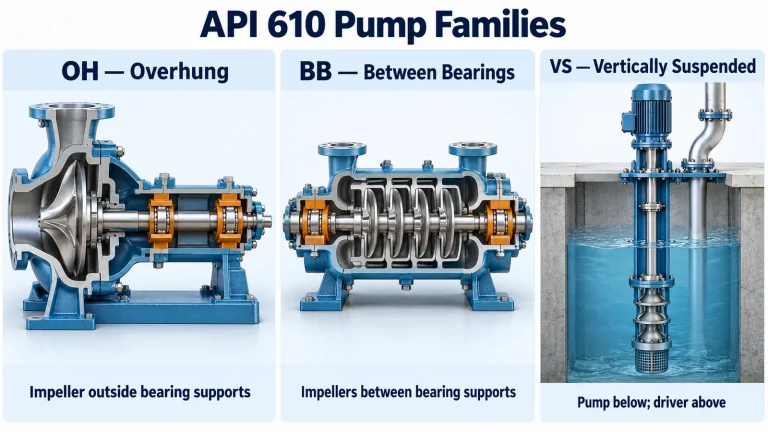
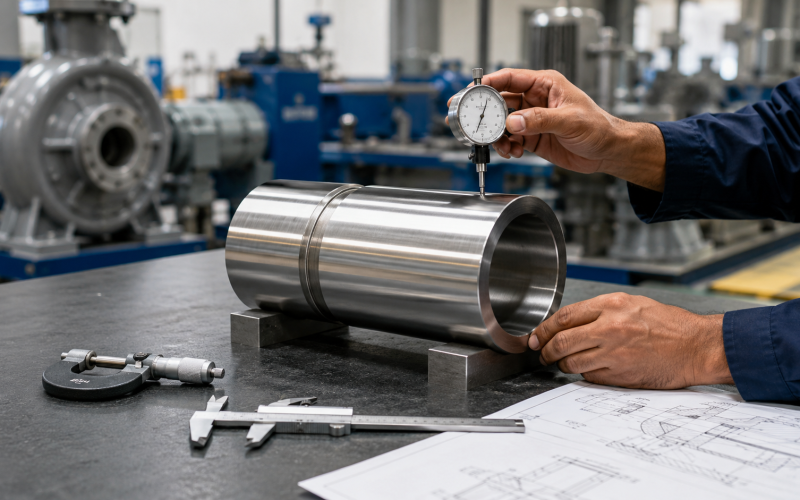
This guide is for maintenance teams, pump repair shops, reliability engineers, and MRO buyers evaluating a replacement sleeve. Use the pump nameplate, current assembly drawing, applicable IOM, seal drawing, and material test report as the controlling records for the specific installation.
CD4MCuN Is an Alloy Designation, Not a Complete Purchase Specification
State the required material standard, grade, product form, and traceability on the purchase documents. For cast duplex stainless steel, CD4MCuN is commonly associated with ASTM A890/A890M Grade 1B and UNS J93372. ASTM A890/A890M covers cast duplex stainless steels; it does not automatically specify material made from wrought bar, tube, or forged stock. If the sleeve is machined from another product form, identify the specification that applies to that material and manufacturing route. See the current ASTM A890/A890M scope and verify the ordered grade against the supplied MTR.
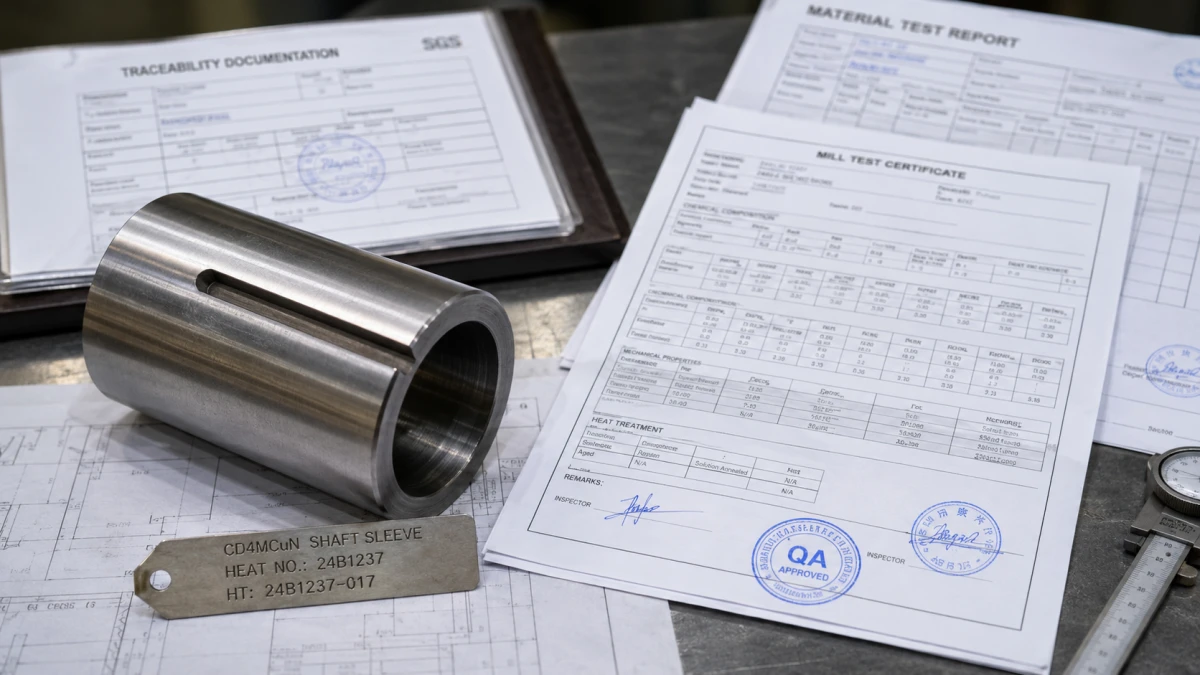
Do not accept “duplex,” “CD4MCuN,” or a commercial alloy name by itself as proof of the delivered material. The MTR should identify the specification and grade, heat number, product form, chemical analysis, applicable mechanical properties, and heat-treatment condition. Match the component or traceability record to the MTR heat number. PMI can help screen selected alloying elements, but it does not replace heat traceability, the MTR, or any heat-treatment or mechanical-property records required by the purchase specification.
Do not infer corrosion life from the alloy name alone. Material selection depends on the complete service: fluid composition and concentration, normal and upset temperatures, chlorides and other contaminants, pH, dissolved gases, velocity, solids, cleaning chemicals, start-stop conditions, and the expected corrosion mechanism. Have the material reviewed against qualified service data when the chemistry is mixed, changes over time, or is outside an established operating history.
What ANSI B73.1 Does and Does Not Establish
ASME B73.1 is a design and specification standard for horizontal end-suction chemical-process pumps. It includes dimensional-interchangeability requirements intended to facilitate installation and maintenance. ASME describes interchangeability for pumps with the same standard dimension designation in areas such as mounting dimensions, nozzle locations, input shafts, baseplates, and foundation bolt holes. Consult the current ASME B73.1 listing for the standard’s scope and edition.
A B73.1 reference does not, by itself, prove that a shaft sleeve from one manufacturer fits another manufacturer’s shaft or seal arrangement. It also does not establish the sleeve alloy, product form, internal dimensions, mechanical-seal setting, or suitability for a particular process fluid. Treat the standard as one part of the equipment record, then verify the actual component interfaces against the pump-specific drawing and inspection requirements.
Verify the Exact Goulds 3196 or Durco Mark III Configuration
Identify the installed pump before cross-referencing a sleeve. A model-family name is not enough to define every rotating-part dimension. Goulds 3196 configurations and Durco Mark III groups can differ by size, frame or group, shaft arrangement, seal chamber, sleeve design, and revision. The OEM parts list and IOM for the exact pump should control item-number interpretation and assembly details.
| Information to confirm | Why it matters |
|---|---|
| Manufacturer, model, pump size, frame or group, serial number, and revision | Distinguishes configurations that share a product-family name. |
| Original part number or BOM position, checked against the applicable parts list | Helps identify the intended component without assuming that item numbers are universal across revisions. |
| Shaft arrangement and shaft drawing | Confirms whether the assembly uses a sleeve and defines the shaft fit, shoulders, steps, and drive features. |
| Mechanical-seal manufacturer, model, size, drawing, setting dimension, and seal-chamber arrangement | Confirms the sleeve’s dynamic-seal surface, axial position, clearances, and secondary-seal interfaces. |
| Fluid, concentration, temperature range, solids, and requested material | Supports a service-specific material review instead of an alloy-name assumption. |
For a recessed-impeller Goulds CV 3196, consult the Goulds CV 3196 i-FRAME IOM. For a standard 3196 or another variant, obtain the IOM for the exact installed model and configuration from Goulds. For Durco Mark 3, locate the applicable frame-mounted manual through the Flowserve Durco Mark 3 product page. Confirm the manual matches the installed pump before applying its assembly instructions or limits.
Dimensions and Interfaces to Check on the Sleeve
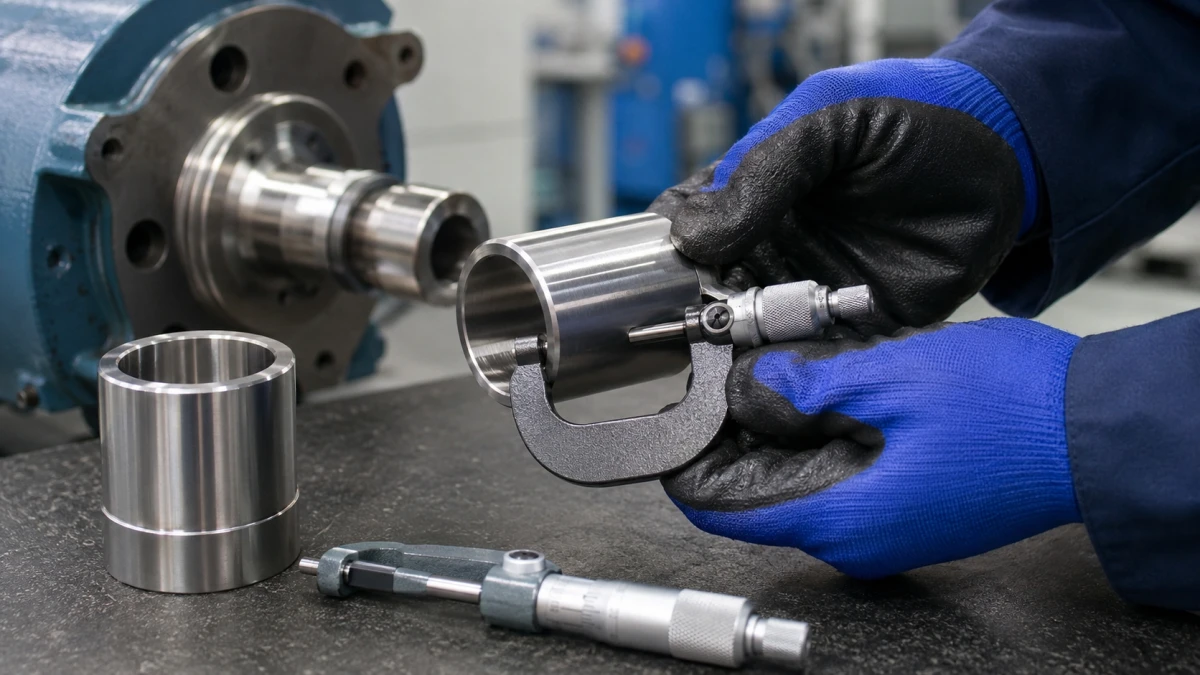
A sleeve can have the right nominal diameter and still be wrong at a functional step or seal interface. Compare the replacement against an approved drawing and inspect each functional feature. A worn or corroded removed sleeve can provide clues, but it should not be the only dimensional reference.
- Inside diameter and shaft fit: Check the specified fit, assembly allowance, contact length, key or drive feature, and any bore relief.
- Outside diameter: Measure each functional section that contacts a mechanical-seal secondary element, packing, bushing, gland, or other component.
- Shoulders, steps, and faces: Confirm diameters, axial locations, face squareness, and impeller or sleeve-nut seating.
- Overall length: Confirm the seal working position, axial stack, impeller location, and engagement of retaining features.
- Grooves and lead-ins: Check O-ring or gasket groove dimensions and installation edges against the drawing and seal design.
Set Runout, Concentricity, and Surface-Finish Limits from the Applicable Records
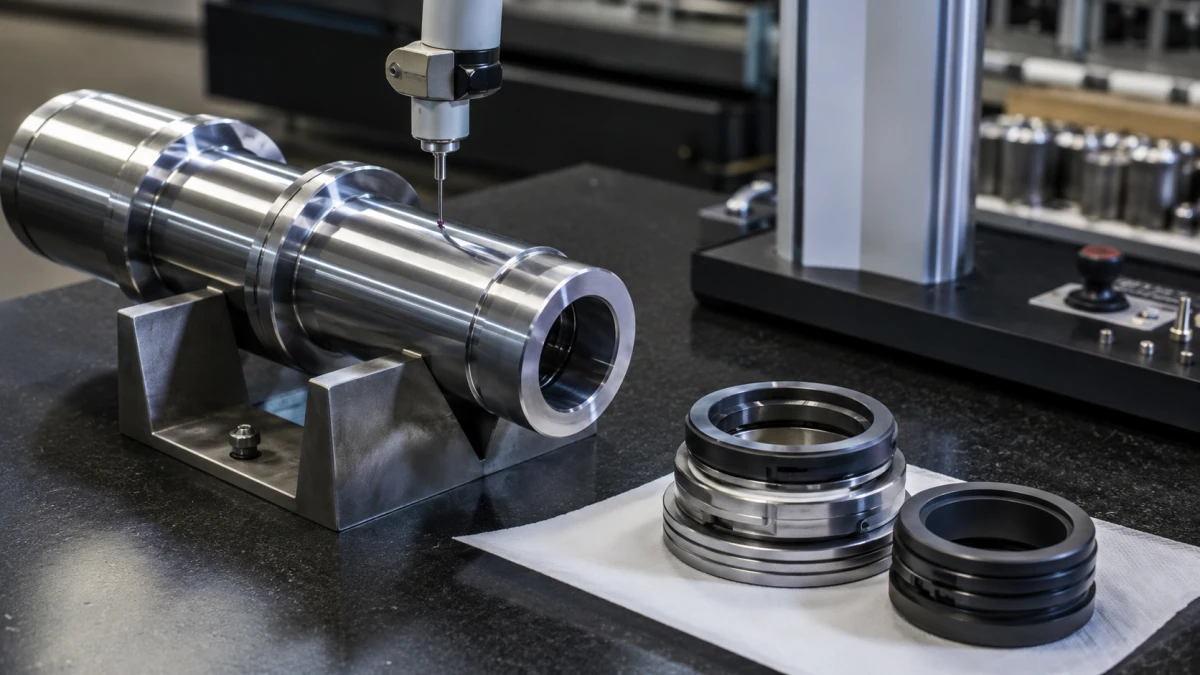
Check shaft runout at the sleeve location, sleeve outside-diameter runout after assembly, concentricity between functional diameters, and face runout at shoulders where specified. Record how and where each measurement was taken. A limit from one pump size, IOM, or seal arrangement should not be treated as a universal acceptance limit for every Goulds 3196 or Durco Mark III configuration.
Use the applicable pump drawing, OEM IOM, mechanical-seal supplier requirements, project specification, and approved inspection plan to set acceptance values. The same principle applies to surface roughness: identify the functional surface that contacts the secondary seal and state the roughness parameter, maximum value, measurement method, and reporting requirement. Do not describe a single roughness value as an ASME B73.1 requirement.
Request an Inspection Package That Matches the Part
For a shaft sleeve, a useful baseline package may include the approved dimensional drawing, dimensional inspection report, MTR, heat-number traceability, and final inspection photographs. Specify additional checks only when required by the design, service, purchase specification, or quality plan.
- Material: MTR and heat traceability; PMI report when required by the purchase specification.
- Dimensions: Report for the specified bores, diameters, steps, grooves, length, and functional interfaces.
- Assembly geometry: Runout, concentricity, and face measurements with the reference condition stated.
- Seal-contact surface: Roughness report when specified, identifying the measured track and method.
- Additional examination: Hardness, ferrite measurement, liquid-penetrant examination, corrosion testing, or third-party inspection only when the applicable requirements call for them.
Hydrostatic testing is generally associated with pressure-containing parts such as casings. It is not a substitute for dimensional and material verification of a shaft sleeve.
Prepare a Complete Shaft-Sleeve RFQ
Include the available records with the inquiry so the supplier can identify missing fitment or material information before quotation:
- Pump manufacturer, model, size, frame or group, serial number, and nameplate photograph.
- OEM part number or BOM position, plus the applicable parts-list or drawing revision.
- Shaft and sleeve drawings, or measured dimensions for every functional section.
- Shaft arrangement, seal model and drawing, seal setting dimension, and seal-chamber details.
- Process-fluid composition, concentration, normal and upset temperatures, solids, and cleaning conditions.
- Required material standard, grade, product form, heat treatment, traceability, and inspection reports.
- Any project-specific acceptance values for dimensions, runout, concentricity, or surface finish.
Frequently Asked Questions
Does ASTM A890 apply to every CD4MCuN shaft sleeve?
No. ASTM A890/A890M covers cast duplex stainless steel. If the sleeve is made from bar, tube, or forged stock, specify the material standard that applies to that product form and verify it against the MTR.
Does ANSI B73.1 prove Goulds 3196 and Durco Mark III sleeves are interchangeable?
No. B73.1 addresses specified pump design and dimensional-interchangeability features. It does not establish universal interchangeability of internal shaft sleeves. Verify the exact pump configuration, shaft dimensions, seal interfaces, and approved drawing.
Can a CD4MCuN sleeve replace a 316 stainless-steel sleeve without changing the mechanical seal?
Possibly, but the alloy change alone does not establish compatibility. Confirm the sleeve dimensions, seal-contact surface, seal setting, secondary-seal design, material requirements, and operating conditions with the applicable drawings and seal supplier.
Is 0.002 in runout a universal acceptance limit for these sleeves?
No. Use the limit defined for the specific pump, shaft, assembly condition, and seal arrangement by the applicable IOM, drawing, seal supplier, or approved inspection plan.
Should a shaft sleeve have a hydrostatic test certificate?
Usually not. Hydrostatic tests are generally used for pressure-containing components. A shaft sleeve is normally verified through its material records and specified dimensional and surface inspections.