
An ANSI pump is an industry term for a standardized process pump, most often a horizontal end-suction centrifugal pump built to the dimensional requirements of ASME B73.1. The standard helps define selected installation interfaces so a pump with the same standard dimension designation can be sourced from different manufacturers. It does not, by itself, establish that two pumps have the same hydraulic performance, materials, seal arrangement, or internal parts.
What Does “ANSI Pump” Mean?
“ANSI pump” is common shorthand used by engineers, maintenance teams, and buyers. For the familiar chemical-process pump, the relevant specification is generally ASME B73.1. ANSI does not write the pump design requirements. ANSI accredits standards developers and approves documents that meet the American National Standards process; ASME develops and publishes the B73 pump standards. See ANSI’s explanation of the American National Standards process and the ASME B73.1 standard page.
The shorthand can be imprecise: B73 includes more than one pump configuration. When specifying or replacing equipment, identify the actual standard, pump model, size designation, and configuration instead of relying on the word “ANSI” alone.
Which ASME B73 Standard Applies?
The B73 family covers several distinct chemical-process pump configurations. The standard number matters because a horizontal end-suction pump and a vertical in-line pump have different layouts and installation interfaces.
- ASME B73.1: Horizontal, end-suction, single-stage, centerline-discharge chemical-process pumps. The current ASME listing is B73.1-2026 and describes metallic and solid-polymer pumps. The standard includes dimensional interchangeability requirements and design features intended to support installation, maintenance, reliability, and safety.
- ASME B73.2: Vertical in-line centrifugal pumps for chemical process. The current ASME listing is B73.2-2023; its scope describes metallic, single-stage pumps with suction and discharge nozzles in line.
- ASME B73.3: Sealless horizontal end-suction centrifugal pumps for chemical process. The current ASME listing is B73.3-2022 and covers metallic and plastic-lined sealless pump designs.
Historical note: ASME states that B73.5M-1995(R2007) was incorporated into B73.1-2012. Treat B73.5M as a historical designation, not as a separate current B73 standard. Check the applicable edition and project specification when making a procurement decision.
Sources: ASME B73.1, ASME B73.2, and ASME B73.3.
What Does ASME B73.1 Standardize?
B73.1 establishes a dimensional framework for a defined family of horizontal chemical-process pumps. ASME says pumps from different sources that have the same standard dimension designation are intended to be interchangeable with respect to specified interfaces, including mounting dimensions, pump size, suction and discharge nozzle size and location, input shafts, baseplates, and foundation bolt holes.
This is useful when screening replacement options and planning installation work. It is not a substitute for checking the installed equipment and the proposed pump drawing. Start with the nameplate and standard dimension designation, then compare the approved general-arrangement drawing with the existing base, piping, driver, coupling, and available service clearance.
For the detailed designation and interface review, see the ASME B73.1 dimensions and interchangeability guide.
What Dimensional Interchangeability Does Not Guarantee
A matching B73.1 dimension designation is evidence about specified external dimensions. It does not prove that a replacement will deliver the required duty or that its internal components will fit an installed pump.
- Hydraulic fit: Check the proposed pump curve at the required flow, head, speed, impeller diameter, and operating range. Review efficiency and NPSH requirements separately.
- Materials: Verify the specified alloy and product form against the fluid, concentration, temperature, solids, and project requirements.
- Sealing: Confirm seal chamber dimensions, gland interface, mechanical-seal arrangement, flush plan, and process conditions.
- Mechanical fit: Check shaft and coupling details, driver, rotation, bearing frame, baseplate, and any field modifications.
- Internal parts: Impellers, shafts, sleeves, bearing housings, casings, and seal chambers are model- and manufacturer-specific unless a documented cross-reference proves compatibility.
Therefore, avoid treating “B73.1 compliant” as a blanket promise of a drop-in replacement. Confirm the actual configuration and installation evidence before release or purchase.
What Is Back Pull-Out Design?
Many horizontal end-suction process pumps use a back pull-out (BPO) arrangement. In a typical design, the rotating assembly can be withdrawn from the casing for inspection or service while the casing remains connected to the suction and discharge piping. This can reduce the amount of piping work during maintenance.
The exact service sequence depends on the pump, coupling, driver, seal, and installation. Some installations require removing a coupling guard or spacer, moving the motor, or using a different lifting arrangement. Confirm the required clearance and procedure in the manufacturer’s installation, operation, and maintenance manual; isolate, drain, and verify the equipment is safe before maintenance. BPO describes a maintenance arrangement, not a guaranteed service time or a guarantee that every driver can remain in place.
ANSI B73.1 vs. ISO and API Pump Standards
These standards address different scopes. Their names alone do not establish that pumps share the same footprint or are suitable for the same duty.
- ASME B73.1: A dimensional and design specification for a defined horizontal end-suction chemical-process pump family. Check the same standard dimension designation and the actual approved drawing for an installation review.
- ISO 2858: Covers end-suction centrifugal pump designation, nominal duty point, and principal dimensions; its published title specifies a 16 bar rating. Do not infer B73.1 dimensional interchangeability from ISO 2858 conformity.
- ISO 5199: Specifies technical requirements for Class II centrifugal pumps. It complements, but is not the same document as, ISO 2858.
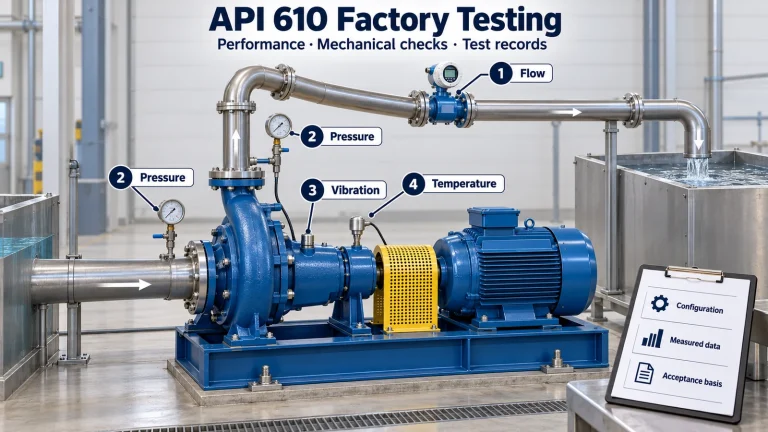
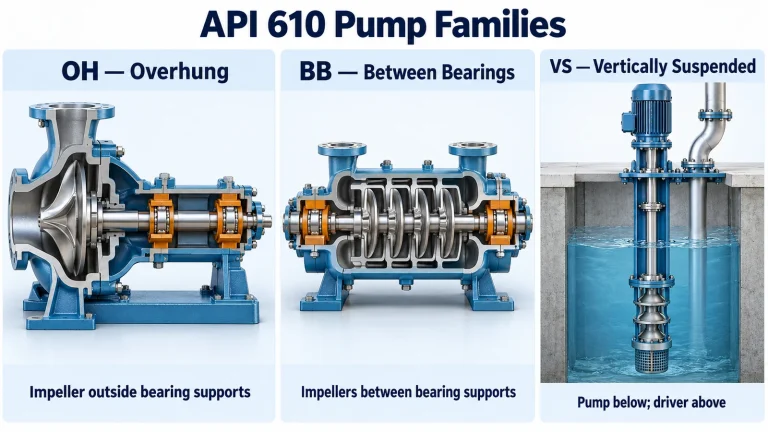
- API 610: Applies to centrifugal pumps for petroleum, petrochemical, and natural-gas industry services and includes multiple pump types. Select against the project specification and required pump type rather than assuming it is simply a higher-pressure B73.1 pump.
For a comparison focused on refinery and petrochemical service, see API 610 vs. ASME B73.1. Official scope references: ISO 2858, ISO 5199, and the API standards listing.
How to Select or Replace an ANSI Process Pump
Build the replacement review from the installed equipment and the required process duty. A model name or standard designation is a starting point; it is not a complete selection specification.
- Identify the pump: Record manufacturer, model, size, standard dimension designation, serial number, and nameplate data. Include a clear nameplate photo if available.
- Define the duty: Provide required and operating flow, total dynamic head, speed, liquid temperature, specific gravity or density, viscosity, vapor pressure where relevant, and available NPSH data.
- Describe the liquid: Identify the process fluid, concentration, corrosive constituents, solids, and cleaning or flushing conditions.
- Specify materials and sealing: State the required material grades and product forms, seal type, chamber configuration, and any project-specified seal or flush plan.
- Document installation: Provide the pump and baseplate GA drawings, piping interface details, coupling/driver information, photos, and any field modifications or space constraints.
- Review performance and acceptance: Compare the proposed curve and operating point separately from dimensional fit. State any required inspection, testing, documentation, and acceptance criteria in the RFQ.
Use the site’s pump calculators for preliminary hydraulic checks. For brand-specific review, see Goulds 3196 replacement options and Durco Mark III replacement options. Replacement scope and part compatibility should be confirmed against the specific installed configuration and supporting drawings.

Frequently Asked Questions
ANSI stands for the American National Standards Institute. In this context, “ANSI pump” is common industry shorthand; ASME publishes the B73 pump standards, and ANSI accredits standards developers and approves American National Standards.
No. The term can be used loosely. Confirm the pump’s actual standard and configuration; B73.1 applies to a defined horizontal end-suction chemical-process pump family, while B73.2 and B73.3 cover different configurations.
A matching standard dimension designation is intended to support interchangeability at specified external interfaces. Check the approved drawings, installed condition, duty, materials, seals, coupling, and project requirements before concluding that no changes are needed.
Not solely because both pumps meet B73.1. Internal part compatibility requires a model-specific cross-reference, drawing, or other documented evidence.
Do not assume so. B73.1 and ISO 2858 use different standard dimension systems. Compare the actual dimensional drawings and installation interfaces for the proposed equipment.
Start with the nameplate, manufacturer and model, pump size, required flow and head, liquid and temperature, material requirements, and any GA or baseplate drawing. Photos and measurements help identify field changes.