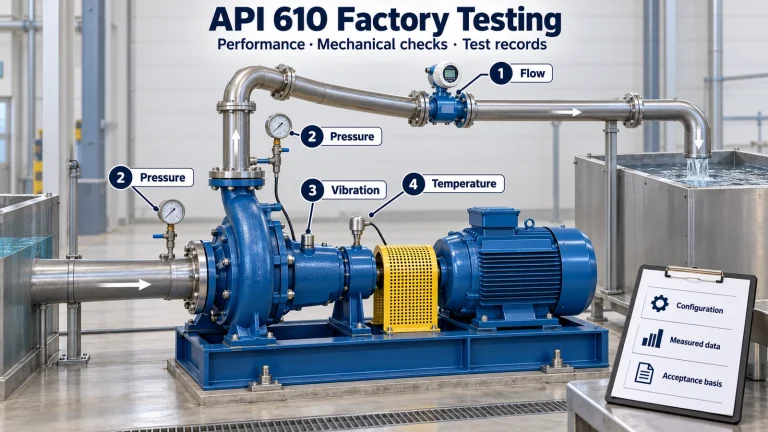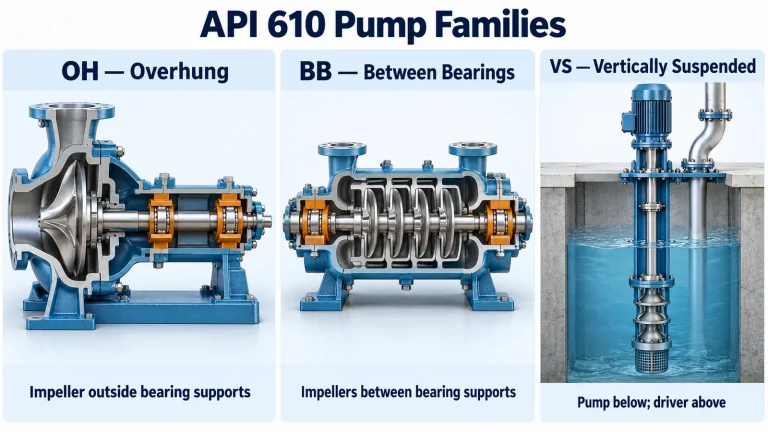

Short answer: API 610 and ASME B73.1 address different pump applications and specification requirements. Select or replace a pump against the governing project specification, service conditions, reliability requirements and approved engineering documents. Similar flow, head or flange sizes do not establish equivalence.
Standards editions referenced: API Standard 610, 13th Edition (2026), covers centrifugal pumps for petroleum, petrochemical and natural-gas industry services. ASME B73.1-2026 covers horizontal end-suction, single-stage, centerline-discharge chemical-process pumps and includes dimensional interchangeability provisions for the same standard dimension designation. Confirm which edition and requirements govern the project.
For context across the broader standards landscape, see our ANSI, ISO and API pump standards comparison.
- If the owner or project specification requires API 610, use that requirement as the starting point and document any proposed deviation for approval.
- If the specified service calls for an ASME B73.1 horizontal chemical-process pump, confirm the pump is within the standard’s scope and meets the project duty and material requirements.
- If the applicable standard is unclear, or a replacement crosses standards, pause the substitution and obtain an engineering review.
How to decide between API 610 and ASME B73.1
1. Confirm the governing requirement
Review the owner specification, equipment datasheet, purchase specification, applicable regulations and any project deviation process. A service description such as “chemical pump” or “hydrocarbon pump” does not, by itself, establish which standard is mandatory.
2. Confirm pump type and service conditions
Check that the pump type is covered by the selected standard, then review the complete operating envelope: normal, rated, minimum and maximum flow; differential head; suction conditions; temperature; pressure; fluid properties; solids; and start-up, upset or transient cases. The pump’s pressure and temperature capability depends on its design, materials and configuration. Neither standard name should be treated as a universal rating.
3. Compare reliability, containment and documentation needs
Review the required sealing arrangement, bearing and rotor requirements, allowable piping loads, inspection and testing scope, material traceability, records and acceptance criteria. These requirements may come from the pump standard, the project specification, purchaser supplements or a combination of them. Record which document governs each requirement.
4. Treat cross-standard replacement as a formal technical review
Do not approve a substitution based only on a matching duty point, flange size or footprint. Compare design, pressure-containing parts, interfaces, rotor and bearings, seal system, materials, inspection, tests and project documentation. List every gap and obtain the required purchaser approval before procurement.
What the standards comparison can—and cannot—tell you
The table summarizes the selection conversation. It intentionally avoids universal pressure, temperature, bearing-life and cost figures: those depend on the pump design, material, operating conditions and project requirements, and should be verified against the applicable standard and manufacturer data.
| Comparison point | API 610 | ASME B73.1 |
|---|---|---|
| Scope | Centrifugal pumps for petroleum, petrochemical and natural-gas industry services. | Horizontal end-suction, single-stage, centerline-discharge chemical-process pumps. |
| Pump types | Multiple pump families, including overhung, between-bearings and vertically suspended designs. | A defined horizontal end-suction chemical-process pump configuration. |
| Design discussion | Mechanical design, service criticality, reliability, inspection, testing and purchaser requirements. | Chemical-process pump design features and dimensional provisions for the applicable standard size designation. |
| Dimensional interchangeability | Does not use the B73.1 dimensional interchangeability framework. | Provides dimensional interchangeability for pumps with the same standard dimension designation; this does not make all internal parts interchangeable. |
| Tests and records | Determine requirements from API 610, the project specification and purchaser supplements. | Determine requirements from B73.1, the project specification and purchaser requirements. |
| Replacement implication | Do not replace with a different-standard pump based only on duty or nozzle size. | Dimensional fit does not establish API 610 compliance, hydraulic equivalence or material suitability. |
| Pressure and temperature | Verify for the specific pump design, material, configuration and project conditions. | Verify for the specific pump design, material, configuration and project conditions. |
For a standards-level comparison, also review the service consequence, operating envelope, materials, seal system, bearings, rotor requirements, piping loads, inspection, testing, installation and deviations. The governing project documents—not a simplified “API is higher-rated” rule—set the acceptance basis.
Need a technical review of an API 610 or ASME B73.1 requirement?
Send the pump nameplate, drawing, part number and operating conditions. ANSI Pumps Pro can review the available fitment, hydraulic, material and documentation information before quotation approval.
Evidence to collect before purchase or replacement
| Review gate | Evidence to request | Question to close |
|---|---|---|
| Dimensional | Approved drawings, interface dimensions and an inspection report where specified. | Will the equipment fit without forced assembly or unapproved machining? |
| Mechanical | Shaft, key, bearing, coupling, seal-chamber and clearance details. | Are the rotating and stationary components compatible? |
| Hydraulic | Applicable pump curve, duty point, NPSH information and power data. | Will the pump meet the required duty for the actual liquid and operating range? |
| Material | Material specification, heat identification, certificates and verification records required by the order. | Is the material suitable for the fluid and traceable to the supplied item? |
| Acceptance | Inspection and test plan, results, deviation list and final records. | How will the purchaser verify conformity before shipment and after installation? |
Step-by-step buyer verification
1. Freeze the reference configuration
Record the existing manufacturer, model, size, frame, impeller diameter, speed, seal chamber, power end, wetted materials, shaft arrangement and part numbers. Photograph the nameplate and critical interfaces. If the pump has been modified, record the changes instead of relying on catalogue configuration.
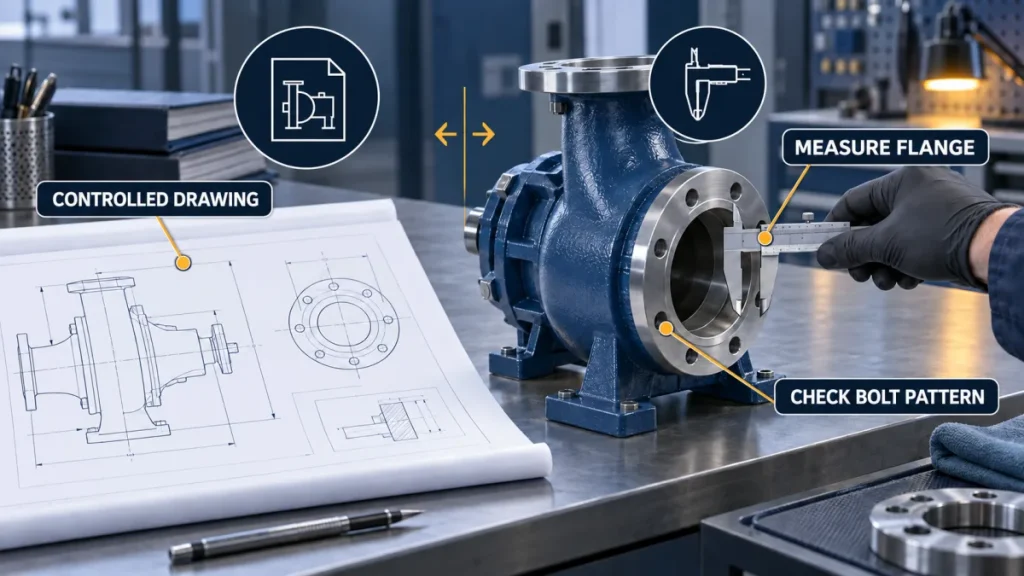
2. Compare controlled drawings, not only catalogue descriptions
Check suction and discharge locations, baseplate and bolt holes, shaft extension, coupling, bearing housing, casing dimensions, impeller clearances, seal chamber, gasket interfaces and rotation. If a supplier claims interchangeability, ask which dimensions are guaranteed, which are conditional and what inspection record will demonstrate compliance.
3. Verify the duty point and liquid
Compare required flow, head, temperature, specific gravity, viscosity, vapor pressure, solids and operating range with the offered curve. A dimensional match does not prove the same head, efficiency, NPSH requirement or motor load. Recheck the curve when material, trim or speed changes.
4. Verify material and manufacturing records
Confirm whether each component is cast or wrought, which material specification applies, how heat treatment is controlled, how repair welds are disclosed and how heat identification is maintained. For corrosion service, evaluate concentration, temperature, chlorides, pH, solids, velocity and oxidizing or reducing conditions. Material name alone is not enough to establish suitability.
Inspection, traceability and acceptance checklist
- Approved general-arrangement and component drawings with revision control.
- Part-number and configuration cross-reference with its stated limits.
- Dimensional report for critical interfaces and fit-up surfaces, where required.
- Material certificates, heat identification and PMI or other verification required by the purchase documents.
- Balance, hydrostatic, performance, coating, weld-repair or casting records as applicable to the order.
- Deviation list identifying differences from the reference equipment or purchase specification.
- Installation and commissioning readings for flow, head, vibration, temperature and leakage, where required by the project.

When to reject or escalate a proposed replacement
Pause the review if the supplier cannot identify the reference configuration, the drawing is uncontrolled, the material is named only by a trade name, the performance curve is missing, critical dimensions are assumed, repair welds are undisclosed or a broad compatibility claim has no stated scope. Record the gap and request the missing evidence before approving the order.
What to send with a technical inquiry
Provide the original pump model and size, serial or asset information, part number, available drawings, duty point, liquid chemistry and temperature, material requirement, seal and coupling details, installation photos, applicable inspection standard, delivery location and required records. Identify which requirements are mandatory and which may be proposed as alternatives.
Frequently asked questions
Is API 610 always better than ASME B73.1?
No. Each standard addresses a different scope. The appropriate choice depends on the project specification, pump type, service conditions, reliability requirements and purchaser acceptance criteria.
Can an ASME B73.1 pump replace an API 610 pump?
Do not approve the substitution based only on flow, head, footprint or nozzle size. It requires a documented review of design, materials, rotor and bearing requirements, seals, testing, reliability requirements and purchaser deviations, followed by the required approval.
Does B73.1 dimensional interchangeability guarantee hydraulic interchangeability?
No. Dimensional interchangeability for the same standard dimension designation does not guarantee the same performance curve, efficiency, NPSH requirement, materials or operating envelope.
Does an API 610 designation set one pressure or temperature rating for every pump?
No. Verify the specific pump design, materials, configuration and operating conditions against its approved data and the governing project requirements.