
What ASME B73.1-2026 Covers
B73.1 addresses a defined family of horizontal end-suction centrifugal pumps used in chemical-process service. Its value in replacement work is the dimensional framework for selected external interfaces and installation relationships.
The scope is narrower than the phrase “ANSI pump” sometimes suggests. Confirm the pump configuration, size designation, frame, materials, seal arrangement, duty and project requirements before treating a proposed replacement as fit.
What “Dimensional Interchangeability” Actually Means
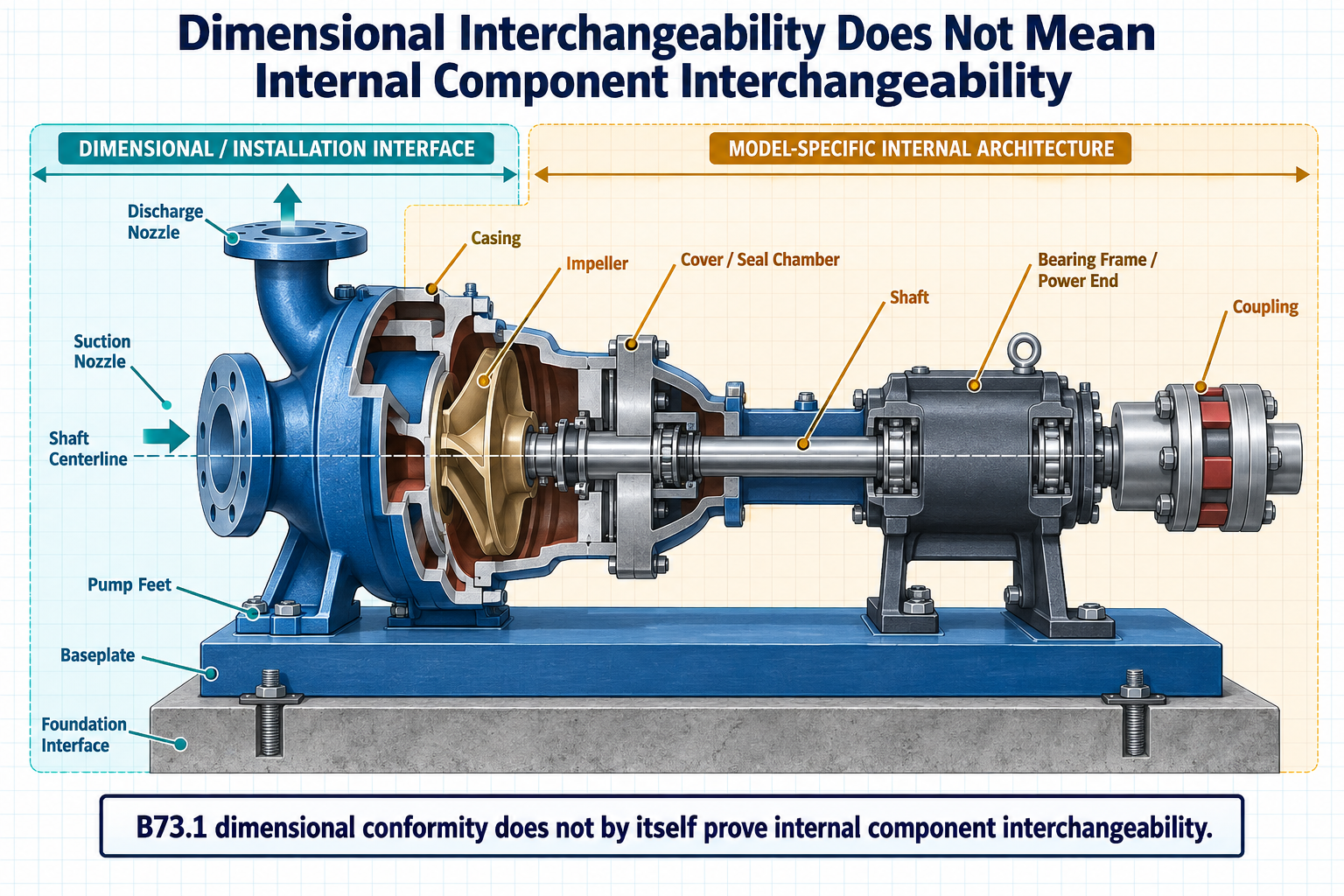
Dimensional conformity concerns the standardized installation envelope and specified external interfaces. It is useful for screening a replacement, but it is not a blanket certification of equal performance or interchangeable internal components.
| Interface to verify | Why it matters | Evidence to request |
|---|---|---|
| Nozzle locations and centerlines | Determines piping fit and alignment | Approved GA or dimensional drawing |
| Shaft position and extension | Determines coupling and driver relationships | Shaft, coupling and driver data |
| Pump feet, baseplate and foundation | Determines mounting and field fit | Baseplate drawing and site measurements |
| Maintenance envelope | Determines access for removal and service | Installed layout and clearance review |
ASME B73.1 Standard Dimension Designations
A standard dimension designation is the dimensional reference used to identify the applicable standardized installation envelope. Replacement review should start by confirming the exact designation, then verifying the actual drawing and installed configuration.
Designation examples may include AA, AB, AC, A05, A10, A20, A30, A40, A50, A60 and A70. These examples are labels, not a substitute for the applicable standard or a controlled dimensional drawing.
Use the designation as the starting point for dimensional review. Final fitment should be confirmed against the applicable B73.1 edition and approved dimensional drawing.
Which Interfaces Should a Replacement Buyer Verify?
Dimensional fit
Confirm nozzle locations, centerline relationships, shaft position, pump feet, baseplate, foundation bolt pattern, maintenance envelope, field modifications and the actual baseplate condition.
Mechanical fit
Check shaft extension, coupling, driver, rotation, bearing-frame relationship and mounting relationships. Bearing and power-end architecture is manufacturer- and model-specific unless source documentation proves otherwise.
Hydraulic fit
Compare flow, head, speed, impeller diameter, efficiency, operating region and NPSHr with the proposed pump curve. Matching external dimensions does not establish an identical hydraulic curve.
For a field-oriented measurement sequence, see the five ANSI pump interfaces to verify.
Materials and sealing
Review casing, impeller and shaft materials together with the seal chamber, mechanical seal, fluid chemistry, temperature, concentration and solids where applicable. The installed process environment controls the suitability review.
What B73.1 Does Not Guarantee
- Hydraulic performance, efficiency or NPSH suitability.
- Internal component compatibility.
- Material suitability for the actual process.
- Seal chamber equivalence or mechanical-seal fit.
- Power-end equivalence.
- API 610 compliance or acceptance-test compliance.
- Compatibility with a field-modified installation.
Same dimension designation does not mean the same hydraulic design or internal-parts architecture.
B73.1 vs Hydraulic Acceptance Testing
Dimensional standardization and hydraulic acceptance testing answer different questions. Compare the proposed duty point and pump performance curves separately from the dimensional review. Do not infer a hydraulic acceptance grade or tolerance from dimensional conformity.
Goulds 3196 vs Durco Mark III: Brand Model vs B73.1 Standard Scope
Goulds 3196 replacement and Durco Mark III replacement work still requires model-specific verification. A brand or model name is not a substitute for the actual drawing, installed configuration and operating duty.
| Review area | What B73.1 helps define | What still requires model-specific verification |
|---|---|---|
| Installation | Standardized dimensional framework | Actual GA drawing and installed condition |
| Nozzles | Interface location/size framework | Exact size and configuration |
| Shaft/baseplate | Standard dimensional relationship | Driver, coupling and installed base |
| Impeller | Not established by dimensional conformity | Geometry, setting and trim |
| Seal chamber | Not established by dimensional conformity | Exact chamber and seal configuration |
| Power end | Not established by dimensional conformity | Frame and architecture |
| Hydraulic duty | Not established by dimensional conformity | Curve, trim and speed |
Why Seal Chamber Configuration Must Be Verified Separately
Dimensional fit alone does not prove that two pumps have the same seal chamber bore, gland interface, flush arrangement, mechanical-seal fit or seal environment. These interfaces depend on the actual model, configuration and process conditions.
For a fitment review, provide the pump model, frame, seal arrangement, seal-chamber drawing if available and existing mechanical-seal details. Do not rely on an external footprint to infer proprietary or controlled internal dimensions.
Common Material Naming Checks
Material review must distinguish the product form from the project specification. Confirm the exact ASTM/UNS grade and whether the item is wrought or cast.
- 316 family: verify the actual casting grade where a pump casting is specified.
- Alloy 20 family: verify cast versus wrought designation.
- C-type Ni-Cr-Mo family: verify the exact specified casting grade.
- Duplex: verify the exact ASTM/UNS grade.
Do not auto-label CD4MCuN as a generic “2205 equivalent”; confirm the specified grade and component form.
B73.1 Replacement RFQ Checklist
Do not wait for a perfect data package. Start with what you have.
Pump Identity
- Manufacturer and model
- Pump size and nameplate
- Serial or reference number, if available
Operating Duty
- Flow and head
- Fluid, temperature, density/SG and viscosity
- Solids where applicable
Fitment Evidence
- GA drawing and baseplate drawing
- Nameplate photo
- Installation photos and measured interfaces
Start with what you have. A nameplate photo, pump model and duty point are usually enough to begin the review.
Frequently Asked Questions
Can a B73.1 pump replace any other B73.1 pump?
Only after the standard dimension designation, actual interfaces, hydraulic duty, materials, seals, power end and project requirements have been verified.
Does dimensional conformity prove hydraulic acceptance?
No. Dimensional fit and hydraulic acceptance are separate review paths.
Can an older Goulds 3196 or Durco Mark III be replaced without repiping?
Possibly, but the answer requires the existing model, drawing or measurements, duty, materials, seal arrangement and power-end information.
Sources
- ASME B73.1-2026 official product page
- ANSI/HI 14.6-2022 official listing
- dimensional interchangeability vs component compatibility
The current licensed standard, approved drawings and project specifications govern final acceptance and fitment decisions.