
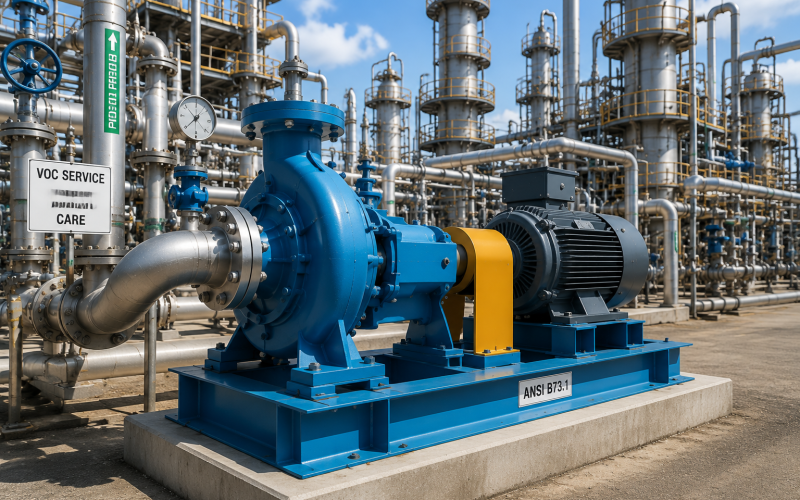
Introduction: Selecting the Right ANSI Pump for VOC Applications
In chemical processing, refining, pharmaceutical, and industrial manufacturing plants, handling volatile organic compounds (VOCs) requires more than simply selecting a pump with the correct flow rate and head. The sealing system, pump construction, material compatibility, and maintenance strategy all directly influence safety, reliability, and environmental performance.
For engineers responsible for VOC-containing fluids, one of the most important questions is: how can an ANSI process pump be selected and configured to minimize VOC leakage risks while maintaining reliable operation?
ANSI B73.1 horizontal end suction centrifugal pumps are widely used in chemical industries because of their standardized dimensions, robust design, and interchangeability. However, the pump itself is only one part of a complete VOC handling solution. The mechanical seal system, seal chamber design, operating conditions, and material selection must all be carefully evaluated.
ANSI Pumps Pro provides ANSI B73.1 chemical process pumps and replacement components engineered for demanding chemical applications, including pumps compatible with Goulds 3196 and Durco Mark III style process pumps. With more than 10 years of experience in ANSI pump design, manufacturing, and application support, we help chemical plants improve pump reliability while reducing maintenance risks.
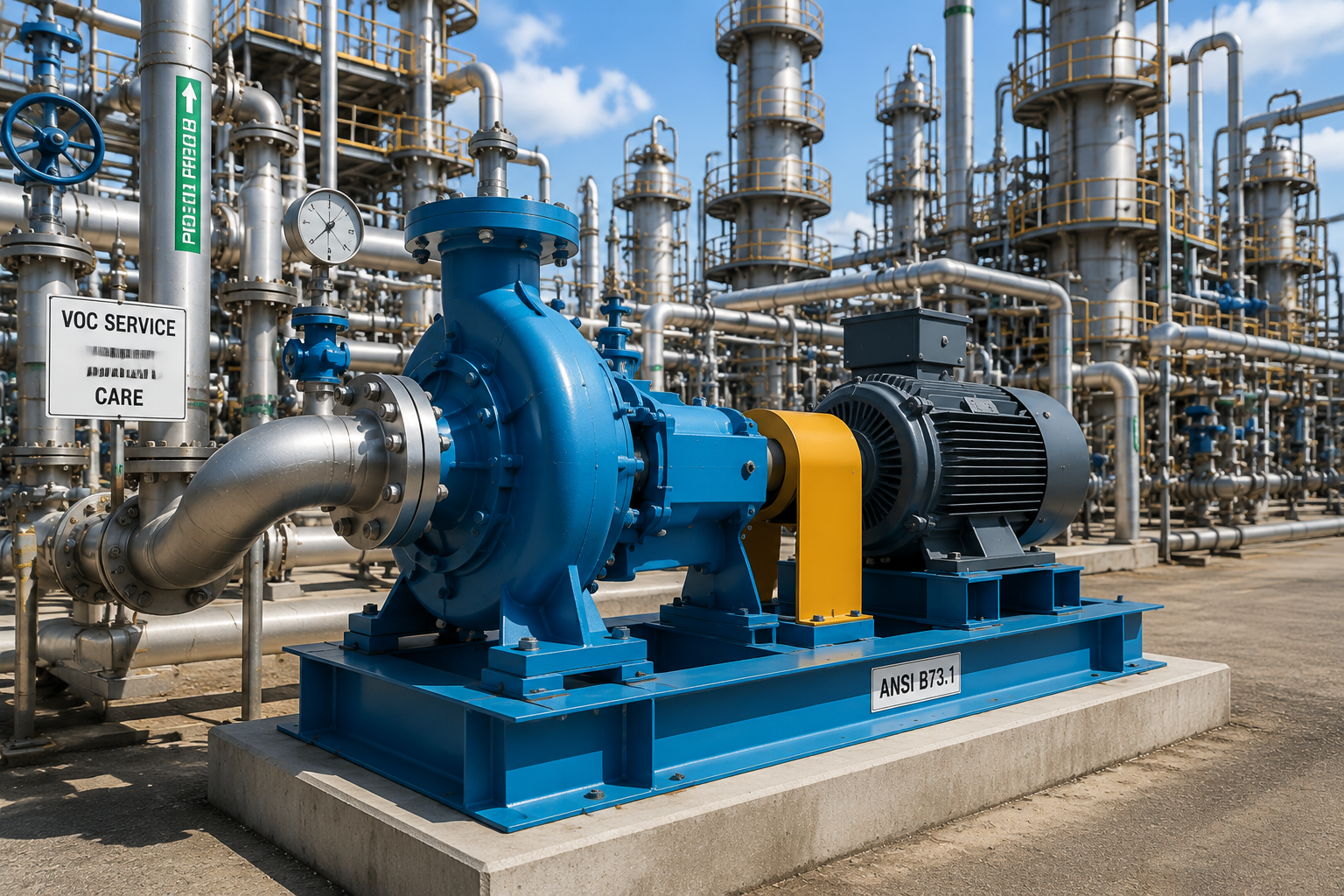
Understanding EPA VOC Requirements for Industrial Pumps
What Are VOC Emissions?
Volatile Organic Compounds (VOCs) are organic chemicals that easily evaporate at normal operating temperatures. Many VOC-containing fluids are commonly found in petroleum refining, petrochemical processing, chemical manufacturing, pharmaceutical production, solvent handling systems, and paint and coating industries.
Examples of VOC fluids include benzene, toluene, xylene, methanol, acetone, and various hydrocarbon solvents.
Because VOC emissions can affect workplace safety, environmental compliance, and product losses, industrial facilities implement strict leak prevention programs. For rotating equipment such as centrifugal pumps, the primary leakage point is usually not the pump casing itself, but the shaft sealing system.
Why Pump Sealing Systems Matter in VOC Applications
A centrifugal pump requires a sealing method where the rotating shaft passes through the stationary pump casing. Traditional sealing methods include packing seals and mechanical seals. For VOC applications, mechanical seals are generally preferred because they provide better leakage control and more consistent performance.
A properly selected mechanical seal helps reduce fugitive emissions, improve operator safety, extend maintenance intervals, and protect the surrounding environment. However, simply installing a mechanical seal does not guarantee reliable VOC service.
The complete sealing system must consider pump operating pressure, fluid temperature, fluid volatility, chemical compatibility, shaft movement, seal chamber design, and installation quality.
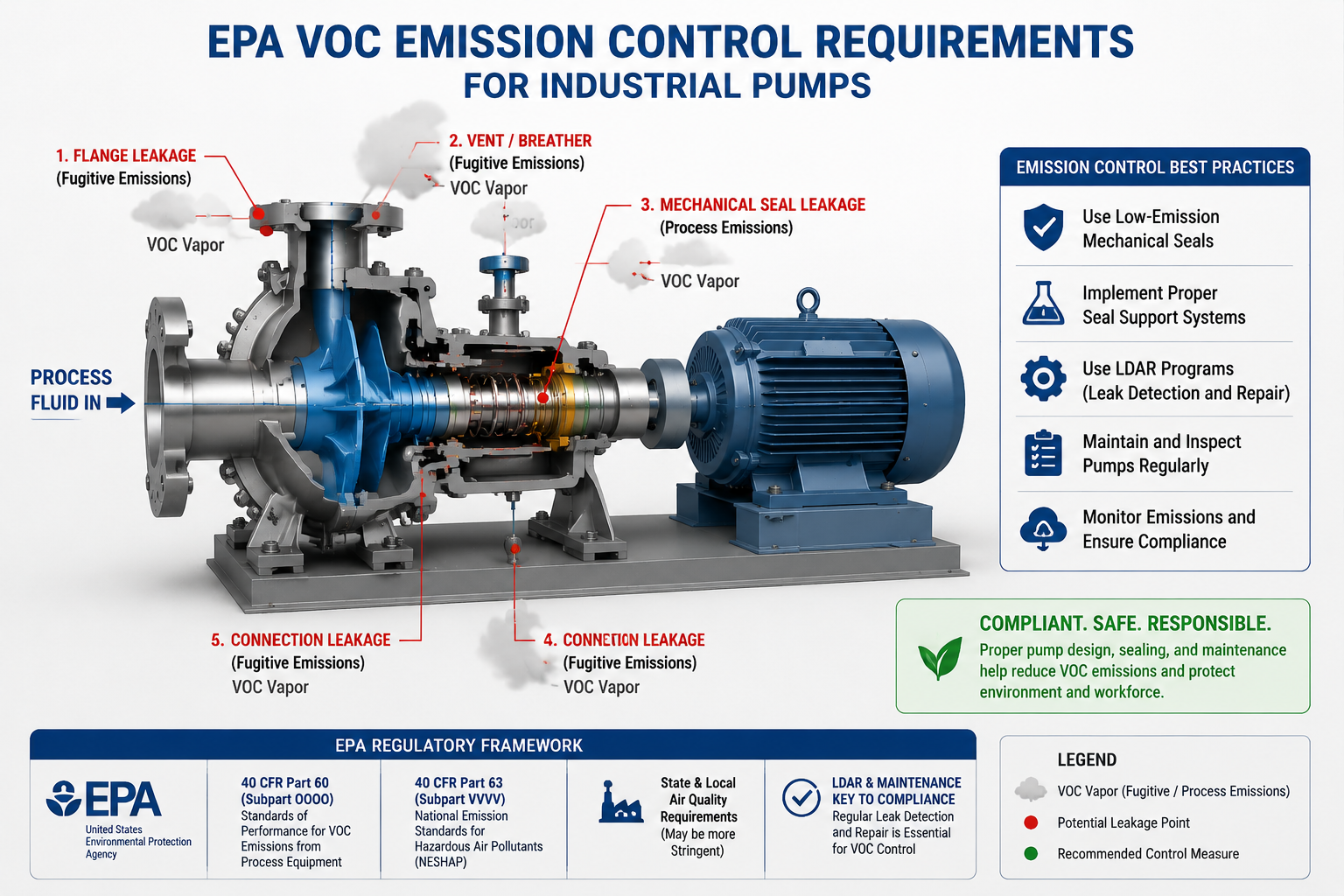
Why ANSI Process Pumps Require Proper Seal Selection for VOC Service
ANSI B73.1 Process Pump Design Overview
ANSI B73.1 is one of the most widely recognized standards for horizontal end suction centrifugal pumps used in chemical processing. These pumps are commonly selected because they provide standardized dimensions, easy maintenance, replaceable wet-end components, wide material availability, and compatibility with chemical applications.
Typical ANSI process pump components include volute casing, impeller, shaft, shaft sleeve, bearing frame, seal chamber, and mechanical seal. Although ANSI B73.1 defines many dimensional requirements, the sealing performance depends heavily on the selected seal configuration and application conditions.
Mechanical Seal vs Packing for VOC Applications
Packing seal limitations: Traditional packing systems use compressed sealing rings around the rotating shaft. Advantages include low initial cost, simple construction, and easy adjustment. However, packing may have limitations in VOC applications including higher leakage potential, continuous adjustment requirements, increased shaft wear, and more maintenance attention.
Mechanical seal advantages: Mechanical seals use precision-machined rotating and stationary faces to create a controlled sealing interface. Benefits include lower leakage — mechanical seals significantly reduce process fluid escape compared with conventional packing systems. Better reliability — modern cartridge mechanical seals provide easier installation and improved alignment. Improved environmental performance — reduced leakage helps plants meet stricter emission control objectives.
For VOC applications, mechanical seal selection should be treated as an engineering decision rather than a standard spare part choice.
Seal Chamber Design Considerations for VOC Pumps
The seal chamber is one of the most important areas affecting mechanical seal performance. A poor seal chamber design can create excessive heat generation, poor lubrication, vapor accumulation, and premature seal failure.
Important design factors include seal chamber volume — adequate space helps improve heat dissipation, fluid circulation, and seal face lubrication. Shaft runout control — excessive shaft movement can cause uneven seal face loading, seal leakage, and reduced operating life.
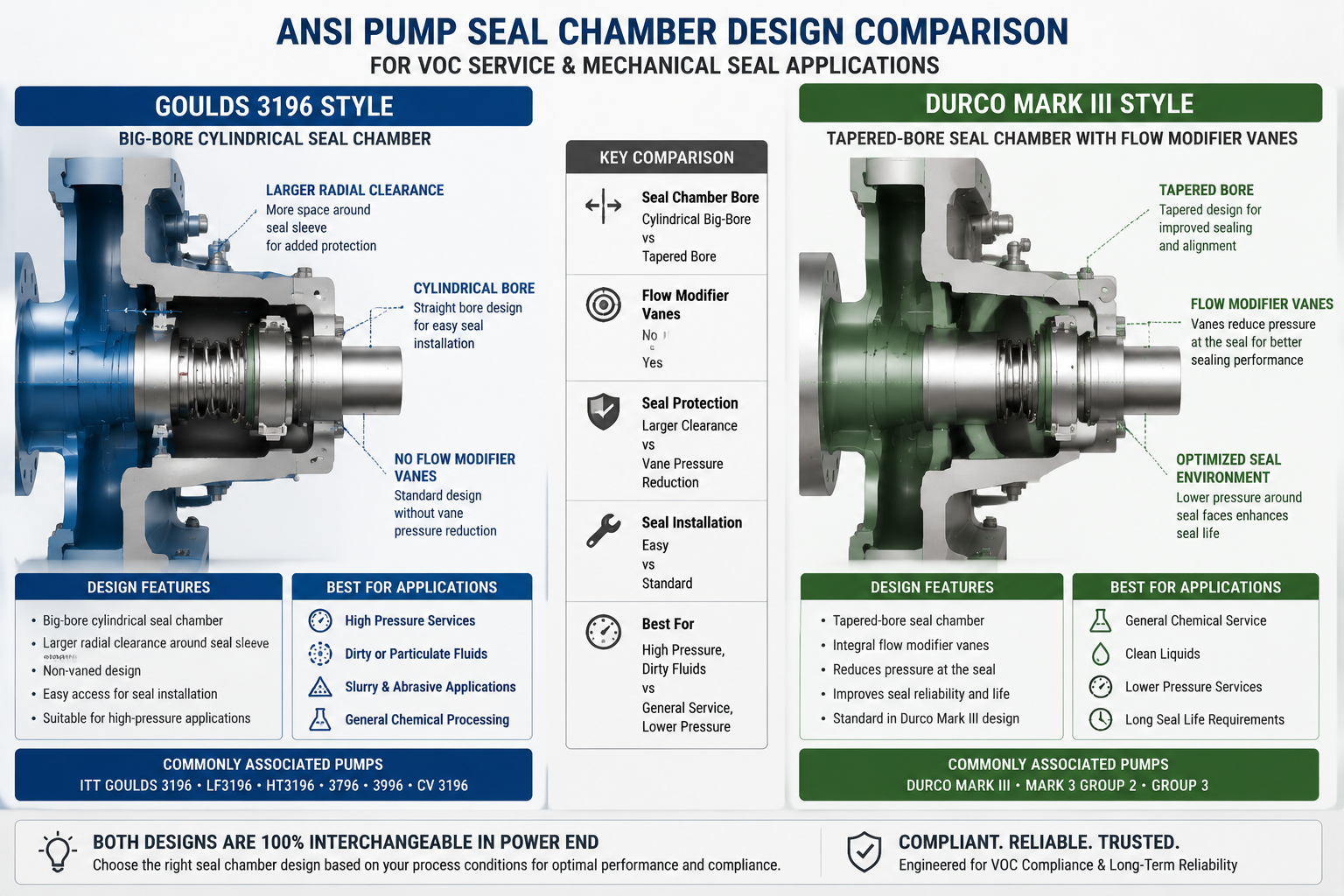
Different ANSI pump manufacturers use different seal chamber designs. For example, Goulds 3196 style pumps commonly use large cylindrical seal chambers, while Durco Mark III style pumps often incorporate tapered bore seal chambers designed to improve circulation around the seal. Selecting the correct seal chamber configuration can improve reliability in demanding VOC services.
Key ANSI Pump Design Features for VOC Compliance
ASME B73.1 Horizontal Process Pump Standard
A properly designed ANSI process pump for VOC service should provide robust shaft design — a rigid shaft reduces deflection and protects the mechanical seal from excessive movement. Replaceable wear components — wear rings and sleeves allow easier maintenance without replacing the complete pump. Chemical-resistant materials — wet-end components must match the handled fluid.
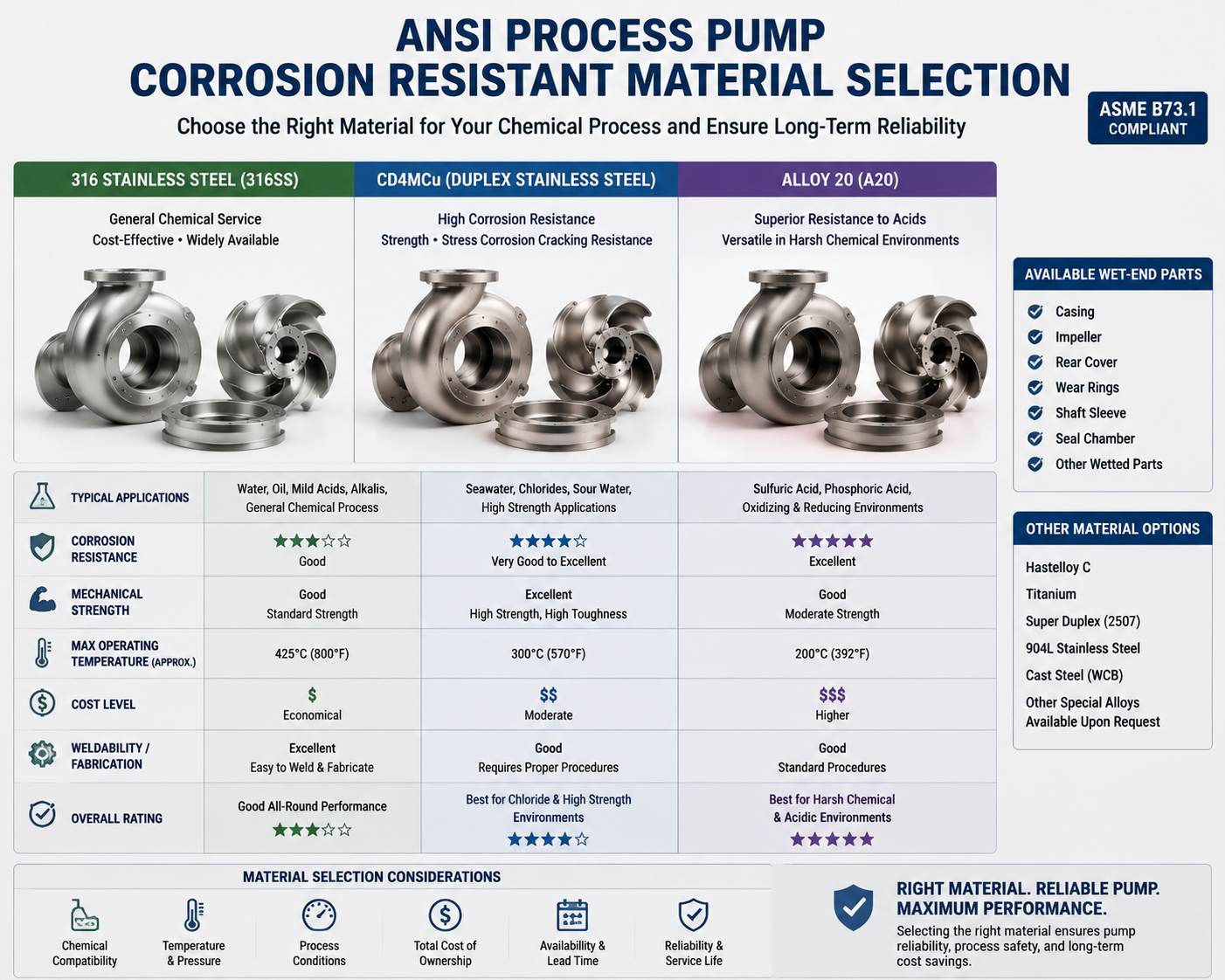
Material Selection for VOC Chemical Pump Applications
Material compatibility directly affects pump reliability. A chemically incompatible material may result in corrosion, surface damage, seal failure, and unexpected downtime. For VOC applications, engineers should evaluate chemical concentration, temperature, pressure, chloride content, and solvent properties.
| Material | Typical Application |
|---|---|
| 316 Stainless Steel (CF8M) | General chemical service |
| CD4MCu Duplex Stainless Steel | Corrosive chloride environments |
| Alloy 20 (CN7M) | Acid applications |
| Hastelloy C (CW2M) | Highly corrosive chemicals |
| Cast Steel (WCB) | General industrial service |
How to Select Mechanical Seals for VOC Pump Applications
Mechanical seal selection is one of the most important decisions when configuring an ANSI process pump for VOC service. A mechanical seal must control leakage while handling chemical compatibility requirements, high vapor pressure fluids, temperature changes, pressure fluctuations, and continuous operation conditions. Choosing the wrong seal design can lead to fugitive emissions, frequent maintenance, production interruption, and higher operating costs.
Single Mechanical Seals for VOC Applications
Single mechanical seals are commonly used in many chemical pump applications. A typical single seal includes rotating seal face, stationary seal face, secondary elastomers, spring assembly, and seal hardware. Advantages include simple structure, lower initial cost, easy maintenance, and suitability for many non-critical applications.
However, for highly volatile or hazardous VOC fluids, engineers must carefully evaluate whether a single seal provides sufficient leakage control. Factors to consider include fluid toxicity, emission requirements, operating temperature, and process pressure.
Double Mechanical Seals for Critical VOC Service
Double mechanical seals provide an additional barrier between the process fluid and atmosphere. They typically include a primary seal, secondary containment seal, and barrier fluid system. Advantages include improved leakage control — the secondary sealing system provides additional protection against process fluid escaping into the environment. Double seals are often considered for toxic VOC fluids, flammable chemicals, high-temperature applications, and critical production systems. The barrier fluid can improve lubrication and temperature control around the seal faces.
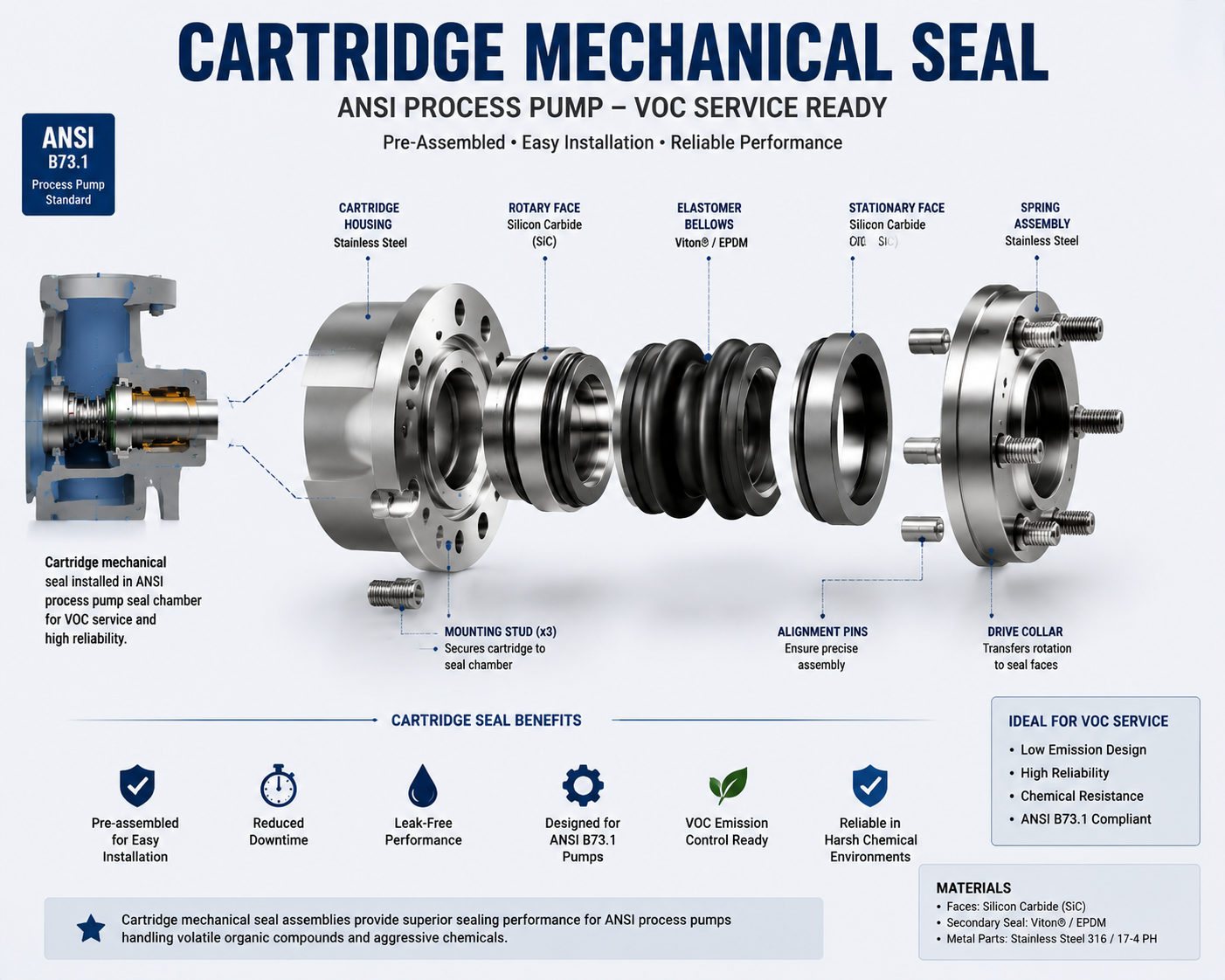
Cartridge Mechanical Seals: A Preferred Solution
Many chemical plants choose cartridge mechanical seals because they simplify installation and reduce maintenance errors. Traditional component seals require technicians to assemble individual parts during installation. Cartridge seals are pre-assembled units. Benefits include easier installation, reduced alignment errors, better repeatability, and shorter maintenance time. For ANSI process pumps operating in demanding VOC applications, cartridge mechanical seals are often selected to improve reliability and reduce downtime.
Common VOC Pump Problems and Engineering Solutions
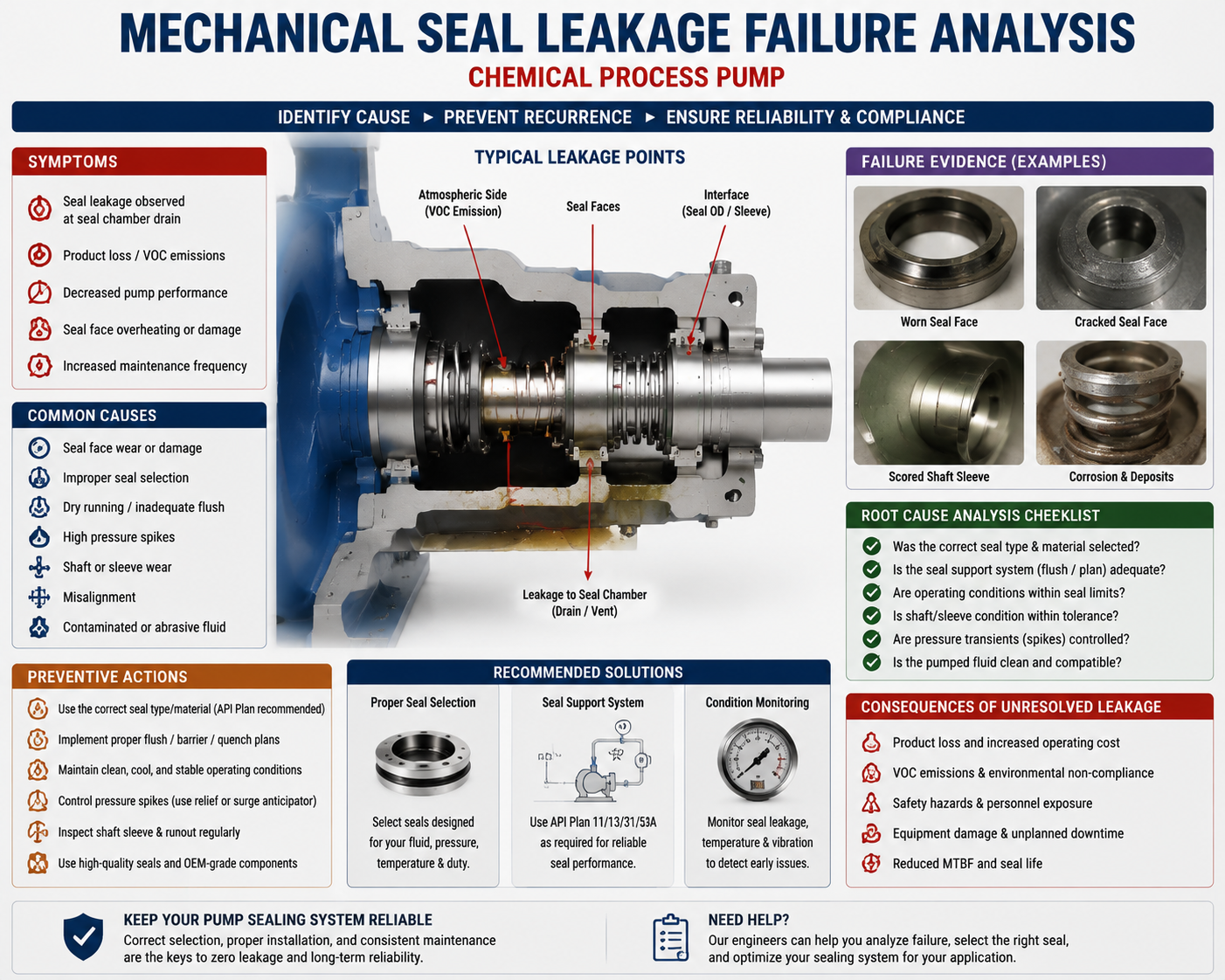
1. Mechanical Seal Leakage
Possible causes: Mechanical seal leakage may result from incorrect seal material selection, excessive shaft vibration, dry running conditions, improper installation, or poor seal chamber circulation.
Engineering solutions: Verify operating conditions before seal selection, use proper seal face materials, check shaft alignment, maintain correct operating range, and improve seal chamber design.
2. Cavitation and Low Suction Performance
VOC fluids often have relatively high vapor pressure. Poor suction conditions may cause vapor formation, impeller damage, vibration, and seal failure. Engineers should evaluate NPSH available, suction piping design, fluid temperature, and pump operating point. A pump operating too far away from its Best Efficiency Point (BEP) may also experience unstable hydraulic conditions.
3. Corrosion and Material Failure
Chemical compatibility is critical for VOC applications. Common corrosion problems include pitting corrosion, stress corrosion cracking, chemical attack, and erosion corrosion. Material selection should consider the complete operating environment. For detailed recommendations, see our chemical resistance guide for ANSI pumps.
ANSI Pumps Pro VOC Pump Solutions for Chemical Industries
Selecting a reliable ANSI process pump supplier is an important part of reducing compliance risks. ANSI Pumps Pro focuses on ANSI centrifugal process pumps and replacement solutions for chemical industries.
Our engineering capabilities include ANSI B73.1 process pump design, Goulds 3196 compatible solutions, Durco Mark III style replacement components, mechanical seal chamber engineering, and multiple corrosion-resistant materials.
For plants operating VOC chemical services, we support pump selection review, material recommendation, wet-end replacement, mechanical seal solutions for ANSI pumps, and technical documentation.
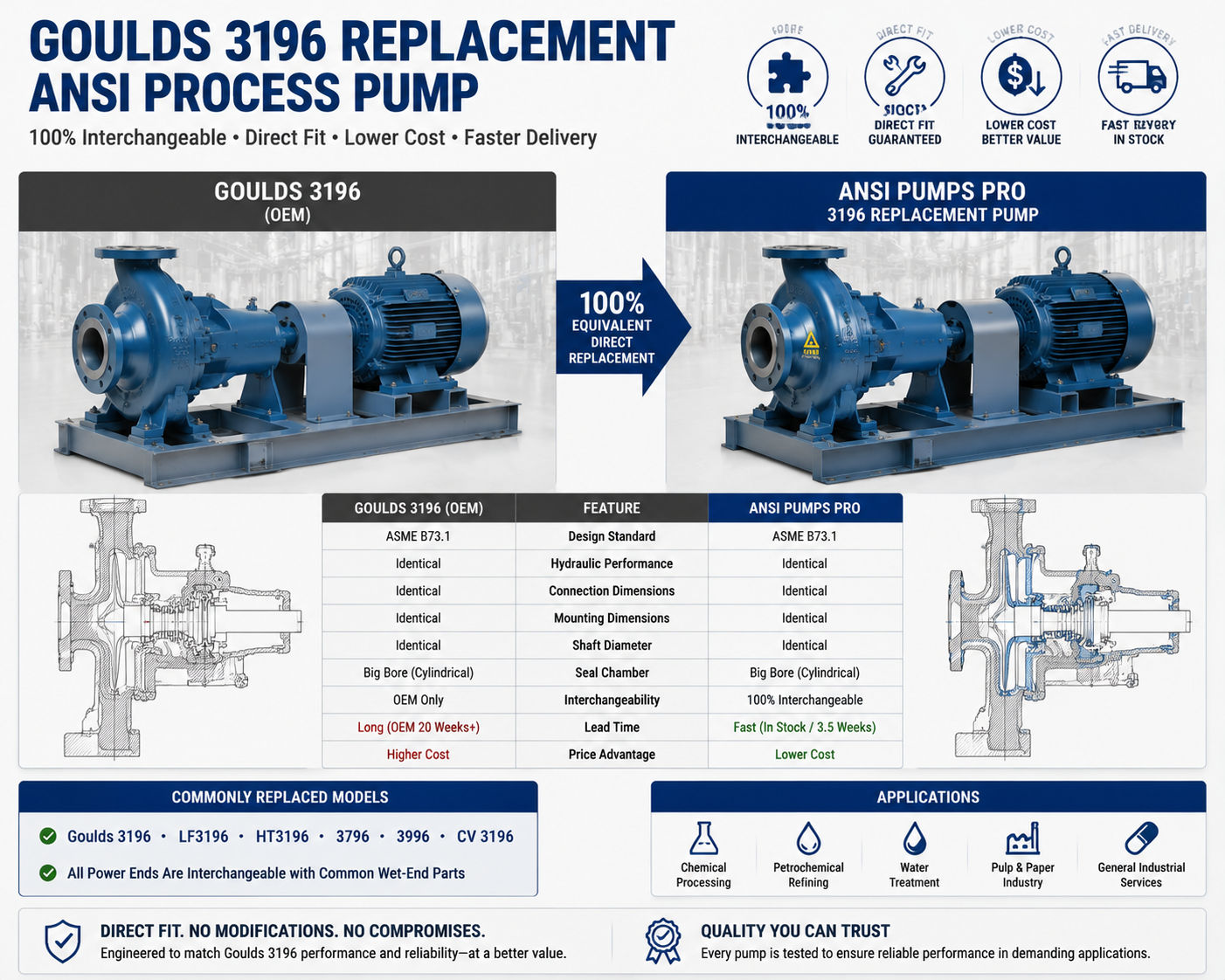
Goulds 3196 Replacement Pumps for VOC Applications
Many chemical plants operate installed bases of Goulds 3196 pumps, Durco Mark III pumps, and ANSI B73.1 process pumps. Over time, original equipment replacement parts may create challenges including long OEM lead times, higher maintenance costs, and limited material availability.
ANSI Pumps Pro provides compatible ANSI process pump components including impellers, volute casings, shafts, shaft sleeves, wear rings, seal chambers, and mechanical seal assemblies. The goal is to provide reliable replacement solutions while maintaining ANSI dimensional compatibility. See our Goulds 3196 compatible ANSI pumps for more information.
VOC Pump Compliance Checklist for Engineers
Before selecting an ANSI process pump for VOC service, engineers should review the following:
| Evaluation Item | Recommended Check |
|---|---|
| Pump standard | ASME B73.1 ANSI process pump design |
| Fluid properties | VOC type, viscosity, temperature, pressure |
| Seal type | Single, double, or cartridge mechanical seal |
| Seal materials | Face materials and elastomer compatibility |
| Pump materials | 316SS, CD4MCu, Alloy 20, Hastelloy selection |
| Operating point | Confirm pump operates near BEP |
| Documentation | Material certificates and inspection records |
| Maintenance | Spare parts availability and service support |
About ANSI Pumps Pro Engineering Team
ANSI Pumps Pro specializes in ANSI process pumps, replacement components, and chemical pump solutions for industrial applications. With more than 10 years of experience in pump technology design, manufacturing, sales, and service, our engineering team supports customers worldwide with ANSI B73.1 process pump solutions, chemical process pump applications, Goulds 3196 compatible replacements, Durco Mark III style replacement components, corrosion-resistant material selection, and mechanical seal and wet-end engineering.
Our experience covers industries including chemical processing, petrochemical, water treatment, pharmaceutical, and industrial manufacturing. We focus on helping customers improve pump reliability, maintenance efficiency, spare parts availability, and total operating cost performance.
Frequently Asked Questions
Are ANSI process pumps suitable for VOC applications?
Yes. ANSI B73.1 process pumps are widely used in chemical industries handling VOC fluids. However, proper mechanical seal selection, material compatibility, and operating condition evaluation are essential.
What type of seal is recommended for VOC pumps?
The recommended seal type depends on the fluid and operating requirements. Single mechanical seals may be suitable for some applications, while double mechanical seals or cartridge seals are often selected for more critical VOC services.
What materials are commonly used for VOC chemical pumps?
Common materials include 316 stainless steel, CD4MCu duplex stainless steel, Alloy 20, Hastelloy, and other corrosion-resistant alloys depending on chemical compatibility. See our chemical process pump applications for more information.
Can ANSI Pumps Pro replace Goulds 3196 pumps?
ANSI Pumps Pro provides ANSI process pump solutions and compatible replacement components designed for applications using Goulds 3196 style equipment. Contact our engineering team for a compatibility review.
How can pump leakage risks be reduced in VOC service?
Leakage risks can be reduced by selecting the correct mechanical seal, using compatible materials, maintaining proper operating conditions, ensuring correct installation, and performing regular inspection.
Need an ANSI Pump Solution for VOC Chemical Applications?
Selecting the correct pump configuration is critical for reliable VOC service. ANSI Pumps Pro can help you evaluate existing pump model replacement, mechanical seal requirements, corrosion-resistant materials, ANSI B73.1 compatibility, and chemical application conditions.
Send us your pump data sheet or operating requirements. Our engineering team will help recommend a suitable ANSI process pump solution.
Request an Engineering Review
Get technical guidance on ANSI process pump selection for VOC applications, including seal selection, material recommendations, and compatibility verification.