Current Standard Status
| Item | Current status |
|---|---|
| ANSI/HI 9.8 | 2024 |
| Supersedes | 2018 edition |
| Primary topic | Rotodynamic pump intake design |
| Related piping standard | ANSI/HI 9.6.6-2022 |
| Detailed numerical criteria | Use the current licensed standard |
For detailed figures, dimensions and acceptance criteria, confirm the current controlled issue and any applicable corrections directly through Hydraulic Institute or the project’s licensed standards source.
What ANSI/HI 9.8-2024 Actually Covers
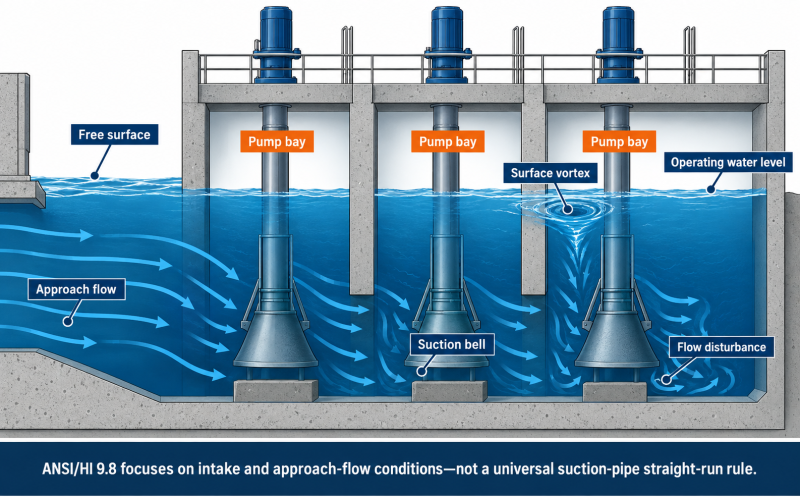
Hydraulic Institute describes ANSI/HI 9.8 as applying to new pump intakes and modifications to existing intakes used with rotodynamic pumps. The design objective is approach flow that is as uniform and steady as practical and free from harmful swirl and entrained air. The scope includes clear-liquid intakes and solids-bearing intake arrangements, with the applicable review depending on the intake geometry, operating range and project requirements.
That makes this standard useful for pump-station intake design, wet-well design and retrofit reviews. It does not publish a single universal number that can be applied to every suction pipe or every pump station.
Why Intake Flow Quality Affects Pump Reliability
Disturbed approach flow can change the conditions presented to one pump or to a group of pumps. Depending on the installation, the resulting symptoms can include unstable head or flow, noise, vibration, air ingestion, loss of hydraulic performance or a different response when pumps are started in combination. Those symptoms still require a complete diagnosis: intake hydraulics, NPSHa vs NPSHr and NPSH margin, closed piping, pump condition and controls can overlap.
ANSI/HI 9.8 vs ANSI/HI 9.6.6: Intake Design vs Pump Piping
These standards address related but different engineering boundaries. A project may need both reviews.
| ANSI/HI 9.8 intake design | ANSI/HI 9.6.6 pump piping |
|---|---|
| Wet well, sump and approach channel | Closed suction and discharge piping |
| Free-surface intake and pump bay | Elbows, reducers, valves and piping arrangement around the pump |
| Suction bell, submergence, swirl and vortex risk | Actual inlet/outlet geometry and piping-generated flow effects |
| Intake hydraulics before the pump intake | Piping upstream and downstream of the pump, within the standard’s scope |
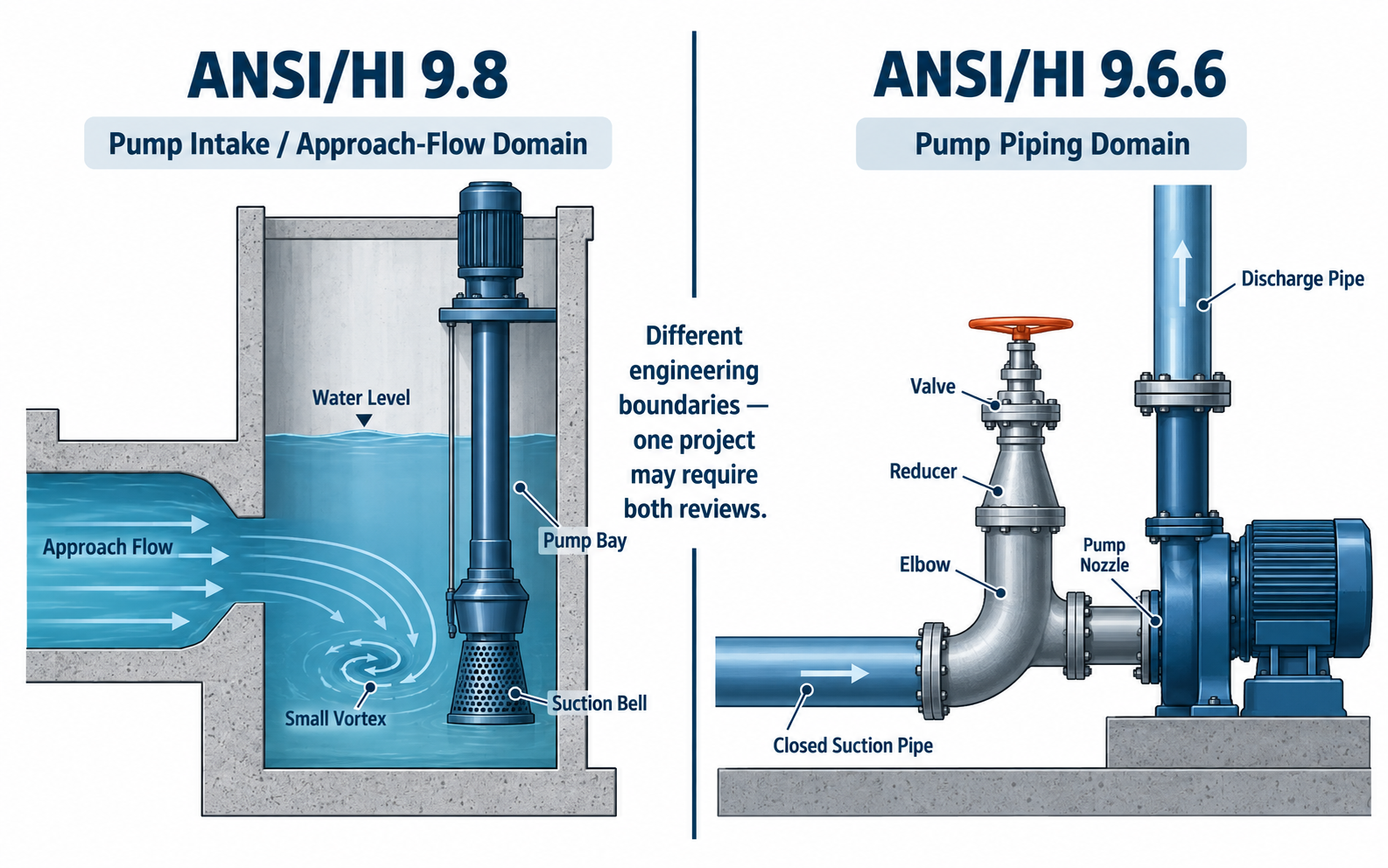
Do not copy a fixed straight-run rule from one installation and treat it as a universal intake requirement. Actual piping geometry, pump-manufacturer guidance and system conditions matter.
Intake Arrangements Covered by ANSI/HI 9.8
| Intake family | Typical engineering review question |
|---|---|
| Rectangular intake | Is approach flow reasonably uniform across the pump bay? |
| Formed suction intake | Does the formed geometry control incoming flow appropriately? |
| Circular pump station | Do pump position and combined operation create asymmetric approach flow? |
| Trench-type intake | How are flow and, where relevant, solids distributed? |
| Tank suction | Can the inlet arrangement create recirculation or vortex risk? |
| Suction-can intake | Do operating level and intake geometry meet the applicable project criteria? |
| Unconfined intake | Are ambient approach conditions adequately controlled? |
| Solids-bearing wet well | Are solids transport, deposition and intake hydraulics being considered together? |
Required Submergence and Vortex Risk
Submergence is an intake-design variable, not a universal fixed number. Low liquid level can increase surface-vortex and air-entrainment risk, while geometry, pump combination, operating level and approach conditions influence the result. ANSI/HI 9.8-2024 includes a dedicated treatment of required submergence for minimizing surface vortices. Use the licensed standard and project-specific review to establish the applicable criteria rather than copying a generic rule.
Surface Vortex vs Subsurface Vortex vs Pre-Swirl
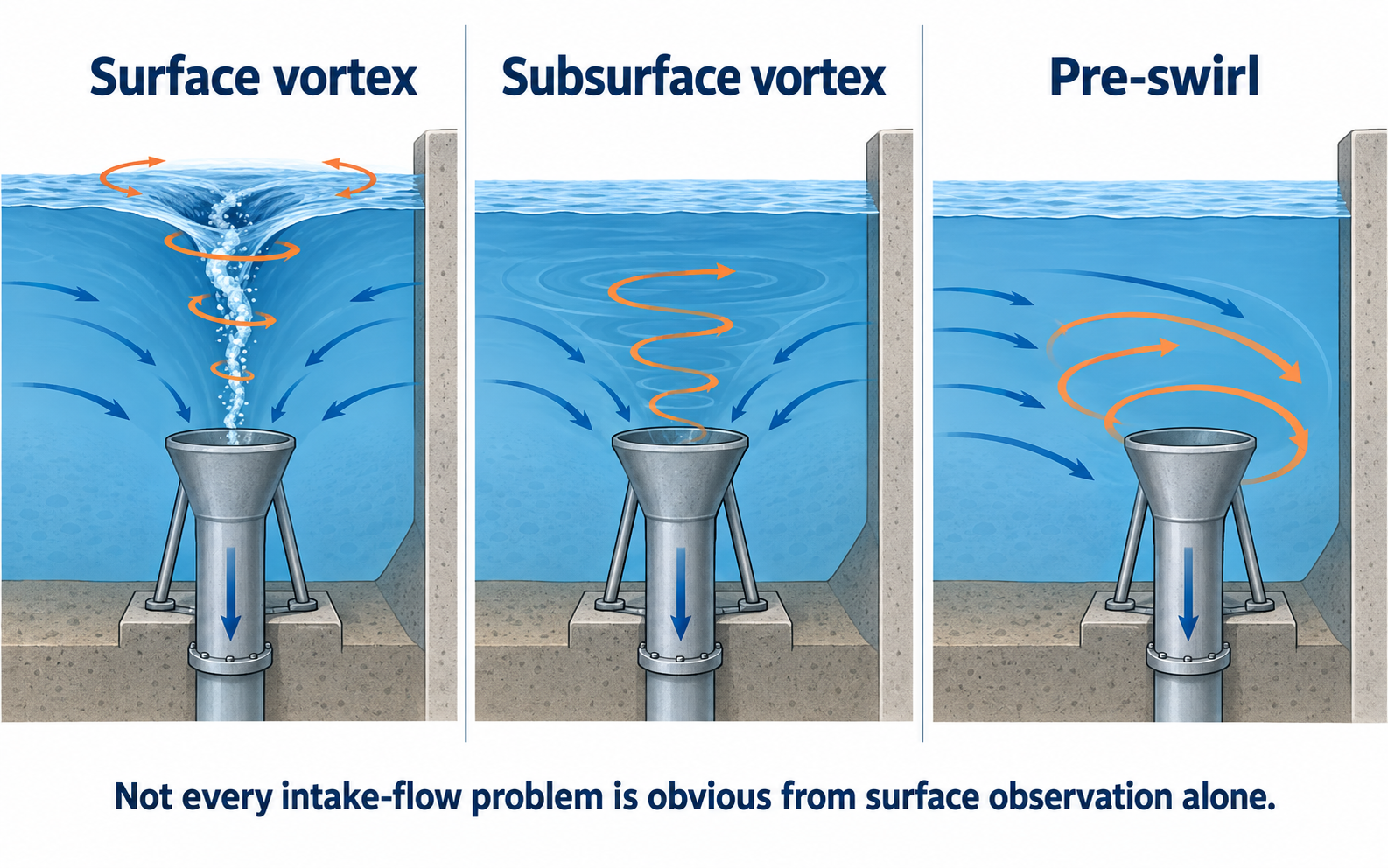
Surface observation is useful field evidence, but it does not describe every flow condition near the intake.
Field Symptoms That Can Point to an Intake-Flow Problem
| Field observation | Intake-related possibility | Also check |
|---|---|---|
| Noise or vibration changes with liquid level | Vortex or nonuniform approach flow | NPSH, mechanical condition |
| One pump performs worse than adjacent identical units | Asymmetric approach flow | Individual pump condition, piping |
| Symptoms change with number of pumps operating | Pump-bay interaction | System curve, controls |
| Visible surface vortex | Low submergence or disturbed approach flow | Obstruction, operating level |
| Air ingestion | Surface vortex or upstream disturbance | Suction leaks, process air |
| Unstable head or flow | Disturbed inlet conditions | centrifugal pump cavitation field checklist, controls, system operation |
These observations are diagnostic clues, not proof of a single root cause.
When a Physical Model Study May Be Required
A physical model decision should be based on the represented geometry and the applicable standard or project requirements. A study scope should define the geometry being represented, operating pump combinations, flow range, water-level range, scale and similitude basis, measurement methods, vortex and swirl observations, test plan, acceptance basis and final report requirements. The standard contains dedicated guidance for the need, objectives, scale selection, instrumentation, test plan, acceptance and reporting; this article does not reproduce proprietary acceptance criteria.
Where CFD Fits—and Where It Does Not Replace Physical Modeling
ANSI/HI 9.8 includes guidance on computational fluid dynamics, and Hydraulic Institute has published work evaluating CFD methodologies for pump-intake modeling. CFD can help visualize complex flow patterns, compare sensitivities and investigate geometry. It should not automatically be treated as a substitute for a required physical model or as proof of compliance. Hydraulic Institute’s current white paper states that CFD alone cannot currently demonstrate compliance with the intake standard.
| Tool | Best used for |
|---|---|
| Standard design criteria | Conventional arrangements within the applicable scope |
| CFD | Flow visualization, sensitivity studies and complex-geometry investigation |
| Physical model | Hydraulic demonstration where the standard or project requires it |
What Data to Collect Before Reviewing an Intake Problem
Intake Geometry
- Wet-well dimensions and approach-channel geometry
- Pump-bay arrangement, walls, columns, screens and gates
- Suction-bell location and obstructions
Operating Conditions
- Minimum, normal and maximum flow
- Number of pumps operating and operating sequence
- Minimum, normal and maximum liquid level
- Solids or debris conditions
Field Evidence
- Photos, video, vibration and noise observations
- Visible vortex, air ingestion or head/flow instability
- Drawings and previous model or CFD reports
Buyer and Retrofit Review Checklist
- Identify whether the issue is intake hydraulics, closed piping, pump condition or a combination.
- Confirm operating flow range and water-level range.
- Map intake geometry, obstructions and pump combinations.
- Correlate symptoms with operating condition and liquid level.
- Check whether the proposed geometry falls inside applicable standard criteria.
- Determine whether CFD, a physical model, field measurement or pump inspection is needed.
- Document modifications and verify the resulting condition.
Start with what you have. A drawing, pump arrangement, duty point, operating levels and a few field observations are enough to begin a structured review.
Need an Intake or Suction Review?
Send the intake drawing, pump arrangement, flow range, operating water levels, photographs and observed symptoms.
Request Intake / Suction Review
Is this part of a pump replacement?
Send the existing pump model, duty point, NPSH information and installation drawing so intake issues can be separated from pump-fitment issues.
Related Engineering Links
- NPSHa vs NPSHr and NPSH margin
- centrifugal pump cavitation field checklist
- ANSI pump dimensions and interchangeability
- pump vibration standards guide remains useful when symptoms are level- or load-dependent.
Frequently Asked Questions
What is ANSI/HI 9.8-2024 used for?
It is used for the design and review of new or modified rotodynamic-pump intakes, including approach flow, wet wells, pump bays, suction bells, submergence, swirl and entrained air.
What is the difference between ANSI/HI 9.8 and ANSI/HI 9.6.6?
ANSI/HI 9.8 addresses pump-intake and approach-flow design. ANSI/HI 9.6.6 addresses pump piping. A pumping installation may require both reviews depending on the system boundary.
Can CFD replace a physical pump-intake model study?
Not automatically. ANSI/HI 9.8 includes CFD guidance, while Hydraulic Institute notes that CFD alone is not currently a demonstration of compliance with the intake standard. Project geometry and applicable requirements determine the appropriate validation method.
Does ANSI/HI 9.8 give one suction-pipe straight-run rule?
No. Intake design and closed pump piping are related but separate review domains. Do not apply a universal straight-run number without checking the applicable standard, geometry and manufacturer guidance.
Sources
- Hydraulic Institute — ANSI/HI 9.8 Rotodynamic Pumps for Pump Intake Design
- Hydraulic Institute — ANSI/HI 9.8-2024 Table of Contents
- Hydraulic Institute — ANSI/HI 9.6.6 Rotodynamic Pumps for Pump Piping
- Hydraulic Institute — Pump Intake CFD Modeling Methodology Evaluation White Paper
- ANSI Webstore — ANSI/HI 9.8-2024