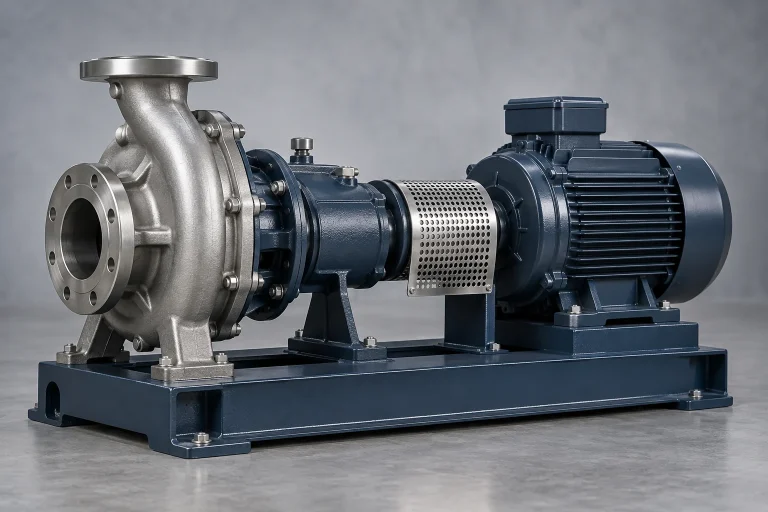

Engineering Insights · Replacement & Retrofit
Can an ASME B73.1 pump replace an ISO 5199 pump without changing the installation? Sometimes a replacement can be engineered with limited work, but the standards alone do not guarantee a drop-in fit. Pump dimensions, pipe interfaces, duty, materials, driver, coupling and seal arrangement must be checked against the installed equipment and the proposed pump.
Short answer: Do not approve a cross-standard replacement from the labels “ANSI” and “ISO” alone. Confirm the exact pump designation, duty point and installation interfaces from current manufacturer drawings.
Quick comparison: ASME B73.1, ISO 2858 and ISO 5199
“ANSI pump” is common industry shorthand. The pump standard discussed here is ASME B73.1. ISO 2858 and ISO 5199 are separate references with complementary roles; one should not be used as a substitute name for the other.
01 · Dimensional / process-pump framework
ASME B73.1-2026
Horizontal end-suction chemical-process pump design and specified dimensional interchangeability within the standard’s scope.
Does not prove: all pumps called “ANSI” share identical internal parts, hydraulic performance or seal arrangement.
02 · Designation / nominal duty / dimensions
ISO 2858:1975
Designation, nominal duty point and principal dimensions for the end-suction pump types covered by the standard.
Does not prove: a pump described as “ISO” has matching nozzles, dimensions or operating performance.
03 · Technical specification
ISO 5199:2002
Technical specifications for Class II centrifugal pumps.
Does not prove: the pump has the same installation envelope as a B73.1 pump.
Check the purchaser’s specification and the current, applicable editions before procurement. A standard’s title is only the starting point for a fitment review.
What “interchangeable” means in a pump replacement
Interchangeability can refer to different scopes. A complete-pump replacement must fit the process duty and the installation. A wet-end or individual-part replacement also depends on platform-specific interfaces and component references. Confirm which scope is being quoted before comparing suppliers.
- Dimensional fit: mounting, nozzle positions, foundation holes, centerline and maintenance clearances.
- Hydraulic fit: flow, head, speed, impeller, operating range, NPSH and system conditions.
- Mechanical fit: shaft extension, coupling, driver, bearing frame and pull-out space.
- Process fit: pressure and temperature limits, materials, seal chamber and auxiliary piping.
- Documentation fit: drawings, inspection, material traceability and testing required by the project.
A pump can meet the required duty and still need installation changes. Conversely, a dimensional difference does not automatically rule out a replacement; it identifies an engineering item to resolve.
Cross-standard pump replacement checklist
Compare the installed pump and proposed replacement using the same reference points. Record the source drawing and revision for every dimension. If a value is unavailable, mark it “unverified” rather than estimating it from the standard name.
Pump identity
Manufacturer, model, size designation, serial number, configuration and applicable standard edition.
Operating duty
Rated and normal flow, head, speed, liquid properties, temperature, solids, operating range and system curve.
Suction and discharge
Nozzle size and orientation; flange type, facing, drilling, material and pressure-temperature rating; gasket and bolting compatibility.
Base and foundation
Footprint, foundation-bolt pattern, pump centerline, grout/baseplate arrangement, support and available adjustment.
Shaft and driver
Shaft diameter and extension, coupling type and spacer, motor frame, speed, power, rotation and pull-out clearance.
Seal and auxiliary connections
Seal-chamber dimensions, gland interface, seal type, flush/quench plan, port location, thread type and piping arrangement.
Materials and limits
Pressure-containing materials, corrosion/erosion compatibility, pressure, temperature and any project-specific qualification.
Inspection and records
Required GA and sectional drawings, dimensional report, material certificates, hydrostatic test and performance-test scope.
Flange compatibility: compare the actual connection, not just NPS or DN
ASME B16.5 and EN 1092-1 / ISO 7005 references describe pipe-flange requirements. A pump nozzle’s actual flange must still be verified from the pump drawing. Nominal size alone does not establish matching bolt-circle diameter, hole count, facing, gasket contact, bolting or pressure-temperature rating.
ASME Class designations and PN designations are not direct, universal pressure equivalents. Ratings depend on the applicable flange standard, material group and temperature. Before proposing a transition, compare the two flange drawings and confirm the full pressure boundary, fluid compatibility, gasket, bolts, pipe loads and available space.
Do not use a universal PCD conversion table without a verified source. Any size-by-size table should identify the exact standard and edition, flange type, pressure class, material assumptions and source drawing. Where the pump nozzle differs from the pipe flange assumed in a table, use the manufacturer’s nozzle drawing.
Retrofit options when a direct replacement does not fit
The right modification depends on which interface differs. These are options for engineering review, not universal installation instructions.
- Baseplate or adapter plate: Consider only after comparing centerline, feet, foundation and shaft alignment. Check stiffness, support, grout, hold-downs and alignment procedure.
- Pipe transition or spool: Have the piping designer check flange standards, pressure-temperature ratings, materials, gasket, bolt loads, nozzle loads, flow path, supports and maintenance access.
- Coupling and driver change: Recheck shaft extension, coupling spacer, motor frame, power, speed, rotation, guard and the clearance needed to remove the rotating assembly.
- Seal-system adaptation: Confirm the seal chamber, gland, ports and seal plan with the pump and seal suppliers. A seal designation alone does not establish chamber or connection compatibility.
- Hydraulic re-selection: If the proposed pump does not cover the required duty and operating range, select the pump from the process requirements rather than attempting to solve a hydraulic mismatch with an interface adapter.
Do not force misaligned pipework into position or modify pressure-containing parts based only on a nominal-dimension comparison. The project engineer should approve the final design and installation procedure.
Which replacement route should you choose?
Like-for-like route
Existing B73.1 installation
Confirm the standard scope, exact configuration, duty, materials, seal and retained installation interfaces.
ISO-based route
Existing ISO pump
Confirm whether ISO 2858 dimensions apply to the selected model, then check drawings and ISO 5199/project requirements.
Conversion route
Moving between pump families
Classify every interface as verified, different or unknown before approving a retrofit.
New system route
New installation or redesign
Select against duty, project specification, lifecycle needs and maintenance support; coordinate pump and piping interfaces.
Neither standard guarantees a universal efficiency or reliability advantage. Compare manufacturer curves at the actual duty point, materials, seal system, driver, operating range, test evidence and lifecycle requirements.
Information to gather for an engineering fitment review
- Current pump nameplate and manufacturer/model/size.
- Current GA drawing and, if available, sectional drawing.
- Flow, head, speed, liquid, temperature, solids and normal operating range.
- Suction and discharge flange details and pipe standard/class.
- Baseplate/foundation dimensions, motor nameplate and coupling information.
- Seal model, seal plan and auxiliary-piping details.
- Material, inspection, testing and documentation requirements.
Photos can help identify the equipment, but they do not replace controlled drawings or dimensional measurements for final fit-up.
Frequently asked questions
Can an ASME B73.1 pump directly replace an ISO 5199 pump?
Not by standard name alone. Confirm the exact pump dimensions, nozzle interfaces, base, shaft and coupling, driver, seal system, materials and hydraulic duty. Some installations may need modifications; others may be adaptable after verification.
What is the difference between ISO 2858 and ISO 5199?
ISO 2858 addresses designation, nominal duty point and principal dimensions for covered end-suction pumps. ISO 5199 sets technical specifications for Class II centrifugal pumps. They are complementary references with different purposes.
Are ASME Class 150 and PN16 flanges interchangeable?
Do not assume they are. Compare the applicable flange standards, material and temperature rating, drilling, facing, gasket, bolts and the pump nozzle drawing. A shared nominal size does not prove a safe or matching joint.
Does ISO 5199 mean a pump is designed only for 50 Hz?
No. Frequency and speed depend on the selected motor, pump configuration, impeller, curve and project electrical supply. Verify the actual equipment and duty.
Can the same mechanical seal be used on both pump standards?
Possibly, but it must be checked against the specific seal chamber, gland interface, shaft, operating conditions and auxiliary connections. The standard name alone is not enough.
What should I send to request a replacement review?
Send the pump model and nameplate, duty point, GA drawing, flange details, motor/coupling information, seal arrangement and materials. Include the project specification and any required inspection or testing documents.
Standards and editorial references
- ASME B73.1 — Specification for Horizontal End Suction Centrifugal Pumps for Chemical Process.
- ISO 2858:1975 — End-suction centrifugal pumps: designation, nominal duty point and dimensions.
- ISO 5199:2002 — Technical specifications for centrifugal pumps, Class II.
- ASME B16.5 — Pipe flanges and flanged fittings.
Use the applicable licensed standard editions and manufacturer drawings for design, procurement and installation. This guide is a screening checklist and does not replace project-specific engineering approval.