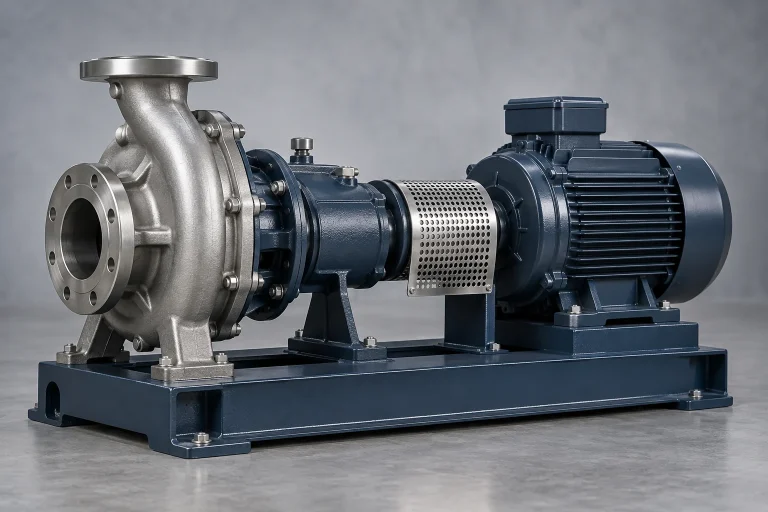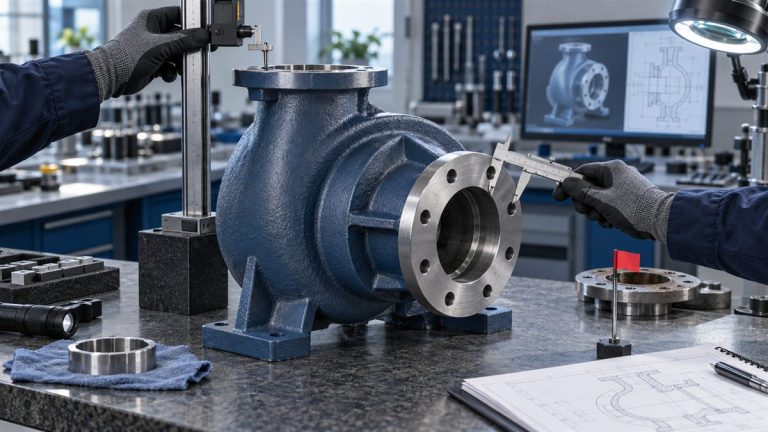

IDENTIFICATION & CONFIGURATION REVIEW
A Goulds 3185 nameplate is a useful starting point, but it does not identify every interface, wet-end arrangement, material, or service condition needed to verify a replacement part. Before ordering, assemble the pump identity and the evidence that describes the installed configuration.
Model designation, full size, serial number, flange standard, construction details, and operating duty each answer a different fit question. A match on one item does not prove overall interchangeability.
01 · MODEL IDENTIFICATION
3185 and 3180: check the standard system first
The most useful first distinction is the installation standard. Goulds literature identifies the 3185 with metric dimensions and ISO or JIS 16 bar flange drilling; the 3180 is the ANSI-flanged counterpart in the product family. This distinction helps identify the installed configuration, but it is not a complete compatibility check.
| Evidence to check | What it can tell you | What it cannot prove by itself |
|---|---|---|
| Model marking: 3180 or 3185 | Which family designation appears on the nameplate or records | That every part, dimension, or material matches another pump |
| Flange drilling and project standard | Whether the visible interface is consistent with ANSI or ISO/JIS metric installation | Full dimensional, hydraulic, or component interchangeability |
| Complete pump size, group, and serial number | A route to the applicable drawing, parts list, and construction record | Current material condition or undocumented field modifications |
For a broader family comparison, see the 3175 vs 3180 paper-stock pump guide. Keep the 3185 discussion here focused on identifying its metric installation and configuration evidence.
02 · CONFIGURATION EVIDENCE
Record the configuration that is actually installed
Two pumps carrying the same family name may differ in size, hydraulic arrangement, construction materials, or sealing details. Photograph the nameplate and overall assembly, then compare the details with the applicable drawing or parts list.
Model, complete size designation, serial number, and any nameplate codes. Mark unreadable or missing fields as unknown instead of inferring them.
Flange standard, nominal sizes, orientation, centerline, baseplate, coupling, and available dimensional drawing. Record measurements with their reference points.
Open or enclosed impeller, any special impeller option, casing and sideplate arrangement, and the impeller diameter or trim where documented.
Material codes for wetted components; mechanical seal, packing, or dynamic-seal arrangement; sleeve and seal-chamber details; and any flush or support plan.
Process fluid, solids or fibers, concentration where known, normal/minimum/maximum flow, head or pressures, temperature, speed, suction conditions, and motor nameplate data.
Paint, wear, previous repairs, and field changes can hide the original arrangement. Use the serial number, drawings, parts records, and measured interfaces together.
03 · OPTIONS & BOUNDARIES
Impeller and seal options must be verified by size and service
The Goulds 3185 brochure describes open and enclosed impellers, plus a Shearpeller option for selected difficult services. It also describes mechanical-seal, packed-box, and dynamic-seal arrangements. These are configuration choices, not a promise that every option is available on every size or material build.
Open impeller
The brochure describes a full back shroud, thick vanes, balance holes, and back vanes. Confirm the installed impeller and sideplate arrangement against the pump drawing before specifying a replacement.
Enclosed impeller
Verify the actual assembly, wear interfaces, and adjustment method from the applicable documentation. Do not transfer a clearance or adjustment value from another pump family.
Shearpeller
Treat this as a specific service option, not a generic name for any 3185 impeller. The OEM brochure’s materials note limits this option to Duplex 2205 construction.
Seal arrangement
Identify the installed seal type, chamber, sleeve, and support connections. Seal selection depends on the actual liquid and operating conditions, not only on the pump model.
For a seal or impeller decision, use the exact OEM drawing and service documentation. For general geometry trade-offs, see the open vs enclosed impeller guide; its general selection logic does not replace 3185 size-specific verification. If the duty has changed, compare the measured or specified operating point with the curve for the correct size, speed, and impeller configuration; this article does not reproduce or estimate pump performance.
04 · OPERATING DUTY
Separate pump identity from operating-duty verification
A replacement component may fit mechanically and still be unsuitable for the current duty. Keep the identification record and process record together, then have the hydraulic and material fit reviewed against the actual installation.
Capture the nameplate, complete size, serial number, flange standard, and current assembly photographs.
Record fluid, solids/fibers, temperature, flow range, head/pressures, speed, suction conditions, and motor data.
Match the evidence to the applicable drawing, material list, seal arrangement, and pump curve before deciding scope.
If the flow and head are uncertain, start with the centrifugal pump sizing calculator to organize the system inputs, then review the assumptions and result with the correct pump data. The calculator does not establish 3185 compatibility on its own.
05 · REVIEW PACKAGE
What to prepare before a 3185 parts or replacement review
A concise evidence package makes it easier to distinguish an individual-component request from a complete-pump review. Send what is available and call out what is missing.
| Include | Useful detail | Why it matters |
|---|---|---|
| Nameplate and serial | Clear, square-on photo; transcribe model and full size | Anchors the model-specific document and parts-list search |
| Interfaces and assembly | Flange faces, base, coupling, casing, cover/sideplate, and seal area | Helps identify geometry and any visible field changes |
| Part scope | Part name/number if known; component photos and dimensions with datums | Distinguishes a component inquiry from a wet-end or complete-pump request |
| Materials and process | Material codes, fluid, concentration, solids/fibers, temperature | Supports a component-by-component materials and sealing review |
| Duty and driver | Flow range, head/pressure, speed/frequency, suction data, motor plate | Allows the operating requirement to be checked independently from physical fit |
| Reference documents | GA drawing, datasheet, curve, IOM, prior quote, or maintenance record | Provides a traceable basis for confirming or resolving discrepancies |
For standards, selection methods, and supporting documents, continue to the ANSI Pumps Pro technical resources library. The review outcome should state what was verified, what remains uncertain, and which drawing or operating data is still needed.
FAQ · IDENTIFICATION LIMITS
Goulds 3185 identification questions
Is a Goulds 3185 the same as a 3180?
They belong to the same paper-stock/process pump family, but the standard configuration differs: Goulds identifies the 3180 with ANSI flanges and the 3185 with ISO/JIS metric interfaces. Do not assume that a shared family name proves dimensional or component interchangeability.
Can I identify a 3185 from the flange alone?
The flange drilling is a useful clue, not a full identity check. Confirm the nameplate, full pump size, serial number, other interfaces, and the applicable drawing or parts list.
Can the model number alone confirm a replacement part?
No. Size, group, serial/build details, materials, seal arrangement, and component revision may affect the correct part. Provide the available records and flag missing data.
Does the 3185 always have an open impeller?
No. Goulds literature describes more than one impeller arrangement. Identify the installed option and verify it for the exact size and construction.
What if the nameplate is missing or unreadable?
Collect overall and close-up photographs, measured interface dimensions, drawings, prior service records, and operating data. Treat the model as unconfirmed until those details are reconciled with reliable documentation.
TECHNICAL SOURCES
Sources and related engineering guidance
- Goulds 3185 Heavy-duty Process Pumps brochure — metric standards and interfaces (p. 2); impeller and sealing options (p. 3); service options and material notes (pp. 8, 12).
- Goulds Pump Selection Guide — 3180/3185 family description and ANSI versus ISO/JIS distinction.
- Related: Goulds 3175 vs 3180 paper-stock pump selection.
- ANSI Pumps Pro technical resources.
Use the documentation that matches the installed size, serial/build, materials, and operating condition. This guide organizes an initial review; it does not certify compatibility, specify a safe operating envelope, or replace the applicable OEM drawing, IOM, or performance curve.