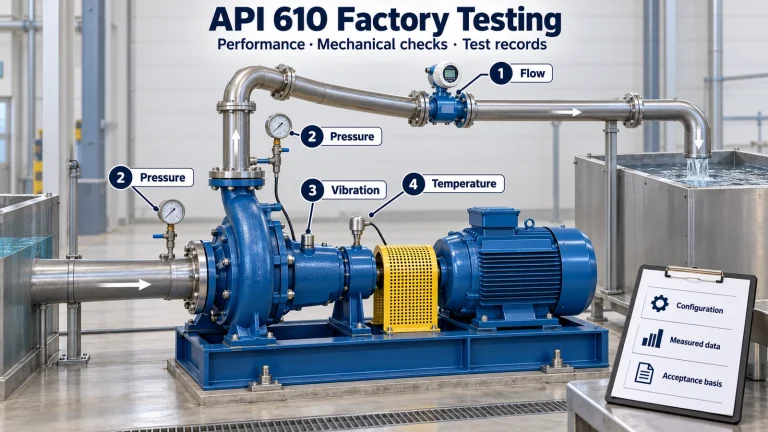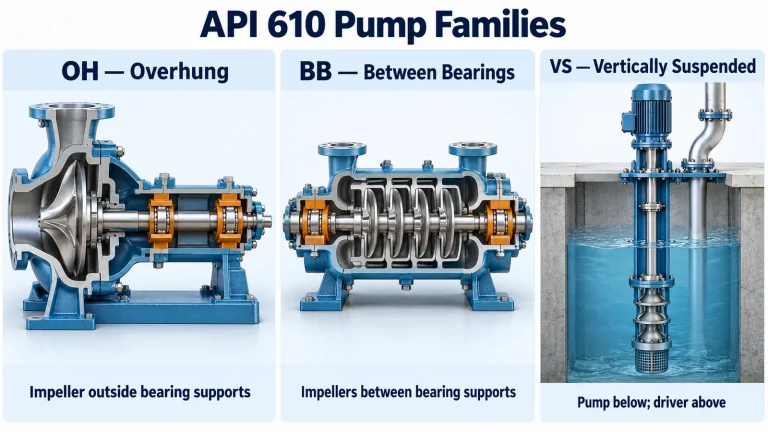

Image note: The hero image is illustrative; it does not identify a specific Goulds 3175 or 3180 configuration.
What Goulds Literature Confirms About the 3175 and 3180
Goulds describes the 3175 as a paper-stock/process pump with a fully open impeller, renewable suction sideplate, external impeller adjustment and back pull-out construction. Goulds literature for the 3180/3185 family describes additional impeller configurations; the exact option depends on the model, size and configuration. These are design differences to investigate, not a stand-alone selection rule.
| Published family reference | Goulds 3175 | Goulds 3180 | How to use it |
|---|---|---|---|
| Maximum capacity in the Goulds online selection guide | Up to 28,000 GPM (6,360 m³/h) | Up to 40,000 GPM (9,000 m³/h) | Catalog family maximum only. Check the size-specific curve, speed and impeller configuration for the proposed duty. |
| Maximum head in the same guide | Up to 350 ft (107 m) | Up to 410 ft (125 m) | This does not show that either pump meets a particular operating point. |
| Maximum temperature in the same guide | Up to 450°F (232°C) | Up to 446°F (230°C) | Confirm the exact material, seal arrangement and operating conditions. |
| Maximum pressure in the same guide | Up to 285 PSIG (20 bar) | Up to 232 PSIG (16 bar) | Use the applicable size, material and documentation for the actual pump; do not treat a family maximum as an allowable rating for every configuration. |
| Published impeller / wear features | Fully open impeller and renewable suction sideplate | Published 3180/3185 literature describes open, enclosed and Shearpeller™ options; verify availability for the exact model and size | Identify the installed impeller and wear arrangement from the nameplate, sectional drawing or part reference. |
| Dimensional standard reference | Confirm the exact pump drawing and flange data | 3180 is the ANSI-flanged model; 3185 is the metric ISO/JIS version | Do not infer nozzle, baseplate, shaft or coupling fit from the family name. |
Family limits are not a pump selection
The values above are published family envelopes from the Goulds online selection guide. They do not replace the curve for the exact size, speed and impeller configuration, and they are not performance claims for an aftermarket replacement. Some older catalog editions publish different 3180 capacity figures; this comparison uses the current online guide and keeps 3180 separate from 3185.
Compare the Actual Duty, Not Just the Model Names
Start with the operating requirement and available evidence. Compare flow, total head, speed, suction conditions, process fluid, stock and solids characteristics, temperature, material and sealing arrangement. Then review the curve for the exact pump configuration. The technical resources library is the route for performance-curve and engineering references.
Keep calculation separate from pump selection
A system calculation can help establish the required duty, but it does not choose between the 3175 and 3180. Use the centrifugal pump sizing calculator to organize duty inputs, then check the candidate against its applicable curve and project conditions. When the duty package is ready for review, continue to the ANSI pump selection and replacement workflow.
| Comparison question | Evidence to collect | Decision it supports |
|---|---|---|
| Does the pump meet the required duty? | Current flow and head, speed, impeller diameter/configuration, suction data and the applicable performance curve | Repair at the existing duty or perform a new hydraulic selection |
| Is the recurring issue hydraulic or mechanical? | Operating history, failure pattern, wear surfaces, vibration or cavitation observations, and clearance/inspection records where applicable | Correct the failure cause before assuming a different family will solve it |
| Can existing installation interfaces be retained? | GA drawings and field measurements for nozzle orientation and centerline, feet/hold-downs, shaft end, coupling and driver elevation | Identify which interfaces match and which require an engineered change |
| Can the requested part be identified? | Installed model and size, part number, sectional drawing, material specification and mating dimensions | Quote a model-specific part only after its configuration is identified |
Verify Parts and Fitment From Controlled References
Do not assume that similarly named parts, shared nominal sizes or a common brand establish cross-family interchangeability. Verify the specific casing, impeller, suction sideplate or wear component, shaft/sleeve and seal-area interfaces against the installed model, part number and drawing. For a 3175 component request, see the Goulds 3175 replacement-parts identification guide.
A proposed complete-pump replacement also needs a fitment check. Compare the applicable general-arrangement drawing and site measurements for suction and discharge connections, centerline, mounting feet, anchor pattern, shaft extension, coupling and driver alignment. The result may support reuse of some interfaces, changes to others, or a new installation scope; do not promise a drop-in result before completing that comparison.
Repair, Replace or Reselect?
| Buyer situation | Recommended review path |
|---|---|
| One casing, impeller, sideplate or shaft component has failed | Confirm the installed family and exact part configuration before requesting a model-specific replacement. |
| Wear or plugging keeps returning while the required duty is unchanged | Diagnose the wear, suction and operating conditions before changing pump family. |
| Required flow, head, process fluid or operating conditions have changed | Recalculate the system duty and reselect from the appropriate pump curve. |
| The plant wants to retain piping, baseplate or driver | Compare the proposed pump GA and field measurements; document each retained or modified interface. |
| The installed configuration is uncertain | Start with the nameplate, sectional/GA drawing and removed-part evidence. Do not identify the pump by appearance alone. |
For a confirmed 3175 request, continue to the 3175 replacement pump and parts page. For a confirmed 3180 request, use the 3180 replacement pump and parts page. Both routes require the actual configuration and duty for engineering review.
Frequently Asked Questions
Can Goulds 3175 and 3180 parts be cross-fitted?
Do not assume that a part fits across the two families. Confirm the installed model, size, part reference, material and mating dimensions against the applicable drawing before ordering.
Can a 3180 replace an installed 3175 without changing the piping or baseplate?
The family names alone cannot answer that. Compare the proposed pump’s GA drawing with the installed nozzle positions, centerlines, mounting points, shaft/coupling and driver arrangement, then document the fitment result.
Is a pump size enough to identify whether the installed unit is a 3175 or 3180?
No. Use the nameplate and model identification first. A size designation by itself does not establish the pump family, frame or internal configuration.
What information is needed to compare the hydraulic duty?
Provide the required and observed flow/head, speed, impeller configuration or trim, suction conditions, process fluid and the curve or datasheet for the exact pump size. Include stock consistency, fibre/solids and temperature when relevant to the service.
When should a mill repair the installed pump instead of changing families?
If the duty and installation remain suitable, identify the failed component and failure cause before changing families. If the duty or process has changed, treat the decision as a new hydraulic and fitment review rather than an automatic upgrade.
Sources and Review Method
- Goulds Centrifugal Pump Selection Guide — family descriptions and published operating envelopes used in the comparison table.
- Goulds 3175 brochure — published 3175 design features.
- Goulds 3175 Installation, Operation and Maintenance Instructions — configuration-specific installation and maintenance reference.
- Goulds 3180 brochure — 3180 design and configuration reference.
Published family ranges are not guaranteed performance for an individual pump. Final duty, material, fitment and replacement scope require review of the exact size, configuration, applicable curve, controlled drawings and site conditions. Source review completed September 26, 2026.
ITT Goulds and the referenced model designations are trademarks or product identifiers of their respective owners. ANSI Pumps Pro / Yingsiman is an independent aftermarket manufacturer and is not affiliated with, sponsored by or endorsed by ITT Goulds. The names are used for identification and cross-reference only.