
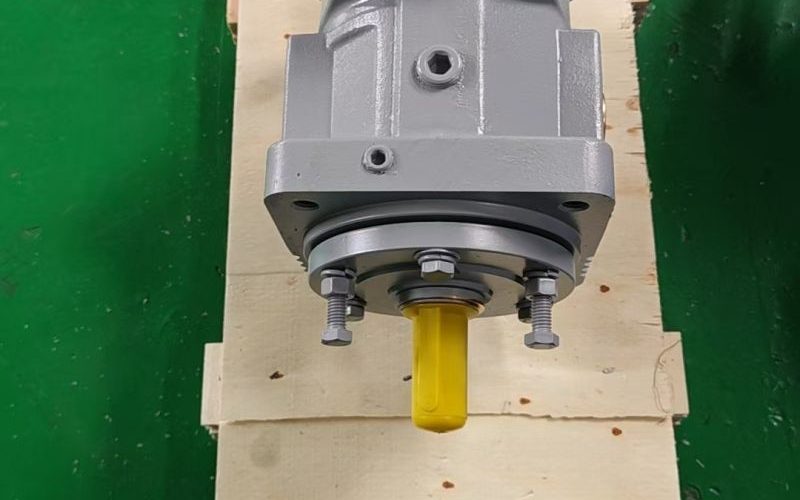
The Hidden Cost of Bearing Failure in Chemical Process Pumps
Industrial reliability data consistently shows that over 50% of all centrifugal pump bearing failures are attributable to two root causes: lubricant contamination (water ingress, particulate intrusion) and excessive axial thrust loading beyond the bearing’s designed dynamic load rating. When a bearing fails prematurely in chemical service, the consequences extend far beyond the cost of replacement bearings — unplanned downtime in a continuous chemical process can cost $10,000 to $100,000+ per hour in lost production alone. Add to this the risk of a catastrophic seal failure following bearing collapse (as shaft deflection destroys the seal faces), and the economics of bearing reliability become compelling.
For plants operating Flowserve Durco Mark III ANSI pumps, there is good news: the pump’s fundamental engineering — specifically its reverse vane impeller (RVI) design — provides an inherent advantage in bearing life extension that many operators do not fully leverage. This article explains how that advantage works, and how to maximize it through proper maintenance practices.
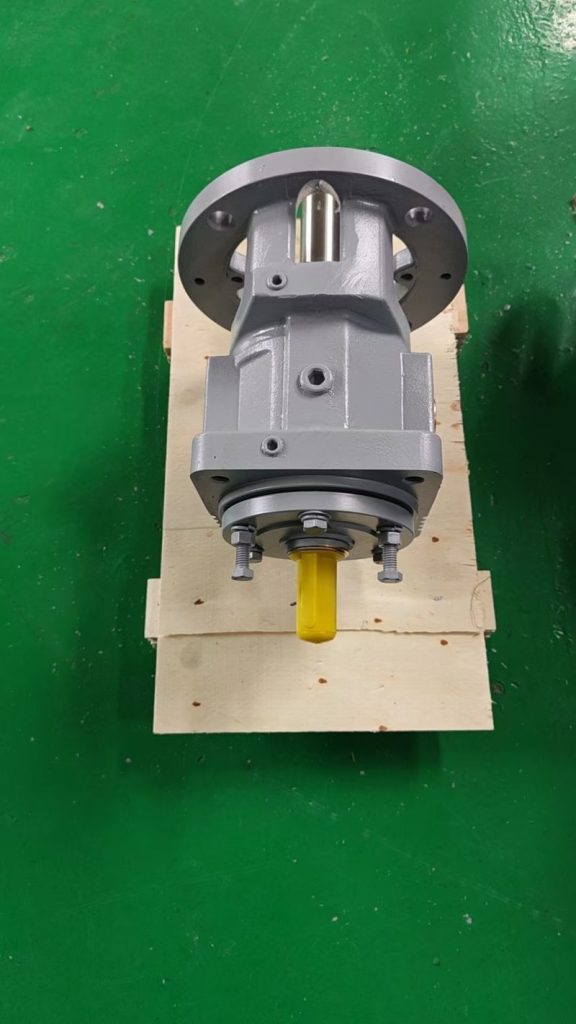
How the Durco Mark III Reverse Vane Impeller Reduces Axial Thrust
In any single-stage centrifugal pump, the pressure distribution across the impeller creates a net axial force — the axial thrust — that pushes the rotating assembly toward the suction side. This force must be absorbed by the thrust bearing. In a conventional pump with a standard enclosed or open impeller, this thrust can be substantial — often exceeding 500-1000 lbf in medium-frame pumps operating at moderate to high differential heads.
⚠️ Quality & Compliance Assurance
All pumps and components from ANSI Pumps Pro are manufactured to ASME B73.1 dimensional specifications. Each shipment includes certified Material Test Reports (MTRs), CMM dimensional inspection reports, and hydrostatic test certificates (1.5× MAWP). 100% dimensional interchangeability guaranteed. Full material traceability from heat number to your receiving dock.
The Durco Mark III’s reverse vane impeller fundamentally changes this equation. The impeller back shroud incorporates pump-out vanes — ribs cast into the rear face of the impeller that act as a miniature centrifugal pump in reverse. As the impeller rotates, these vanes actively pump fluid away from the impeller eye and toward the periphery of the back shroud, reducing the static pressure acting on the rear face of the impeller. The result is a 50% to 70% reduction in net axial thrust transmitted to the thrust bearing.
Why does this matter for bearing life? The relationship between bearing load and bearing L₁₀ life (the number of revolutions that 90% of identical bearings will complete or exceed) is governed by the equation:
L₁₀ ∝ (C/P)³ — for ball bearings
Where C is the bearing’s dynamic load rating (a constant for a given bearing) and P is the equivalent dynamic bearing load. Because bearing life is proportional to the cube of the load ratio, halving the load on the thrust bearing does not merely double its life — it increases life by approximately 8 times (2³ = 8). This cubic relationship is the fundamental reason why the Mark III’s axial thrust reduction translates so powerfully into extended bearing MTBR.
Best Practices for Maximizing Durco Mark III Bearing Life
1. Maintain Correct Impeller Clearance to Preserve Thrust Balance
The reverse vane impeller’s ability to reduce axial thrust depends critically on maintaining the correct clearance between the reverse vanes and the rear cover / seal chamber face. As this clearance increases — due to wear, incorrect initial setting, or thermal growth — the pumping effectiveness of the reverse vanes degrades, and axial thrust begins to climb back toward conventional levels.
Recommended practice: Measure and record the impeller-to-rear-cover clearance at every preventive maintenance interval. The Mark III’s external jacking bolt adjustment mechanism makes this a straightforward task that can be completed in under 30 minutes without disturbing the mechanical seal, casing, or piping. If the clearance has opened by more than 0.005-0.010 inches from the initial setting, re-adjust to the manufacturer’s recommended value for the specific service temperature.
2. Protect the Lubricant from Contamination
Water is the enemy of rolling element bearings. Even 0.01% water contamination in bearing oil can reduce bearing fatigue life by 50%. The Durco Mark III bearing housing should be equipped with:
- Bearing isolators (e.g., Inpro/Seal or equivalent labyrinth seals) on both the inboard and outboard sides. These non-contacting seals prevent moisture and particulate ingress while allowing the bearing housing to “breathe” during thermal cycling without drawing in ambient air and humidity.
- Desiccant breathers on the oil fill / vent port to actively remove moisture from the headspace air that enters the housing during cool-down cycles.
- Proper oil level maintained at the center of the lowermost ball in the bearing. Overfilling causes churning, heat generation, and oxidation; underfilling starves the bearing.
3. Implement Condition Monitoring
The Mark III bearing housing provides access ports for vibration sensors and temperature probes. A minimum monitoring regimen should include:
- Monthly vibration spot readings at the inboard and outboard bearing locations in both horizontal and vertical directions. Trend the data — a gradually increasing vibration signature at bearing defect frequencies (BPFO, BPFI, BSF) indicates developing spalling or brinelling.
- Quarterly oil analysis — check for water content (Karl Fischer titration), particle count (ISO 4406 cleanliness code), and wear metals (spectrometric analysis). An increase in iron, chromium, or copper indicates bearing cage or raceway wear before vibration signatures become detectable.
- Infrared thermography during operation — a bearing housing running 20-30°F hotter than its stable baseline warrants investigation, even if still within the bearing’s rated temperature range.
4. Use Precision-Manufactured Replacement Power Ends
When a Durco Mark III bearing housing or complete power end requires replacement — due to bearing bore wear, fretting damage, or upgrade to a different frame size — the precision of the replacement component directly determines bearing life. Key quality indicators include:
- Bearing bore concentricity: Within 0.0005 inches TIR (total indicator reading) to both the shaft axis and the mating register surfaces
- Bearing fit: Correct interference fit on the inner race / shaft and correct clearance-to-transitional fit on the outer race / housing bore, per ABEC / ISO standards
- Material: Ductile iron (ASTM A536 Grade 65-45-12 minimum) or cast steel, not gray iron, for adequate dynamic load capacity and fatigue resistance
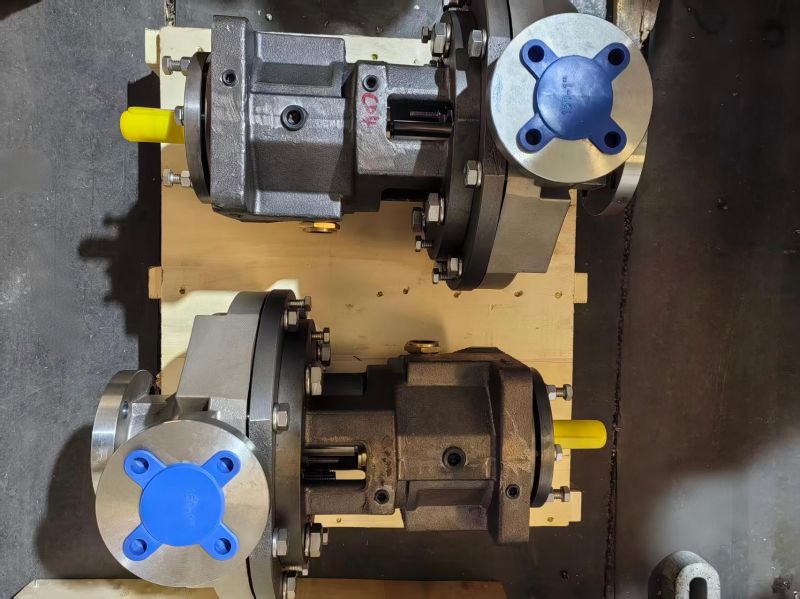
Commercial Alternative: High-Performance Durco Mark III Replacement Power Ends
At ansipumpspro.com, we manufacture complete Durco Mark III interchangeable power ends and bearing housings that match or exceed OEM specifications in every critical dimension. Our power ends are machined from high-grade ductile iron castings on CNC machining centers, with bearing bores held to H7 tolerance (ISO) and bearing mounting surfaces finished to Ra 1.6 μm or better. Each assembly is supplied with premium-name bearings (SKF, FAG, NSK, or equivalent), correctly pre-greased, and ready for direct bolt-on installation.
Our components include optimized cooling fin designs on the bearing housing exterior to enhance convective heat dissipation, keeping bearing operating temperatures 5-10°C lower than standard OEM housings — a difference that, by the Arrhenius rate law for lubricant oxidation, can double oil life.
To request a quotation for Durco Mark III replacement power ends, bearing housings, or complete wet end assemblies, contact our technical sales team at ansipumpspro.com/contact with your pump serial number or part numbers.
📋 Quick RFQ — No Registration Required
🔗 Related Reading
Bearing Life Troubleshooting: Symptom → Root Cause
🛑 Bearing Life Less Than 2 Years? Check These First:
| Symptom | Most Likely Cause | Fix |
|---|---|---|
| Outer race spinning in housing | Housing bore worn or oversized | Inspect bore diameter; tolerance H7 max |
| Inner race loose on shaft | Shaft journal undersized or worn | Micrometer check; k6 tolerance required |
| Balls/rollers brinelled (evenly spaced dents) | Excessive static or impact load | Check for water hammer; verify pump is not dead-headed |
| Discoloration (blue/black) + spalling | Lubrication failure — insufficient or wrong oil | ISO VG 46 or 68 mineral oil; check oiler function |
| Thrust face wear only | Axial thrust overload — impeller balance issue | Verify reverse-vane clearance (Mark III) or balance holes (3196) |