
Why the Adjustment Methods Are Different
The key difference is not simply the clearance number. It is which surface the impeller is referenced to and how the rotating assembly is moved to establish that clearance.
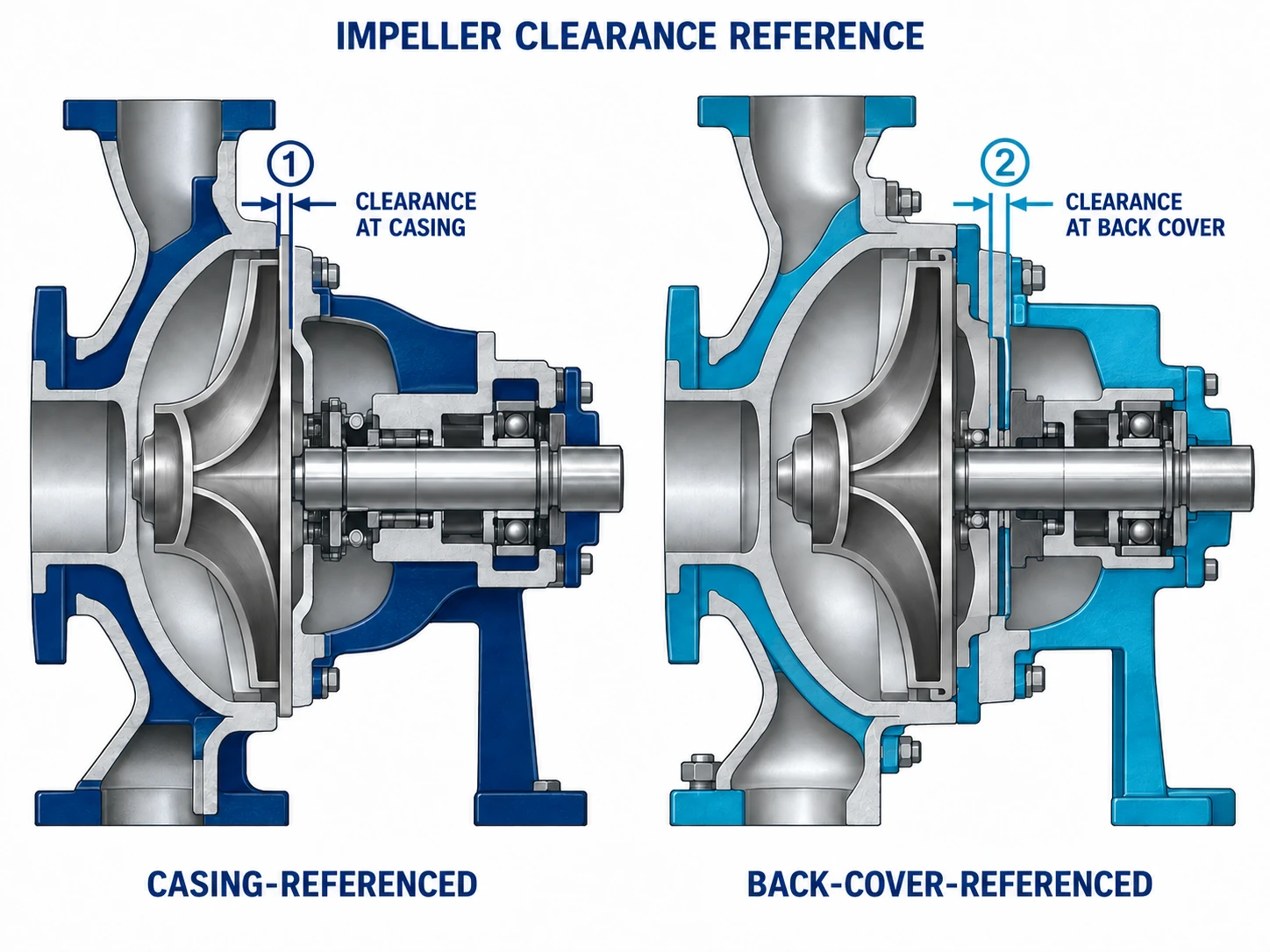
Goulds 3196 standard open-impeller configuration: final running clearance is referenced to the casing.
Durco Mark 3 ASME reverse-vane configuration: reverse-vane clearance is referenced to the rear cover and is adjusted through the external bearing-carrier mechanism.
This article is intentionally limited to those two configurations. CV3196, LF3196 special procedures, recessed-impeller variants, Mark 3 open-impeller configurations, Mark 3 ISO and other special arrangements must follow their own applicable IOM instructions.
3196 vs Mark 3: Adjustment Architecture
| Engineering point | Goulds 3196 standard open impeller | Durco Mark 3 ASME reverse vane |
|---|---|---|
| Primary clearance reference | Casing / front running-clearance reference | Rear cover |
| Axial adjustment mechanism | Bearing housing moved with locking bolts and jack bolts | Threaded bearing carrier with external adjustment |
| Setting method | Applicable IOM dial-indicator or feeler-gauge method | Bearing-carrier indicator pattern / micrometer-style external setting |
| Published adjustment increment | No equivalent universal notch increment should be transferred from Mark 3 | 0.004 in (0.10 mm) axial shaft movement from center of one lug to the next |
| Casing required for final reference | Yes, for the final casing-referenced operating clearance | No for the reverse-vane rear-cover clearance setting |
| Temperature affects setting | Yes — published clearance varies by frame and service temperature | Yes — published clearance varies with service temperature |
| Cartridge-seal consideration | Yes — protect/release the seal setting before axial movement as specified | Yes — do not move the rotor axially with the seal incorrectly set |
| Final verification | Lock, recheck clearance and confirm free rotation | Lock set screws, recheck and confirm free rotation |
Goulds 3196 Impeller Clearance Adjustment
For the standard 3196 open-impeller arrangement, the applicable IOM establishes the running clearance by moving the bearing housing axially relative to the casing. The final value cannot be selected from the pump family name alone because the published cold setting changes with frame and service temperature.
Confirm STi, MTi, LTi, XLT-i or i17 as applicable, together with the actual pump configuration and service temperature.
Following the IOM, move the bearing housing until the impeller establishes the specified light casing-contact reference while the shaft is rotated as instructed.
Use the applicable dial-indicator or feeler-gauge procedure. Do not import the Mark 3 indicator-pattern method into a 3196 procedure.
Move the bearing housing to the published setting for the identified frame and service temperature.
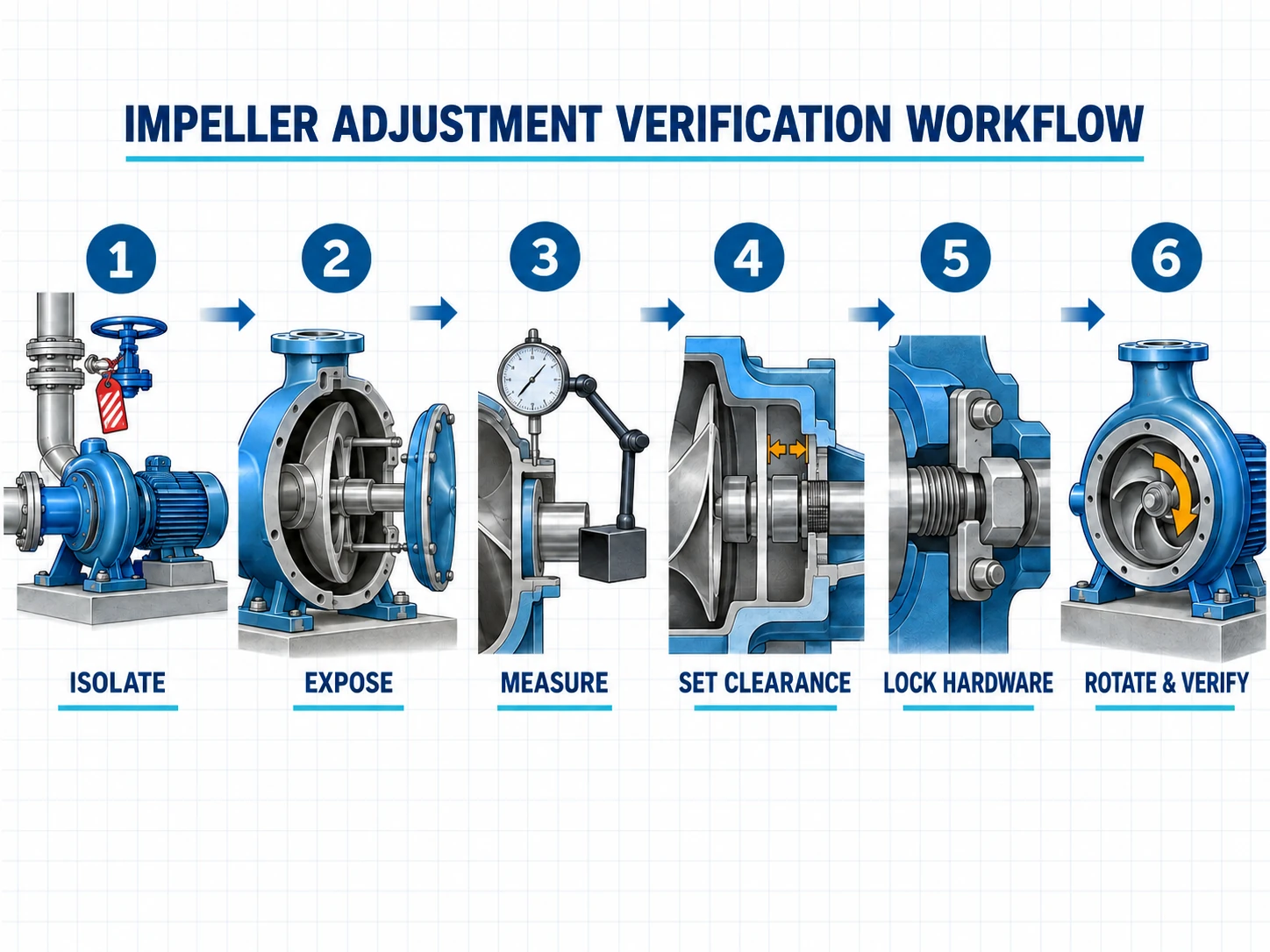
Tighten the locking/jack-bolt system as specified, recheck the clearance and confirm that the shaft turns freely without rubbing.
Goulds 3196 Clearance by Frame and Service Temperature
The table below reproduces the published 3196 i-FRAME clearance logic for the standard 3196/HT3196 arrangement. It is a reference for interpreting the IOM, not a substitute for checking the current manual and installed configuration before maintenance.
At -20 to 200°F (-29 to 93°C), the published values are 0.005 in for STi, 0.008 in for MTi/LTi and 0.015 in for XLT-i/i17.
| Service temperature | STi | MTi / LTi | XLT-i / i17 |
|---|---|---|---|
| -20 to 200°F (-29 to 93°C) | 0.005 in (0.13 mm) | 0.008 in (0.20 mm) | 0.015 in (0.38 mm) |
| Up to 250°F (121°C) | 0.006 in (0.15 mm) | 0.009 in (0.22 mm) | 0.016 in (0.41 mm) |
| Up to 300°F (149°C) | 0.007 in (0.18 mm) | 0.010 in (0.25 mm) | 0.017 in (0.43 mm) |
| Up to 350°F (177°C) | 0.009 in (0.22 mm) | 0.012 in (0.30 mm) | 0.019 in (0.48 mm) |
| Up to 400°F (204°C) | 0.010 in (0.25 mm) | 0.013 in (0.33 mm) | 0.020 in (0.50 mm) |
| Up to 450°F (232°C) | 0.011 in (0.28 mm) | 0.014 in (0.35 mm) | 0.021 in (0.53 mm) |
| Up to 500°F (260°C) | 0.012 in (0.30 mm) | 0.015 in (0.38 mm) | 0.022 in (0.56 mm) |
| Up to 550°F (288°C) | 0.013 in (0.33 mm) | 0.016 in (0.41 mm) | 0.023 in (0.58 mm) |
| Up to 600°F (316°C) | 0.014 in (0.36 mm) | 0.017 in (0.43 mm) | 0.024 in (0.61 mm) |
| Up to 650°F (343°C) | 0.016 in (0.40 mm) | 0.019 in (0.48 mm) | 0.026 in (0.66 mm) |
| Up to 700°F (371°C) | 0.017 in (0.43 mm) | 0.020 in (0.50 mm) | 0.027 in (0.69 mm) |
Use boundary: confirm the current ITT Goulds IOM revision, pump serial/model configuration, material and service temperature before using a table value as a maintenance setting.
Durco Mark 3 Reverse-Vane Adjustment
For the Mark 3 ASME reverse-vane configuration, the running clearance is referenced to the rear cover rather than the casing. Flowserve’s published procedure uses the threaded bearing carrier as the external axial adjustment mechanism.
Verify that the installed unit is the applicable Mark 3 ASME reverse-vane arrangement. Do not use the same procedure for Mark 3 ISO, open-impeller or other variants.
Following the IOM, rotate the bearing carrier until the impeller establishes light contact with the rear cover while the shaft is rotated to confirm the zero reference.
Flowserve documents approximately 0.004 in (0.10 mm) axial shaft movement from the center of one indicator lug/pattern to the next.
Use the published clearance for the actual process-temperature range and observe any pump-size/speed note in the applicable IOM.
Tighten the bearing-carrier set screws as specified, then confirm the resulting clearance and free shaft rotation.
Durco Mark 3 Temperature-Based Clearance and External Setting
| Process temperature | Published clearance |
|---|---|
| <200°F (<93°C) | 0.018 ± 0.003 in (0.46 ± 0.08 mm) |
| 200–250°F (93–121°C) | 0.021 in (0.53 mm) |
| 251–300°F (122–149°C) | 0.024 in (0.61 mm) |
| 301–350°F (150–176°C) | 0.027 in (0.69 mm) |
| 351–400°F (177–204°C) | 0.030 in (0.76 mm) |
| 401–450°F (205–232°C) | 0.033 in (0.84 mm) |
| >450°F (>232°C) | 0.036 in (0.91 mm) |
Published Mark 3 adjustment increment: moving the bearing carrier from the center of one lug to the center of the next produces approximately 0.004 in (0.10 mm) axial shaft movement.
Special note: Flowserve’s published table calls for an additional 0.003 in (0.08 mm) for 3×1.5-13 and 3×2-13 at 3500 rpm. Verify the current IOM before applying this note to an installed unit.
Why Reverse-Vane Clearance Can Be Set Without the Casing
Goulds 3196 standard open impeller
The final operating clearance is referenced to the casing. A preliminary rebuild position may be established during assembly, but it does not replace the final casing-referenced setting.
Durco Mark 3 reverse vane
The primary reverse-vane clearance is referenced to the rear cover, allowing that clearance to be established on the back-pull-out assembly without installing it in the casing first.
This maintenance advantage does not make casing condition, gasket installation or final commissioning irrelevant. Free rotation, correct assembly and the complete pump condition still must be verified before startup.
Mechanical Seal Precautions Before Axial Adjustment
Do not move the shaft axially with a cartridge seal incorrectly locked in its operating position.
For the 3196, ITT Goulds specifically instructs maintenance personnel using a cartridge mechanical seal to install the centering clips and loosen the seal locking-ring set screws before impeller-clearance adjustment. Flowserve documentation likewise requires the seal setting to be protected during impeller adjustment.
Always follow both the applicable pump IOM and the installed mechanical-seal manufacturer’s setting procedure. Seal hardware and setting methods are not universal.
How to Diagnose an Incorrect Clearance
Excessive running clearance may increase internal recirculation. Compare the as-found clearance with the correct IOM value, then review the actual pump curve and duty point.
Clearance may be too small, or the rotor may be moving because of bearing, shaft, thermal or installation problems. Stop and inspect before resetting the clearance.
The seal’s axial setting may have been disturbed. Verify cartridge-seal clips, set screws and installed working position.
Inspect shaft endplay, bearings, carrier/housing condition, threads and locking hardware rather than repeatedly resetting the same clearance.
Check shaft runout, bearings, alignment, piping loads and reference-surface damage. A smaller or larger nominal setting may not address the root cause.
Review hydraulic duty, system resistance and the correct performance curve. Clearance adjustment is not a substitute for hydraulic diagnosis.
For hydraulic verification after mechanical work, use the Pump Performance Curves resource rather than creating an estimated curve inside this article.
Impeller Clearance Adjustment Is Not the Same as Impeller Trimming
Clearance adjustment changes the axial running relationship between the impeller and its reference surface. Impeller trimming changes impeller diameter and therefore the hydraulic performance of the pump.
If the maintenance question is “Where should the impeller sit axially?”, use the applicable IOM clearance procedure. If the question is “What diameter or duty will this impeller produce?”, use the approved performance curve and pump-selection data.
When Adjustment Is No Longer the Correct Repair
Correct clearance cannot compensate for a damaged reference surface, an unstable rotor, the wrong hydraulic component or a mismatched replacement part.
What the Adjustment Difference Means for Replacement Verification
ASME B73.1 standardizes defined installation interfaces such as mounting dimensions, nozzle locations, shafts, baseplates and foundation bolt holes. It does not make the internal hydraulic architectures of Goulds 3196 and Durco Mark III universal.
For the broader cross-platform decision, see the Goulds 3196 vs Durco Mark III engineering replacement comparison. For part-level Durco verification, use the Durco Mark III replacement-parts fitment guide.
If the maintenance decision becomes a complete-pump replacement project, continue to the Goulds 3196 replacement or Durco Mark III replacement engineering page.
Frequently Asked Questions
Is Goulds 3196 impeller clearance always 0.015 in?
No. The published 3196 setting depends on the frame and service temperature. At -20 to 200°F (-29 to 93°C), the standard published values are 0.005 in for STi, 0.008 in for MTi/LTi and 0.015 in for XLT-i/i17.
What does one Durco Mark 3 adjustment indicator pattern represent?
Flowserve’s Mark 3 documentation states that moving the bearing carrier from the center of one lug to the center of the next produces approximately 0.004 in (0.10 mm) of axial shaft movement.
Can a Durco Mark 3 reverse-vane impeller be set without the casing?
For the applicable reverse-vane configuration, the running clearance is referenced to the rear cover, which allows the clearance to be established on the back-pull-out assembly without the casing installed. Final assembly and commissioning checks still remain necessary.
Do I need to deal with the cartridge mechanical seal before changing impeller clearance?
Yes. Axial rotor movement can disturb the cartridge-seal setting. Follow the pump IOM and the installed seal manufacturer’s procedure for clips, set screws and final seal setting before and after adjustment.
Is impeller-clearance adjustment the same as trimming an impeller?
No. Clearance adjustment changes the axial running relationship between the impeller and its reference surface. Trimming changes impeller diameter and must be evaluated against the hydraulic performance curve.
Technical Sources
- ITT Goulds Pumps — 3196 chemical process pump; 3196 i-FRAME Installation, Operation and Maintenance Manual, impeller-clearance and adjustment sections.
- Flowserve — Durco Mark 3 Sealed ASME (ANSI) Chemical Process Pump; Mark 3 ANSI User Instructions 71569102 EN, impeller-clearance and adjustment sections.
- ASME B73.1 — Specification for Horizontal End Suction Centrifugal Pumps for Chemical Process.