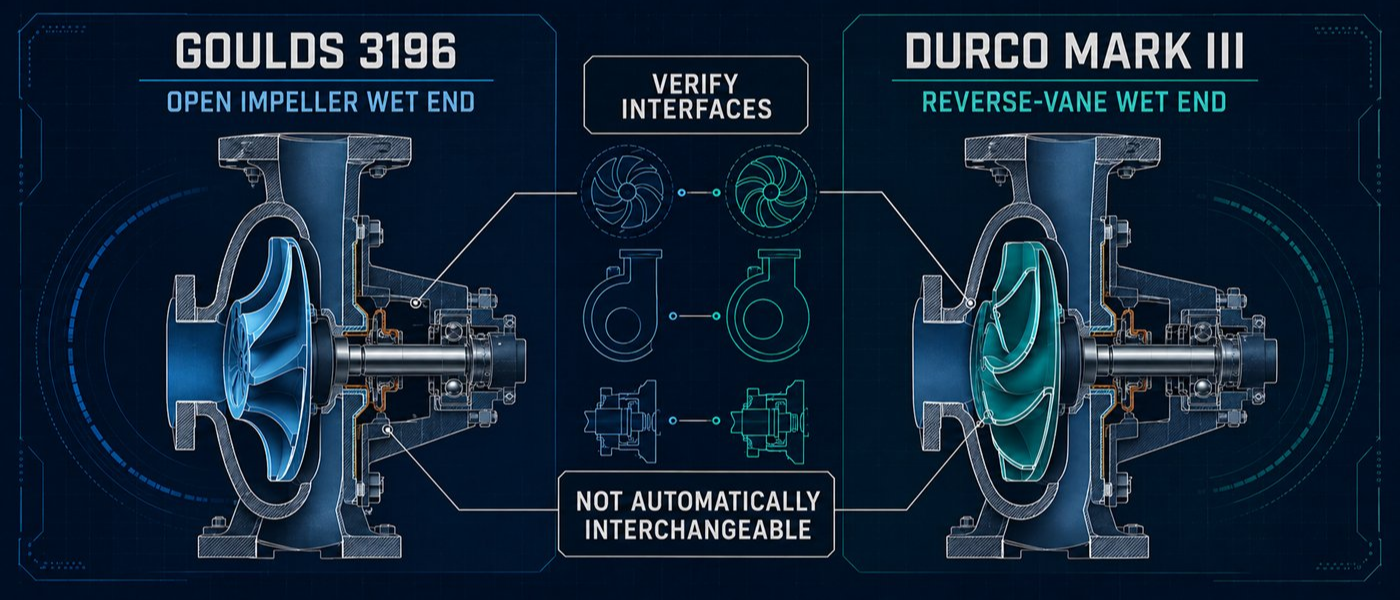
Goulds 3196 vs Durco Mark III: The Ultimate ANSI Pump Comparison Guide

Technical comparison of a big-bore cylindrical seal chamber vs a Durco style tapered-bore seal chamber for ANSI chemical process pumps.

Goulds 3196 vs Durco Mark III: The Ultimate ANSI Pump Comparison Guide

For over 60 years, two names have dominated the ANSI B73.1 chemical process pump market: Goulds 3196 (now part of ITT Goulds Pumps) and Durco Mark III (now Flowserve). Together, they represent an estimated 70%+ of all ANSI pumps installed in North American chemical, petrochemical, and pharmaceutical plants.

If you are specifying a new pump, planning a major replacement, or standardizing your plant pump fleet, the choice between these two platforms carries decades of operational consequences. This comprehensive Goulds 3196 vs Durco Mark III comparison examines the key design differences, application strengths, and total cost of ownership factors that should drive your decision.

Design Philosophy and History

Aspect / Specification Goulds 3196 Durco Mark III
Introduced 1960s (continuously evolved) 1970s (reverse impeller innovation)
Parent Company ITT Goulds Pumps Flowserve (Durco division)
Design Philosophy Modular back pull-out; serviceability-first Reverse impeller hydraulics; performance-first
Impeller Type Fully open, back pump-out vanes Reverse (front-shrouded), back pump-out vanes
Frame Size Range STX, MTX, LTX, XLT-X (5 frame sizes) Group 1, Group 2, Group 3 (3 frame sizes)
Standard Alignment ANSI / ASME B73.1 ANSI / ASME B73.1

Seal Chamber: The Maintenance Battleground

The seal chamber is where theoretical design differences become real maintenance costs. This is where the Goulds 3196 and Durco Mark III diverge most significantly — and where repair shop labor hours are won or lost.

Technical comparison of a big-bore cylindrical seal chamber vs a Durco style tapered-bore seal chamber for ANSI chemical process pumps.

Goulds 3196 Seal Chamber Characteristics

  • Larger radial space: The 3196 seal chamber offers generous radial clearance, accommodating a wide range of heavy-duty mechanical seals, including large cross-section cartridge seals and dual pressurized seal arrangements.
  • Back pull-out advantage: When you pull the rotating assembly rearward, the seal remains mounted with the rear cover, making quick inspections and cleaning between batch changeovers straightforward.
  • The maintenance catch: Because the 3196 relies on front casing clearance alignment, any field adjustment of the impeller shifts the shaft axially. Consequently, the mechanical seal must always be re-set and locked after adjusting the impeller, adding a critical procedural step for maintenance crews. Skip this step and you risk immediate seal face damage on startup.

Durco Mark III Seal Chamber Advantages

  • Tapered bore option: The Mark III features a specialized tapered bore design that uses centrifugal action to evacuate solids and debris away from the seal faces — a significant advantage in crystallizing or slurry services where solids packing around the seal is a known failure mode.
  • No seal adjustment required: Unlike the 3196, the Mark III reverse impeller clearance is set directly against the rear cover. Because the Durco Mark III sets clearance against the rear cover, the axial position of the shaft relative to the seal chamber is locked, eliminating the standard 3196 requirement to reset the mechanical seal after every impeller adjustment. You can adjust the impeller clearance without ever disturbing or re-setting the mechanical seal — a major procedural time-saver in the field.
  • Reverse impeller balance: The reverse impeller design inherently lowers the pressure and temperature inside the seal chamber, extending mechanical seal life by 15-25% in high-temperature chemical transfers based on field data from refinery HDS and hot-oil services.

Solids Handling and Hydraulics: Open vs. Reverse Impeller

For chemical processes involving entrained solids — such as slurries, crystallizers, and filter feed — the Goulds 3196 open impeller has a natural operational edge. The fully open design allows the pump to pass larger particles with less risk of clogging, and wear is distributed across the impeller vanes and casing rather than concentrated at close-running clearance rings.

The Durco Mark III reverse impeller, while hydraulically more efficient and offering better NPSHr performance, has a tighter clearance profile. When dealing with abrasive solids, specifying the right interchangeable wet end material — such as CD4MCuN or Alloy 20 — can mitigate the tighter clearance wear of the Mark III design. For clean, highly corrosive applications — such as hot acids, solvents, and chemical transfer — the Mark III reverse impeller design minimizes axial thrust loads, drastically extending your ANSI pump bearing life.

Side-by-side comparison of a standard Fully Open Impeller and a Durco style Reverse Impeller showing technical clearance differences.

Interchangeability and Spare Parts Strategy

One of the most valuable features of both platforms — and one that procurement managers often leverage — is power-end commonality across hydraulic sizes.

Goulds 3196 Power End Coverage

The Goulds STX power end covers smaller hydraulic sizes, while the MTX covers mid-range sizes. This parts cross-pollination means a single spare power end can service multiple pump sizes on site. Furthermore, Goulds uses these same power ends across different model configurations: the 3196, 3796, 3996, and LF3196 all share common power end components, reducing the spare parts inventory burden for multi-unit plants.

Durco Mark III Power End Coverage

The Mark III family is streamlined into Group 1, Group 2, and Group 3 frames. Within each group, one bearing frame, one shaft, and one bearing set service multiple pump sizes. The distinguishing component is the micrometer thread bearing housing, which provides precise impeller clearance adjustment but requires proper handling and clean threads during shop rebuilds.

Application Match-Up: Choosing the Best ANSI Pump

Process Condition / Environment Recommended Platform Engineering Reason
Highly corrosive, hot acids and solvents Durco Mark III Reverse impeller protects seal; excellent for exotic alloys like Alloy 20 and Hastelloy C.
Slurries, suspended solids, filter feed Goulds 3196 Fully open impeller handles solid particles without clogging.
Frequent process changeovers (Pharma / Fine Chem) Goulds 3196 Back pull-out design enables faster cleaning between batches.
Continuous, low-NPSHa processes Durco Mark III Reverse impeller geometry inherently reduces NPSHr by 1-2 ft.
Severe-duty corrosive services requiring Titanium Either (with proper wet end) Both lines excel when fitted with high-tier interchangeable ANSI pump wet ends.

The Aftermarket Reality: Breaking the OEM Bottleneck

For decades, chemical plants standardized on one brand — Goulds or Durco — and accepted long lead times and high OEM prices for spare parts. Today, with typical OEM lead times stretching to 12-16 weeks, forward-thinking maintenance repair shops and procurement managers are shifting to premium, 100% interchangeable aftermarket solutions.

The big logistical breakthrough? You no longer have to choose between the two ecosystems. A single, qualified manufacturer can provide replacement wet ends, complete power ends, and precise spare parts for both the Goulds 3196 and Durco Mark III lines — all built strictly to ASME B73.1 dimensions with certified material traceability.

With over 10 years of experience in chemical pump manufacturing, we have established a complete ANSI pump interchangeability solution. Whether Goulds 3196 (STX, MTX, LTX) or Durco Mark III (Group 1, 2, 3) series, we provide 100% dimensionally interchangeable spare parts and complete assemblies. From standard 316SS and cast steel to high-value Titanium, Hastelloy C, and Alloy 20, all wet end materials are available with CMM-verified dimensional accuracy — helping you break through OEM supply chain bottlenecks.

If you need a dimension-verified replacement for either platform, contact our engineering team at [email protected] or call +86-186-5910-6155 for a cross-reference quote with your pump model code.

Related Reading

APP

Editorial Standards and Expertise

ANSI Pumps Pro Engineering Team — 10+ years in ANSI B73.1 process pump design, manufacturing, and aftermarket solutions. Our content is reviewed by senior pump engineers with direct field experience across chemical, petrochemical, and industrial pump applications.

Fact-Checking: Technical claims reference published industry standards (ASME B73.1, ASTM, API 682, HI), peer-reviewed corrosion data, and internal engineering documentation. Product specifications and pricing reflect current (2026) information. Questions? Contact our team

Quick Quote