
01 · Diagnose before changing hardware
Is This Cavitation or Another Suction-Side Problem?
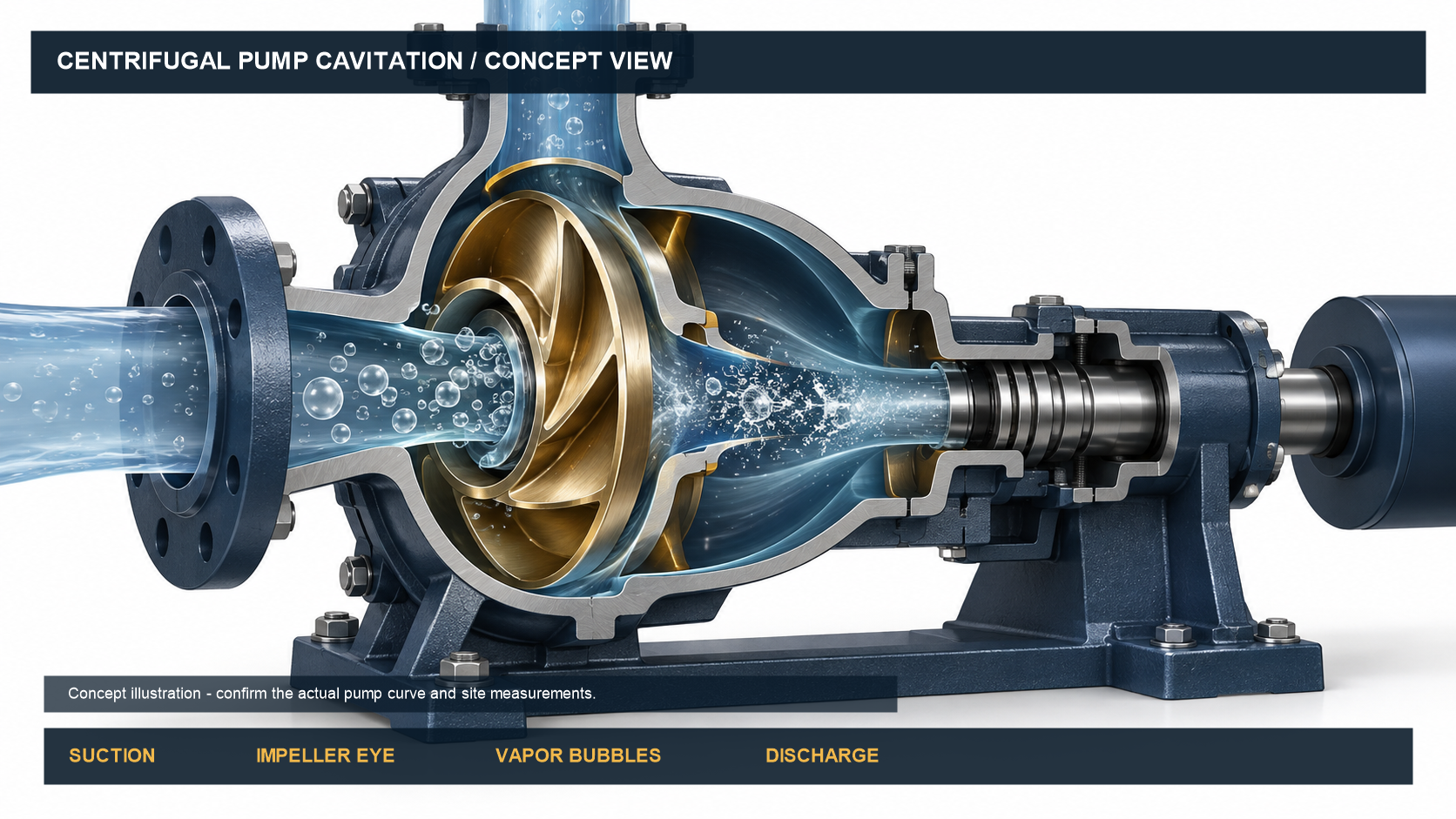
Possible cavitation clues include crackling or gravel-like noise, unstable pressure or flow, vibration that changes with duty, reduced head and pitting near the impeller eye or vane inlet. These clues overlap with air entrainment, a restricted strainer, mechanical looseness, resonance, bearing damage, solids erosion and internal recirculation.
Noise is a clue, not a diagnosis
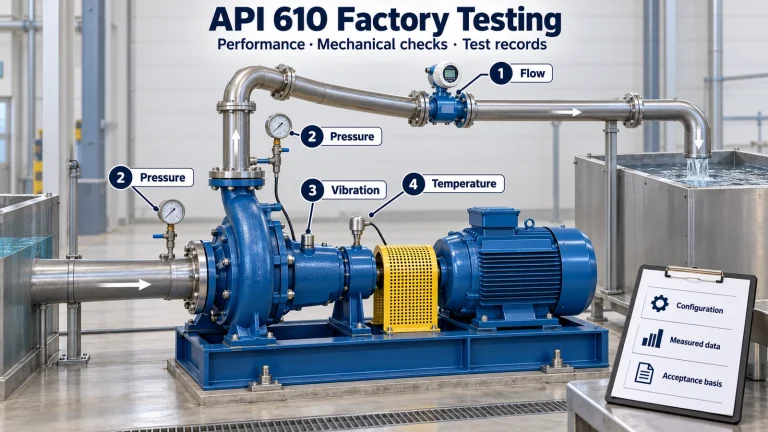
Record suction pressure, discharge pressure, flow, speed, liquid temperature and valve position while the symptom is present. Compare the trend with the pump curve and inspect the damage pattern after safe isolation.
02 · Compare like with like
Compare NPSH Available With Pump NPSH Required
NPSH available (NPSHA) comes from the connected system and liquid condition. It is affected by source pressure or liquid level, elevation, suction losses, liquid temperature and vapor pressure. NPSH required (NPSHR) is pump-side data reported for a defined flow, speed, impeller condition and test basis.
The comparison is meaningful only when the flow, speed, liquid temperature, datum, units, impeller and pressure basis are consistent. A replacement pump can match the external connection pattern and still have the wrong curve or suction requirement.
Need the system-side number?
Use the NPSH Available Calculator to organize suction pressure, vapor pressure, density, liquid level, suction losses and velocity-head inputs before checking the pump curve.
03 · Find the system-side loss
What Reduces NPSH Available in the Installed System?
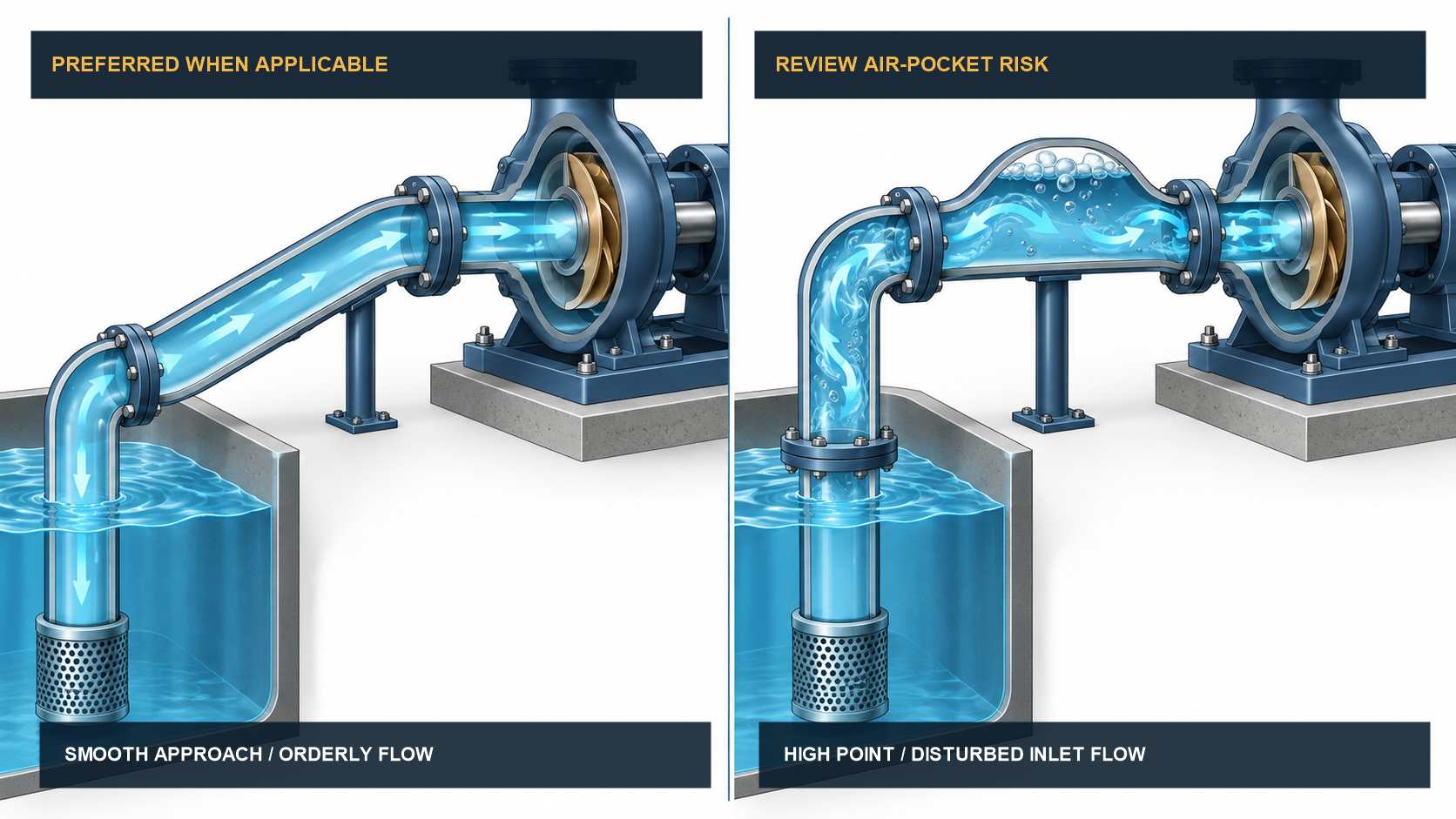
Investigate the suction system under the same conditions in which the symptom occurs. A minimum liquid level, higher process temperature, higher vapor pressure, a blocked strainer, a partly closed suction valve, an air leak or an unexpected parallel-pump condition can remove the margin that existed during commissioning.
| Condition | What changes | Evidence to collect |
|---|---|---|
| Source level or pressure | Less static head or vessel pressure reaches the pump. | Minimum, normal and upset level or absolute source pressure. |
| Liquid temperature | Vapor pressure rises as the liquid gets hotter. | Temperature at the pump suction and the vapor-pressure basis used. |
| Suction restriction | Pipe, valve, strainer and fitting losses increase. | Valve position, strainer differential pressure, piping condition and flow. |
| Air or gas ingress | Gas enters before the impeller and can imitate cavitation. | Tank level, vortex risk, flange or seal leaks and process gas release. |
| Transient operation | Startup, drawdown, pump switching or temperature changes reduce margin. | Trend data rather than a single nominal reading. |
Do not use a universal suction-pipe distance
Required straight length and reducer arrangement depend on the fitting, reducer, pump type, flow range and layout. Review closed pump piping against applicable ANSI/HI 9.6.6 pump-piping guidance and the manufacturer’s instructions. Use ANSI/HI 9.8 intake-design guidance when the issue is a free-surface intake, sump or suction-can arrangement.
04 · Check the pump and operating region
What Increases NPSH Required or Creates Similar Damage?
NPSHR generally varies with flow and speed, but the exact relationship belongs to the applicable pump curve. Impeller geometry, trim, wear, viscosity, pump modification and operation away from the intended range can change the hydraulic response.
Low-flow suction or discharge recirculation can also produce noise, vibration and cavitation-like pitting without being the same mechanism as insufficient system NPSH. For the broader differential diagnosis, see the pump cavitation field diagnosis guide. For BEP, POR and AOR context, use the ANSI pump operating-regions guide.
System-side shortfall
NPSH available falls because of level, pressure, temperature, air ingress or suction losses.
Pump-side or range issue
The selected curve, speed, impeller trim or operating region does not match the actual duty.
Do not infer a safe margin from a different pump model, impeller diameter or speed. The 2024 NPSH margin guidance also moved the margin discussion toward the manufacturer-supplied NPSHR basis rather than copying one universal NPSH3 rule into every application.
05 · Collect field evidence
Field Evidence Checklist for a Cavitation Review
Take readings at minimum, normal and maximum credible conditions where practical. Keep the measurement time, instrument basis and pump configuration with the record.
| Record | Why it matters | Decision supported |
|---|---|---|
| Flow, speed and VFD frequency | Locates the actual operating point. | Check curve, operating range and control response. |
| Suction and discharge pressure | Defines the measured hydraulic condition. | Review NPSH basis and developed head. |
| Liquid temperature, SG, viscosity and composition | Sets vapor pressure and fluid-property assumptions. | Recalculate system conditions and review material risk. |
| Tank level, strainer differential and valve position | Shows whether suction losses or source conditions changed. | Correct the system before changing the pump. |
| Vibration trend and inspection photos | Links the symptom to duty and damage location. | Separate hydraulic damage from mechanical or solids damage. |
| Nameplate, curve, impeller trim and drawing | Identifies the actual pump configuration. | Verify hydraulic, dimensional and replacement compatibility. |
06 · Use controlled checks carefully
Can a Discharge-Throttling Check Help Diagnose the Cause?
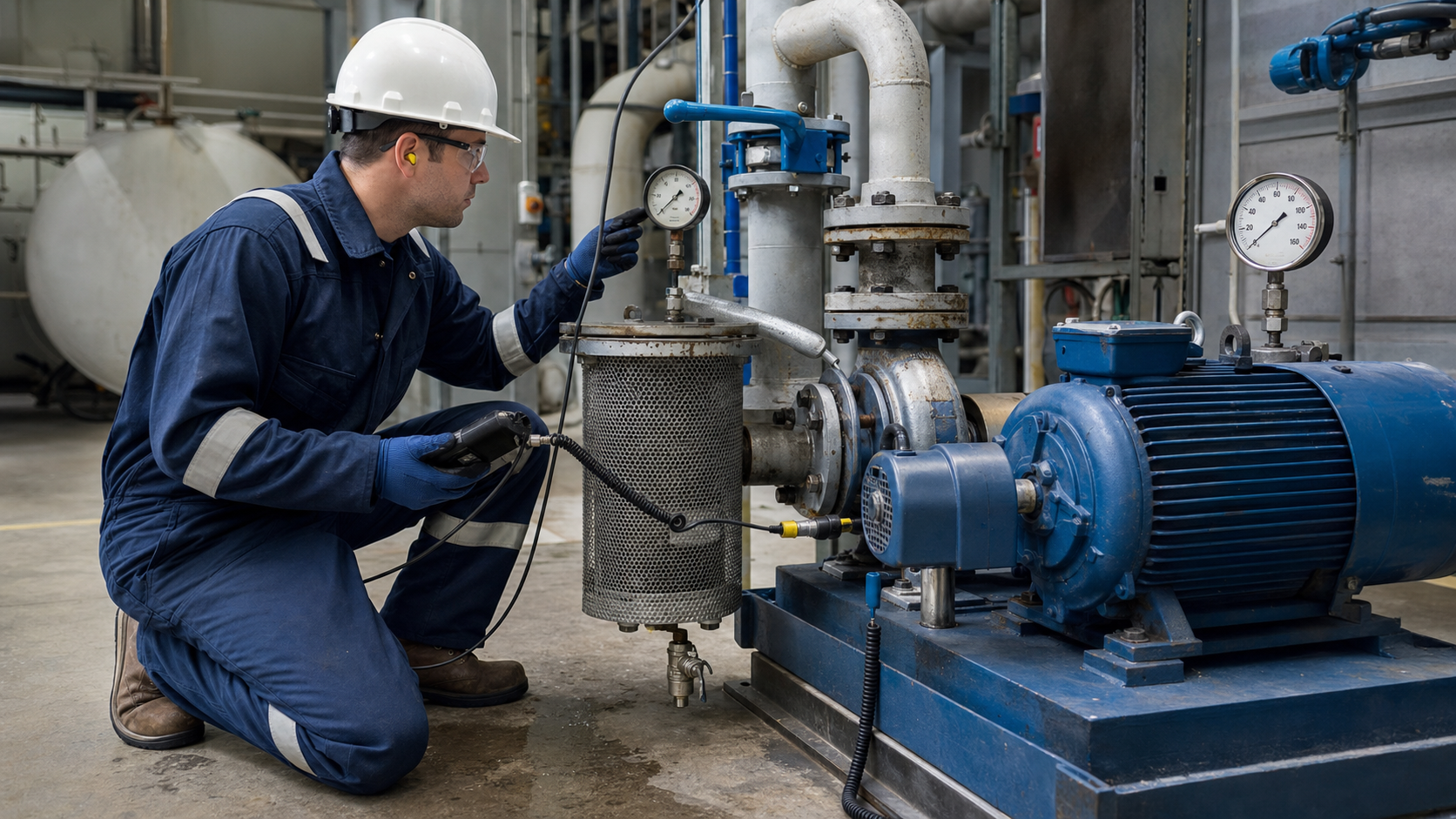
A small, controlled discharge-valve change can provide a diagnostic clue because it changes the operating point. If symptoms reduce as flow moves back from runout, insufficient NPSH available at the higher flow may be involved. If symptoms worsen as the pump moves toward low flow, internal recirculation or another low-flow problem may be involved.
This is not a proof test
Use only an approved operating procedure, keep the suction valve fully open, stay above the required minimum flow and monitor pressure, vibration, power and temperature. Stop if the response is unstable or the safe operating boundary is approached.
Never use suction-valve throttling as a routine flow-control method. It increases suction loss and can reduce the available margin further.
07 · Correct the right layer
Prevent Cavitation by Decision Type
Move through the evidence in order: system condition, operating point, exact pump data, inspection evidence and replacement verification. The visual map below is a screening sequence, not a universal operating envelope.

08 · VFD decision boundary
Can a VFD Prevent Centrifugal Pump Cavitation?
A VFD may reduce speed and move the pump to a lower-flow condition, but it does not automatically create NPSH margin. Check the resulting flow, head, NPSHR, minimum flow, motor cooling, control stability and suction conditions.
If the root cause is a blocked strainer, high liquid temperature, poor source pressure, air ingress or unsuitable suction piping, speed reduction may only mask the symptom. Use the site’s pump calculators to organize the duty data, then verify the final result against the applicable performance curve.
09 · Replacement verification
Repair and Replacement: What Must Be Verified?
Replacing a pitted impeller without correcting the suction condition treats the evidence rather than the cause. Before requesting a replacement pump or wetted component, separate the following compatibility checks:
| Compatibility layer | Verify before quotation |
|---|---|
| Dimensional | Model, size, frame or group, flanges, centerline, mounting and critical interfaces. |
| Hydraulic | Flow, head, speed, impeller diameter, trim, efficiency, power and NPSH curve. |
| Mechanical | Shaft arrangement, seal chamber, wear clearances, bearings, coupling and rotation. |
| Material | Fluid, concentration, temperature, contaminants, solids, pH, chloride and oxidizing or reducing conditions. |
| Documentation | Approved drawing, MTR or PMI requirements, dimensional report, balance, hydrostatic or performance records as applicable. |
ANSI or ASME dimensional conformity does not by itself prove internal-part, hydraulic, NPSH or material compatibility. Use the OEM part-number cross-reference for part identification and the ANSI pump selection and replacement worksheet when the complete duty or replacement scope needs review.
10 · Prepare the engineering package
What to Send for an NPSH Review?
Send enough information to reproduce the suction condition and identify the installed pump. Model-specific evidence makes the review more defensible and reduces the risk of ordering a dimensionally similar but hydraulically unsuitable part.
- Pump model, size, serial number, speed, motor data and impeller diameter.
- Minimum, normal and maximum flow; suction and discharge pressure; liquid temperature; SG, viscosity, solids and gas information.
- Vapor-pressure basis, tank level or source pressure, elevation reference and suction-pipe layout.
- Valve, strainer and fitting information; recent process changes; startup or drawdown conditions.
- Vibration trend, sound or video record, photos of the impeller and casing damage, pump curve and dimensional drawing.
- Required material, seal, inspection and documentation scope.
Start with the evidence you have
A nameplate photo, pump curve or damage photograph can start the review. The final replacement scope still requires confirmation of duty, interfaces, materials and operating conditions.
Sources and related reading
Sources and Related Reading
- ANSI/HI 9.6.1-2024 — Rotodynamic Pumps Guideline for NPSH Margin.
- ANSI/HI 9.6.6 — Rotodynamic Pumps for Pump Piping.
- U.S. Department of Energy, Improving Pumping System Performance.
- ANSI Pumps Pro NPSH Available Calculator.
- NPSHa vs NPSHr and ANSI/HI 9.6.1-2024 Buyer Guide.
Standards, manufacturer documentation and project specifications govern final limits. This article provides an engineering screening workflow and does not replace a project-specific hydraulic calculation or site procedure.
Frequently Asked Questions
Does pump noise prove cavitation?
No. Noise is a clue. Air entrainment, debris, recirculation, alignment, bearings and resonance can create similar symptoms. Confirm suction conditions, operating point and inspection evidence.
What data is needed to compare NPSH available and required?
Use the actual flow, speed, liquid temperature, vapor pressure, source pressure or level, suction losses, pump curve, impeller condition and consistent datum and units.
Can closing the suction valve fix cavitation?
No. Suction throttling increases suction loss and can reduce NPSH available. Keep the suction path open in normal service and correct the source, piping or operating condition through an approved procedure.
Can throttling the discharge valve diagnose cavitation?
A controlled, small change may provide a clue by moving the operating point, but it is not a proof test. Stay above minimum flow and monitor the pump within the approved operating procedure.
Can a VFD prevent centrifugal pump cavitation?
It may change speed and duty, but it cannot correct every suction restriction, high-temperature condition, tank vortex, air leak or wrong pump selection. Verify the resulting curve, NPSH and minimum-flow condition.