
What Does an ANSI Pump Wet-End Replacement Package Include?
“Wet end” is a purchasing description, not a universal bill of materials. Depending on the pump design and the agreed supply scope, a package may cover the casing, impeller, cover or seal chamber, shaft sleeve, gaskets, wear components, fasteners, or a mechanical seal. The quotation should identify every included and excluded item by name or drawing reference.
For example, the parts listing in the Goulds CV 3196 i-FRAME manual identifies the casing, impeller, frame adapter, shaft sleeve, seal chamber/stuffing-box cover, and bearing frame as distinct components for that documented pump variant. That is a model-specific reference, not a universal wet-end package definition. See the Goulds CV 3196 i-FRAME IOM parts listing.
Ask the supplier to state whether the seal, seal chamber, shaft sleeve, gaskets, rotating hardware, and any installation parts are included. Do not assume that two quotations using the phrase “wet end” cover the same components.
When Should You Replace the Wet End or Review the Complete Pump?
A wet-end-only scope is worth evaluating when the buyer intends to retain the existing power end and installation, and the retained parts can be verified for condition and fit. A broader pump review is needed when the duty, installation, or retained mechanical components are changing or uncertain. These are review paths, not automatic pass/fail rules.
Retain the existing power end?
Identify the bearing frame, shaft arrangement, coupling, driver, baseplate, and interfaces intended to remain.
Verify the wet-end interfaces
Compare the applicable drawings or measurements for the casing, shaft-side mating parts, impeller, cover/seal chamber, and installation interfaces.
Confirm the duty and service
Check the required operating point, pump configuration, fluid conditions, materials, and seal arrangement against the proposed scope.
Hold the fitment conclusion and request the missing model, drawing, measurement, or operating data. Expand the review to a complete pump when the retained equipment or installation is part of the unresolved requirement.
For a broader comparison of complete-pump, matched wet-end, and individual-part replacement decisions, use the Goulds 3196 vs. Durco Mark III replacement comparison. This page stays focused on package scope and the information needed to request a review.
What Information Is Needed for a Wet-End Fitment Review?
A brand or nominal size alone does not identify every configuration detail needed for a replacement review. Send the best available records and mark any field measurements as measured, estimated, or unknown.
If only a part number is available, use the OEM part-number cross-reference to identify the reference and provide the installed pump context. Part-number identification by itself does not confirm fitment.
What Does ANSI B73.1 Interchangeability Confirm?
ASME’s published B73.1 description says pumps with the same standard dimension designation are intended to be interchangeable for defined installation dimensions, including mounting dimensions, suction and discharge nozzle size/location, input shafts, baseplates, and foundation bolt holes. That dimensional scope should not be extended into a claim that all internal parts, seal arrangements, materials, or hydraulic performance are interchangeable. Review the ASME B73.1 scope and description.
For a proposed package, confirm the exact pump configuration and the interfaces that will mate with retained parts. Separately review duty, materials, seal configuration, and acceptance requirements. Do not infer internal-component compatibility from the ANSI/ASME designation alone.
For a model-specific Goulds 3196 and Durco Mark III interface discussion, follow the Goulds 3196 and Durco Mark III wet-end interchange guide. Flowserve lists multiple Mark 3 configurations and identifies Group 4 as outside traditional ANSI performance and dimensional requirements; confirm the exact family and configuration before using a group or size reference. Flowserve Durco Mark 3 product information.
How Should Materials and the Mechanical Seal Be Reviewed?
Do not select a material from a generic alloy ranking or pump-family name. Give the responsible engineer or supplier the actual fluid and operating conditions, including concentration, temperature, contaminants, solids, and any known changes or upset cases. Then confirm the specified material grade and product form for each wetted component against the project requirements.
Material examples vary by pump design and component. The Goulds CV 3196 i-FRAME component table lists, among other entries, ductile iron, CD4MCuN, Alloy 20, and Hastelloy B/C for specified components and configurations. These are model-specific examples, not a universal package options list or material recommendation. Review the CV 3196 i-FRAME parts and materials table.
Review the mechanical seal as a separate configuration item. Confirm the seal arrangement, faces, elastomers, metal parts, chamber/gland interface, pressure and temperature conditions, and flush or barrier requirements from the applicable equipment data and project specification.
Where chemistry, grade, seal details, or duty information is missing or uncertain, record the open item and defer the selection. The chemical resistance guide is a starting reference; it does not replace application-specific review.
What Should the Quotation and Inspection Scope State?
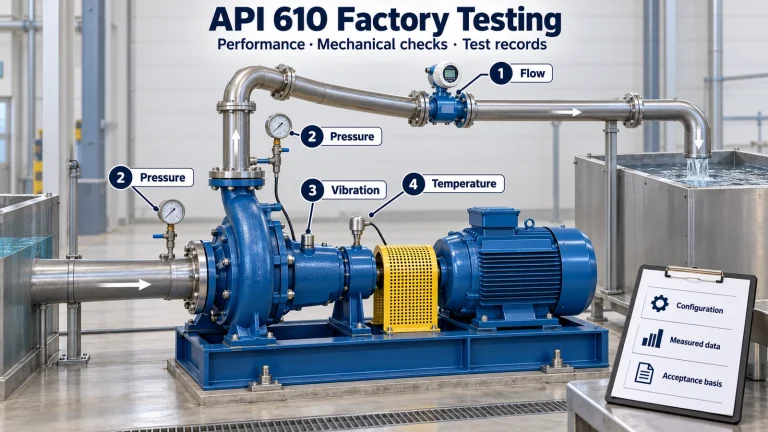
Request a quote that ties the proposed assembly to the installed pump information and lists its boundaries. Agree inspection and documentation requirements before order release; whether a test or record is required depends on the purchase specification, component, and service.
For hydraulic checks, use the site’s total dynamic head calculator with project data; use the pump performance-curve resource for actual curve references. Neither a calculator result nor a curve substitutes for dimensional or materials verification.
How to Prepare an ANSI Pump Wet-End RFQ
Send one package containing the available nameplate and pump records, the requested replacement scope, operating duty, fluid/service details, interface drawings or measurements, seal information, material requirements, and the inspection/document list. Label missing data rather than filling gaps with assumptions.
Ask the supplier to return a component-by-component scope, the drawing/configuration used for fitment review, the proposed hydraulic basis when an impeller or matched assembly is included, material/inspection records offered, exclusions, deviations, and the order-specific delivery commitment. If the request is for a Goulds 3196 or Durco Mark III assembly, the applicable Goulds 3196 replacement page or Durco Mark III replacement page identifies the commercial replacement route; exact scope still requires configuration review.
ANSI Pump Wet-End Replacement FAQ
What is included in a wet-end replacement package?
There is no universal package list. Depending on the pump design and order scope, it may include a casing, impeller, cover or seal chamber, sleeve, wear parts, gaskets, fasteners, or seal. Require an itemized included/excluded list.
Can I keep the existing power end?
That can be evaluated when the buyer intends to retain it and its condition, configuration, shaft-side interfaces, and duty requirements are reviewed. The model name alone does not establish that a proposed wet end will fit.
Does ANSI B73.1 confirm that internal pump parts are interchangeable?
No. The published standard description defines interchangeability for specified installation dimensions for pumps with the same standard dimension designation. Internal parts, materials, seal arrangements, and hydraulic performance need their own review.
What information should I send for a fitment review?
Send the nameplate and complete model, frame/group and size, drawing or photos, operating duty, fluid conditions, seal arrangement, retained-component details, and the required inspection/document scope. Mark unknowns clearly.
Which inspection documents should be included?
Agree the required drawing, material traceability, dimensional inspection, tests, certificates, and acceptance records in the purchase specification. The required set depends on the project and components being supplied.
Technical Sources
- ASME B73.1 — Specification for Horizontal End Suction Centrifugal Pumps for Chemical Process. Used for the standard’s published scope and dimensional interchangeability description.
- Goulds CV 3196 i-FRAME Installation, Operation, and Maintenance Manual. Component references apply to the documented CV 3196 i-FRAME variant; they are not a universal BOM or cross-brand POS map.
- Goulds CV 3196 i-FRAME Product Brochure. Cited only for its model- and component-specific parts/materials table; listed options are not a universal recommendation.
- Flowserve Durco Mark 3 Sealed ASME (ANSI) Chemical Process Pump. Used to identify the published range of configurations and the stated Group 4 scope boundary.