Do not treat a Goulds 3196 wet end and a Durco Mark III wet end as direct substitutes based on nominal pump size or ASME B73.1 designation alone. Verify the exact configuration, mating dimensions, shaft and seal arrangement, impeller setting, material and hydraulic duty against controlled drawings and the applicable OEM instructions.
“Fits the piping” is not the same as “fits the pump” or “meets the process duty.” A casing may match the nozzle envelope while the cover, shaft, impeller, seal chamber or performance curve does not. Use the checks below to define exactly what is being compared before you request a quotation.
01 · Set the boundary
What does interchangeability mean here?
ASME B73.1 includes dimensional interchangeability requirements for specified installation interfaces of pumps with the same standard dimension designation. Those requirements help with installation planning. They do not certify that all internal wetted components from different manufacturers have matching geometry or equivalent hydraulic performance. See the ASME B73.1 standard scope.
For a replacement review, state the scope precisely: one component, a casing-and-impeller combination, a matched wet end, or a complete pump. Then separate the evidence into five compatibility checks:
| Check | What it establishes | Typical evidence |
|---|---|---|
| Dimensional | Whether specified interfaces and envelopes line up | Controlled drawings, revision, measured dimensions |
| Mechanical | Whether shaft, coupling, bearings and seal relationships are suitable | Section drawing, shaft and sleeve measurements, seal data |
| Hydraulic | Whether the proposed casing/impeller configuration meets the duty | Flow, head, speed, curve, impeller diameter and power |
| Material | Whether wetted materials suit the actual fluid and conditions | Material specification, concentration, temperature and service history |
| Operating | Whether the assembly fits pressure, temperature and control conditions | Operating envelope, upset cases and project requirements |
For a broader explanation of standard scope, see ANSI B73.1: dimensional interchangeability vs. real compatibility.
02 · Identify before measuring
Start with the complete pump identity
Series names alone are not enough. Record the nameplate and all model details before matching a component or cross-reference. Include the pump size, complete model code, frame or group designation where shown, serial number, production revision if available, speed and current impeller trim.
Goulds 3196 information
Capture the full 3196 model/frame designation exactly as marked, along with pump size, serial number, impeller reference and seal-chamber or cover arrangement. Do not translate a Goulds frame label into a Durco group by assumption.
Durco Mark III information
Capture the exact Mark III configuration, group and pump size shown on the nameplate or drawing. Record the impeller design and reference, cover/seal-chamber configuration and any adjustment hardware or previous modifications.
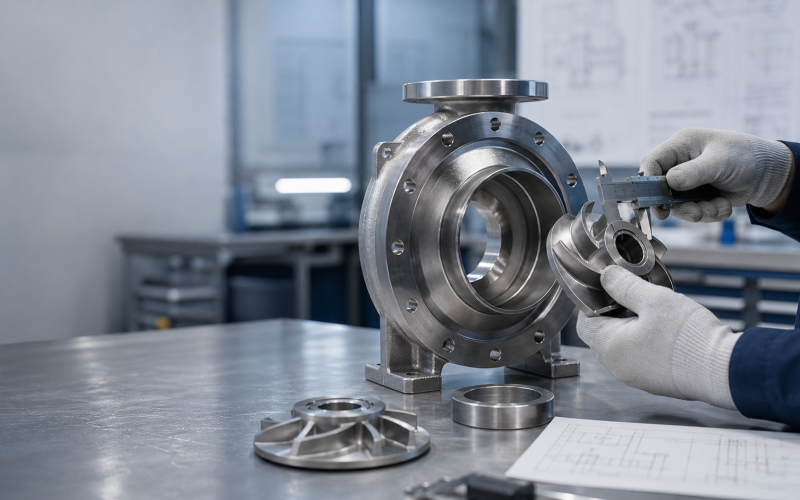
When the nameplate is missing, combine an outline or section drawing with clear photos and measured interfaces. Mark any dimensions taken from worn, corroded or modified parts as field measurements, not controlled drawing values.
03 · Interface-by-interface
Compare the mating interfaces, not just the model names
| Interface | What to verify | Common mistake |
|---|---|---|
| Casing and cover | Pilot/register diameters, gasket faces, bolt pattern, casing-to-adapter relationship and datum positions | Assuming matching bolt holes prove the internal position is correct |
| Suction and discharge | Nozzle size, flange class/drilling, orientation and centerline relationship to the base | Checking nominal size while overlooking orientation or piping clearance |
| Shaft and coupling end | Shaft diameter and extension, coupling fit, key and keyway where applicable, runout and axial position | Using “keyway” as a substitute for checking the impeller-to-shaft connection |
| Impeller connection | Exact impeller design, shaft engagement/retention, rotation, diameter/trim and axial setting procedure | Assuming two impellers with similar outside diameter have equivalent geometry |
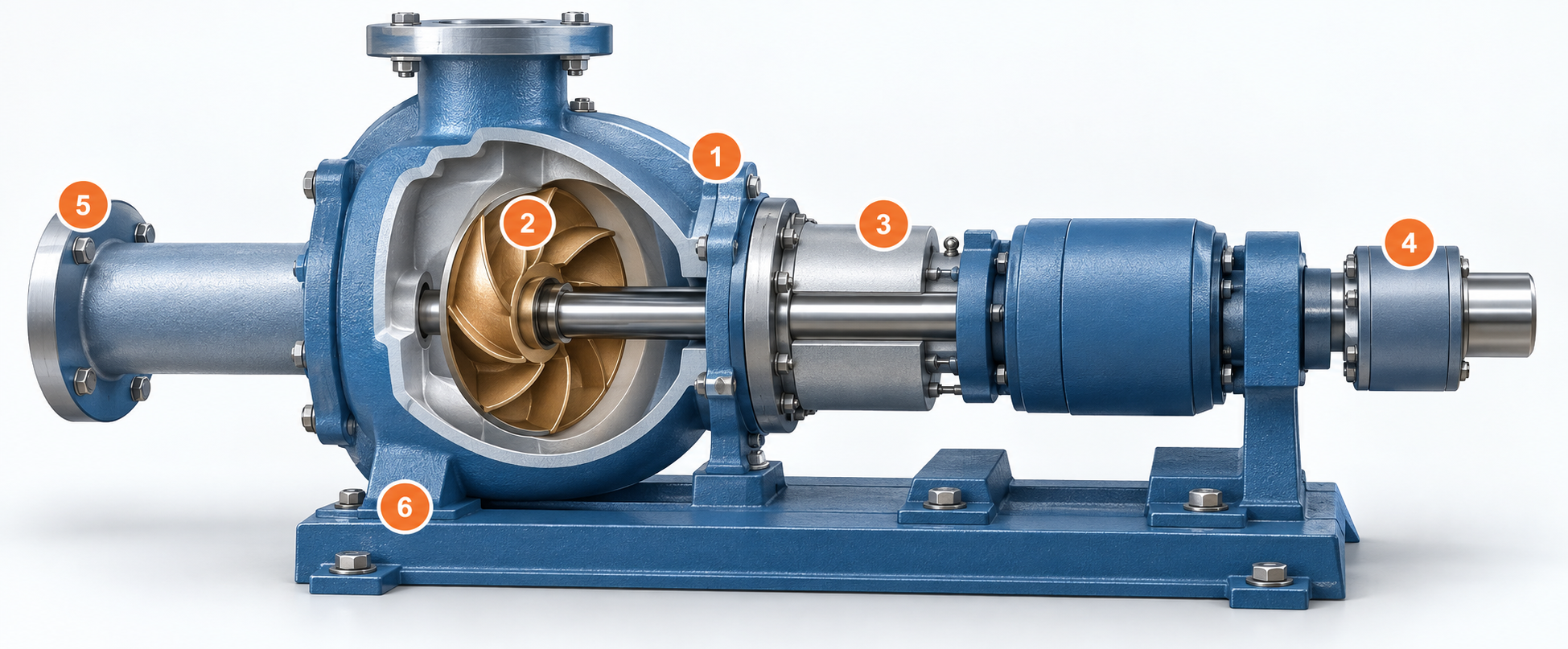
| Seal chamber and sleeve | Chamber type, bore/depth, gland pilot and bolt pattern, sleeve diameter, ports and seal working length | Assuming the existing mechanical seal transfers without checking the chamber and sleeve |
| Materials and duty | Each wetted component grade, fluid composition, temperature, solids, speed, flow, head and power | Selecting by a generic alloy family or nominal pump size alone |
04 · Family-specific evidence
Brand-specific checks for each pump family
Goulds 3196: verify the exact 3196 variant
- Match the complete model and frame context to the applicable Goulds parts list and IOM.
- Confirm whether the comparison is for a casing, cover/seal chamber, impeller, sleeve, shaft or a combined assembly.
- Check the 3196-specific impeller setting procedure for that configuration and operating temperature.
- Use the exact drawing to confirm shaft and impeller retention details; do not infer these from the coupling keyway.
Durco Mark III: verify impeller design and setting method
- Identify the specific Mark III platform, group, pump size and production configuration.
- Confirm whether the installed impeller is reverse-vane, open-vane or another listed design.
- Check the matching rear cover/seal chamber, external adjustment parts and shaft/sleeve arrangement.
- Follow the relevant Flowserve Mark 3 IOM; one setting method does not apply to every Mark 3 impeller design.
Flowserve lists multiple Mark 3 impeller options, including reverse-vane and open designs. This variation is one reason to use the pump-specific service instructions rather than a family-level rule. See the Flowserve Durco Mark 3 product documentation and the applicable Goulds 3196 i-FRAME IOM.
For additional component-level Durco checks, read How to Verify Durco Mark III Replacement Parts Before Ordering. For number lookup, use the OEM Part Number Cross-Reference as a starting point, then confirm configuration and fitment.
05 · High-risk detail
Impeller clearance: never copy a value across designs
Clearance is set from a defined datum using a defined adjustment procedure. The reference surface can depend on impeller design and the pump configuration. Temperature and the applicable OEM instructions can also affect the specified setting.
For Durco Mark 3, the Flowserve IOM distinguishes reverse-vane/recessed arrangements from open-impeller arrangements and specifies the relevant reference surfaces and temperature-dependent procedure. For Goulds 3196, use the exact 3196 model/configuration IOM. Confirm the installed impeller style and manual revision before setting or approving clearance.
Keep three checks separate in a work instruction: (1) identify the impeller type; (2) identify the reference datum and adjustment direction in that model’s IOM; and (3) record the measured setting, temperature basis and acceptance source. Do not substitute an assumed clearance uplift for measured or manufacturer data.
06 · Review workflow
A five-step wet-end compatibility review
A defensible cross-reference should say which exact interfaces were checked, what evidence was used, what remains unverified and whether modifications are required. It should not promise a universal frame match or “drop-in” fit based solely on a family name.
07 · Prepare a useful RFQ
What to send for a dimensional compatibility review
| Input | Preferred evidence |
|---|---|
| Pump identity | Nameplate photo, full model, size, frame/group and serial |
| Part scope | OEM/POS number where available; list of parts to replace and retain |
| Fitment data | GA or section drawing, revision, mating dimensions and clear photos |
| Hydraulic duty | Flow, head, speed, impeller diameter/trim and motor power |
| Service | Fluid composition, concentration, operating temperature, solids and service history |
| Seal/material | Seal type, chamber details, sleeve and material requirements |
| Acceptance | Required dimensional records, material documents and project inspection criteria |
Frequently asked questions
Wet-end interchange FAQs
Does ASME B73.1 make Goulds 3196 and Durco Mark III wet ends interchangeable?
No. ASME B73.1 defines selected dimensional interfaces for pumps with the same standard designation. It does not prove that brand-specific casings, impellers, seal chambers, shafts or hydraulic performance are interchangeable.
Can I use a Goulds 3196 frame name to identify the matching Durco Mark III group?
Do not infer a cross-brand match from frame or group names. Provide the complete model, size, serial or drawing revision and measured interfaces for a configuration-specific review.
Can I use one impeller-clearance value for both pump families?
No. Clearance datum and setting method depend on the pump family, impeller design, configuration, temperature and applicable OEM IOM. Use the exact procedure for the installed pump.
What should I send for a wet-end fitment review?
Send the nameplate, complete pump size and frame or group, serial number, drawings or dimension photos, impeller details, seal arrangement, materials and operating flow, head, speed, fluid and temperature.
Does a casing or nozzle that bolts up prove the replacement is suitable?
No. Mechanical fit is only one part of the review. Confirm shaft and seal interfaces, impeller setting, materials and hydraulic duty before approving the replacement.
Related engineering resources
Editorial note: This reference was prepared by the ANSI Pumps Pro technical content team. It is a buyer-side review checklist; project fitment must be confirmed by the responsible engineer against the actual equipment records and manufacturer instructions.
Goulds, ITT, Flowserve, Durco and Mark III are third-party trademarks used solely to identify installed equipment and replacement-reference applications. ANSI Pumps Pro is an independent aftermarket manufacturer and is not affiliated with or endorsed by the referenced OEMs. Final compatibility must be confirmed against the exact pump configuration, controlled documentation and service conditions.