
Quick Diagnosis: Measure Flow, Head and Power Together
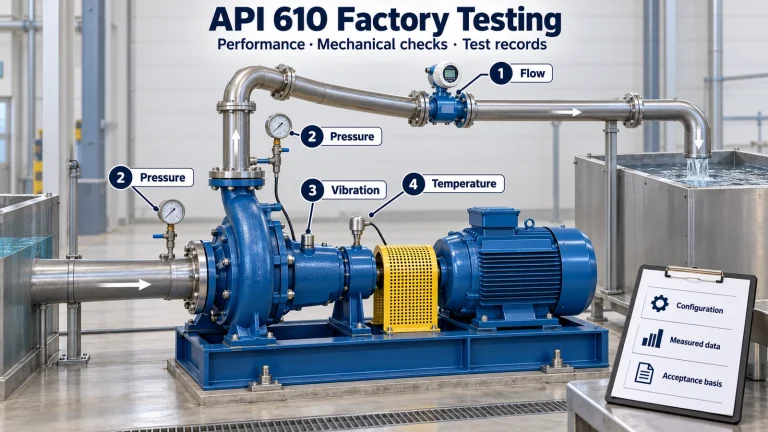
High motor power combined with low discharge pressure does not identify a failed pump part. First verify the operating point: measure flow, suction and discharge pressure, liquid temperature, actual speed, and electrical input at the same stable condition. Convert the pressure readings to developed head, then compare measured flow, head, and pump input power with the approved curve for the installed speed and impeller trim.
The pattern narrows the next check. High measured flow with low head points first to the system path, actual speed, and the pump’s power curve. Low flow and low head call for checks of prime, suction conditions, rotation, speed, blockage, and wear. If flow and head match the pump curve but electrical input is high, investigate fluid properties, pump efficiency, and the motor or drive measurements before opening the pump.
Use a four-step sequence
Measure a stable operating condition → calculate developed head from both pressure taps → compare flow, head, and power with the correct pump curve → inspect the system, driver, or pump branch indicated by the evidence.
Record a Stable Operating Snapshot
Record readings close enough in time that the process condition has not changed between measurements. Note units, instrument identity, tap location, and whether each value is measured, calculated, or taken from a nameplate. Do not change a valve or open the casing until the initial condition is documented and site procedures allow the next check.
| Record | Why it matters | Field notes |
|---|---|---|
| Flow, suction pressure, discharge pressure | Places the pump on its curve and allows developed head to be calculated. | Meter type and location; pressure-tap locations, elevations, units, and gauge or absolute basis. |
| Liquid and process state | Density and viscosity affect power and performance; temperature can change vapor pressure. | Liquid composition, temperature, density or specific gravity, viscosity, solids, gas, and tank level where relevant. |
| Speed and installed configuration | Curve comparisons require the actual operating speed and impeller configuration. | Measured rpm or verified drive frequency, impeller diameter/type, motor connection, and recent work. |
| Driver electrical data | Electrical input is not the same quantity as pump shaft power. | Three-phase active kW where available, voltage, current on each phase, power factor, drive status, and instrument method. |
| System configuration | Changes in resistance or parallel equipment can move the operating point. | Valve positions, bypass/recycle status, strainer condition, parallel-pump status, and recent piping changes. |
| Condition indicators | Trends can support, but do not alone prove, a mechanical diagnosis. | Vibration, bearing temperature, seal leakage, unusual noise, and maintenance/inspection history. |
If flow has not been measured, use a suitable method and installation for the meter rather than estimating it from motor current. The centrifugal pump flow-rate guide reviews common measurement and calculation approaches; calculated flow should be identified as an estimate.
Calculate Developed Head and Separate Pump from Motor Power
Discharge pressure alone is not pump head. For pressure taps at the suction and discharge flanges, calculate total head added by the pump using pressure, velocity, and elevation terms. Use consistent units and the measured liquid density. If the taps are remote from the flanges, account for the intervening piping and datum before comparing the result with a pump curve.
Hp is pump total head added; Pd and Ps are discharge and suction static pressures; ρ is liquid density; g is gravitational acceleration; vd and vs are average velocities at the pressure sections; and zd and zs are elevations from the same datum.
For water-based screening in US customary units, brake horsepower (BHP) estimates the power delivered to the pump shaft from flow, head, specific gravity, and pump efficiency:
QGPM is flow in US gallons per minute; Hft is pump total head in feet; SG is liquid specific gravity relative to water; and ηpump is pump efficiency expressed as a decimal.
The Hydraulic Institute explains pump input power and field power measurements in its pump-curve reference and pump FAQs. Compare like quantities: pump shaft power to the pump power curve, and measured electrical input to an electrical or driver model that includes applicable losses.
Read the Pump and System Curves at the Actual Speed and Trim
A pump curve describes the head and power the pump can produce across flow at a stated speed and impeller configuration. A system curve describes the head the connected system requires as flow changes. Their intersection is the operating point. Verify that the curve applies to the installed model, impeller diameter, rotational speed, and relevant liquid correction before using it to diagnose the symptoms.
High flow paired with low head can occur when system resistance is lower than expected, a bypass is open, a valve or control path has changed, another pump is operating in parallel, or actual speed/configuration differs from the design record. Check the specific pump’s power curve: power behavior near the high-flow end varies by design, so “runout” should not be assumed from pressure and current alone.
Low flow and low head can be consistent with loss of prime or entrained air, incorrect rotation or speed, restricted suction, a blocked or damaged impeller, internal wear, or a measurement error. Cavitation may reduce head and produce vibration, but its effect on power depends on the pump and operating condition. Confirm suction pressure, liquid temperature, vapor pressure, flow, and NPSH margin; noise alone is not a diagnosis. See the site’s NPSH and operating-regions guide.

The Hydraulic Institute’s system-curve reference explains the system relationship and pressure/head concepts. Plot measured flow and calculated head on the actual pump curve, then check whether the process system could produce the observed operating point.
Match the Evidence to Likely Causes
| Measured pattern | Likely diagnostic branch | Next discriminating check |
|---|---|---|
| Flow high; head low | System resistance or configuration, actual speed, or pump operation toward the high-flow side. | Check bypass/recycle, valve positions, parallel pumps, system changes, speed, and the installed pump’s head and power curves. |
| Flow low; head low | Prime/air, suction condition, rotation/speed, blockage, impeller damage, or internal wear. | Verify liquid-filled casing, suction pressure and restrictions, rotation, actual rpm, and inspect only under the applicable isolation procedure. |
| Flow and head match curve; electrical input appears high | Different liquid density/viscosity, lower efficiency, motor/drive condition, or an electrical measurement/comparison error. | Confirm fluid properties and curve basis; obtain active kW and power factor with a suitable instrument; account for motor and drive losses. |
| Readings do not reconcile with the curve | Instrument range/calibration, meter installation, pressure-tap location or datum, or wrong curve/configuration. | Cross-check instruments and units; confirm tap locations, impeller trim/type, actual speed, and curve revision before drawing a mechanical conclusion. |
Do not make a zero-flow shutoff test the default diagnostic step. Running against a closed discharge can heat the liquid and damage equipment. A shutoff-head check should only be considered within an OEM-approved, instrumented procedure with explicit duration limits and site safeguards.
Use Model-Specific Mechanical Inspection and Clearances
Open the pump only after the hydraulic and electrical evidence supports an internal inspection and the equipment is isolated under site lockout/tagout procedures. Record the installed model and variant, impeller type and diameter, wear-part dimensions, shaft/sleeve condition, seal arrangement, and visible erosion, corrosion, deposits, or solids damage. Compare every measurement with the applicable OEM IOM or approved drawing for that model, size, material, and operating temperature.
There is no single wear-ring or impeller clearance that applies to all ANSI process pumps. Even variants within a product family can specify different settings and adjustment methods. The Goulds NM 3196 IOM and Flowserve Durco Mark 3 IOM illustrate why the exact configuration and manufacturer instructions matter. These examples do not establish a universal setting for other pumps.

Repair, Re-rate or Replace?
A repair is a reasonable path when the required duty remains appropriate, the pressure boundary and base are serviceable, and inspection identifies a defined defect that can be corrected to documented limits. Ask for a repair scope that records measured dimensions, materials, shaft and sleeve condition, seal configuration, balance or test requirements, and acceptance criteria.
Re-rate or system changes may be more appropriate when the process duty or system resistance has changed. Replacement merits review when the current pump cannot meet the required operating range, repeated repairs do not restore reliability, or major damage makes repair uneconomic. For Goulds 3196 or Durco Mark III 2 equipment, confirm model, size, group/frame, shaft arrangement, seal chamber, impeller trim, material, connection dimensions, and duty point. ASME B73.1 dimensional alignment does not by itself establish internal component or hydraulic interchangeability; see the site’s B73.1 compatibility guide, Goulds 3196 replacement information, and Durco Mark III replacement information.
Prepare a useful performance review
Share the pump model and nameplate, measured flow and pressure with tap locations, liquid properties and temperature, actual speed and impeller configuration, electrical data, curve or datasheet, and recent maintenance findings. Request a technical review with the records available; the review should be based on the supplied configuration and duty.
Practical Troubleshooting Checklist
- Confirm the symptom and operating state; record all units and instrument/tap locations.
- Verify flow, suction and discharge pressure, liquid temperature, actual speed, and electrical readings at the same stable condition.
- Check prime, rotation, valve and bypass positions, suction restrictions, and parallel-pump status.
- Calculate developed head from pressure, velocity, and elevation terms using consistent units.
- Compare flow, head, and pump shaft power with the approved curve for the installed speed, impeller trim, and fluid basis.
- Follow the matching diagnostic branch; verify instruments and system configuration before internal inspection.
- Before opening or hand-turning equipment, apply site isolation and lockout/tagout requirements and the applicable OEM procedure.
- After correction, repeat the same measurements and document whether the operating point returned to the required range.
Frequently Asked Questions
Why can a pump draw more power while discharge pressure is low?
The pump may be operating at higher flow on a lower-resistance system, handling a denser or more viscous liquid, operating at a different speed or impeller configuration, or losing efficiency. A pressure reading alone does not establish pump head. Measure flow and both suction and discharge conditions, then compare head and power with the correct pump curve.
Does high motor current mean high pump BHP?
No. Current depends on voltage, power factor, motor efficiency, phase balance, and drive behavior as well as load. BHP estimates pump shaft input power. Use suitable electrical measurements, preferably active kW, and account for motor and drive losses when comparing electrical input with pump-curve power.
Can low discharge pressure alone prove that the impeller is damaged?
No. First verify flow, suction pressure, pressure-tap location, actual speed, rotation, and impeller configuration. Loss of prime, air, suction restriction, system conditions, and measurement error can also produce low pressure or head.
Can cavitation cause low head and high power?
Cavitation can reduce developed head and cause vibration, but its effect on power is duty-dependent. Check actual flow, suction conditions, liquid temperature and vapor pressure, and available versus required NPSH instead of diagnosing from noise alone.
Is there a standard clearance for ANSI pump wear rings?
No single clearance applies to every pump. Use the applicable manufacturer instructions for the exact model, size, internal design, material, and temperature. Record the measured value and compare it with that document’s limits.
Technical Sources
- Hydraulic Institute Data Tool: Pump Curves — pump performance curves, power, and operating point concepts.
- Hydraulic Institute Data Tool: System Curves — system head and pressure/head relationships.
- Hydraulic Institute: Pump FAQs — field measurement and pump power context.
- Goulds NM 3196 Installation, Operation and Maintenance Manual — model-specific inspection and clearances.
- Flowserve Durco Mark 3 ISO Close-Coupled Installation, Operation and Maintenance Manual — configuration-specific adjustment information.
- ANSI/HI 9.6.5-2022, Rotodynamic Pumps — Guideline for Condition Monitoring.
- KSB Centrifugal Pump Lexicon: Operating Behaviour — operating-condition context, including closed-discharge cautions.
Use the cited manuals for the configurations they cover; they are examples, not substitutes for the IOM supplied for another pump variant. Engineering decisions must use verified site measurements, the approved pump documentation, and applicable safety procedures.