
Evaluate the Full Flow Range, Not One Rated Point
A pump selection is not complete when one rated point appears to match a curve. Check the full expected flow range against the pump’s published best efficiency point (BEP), the applicable preferred operating region (POR), the manufacturer-defined allowable operating region (AOR), and the suction, power and minimum-flow limits for the exact configuration.
NPSH is one constraint in that review: NPSH available (NPSHA) comes from the connected system, while the manufacturer supplies the pump’s NPSH required (NPSHR) at defined conditions. Compare the values on a consistent basis across the operating cases that matter. This guide explains that decision path; the NPSHa calculator handles the numerical system-side calculation, and the applicable pump curve supplies pump-specific performance data.
What BEP, POR, AOR, NPSHA and NPSHR Tell You
| Term | What it describes | Where to verify it |
|---|---|---|
| BEP | The manufacturer-published flow point of best efficiency for a stated pump configuration. | Applicable curve, speed and impeller configuration. |
| POR | The preferred flow region around BEP where hydraulic efficiency and reliability are not substantially degraded under the applicable guideline. | Current ANSI/HI 9.6.3 guidance for the pump class, plus the manufacturer’s curve and application limits. |
| AOR | The broader allowable range that includes POR and is limited by the pump’s design and application conditions. | Manufacturer-defined limits for the supplied pump, speed and impeller. |
| NPSHA | The suction head available from the system above the liquid’s vapor-pressure head. | System calculation or suitably located pressure measurements, with datum and pressure basis recorded. |
| NPSHR | The pump-side NPSH requirement published by the manufacturer at stated operating conditions. | Correct curve revision, flow, speed, impeller and manufacturer’s stated basis. |
ANSI/HI 9.6.3-2024 relates POR to pump specific speed; it does not make one percentage band correct for every pump and application. AOR is bounded by considerations such as cavitation, heating, vibration, noise, shaft deflection, fatigue and other design limits. Use the applicable current guidance and the pump manufacturer’s limits rather than inferring boundaries from a generic diagram. See the Hydraulic Institute’s ANSI/HI 9.6.3 operating-regions guidance.
Establish the Operating Cases Before Reading the Curve
List the normal, minimum and maximum flow cases, then add startup, turndown, low source level, high liquid temperature, parallel-pump operation or process upsets when they are credible for the installation. One rated point cannot show whether the full operating range stays within the pump’s limits.
Record units, measurement locations, pressure basis and whether each value is measured, calculated or taken from a document. These details keep the pump curve, system calculation and field readings comparable.
Locate the Duty Range on the Correct Pump Curve
Confirm that the curve matches the exact pump size, speed, impeller and stated liquid or test basis. Mark each normal, minimum and maximum flow case, then identify BEP and the manufacturer-published POR and AOR limits. If the curve does not show those limits, request the applicable boundaries from the manufacturer instead of drawing them from a generic percentage.
Define cases
List normal, minimum, maximum and credible transient duties.
Confirm curve
Match pump size, speed, impeller, revision and liquid basis.
Mark limits
Locate BEP, applicable POR and manufacturer AOR.
Overlay checks
Review NPSH, power, minimum flow and system constraints.
Resolve gaps
Request a model-specific review where limits or data are missing.
For a step-by-step curve-reading method, see the centrifugal pump curve guide. For actual model data, use the site’s pump performance curves; a general article cannot replace the selected pump’s published curve.
What to Check Away from BEP
Operation away from BEP can change internal flow patterns and hydraulic loading. The direction and severity of the effects depend on the pump design and operating condition. Treat the following as checks to investigate, not as universal failure thresholds tied to a fixed percentage of BEP.
| Operating condition | Potential concerns | Evidence to check |
|---|---|---|
| Low flow or below POR | Internal recirculation, temperature rise, vibration or hydraulic loading may become limiting. Minimum continuous thermal flow and minimum continuous stable flow are distinct checks. | Manufacturer minimum-flow data, actual flow, temperature, vibration and the applicable operating-region limits. |
| High flow or beyond POR | NPSHR, absorbed power, motor load or hydraulic stability may limit the usable range; the exact constraint depends on the pump curve and system. | NPSHR and power curves at the evaluated flow, available NPSH, driver rating and manufacturer AOR. |
| Outside the stated AOR | Acceptability cannot be inferred from a generic flow percentage or a neighboring model. | Written manufacturer assessment and project-specific operating requirements before continuous operation is accepted. |
Do not turn a guideline band into an alarm setpoint
POR is not the same as the pump’s absolute operating limit. The AOR and minimum-flow limits must be established for the specific pump and service. A point outside POR may require further evaluation; it is not, by itself, proof of immediate damage.
Compare NPSHA and NPSHR Across the Relevant Range
NPSHA is determined by the system. For a source vessel with negligible surface velocity, a useful head-form relationship is:
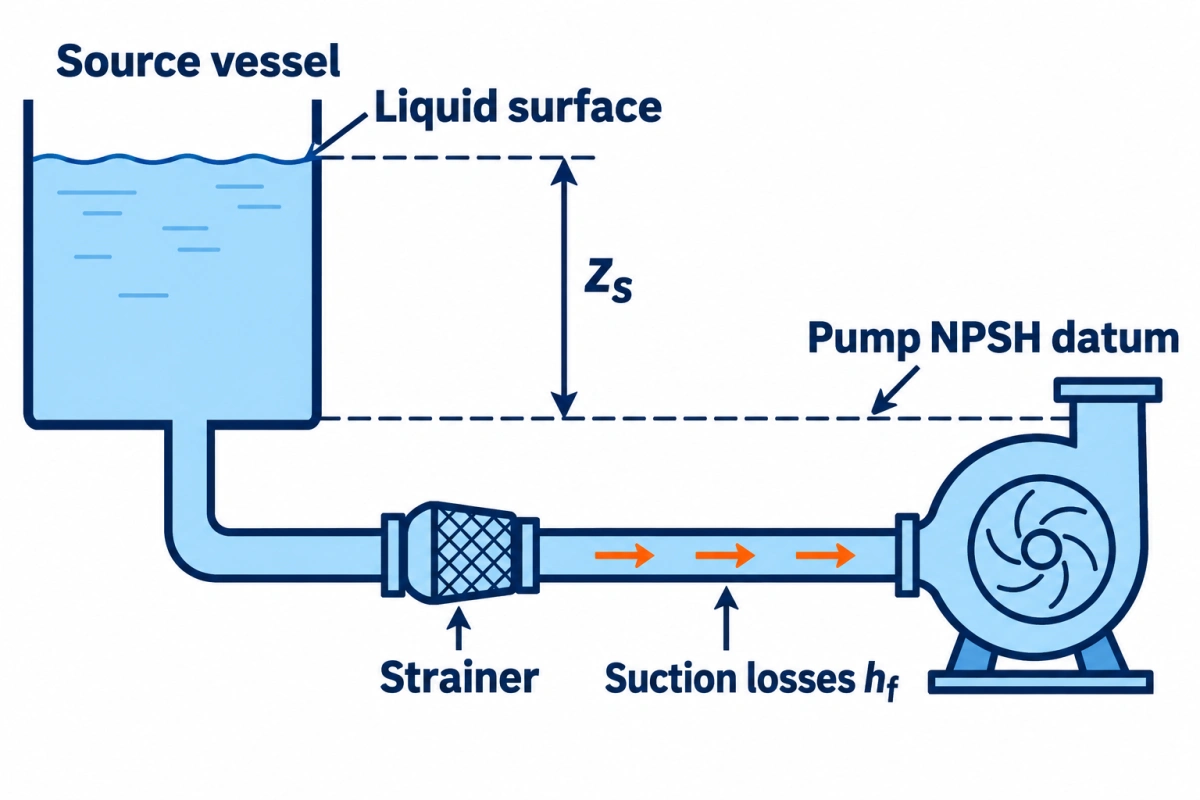
Calculate the system value at the lowest credible NPSHA condition and compare it with the manufacturer’s NPSHR at the corresponding flow, speed and impeller configuration. Evaluate the operating range rather than comparing one unrelated point. The required NPSH margin is application-specific under current ANSI/HI 9.6.1 guidance; do not substitute a universal ratio or fixed head value.
The 2024 ANSI/HI 9.6.1 guidance uses manufacturer-supplied NPSHR as the margin reference. NPSH3 describes the test point associated with a 3% head drop; it should not be presented as a no-cavitation boundary. See the dedicated ANSI/HI 9.6.1 NPSH margin guide for the detailed margin discussion, and use the NPSHa calculator for system-side inputs.
Keep diagnosis evidence-based
Noise alone does not prove cavitation. Compare suction pressure, liquid temperature, source level, flow, vibration and pump data. For field diagnosis and competing causes, continue to the centrifugal pump cavitation guide.
What ANSI B73.1 Does—and Does Not—Verify
ASME B73.1 covers horizontal end-suction centrifugal pumps for chemical process and includes dimensional interchange requirements for specified interfaces. That dimensional scope does not establish that two pumps have the same performance curve, BEP, NPSHR, operating region, material suitability or internal-part interchangeability.
When reviewing an ANSI process-pump replacement, verify the proposed pump’s curve and operating limits against the actual duty, then separately check dimensions, materials, seal arrangement and mechanical configuration. The manufacturer’s specific curve and documentation remain the evidence for hydraulic suitability.
For a replacement decision, use the applicable Goulds 3196 replacement verification or request a configuration-specific review through the site’s standard Engineering Review path.
What to Request from the Pump Supplier
If an operating limit or curve is unavailable, mark it as unverified and request the source. Do not fill data gaps with a value from a different pump family or a generic industry graphic.
Frequently Asked Questions
What is the difference between POR and AOR?
POR is the preferred operating region around BEP under applicable guidance. AOR is the wider allowable range for the specific pump and application, bounded by manufacturer and engineering limits.
Is POR the same percentage of BEP for every ANSI pump?
No. POR depends on the applicable ANSI/HI 9.6.3 guidance and pump characteristics, including pump specific speed. Confirm the current standard’s applicable range and the manufacturer’s data for the selected pump.
Does NPSHA greater than NPSHR guarantee cavitation-free operation?
No. Compare values on a consistent basis and apply the NPSH margin appropriate to the service under ANSI/HI 9.6.1, the project requirements and manufacturer guidance. NPSH3 is not a no-cavitation threshold.
Can a pump operate outside POR?
Possibly, if the operating point remains within the manufacturer-defined AOR and meets project requirements. Do not infer the AOR from POR percentages; request the specific pump limits.
What information is needed for an operating-range review?
Provide the normal, minimum and maximum flow, pump curve, speed, impeller configuration, liquid properties, suction conditions, driver data and any known manufacturer operating limits.
Sources and Verification Basis
- Hydraulic Institute — ANSI/HI 9.6.3, Rotodynamic Pumps Guideline for Operating Regions.
- Hydraulic Institute — ANSI/HI 9.6.1, Rotodynamic Pumps Guideline for NPSH Margin.
- Hydraulic Institute — Understanding the 2024 Updates to ANSI/HI 9.6.1.
- Hydraulic Institute Data Tool — Pump Curves.
- ASME — B73.1 specification scope and dimensional interchange requirements.