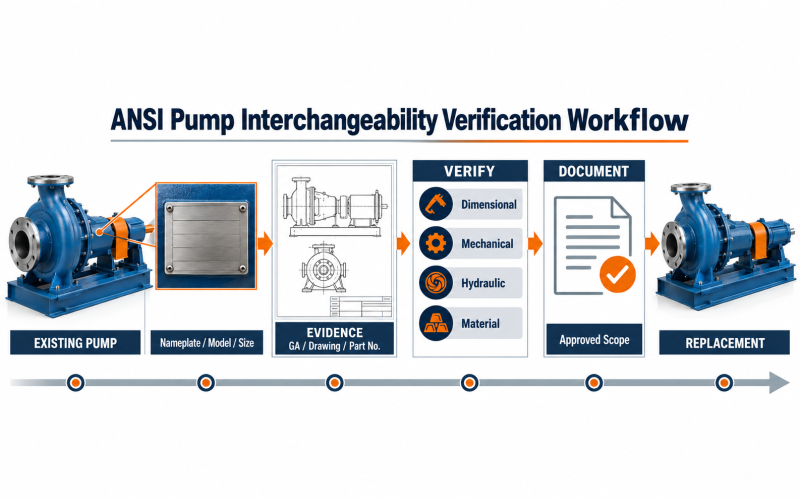
Short answer: ANSI pump interchangeability should be approved through a defined verification process—not from an “ANSI dimensional” claim alone. ASME B73.1 establishes selected external dimensional interfaces for applicable pump sizes, while the replacement scope, installed configuration, internal mechanical interfaces, hydraulic duty, materials and documentation must still be verified before approval.
Before You Start: What B73.1 Establishes
ASME states that pumps with the same standard dimension designation are intended to be interchangeable for defined mounting and installation relationships. That is useful evidence for an external fit review, but it is not a blanket approval for every internal component, hydraulic duty or service condition.
| B73.1 helps establish | Still requires separate verification |
|---|---|
| Standard dimensional designation | Exact installed configuration |
| Mounting dimensions | Field modifications |
| Suction/discharge size and location | Internal casing and impeller fit |
| Input shaft interface | Seal chamber and power-end configuration |
| Baseplate relationships | Hydraulic curve and NPSHr |
| Foundation-bolt pattern | Material and service suitability |
For the standard’s detailed scope, see ASME B73.1-2026 dimensions and interchangeability. This page focuses on the approval workflow that follows the dimensional starting point.
Step 1 — Define What Is Being Replaced
Start with the commercial and engineering scope. The review becomes clearer when the replacement is defined before individual parts are compared.
| Replacement scope | Primary verification focus |
|---|---|
| Complete pump + baseplate | Piping, foundation, driver, hydraulics and materials |
| Bare pump on existing base | Nozzles, feet, shaft, coupling and driver |
| Wet end | Casing, impeller, rear cover, seal chamber and shaft interfaces |
| Rotating assembly | Shaft, bearings, impeller, frame/register interfaces |
| Power end | Frame/group, shaft, registers, bearings, lubrication and coupling |
| Individual component | Part number, drawing revision, mating interfaces and material |
Commercial priority should normally be complete pump, bare pump, assembly and then individual part. A part-number request is valid, but it should not hide a larger pump-fitment risk.
Step 2 — Identify the Installed Pump and Configuration
Collect the manufacturer or platform, exact model, pump size, frame or group, serial number or equipment tag and nameplate. Add the current configuration, seal arrangement, impeller type or trim if known, drawing revision and any known field modifications.
A model-family name alone is not enough to approve interchangeability. The review must identify the installed configuration that will actually be removed or modified.
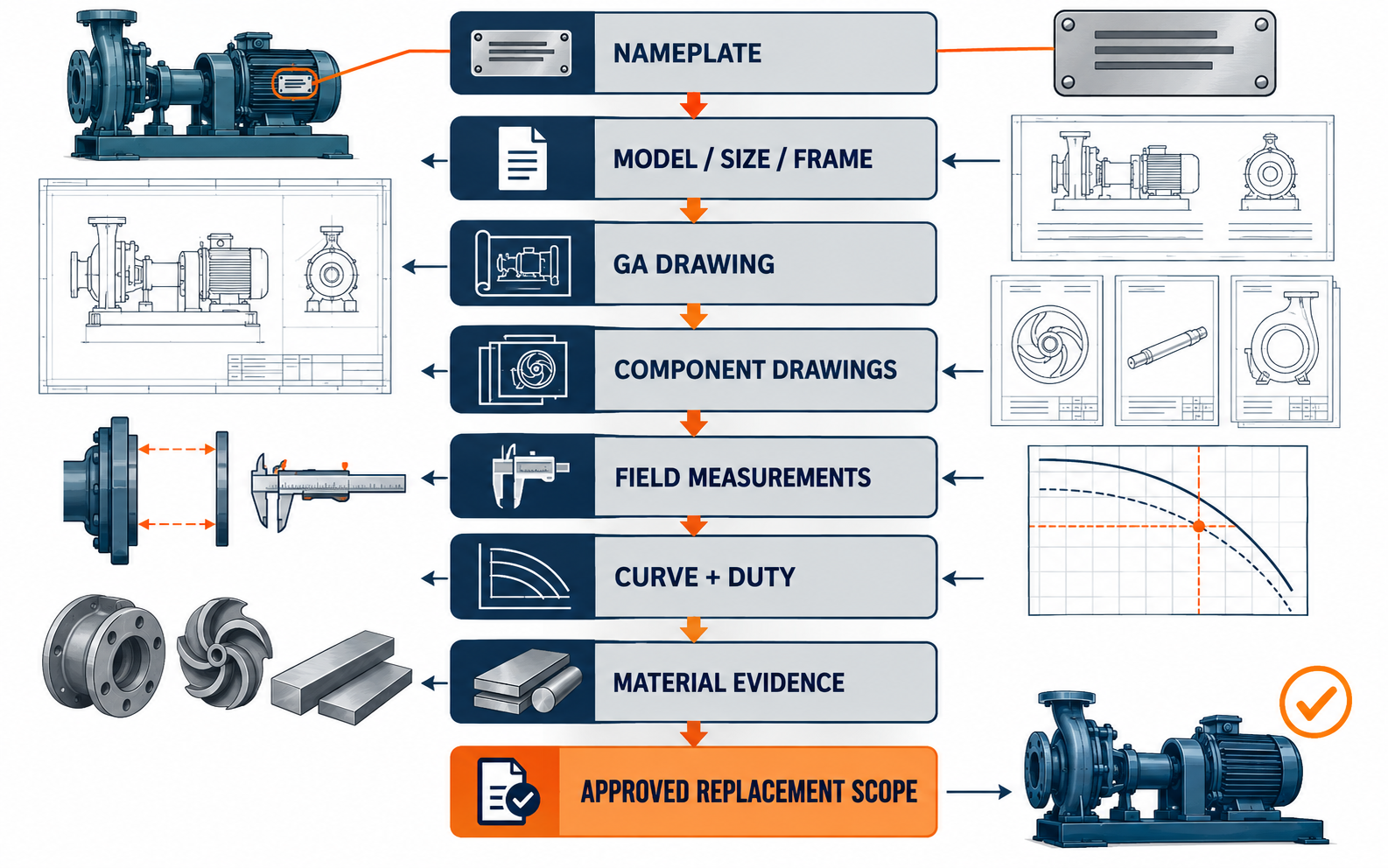
Step 3 — Establish the Evidence Basis
| Evidence | What it can establish | Typical strength |
|---|---|---|
| Model name only | Pump family | Low |
| Nameplate | Model, size, speed and identity | Starting evidence |
| Part number | Component reference | Useful if revision/configuration is known |
| Approved GA drawing | External installation interfaces | Strong |
| Controlled component drawing | Internal mating interfaces | Strong |
| Field dimensional inspection | Actual installed condition | Strong |
| CMM or detailed dimensional report | Precision component geometry | Strong |
| Pump performance curve | Hydraulic verification | Required for hydraulic approval |
| BOM or seal documentation | Configuration | Strong |
| MTR or PMI | Material identity | Required where material verification matters |
| Final written fitment approval | Exact approved scope | Final record |
Step 4 — Verify External Installation Fit
Verify the suction interface, discharge interface, shaft centerline, pump feet, baseplate, foundation bolts, coupling position, driver relationship, maintenance clearance and any field modifications. The goal is to confirm the installed envelope—not simply to match a catalog label.
Use the five ANSI pump installation interfaces to verify guide when actual field measurements are required.
Step 5 — Verify Internal Mechanical Compatibility
Check the casing register, impeller, shaft, shaft sleeve, wear rings, rear cover, seal chamber, bearing frame, adapter, bearings, coupling, keyways, mating interfaces and drawing revision as applicable.
External B73.1 dimensional fit is not evidence that internal parts are interchangeable. See dimensional interchangeability vs component compatibility for the narrower component boundary.
Step 6 — Verify Hydraulic Duty
Verify flow, head, speed, impeller trim, efficiency, power, NPSHr and the intended operating range against the system duty. A pump can fit the same installation envelope and still be hydraulically unsuitable.
Use the available pump performance curves and the actual duty basis, not a dimensional designation, to establish hydraulic suitability.
Step 7 — Verify Materials, Sealing and Service
Check the fluid, concentration, temperature, specific gravity or density, viscosity, solids, casing material, impeller material, shaft material, seal chamber, mechanical seal, gaskets or elastomers and corrosion history. Use the exact material specification where available and avoid broad “equivalent alloy” claims without a controlled basis.
Step 8 — Document Exactly What Has Been Approved
A defensible approval should state what is being replaced; which pump, model and configuration were reviewed; which external and internal interfaces were checked; which drawing revision and hydraulic curve were used; which material basis was used; whether field modifications exist; whether installation changes are required; which inspection or test documents are required; and what is not covered.
Do not issue a blanket “interchangeable” statement when only a defined scope has been verified.
Do Not Approve the Replacement Yet If…
- Exact model or frame cannot be confirmed.
- Nameplate and drawing information conflict.
- The installed pump has an undocumented field modification.
- A GA drawing is unavailable and critical dimensions remain unknown.
- Shaft or coupling relationship is not confirmed.
- The hydraulic curve is unavailable.
- Material designation is ambiguous.
- Seal-chamber configuration cannot be confirmed.
- A part-number cross-reference lacks revision or configuration basis.
- The supplier provides only a generic “ANSI interchangeable” statement.
Put the review on engineering hold until the unresolved interface is documented.
Model-Specific Claims Require Model-Specific Evidence
Manufacturer interchangeability documentation can be useful evidence, but the claim applies only to the model, size and component scope stated by that manufacturer. For example, PSG Dover publishes dedicated Griswold 811 ANSI Series information. For installed equipment, model-specific references such as Goulds 3196 replacement parts and Durco Mark III replacement should likewise be applied only within their documented scope. Do not generalize any model or part-number claim to every ANSI pump.
ANSI Pump Interchangeability Verification Checklist
- [ ] Replacement scope defined
- [ ] Existing pump identity confirmed
- [ ] Standard or dimensional basis confirmed
- [ ] Approved GA or field dimensions available
- [ ] External installation fit verified
- [ ] Internal mechanical interfaces verified
- [ ] Hydraulic duty verified
- [ ] Material, seal and service verified
- [ ] Drawing and BOM revisions confirmed
- [ ] Required inspection or test records defined
- [ ] Open issues placed on HOLD
- [ ] Exact approved scope documented in writing
What Are You Replacing?
Complete Pump or Bare Pump Replacement
Send the existing model, flow, head, fluid, temperature, material, motor or speed information and the available nameplate or GA drawing.
Wet End, Rotating Assembly or Power End
Provide the assembly scope, model, frame, part numbers, drawings and the mating interfaces that must remain unchanged.
Individual Part
Start with the part number, drawing revision, pump configuration and the mating components. A cross-reference is a starting point, not final approval.
Frequently Asked Questions
Does ASME B73.1 make all ANSI pump parts interchangeable?
No. B73.1 establishes selected external dimensional relationships for applicable pumps. Internal mechanical fit, hydraulics, materials, sealing and service still require separate verification.
What is the minimum information needed to start an interchangeability review?
Start with the installed model or nameplate, the replacement scope and operating duty. Drawings, measurements and component documentation can then be added based on what remains uncertain.
Is a part-number cross-reference enough to approve a replacement?
No. It is a starting reference. Configuration, revision, mating interfaces, material and applicable drawings still need verification.
When should a replacement be put on engineering hold?
When a required interface, configuration, hydraulic basis or material requirement cannot be confirmed reliably.
What should a final fitment approval state?
The exact replacement scope, pump and configuration reviewed, interfaces checked, drawings and data used, required changes and any exclusions or unresolved conditions.