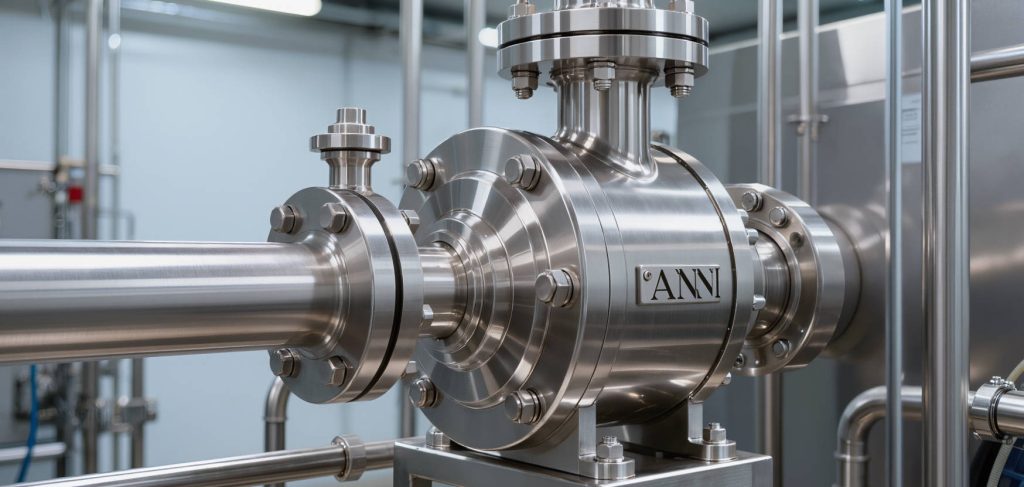
Process Pumps in the Food and Beverage Industry
Food and beverage processing might not be the first industry that comes to mind when you think of ANSI B73.1 process pumps — but it should be. From transferring liquid sugar in a candy factory to circulating CIP solutions in a dairy, from moving wort in a brewery to pumping tomato paste in a food plant, ANSI process pumps handle thousands of food-grade fluid transfer applications across North America.
The unique requirements of food-grade pumping — sanitary design, cleanability, FDA-compliant materials, and resistance to both process fluids and aggressive cleaning chemicals — make material selection and pump configuration critically important.
Key Standards for Food-Grade Pumps
| Standard |
Scope |
Key Requirements |
| 3-A Sanitary Standards |
Dairy and food processing |
Surface finish ≤32 Ra μin, drainability, bacterial harborage prevention |
| FDA 21 CFR |
Food contact materials |
Wetted materials must be FDA-compliant |
| EHEDG |
Hygienic equipment design (Europe) |
Cleanability verified by practical testing |
| ASME B73.1 |
Dimensional standard |
Interchangeability benefits apply to food-grade installations too |
Food and Beverage Pump Applications
Dairy Processing
| Application |
Material |
Special Considerations |
| Milk receiving/transfer |
316SS, polished ≤32 Ra |
3-A certification; CIP-compatible design |
| CIP supply |
316SS min; Nickel for hot caustic >3% |
Double mechanical seal with barrier fluid |
| Whey processing |
316SS |
Low-NPSH design for vacuum evaporation processes |
Brewery and Beverage Production
| Application |
Material |
Special Considerations |
| Wort transfer |
316SS |
Semi-open impeller for hop particles; NPSH margin for hot water |
| Yeast pitching |
316SS |
Low-shear impeller (yeast cells are shear-sensitive) |
| Beer transfer/filtration |
316SS, polished |
CO₂ environment — seal flush plans must accommodate dissolved gas |
| CIP supply |
316SS or Alloy 20 |
Phosphoric acid cleaners aggressive to 316SS at elevated temp |
General Food Processing
| Application |
Material |
Key Considerations |
| Liquid sugar / corn syrup |
316SS |
High viscosity at ambient; heating jackets sometimes required |
| Vegetable oil transfer |
316SS |
Viscosity varies with temperature; free fatty acids corrosive |
| Tomato paste / fruit puree |
316SS, polished |
Very high viscosity; acidic (pH 3.5-4.5) |
| Brine / salt solutions |
CD4MCuN or Titanium |
Hot brine attacks 316SS via Cl-SCC |
Sanitary Design Features for Food-Grade ANSI Pumps
- Surface finish: Product-contact surfaces polished to ≤32 Ra μin (3-A dairy standard)
- Drainability: Casing designed to be self-draining — no dead legs
- Crevice-free construction: Sanitary clamp (Tri-Clamp) or butt-weld connections preferred
- FDA-compliant elastomers: EPDM, FKM (Viton), or PTFE O-rings and gaskets
- CIP compatibility: Withstand 180-200°F cleaning solutions for 30-60 minute cycles
- SIP compatibility: Withstand saturated steam at 250-270°F for aseptic processes
Mechanical Seals for Food-Grade Service
- Sanitary seal design: Single cartridge with FDA-compliant elastomers
- Double seals for CIP: Back-to-back seal with barrier fluid for aggressive CIP chemicals
- SiC vs. SiC faces: Preferred for CIP resistance (carbon faces attacked by hot oxidizing CIP chemicals)
Maintaining Pumps in a Food Processing Facility?
We provide food-grade wet-end components and complete rebuild kits for Goulds 3196 and Durco Mark III pumps in all required sanitary configurations. Full material traceability, FDA-compliant elastomers, and polished surface finishes.
Request food-grade pump components →