What ASME B73.1-2026 Actually Governs
ASME B73.1-2026 is a design and specification standard for applicable horizontal, end-suction, single-stage, centerline-discharge chemical-process centrifugal pumps. The 2026 scope covers metallic, thermoplastic polymer, thermoset polymer and fluoropolymer-lined constructions. It includes dimensional interchangeability requirements and selected design features intended to support installation, maintenance, reliability and safety.
For pumps carrying the same applicable standard dimension designation, the standard is intended to make defined installation interfaces interchangeable with respect to mounting dimensions, suction and discharge nozzle size/location, input shafts, baseplates and foundation-bolt holes.
That does not mean two pumps with the same B73.1 designation automatically have the same hydraulic curve, NPSHR, impeller geometry, shaft, seal chamber, bearing arrangement, materials or internal spare parts. Those items still require configuration-specific evidence.
Buyer rule
“B73.1 compliant” is the beginning of a replacement review—not the end of it. Use the standard claim to establish the applicable design and dimensional framework, then separately verify hydraulics, materials, seal arrangement, rotating assembly, inspection requirements and documented deviations for the quoted pump.
What Actually Changed in ASME B73.1-2026
The 2026 edition should be discussed from the published revision summary rather than from inferred marketing claims about universally tighter tolerances or automatic test-grade changes. For procurement, each revision area should be translated into a question the buyer can verify in the quotation, drawing set or inspection plan.
| Published 2026 revision area | Buyer / MRO implication |
|---|---|
| Thermoset and thermoplastic composites added to the material/construction provisions | State the actual construction system; do not use “polymer pump” as the complete material specification. |
| Low-temperature-limit guidance added | State the actual operating/design temperature and verify the applicable material and construction limits. |
| Additional gasket design criteria | Review the quoted gasket/joint configuration rather than assuming a generic detail. |
| Impeller-balance figure added | Where balance is part of the purchase requirement, define the basis and evidence expected from the supplier. |
| Welded and flanged auxiliary-piping details added | Verify the actual auxiliary piping/interface arrangement on the approved configuration. |
| Austenitic stainless-steel welding note added | A material name alone is not a complete fabrication requirement; project welding requirements may still need to be stated. |
| Guard communication/material provisions updated | Treat guarding as part of the documented delivered configuration rather than an assumed site accessory. |
| Casing temperature, bearing temperature and bearing vibration measurement sections added | If monitoring or acceptance documentation is required, define what is measured, where it is measured and what criterion applies. |
| Fluoropolymer-lined metallic pumps added | Do not transfer metallic-pump assumptions automatically to lined construction; verify the actual product architecture. |
| Vacuum-limit provisions added | Vacuum service requires an explicit review rather than a generic B73.1 compliance statement. |
| Table 7.2.2.3-1 revised and a new nonmandatory appendix added | Use the current licensed edition for contractual dimensions and requirements; this guide is not a substitute for the standard. |
Do not invent 2026 requirements
Do not claim that B73.1-2026 universally tightened shaft TIR, imposed one vibration velocity limit, selected one ANSI/HI 14.6 acceptance grade, standardized a specific mechanical-seal piping plan or introduced a universal hydrostatic-test pressure/time rule unless the applicable standard text and project specification support that statement.
Standard Dimension Designation Is Not the Same as an OEM Model or Frame Name
A standard dimension designation belongs to the ASME B73.1 dimensional framework. An OEM model, bearing-frame name or product-family group is a manufacturer-specific identifier. They should not be merged into one classification system.
For replacement work, record all three where available. A matching standard designation can support external fitment review, but it does not prove that one manufacturer’s impeller, shaft, seal chamber or power end can be installed in another manufacturer’s pump.
What B73.1 Can Help Verify—and What It Cannot Prove by Itself
Standardized Interfaces vs. Model-Specific Evidence
Separate installation interfaces covered by the B73.1 dimensional framework from hydraulic, mechanical and material details that must be verified for the actual proposed pump.
Nozzle interfaces
Suction/discharge size and location within the applicable standard dimension designation.
Mounting / baseplate
Mounting relationship, input-shaft interface and foundation/baseplate relationships within scope.
Hydraulic curve
Requires the proposed curve, speed, impeller diameter and operating-point verification.
Shaft / seal chamber
Requires model-specific drawings and component/interface confirmation.
Materials / internals
Requires exact material specifications, BOM and configuration-specific evidence.
| Buyer question | B73.1 alone? | Additional evidence |
|---|---|---|
| Mounting dimensions | Within applicable standard scope | Approved GA / outline drawing |
| Suction/discharge nozzle size and location | Within applicable designation | Approved outline drawing |
| Baseplate / foundation relationship | Within applicable standard scope | Baseplate drawing / as-built check |
| Input-shaft interface | Within applicable standard scope | Approved dimensional drawing |
| Same hydraulic curve | No | Proposed or certified pump curve as required |
| Same NPSHR | No | Manufacturer hydraulic data / specified test data |
| Same impeller geometry | No | Model-specific drawing / BOM |
| Same shaft or seal chamber | No | Component / chamber drawings |
| Same metallurgy | No | Exact material specification / BOM / traceability as required |
| Same internal spare parts | No | Model / part-number / fitment verification |
For field replacement work, use the ANSI pump interchangeability verification guide to separate standardized external fitment from internal compatibility. If a field survey is required, use the five ANSI pump interfaces to verify before approving a drop-in replacement.
Which Standard Answers Which Engineering Question?
| Standard / guideline | Primary question it answers | Procurement use |
|---|---|---|
| ASME B73.1-2026 | What chemical-process pump design/dimensional framework applies? | Specify the applicable B73.1 scope/designation and verify controlled installation interfaces. |
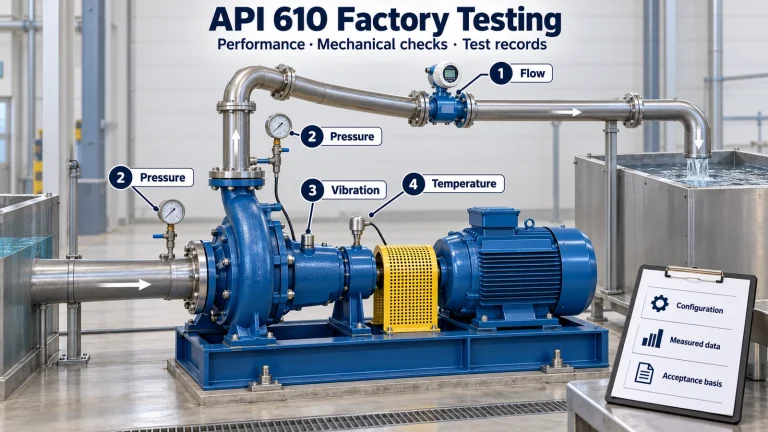
| ANSI/HI 14.6-2022 | How should rotodynamic pump performance be tested and accepted? | State the required hydraulic-performance, NPSH, hydrostatic or mechanical-integrity test basis separately from a B73.1 claim. |
| ANSI/HI 9.6.1-2024 | What NPSH margin should be reviewed? | Evaluate NPSHA versus manufacturer-supplied NPSHR with application-specific margin considerations. |
| ANSI/HI 9.6.2-2021 | How should applied nozzle loads be assessed? | Review piping forces and moments where nozzle loading is part of the reliability or project specification. |
| ANSI/HI 9.6.3-2024 | Where should the pump operate relative to BEP? | Review preferred and allowable operating regions instead of approving only one isolated rated point. |
| ANSI/HI 9.6.4-2022 | How should pump vibration be measured and evaluated? | Define measurement location, test environment, operating point and applicable acceptance criteria instead of using one generic vibration number. |
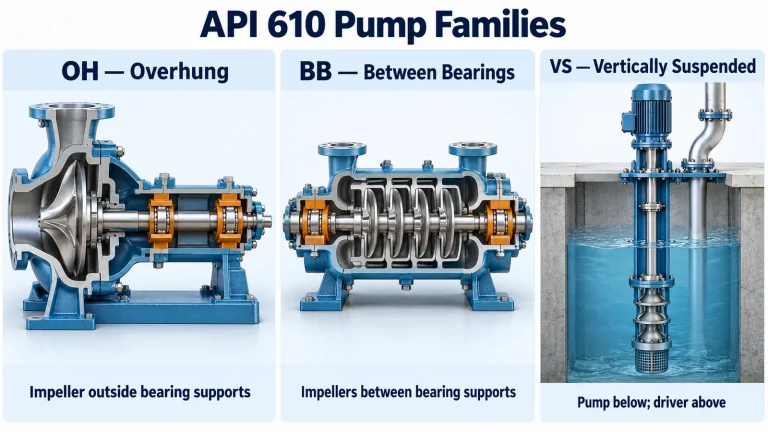
| API 610 | Is the project governed by an API petroleum/process-pump specification instead? | Do not treat B73.1 and API 610 as interchangeable procurement frameworks. |
For hydraulic acceptance details, use the ANSI/HI 14.6 pump acceptance testing guide. For piping loads, see the pump nozzle loads and piping-strain guide. When the project may belong in an API pump specification instead, review API 610 vs ASME B73.1.
B73.1 compliance does not select an HI 14.6 acceptance grade for you
If a factory acceptance test is required, state the applicable ANSI/HI 14.6 requirement in the RFQ or purchase specification. Do not treat “ANSI compliant” as shorthand for a particular hydraulic-test grade, vibration limit or NPSH acceptance criterion.
10-Point Engineering Audit for a Third-Party ANSI Process Pump
| Audit point | Buyer verifies | Evidence to request | Typical red flag |
|---|---|---|---|
| 1. Edition and scope | Applicable B73.1 edition, pump type and project exceptions | RFQ / datasheet / compliance statement / deviation list | Supplier states only “ANSI pump” |
| 2. Dimension designation | Correct standard dimension designation and quoted configuration | Approved GA / outline drawing | Only nozzle nominal size is compared |
| 3. Installation interfaces | Nozzle locations, shaft interface, mounting and base/foundation relationship | Controlled dimensional drawing plus as-built data where needed | Generic catalogue drawing replaces job drawing |
| 4. Hydraulic duty | Minimum / normal / maximum flow, head, speed, impeller diameter, power and efficiency | Proposed curve and test requirement if specified | A curve is supplied with no speed or impeller basis |
| 5. NPSH and operating region | NPSHA/NPSHR basis plus expected operation relative to BEP, POR and AOR | System data, manufacturer NPSHR and operating-region review | Only the rated point is checked |
| 6. Rotating assembly | Shaft, impeller attachment, balance requirement, bearings, lubrication and coupling basis | Section drawing / BOM / inspection criteria as required | Runout, deflection and vibration are treated as one measurement |
| 7. Seal and containment | Seal chamber, seal arrangement, faces, elastomers and supporting system | Seal data sheet / chamber drawing / piping plan where applicable | Seal is selected without fluid and temperature review |
| 8. Materials and traceability | Exact material specification for wetted and pressure-containing components | Material schedule, MTR/PMI only where specified, heat traceability as required | Material is described only as “316” or “Hastelloy” |
| 9. Inspection and tests | Required hydraulic, hydrostatic, vibration, balance, NDE or other project tests | ITP / test procedure / reports traceable to the order | “Tested” is stated without a standard, criterion or report |
| 10. Final release dossier | All controlled drawings, reports, certificates, deviations and IOM documents are complete | Document index / MDR / deviation register / packing and serial records | Supplier cannot identify unresolved deviations before shipment |
Shaft runout is not the same as dynamic shaft deflection
Do not reuse a runout value as a universal shaft-deflection rule
Runout limits, dynamic shaft-deflection requirements and vibration acceptance criteria are different checks. Use the applicable B73.1 edition, manufacturer design basis and project specification for the exact acceptance values rather than transferring one number from one measurement to another.
What Evidence Should a Buyer Request Before PO Approval or Shipment Release?
| Document | Why the buyer needs it | Typical use |
|---|---|---|
| Approved GA / outline drawing | Confirms the installation interfaces being supplied | Always for replacement fitment review |
| Sectional drawing | Defines the proposed internal architecture and major interfaces | Replacement / mechanical review |
| Material schedule / BOM | Defines exact wetted and pressure-containing materials | Always for material review |
| MTR / PMI | Supports material identity/traceability when contractually required | Critical alloy or project-specific QA scope |
| Pump curve / performance report | Defines or verifies the hydraulic basis | Always need a curve; certified test only when specified |
| Hydrostatic / mechanical / vibration records | Documents specified acceptance checks | Per RFQ, ITP or purchase specification |
| Deviation register | Shows what differs from the RFQ, installed pump or project standard | Before final technical approval |
| IOM / final document index | Supports installation, commissioning, maintenance and turnover | Before shipment / final release |
MTR / PMI boundary
MTR and PMI can help verify what material was supplied. They do not prove that the alloy is suitable for the actual process chemistry, concentration, temperature, velocity, solids or contamination risk. Material suitability remains an application-specific engineering decision.
Six Steps From Existing Pump to an Approve / Hold Decision
Buyer Verification Workflow
Resolve fitment, hydraulics, materials and acceptance evidence before the purchase order or shipment is released.
Identify existing equipment
Nameplate, model, size, tag, drawings and field modifications.
Verify interfaces
Designation, mounting, nozzles, shaft and baseplate/foundation relationship.
Verify hydraulics
Flow, head, RPM, impeller diameter, NPSHR and operating region.
Verify materials / seal
Exact wetted materials, seal chamber/arrangement and service evidence.
Define tests / documents
Inspection plan, test basis, hold points, deviations and document package.
Approve or hold
Release only after exceptions and unresolved interfaces are documented.
Goulds 3196 and Durco Mark III: Same B73.1 Framework Does Not Mean Same Internal Architecture
Both product families are used in ASME B73.1 chemical-process pump service, but their manufacturer-specific hydraulic and mechanical architectures remain distinct. The practical audit lesson is to use B73.1 for the standardized installation framework and use model-specific drawings and manufacturer data for internal compatibility.
Replacement implication
A common B73.1 dimensional envelope can reduce installation uncertainty, but it does not create a universal cross-OEM impeller, shaft, seal chamber, bearing-frame or wet-end parts standard.
When Should a Buyer Hold or Escalate a B73.1 Compliance Claim?
| Supplier / project condition | Buyer action |
|---|---|
| “ANSI compliant” but no edition or standard dimension designation is identified | Request the exact standard basis and applicable designation before approval. |
| No approved GA / outline drawing | Hold dimensional-fit approval. |
| “Fits 3196 / Mark III because both are ANSI” | Require model-specific fitment evidence; do not accept the B73.1 claim as internal-parts proof. |
| No hydraulic curve for the proposed configuration | Hold hydraulic approval until the flow/head/NPSHR/power basis is available. |
| Material described only as “316”, “Hastelloy” or “Alloy 20” | Request the exact grade/specification, component scope and traceability requirement. |
| “ANSI tested” but no test standard or acceptance criterion is stated | Ask for the actual test basis, operating point, acceptance criteria and required report. |
| Installed baseplate or piping was field-modified | Use as-built measurements; do not assume original standardized geometry remains intact. |
| Drawing revision conflicts with RFQ / PO | Resolve the controlled document revision before manufacturing or shipment release. |
Inputs to Lock Before Approving a Replacement Pump
If the current pump identity or installed interfaces are uncertain, send the available nameplate, drawing, duty point and site dimensions first. The review should identify what is confirmed, what remains assumed and what must be measured before a replacement is released.
ASME B73.1-2026 Buyer FAQ
Is ASME B73.1-2026 a product certificate for an individual pump?
No. B73.1 is a published design and specification standard. A supplier should demonstrate the applicable requirements for the quoted configuration through controlled drawings, data, specified tests, material records and documented deviations rather than presenting a generic “ASME certified pump” claim.
Does ASME B73.1 make every ANSI process pump internally interchangeable?
No. B73.1 provides defined dimensional interchangeability for applicable installation interfaces. Internal components such as impellers, shafts, seal chambers, bearing frames and power ends still require model-specific verification.
Does B73.1 compliance prove that a replacement has the same hydraulic curve?
No. Hydraulic performance must be verified from the proposed pump curve, duty point, speed, impeller configuration, power, efficiency, NPSHR and operating-region basis. A dimensional compliance statement is not a hydraulic guarantee.
Are ASME B73.1 and ANSI/HI 14.6 the same requirement?
No. B73.1 is a chemical-process pump design/specification framework with dimensional interchangeability requirements. ANSI/HI 14.6 addresses rotodynamic pump acceptance testing. If testing is required, the applicable test and acceptance basis should be stated separately in the RFQ or purchase specification.
Should every replacement-pump order automatically include MTR, PMI, hydrostatic and vibration certificates?
No. The required inspection, test and documentation package should be defined by the RFQ, purchase specification, ITP and project requirements. Material and test records should be requested when they are necessary to demonstrate a stated requirement, not added as generic paperwork without an acceptance basis.
What should I request before approving a third-party ANSI pump replacement?
At minimum, verify the existing equipment identity, applicable standard/designation, approved dimensional drawing, hydraulic duty and curve, exact materials, seal/interface requirements, required inspection/test scope and documented deviations from the installed pump or project specification.
Technical Sources
- ASME — B73.1-2026, Specification for Horizontal End Suction Centrifugal Pumps for Chemical Process
- Accuris / ASME preview — B73.1-2026 scope and published revision summary
- Hydraulic Institute — ANSI/HI 14.6-2022 Rotodynamic Pumps for Hydraulic Performance Acceptance Tests
- Hydraulic Institute — ANSI/HI 9.6.1-2024 Rotodynamic Pumps Guideline for NPSH Margin
- Hydraulic Institute — ANSI/HI 9.6.3-2024 Rotodynamic Pumps Guideline for Operating Regions
- Hydraulic Institute — ANSI/HI 9.6.4-2022 Rotodynamic Pumps for Vibration Measurements and Allowable Values
- Hydraulic Institute — ANSI/HI 9.6.2-2021 Rotodynamic Pumps for Assessment of Applied Nozzle Loads
- ITT Goulds Pumps — Model 3196 i-FRAME Installation, Operation and Maintenance Manual
- Flowserve — Durco Mark 3 Sealed ASME (ANSI) Chemical Process Pump