
Identify the Damage Pattern Before Changing the Material
A corroded casing or impeller does not automatically mean that the next step is a higher alloy. Start by classifying where the damage occurs, how it is distributed and what changed in the process. Uniform corrosion, localized pitting, crevice corrosion, erosion-corrosion, cavitation and stress-assisted damage can require different corrective actions.
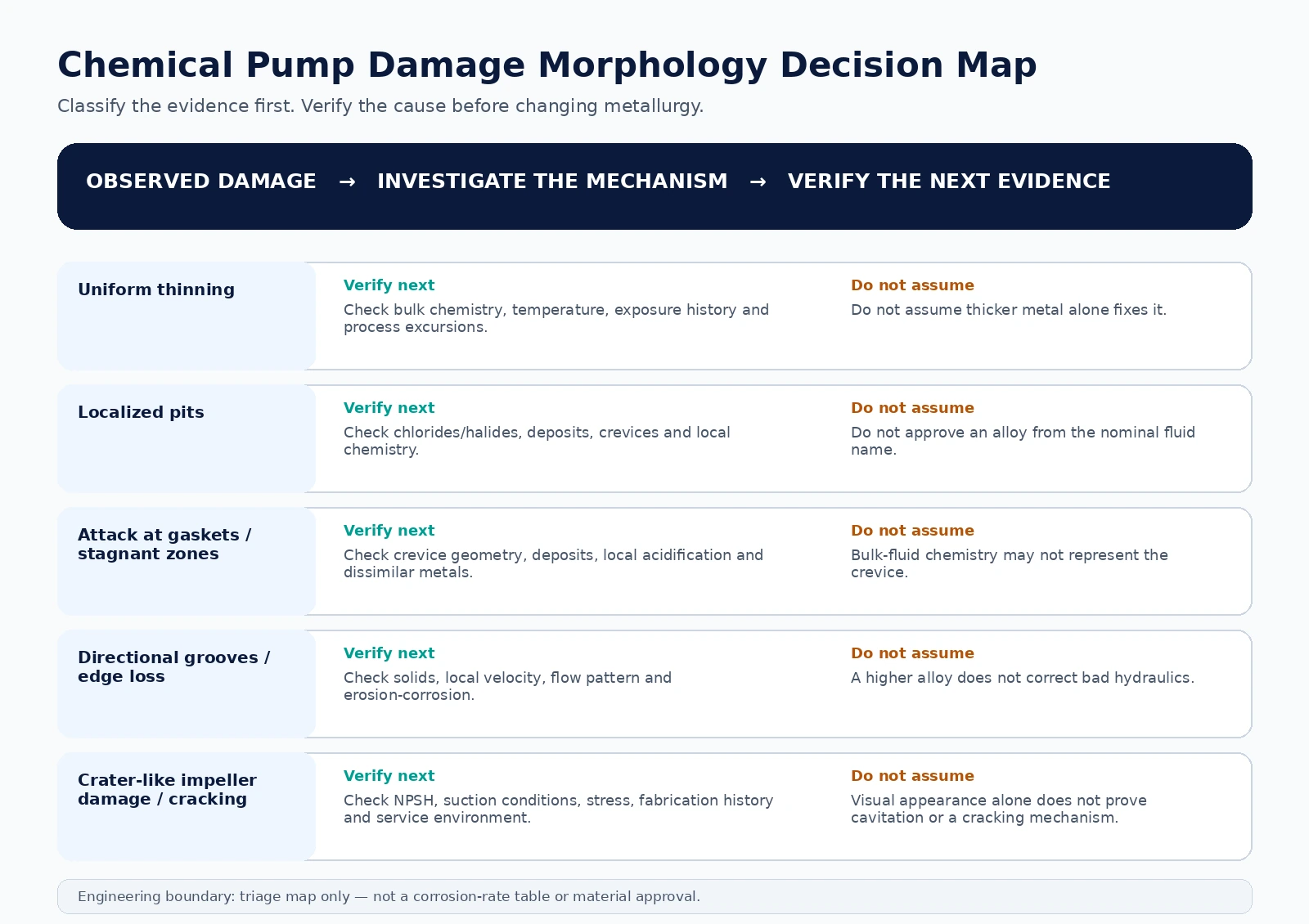
| Observed evidence | Investigate first | Verify next | Do not assume |
|---|---|---|---|
| Broad, relatively uniform wall loss | General corrosion or process upset | Bulk chemistry, normal/upset temperature, exposure history and inspection records | That a thicker casting alone resolves the mechanism |
| Discrete deep pits | Localized corrosion | Halides, deposits, inclusions, crevices and local chemistry | That the nominal alloy or fluid name proves compatibility |
| Attack concentrated under gaskets, deposits or stagnant zones | Crevice or galvanic effects | Geometry, deposits, gasket interface, dissimilar metals and local chemistry | That bulk-fluid chemistry represents the local environment |
| Directional grooves, leading-edge loss or flow-shaped thinning | Erosion-corrosion or solids-assisted attack | Solids, velocity, flow pattern, recirculation and component condition | That a higher alloy alone corrects the hydraulic cause |
| Crater-like impeller damage or repeated localized attack | Possible cavitation, erosion-corrosion or combined damage | Suction conditions, NPSHa, pump curve, operating point and impeller condition | That visible pitting is automatically chemical corrosion |
| Cracks around highly stressed or fabricated areas | Stress-assisted failure | Stress, temperature, fabrication/repair history, environment and metallurgical evidence | That visual appearance alone identifies the cracking mechanism |
Collect the Process and Failure Evidence
Material decisions become more reliable when the chemistry, operating envelope, hydraulic duty and physical damage are reviewed together. Record normal conditions and credible excursions rather than a single nominal operating point.
Process chemistry
Liquid identity, complete composition, concentration, pH where relevant, chlorides/halides, oxidizers, reducers, contaminants and cleaning fluids.
Operating envelope
Normal and upset temperature, pressure, startup/shutdown conditions, dilution events, aeration and process changes.
Hydraulic context
Flow, total head, speed/frequency, suction condition, solids, gas content, operating point history and evidence of recirculation or cavitation.
Material and construction
Existing casing, cover, impeller, shaft and adjacent wetted materials; casting or wrought form; repair/weld history; seal and gasket interfaces.
Failure evidence
Photos, damage location, wall-thickness or dimensional records, time to failure, previous repairs and repeat-failure history.
Pump identity
Manufacturer reference, model, pump size, frame/group, nameplate, impeller diameter where known, drawing and part references.
When Alloy 20 / CN7M Enters the Review
Alloy 20-family materials are considered for selected sulfuric-acid and related acidic services, but the decision is condition-specific. Concentration, temperature, contaminants, aeration, velocity, solids, process transients and the component’s product form can all change the screening result.
Use exact listed corrosion data for the stated condition and keep uncertainty visible when the service falls between or outside published records.
| Reference encountered | What it means | Procurement action |
|---|---|---|
| Alloy 20 / UNS N08020 | Common wrought-product reference | Confirm the exact wrought specification when the component is actually wrought |
| CN7M / cast UNS N08007 where specified | Cast pump-component reference used for related Alloy 20-family service | State the applicable casting specification, product form, heat treatment and required documentation |
For broad material-family screening, use the ANSI pump material selection guide. For listed chemical, concentration and temperature records, use the Chemical Resistance Guide. For an Alloy 20 versus C-276 comparison, use the Alloy 20 vs C-276 guide.
Is It Corrosion—or Hydraulic Damage?
High local velocity, suspended solids, recirculation, flashing, entrained gas and cavitation can accelerate metal loss or create damage that resembles corrosion. A repeat failure after a metallurgy change is a strong reason to reopen the hydraulic diagnosis instead of moving directly to another alloy.
Uniform loss, pits, crevice attack, grooves, crater-like damage or cracking.
Confirm concentration, temperature, contaminants, solids and process excursions.
Calculate system-side NPSHa when cavitation is plausible.
Compare the actual duty with the published performance curve and NPSHr where shown.
Hydraulic correction, process correction, material review, repair or replacement verification.
Calculate NPSHa, review the cavitation / NPSH guide, and verify the installed duty against the published pump performance curves. The article explains the decision; it does not invent a universal BEP or velocity threshold.
Move From a Failed Component to a Verified Replacement
Once the failure mechanism and candidate material are understood, replacement approval still requires fitment and hydraulic verification. Dimensional fit alone does not prove that the proposed component or pump will reproduce the required performance or NPSH behavior.
| Verification gate | What to confirm before quotation or release |
|---|---|
| Pump identity | Manufacturer reference, model, size, frame/group, nameplate, serial or revision information where available |
| Fitment | Interfaces, dimensions, casing/cover/impeller geometry, shaft and seal-related interfaces applicable to the requested scope |
| Hydraulic duty | Flow, head, speed/frequency, impeller diameter, liquid properties and applicable performance curve |
| Material and QA | Required material grade and product form; MTR/traceability, PMI, dimensional inspection, hydrostatic, balance or other records where required and applicable |
For an installed Goulds 3196, continue with the Goulds 3196 replacement verification resource. For a Durco Mark III installation, continue with the Durco Mark III replacement verification resource.
Match the Inspection Package to the Component and Risk
Do not assume that every component requires—or automatically receives—the same certificate and inspection package. State the project requirements in the RFQ and confirm them before release.
| Evidence | Why it may be requested |
|---|---|
| MTR / material record | Confirm the specified material record and reported chemistry/mechanical data as applicable |
| Heat or melt traceability | Connect the supplied component to its material record where required |
| PMI | Verify alloy identity when agreed and applicable |
| Dimensional inspection | Verify replacement interfaces and agreed drawing dimensions |
| Hydrostatic test record | Pressure-containing component verification where required |
| Balance record | Rotating-component verification where applicable |
| Drawing / inspection report | Record agreed interfaces, dimensions and project-specific inspection points |
What to Send for a Corrosion and Replacement Review
Pump
Model, size/frame/group, nameplate, drawing and current component reference.
Process
Fluid composition, concentration, normal/upset temperature, contaminants, solids and cleaning exposure.
Duty
Flow, head, speed/frequency, suction conditions, operating history and known NPSHa data.
Failure
Damage photos, location, measurements, time to failure and previous repair/material-change history.
Required scope
Complete pump, casing, cover, impeller, shaft, or an identified metallic mechanical-seal component.
Documentation
Required material, drawing, MTR/traceability, PMI, inspection or project-specific records where applicable.
Frequently Asked Questions
Is Alloy 20 suitable for every sulfuric-acid pump?
No. Concentration, temperature, contaminants, aeration, velocity, solids, process transients and the required product form all affect the decision. Use exact listed conditions and project-specific evidence.
How can I tell corrosion pitting from cavitation damage?
Visual appearance can overlap. Review damage location and morphology together with suction conditions, NPSHa, the applicable pump curve, operating history, solids and chemistry before assigning the mechanism.
Can a material upgrade fix erosion-corrosion?
Not by itself when the main driver is solids, velocity, recirculation or another hydraulic condition. Correct the mechanism and then review whether a different material is justified.
What is the difference between Alloy 20 and CN7M for pump components?
Alloy 20 is commonly encountered as the wrought UNS N08020 reference. CN7M / cast UNS N08007 is a cast pump-component reference where specified. Treat the product form and governing material specification separately in procurement.
What information should I send before changing pump material?
Send the complete chemistry and concentration, normal/upset temperature, pump identity, flow/head/speed, suction information, current material, failure photos and measurements, service history and required replacement scope.
Engineering Sources & Related Reading
- Nickel Institute — The Corrosion Resistance of Nickel-Containing Alloys in Sulphuric Acid and Related Compounds
- Nickel Institute — Alloy Selection for Service in Sulphuric Acid
- Carpenter Technology — 20Cb-3 / Alloy 20 (UNS N08020)
- AMPP — Pitting Corrosion
- AMPP — Crevice Corrosion
- ANSI Pump Material Selection Guide
- Chemical Resistance Guide