
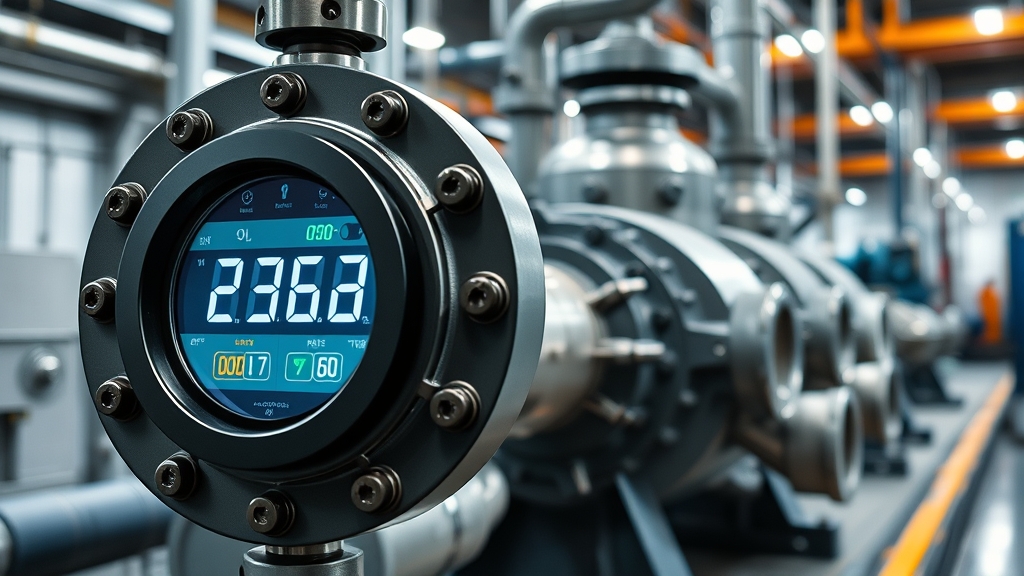
Understanding Pump Flow Rate
Flow rate — the volume of fluid a pump moves per unit of time — is the most fundamental measure of pumping system performance. Whether expressed in gallons per minute (GPM), cubic meters per hour (m³/h), or liters per second (L/s), flow rate is the output that justifies the pump’s existence. Understanding how flow rate relates to impeller geometry, rotational speed, and system head is essential for pump sizing, performance verification, and troubleshooting.
The Basic Flow Rate Formula
The fundamental equation for volumetric flow rate through any pipe or pump nozzle is the product of cross-sectional area and fluid velocity:
⚠️ Quality & Compliance Assurance
All pumps and components from ANSI Pumps Pro are manufactured to ASME B73.1 dimensional specifications. Each shipment includes certified Material Test Reports (MTRs), CMM dimensional inspection reports, and hydrostatic test certificates (1.5× MAWP). 100% dimensional interchangeability guaranteed. Full material traceability from heat number to your receiving dock.
Q = A × v = (π × d² / 4) × v
Where:
| Symbol | Parameter | Metric Units | US Units |
|---|---|---|---|
| Q | Volumetric flow rate | m³/h | GPM (gallons per minute) |
| A | Cross-sectional area | m² | ft² or in² |
| d | Internal pipe / nozzle diameter | meters (m) | inches (in) or feet (ft) |
| v | Average fluid velocity | m/s | ft/s |
Practical velocity guidelines for ANSI centrifugal pumps: For chemical process fluids, recommended suction piping velocity is 1–2 m/s (3–6 ft/s); discharge piping velocity is 2–4 m/s (6–12 ft/s). Higher velocities increase friction losses and accelerate pipe erosion. For Goulds 3196 and Durco Mark III ANSI pumps, the discharge nozzle is sized per ASME B73.1 to maintain these velocity ranges at the pump’s best efficiency flow.
Worked Example: Metric and US Customary Units
Consider a chemical process pump with a 4-inch (100 mm) discharge nozzle, handling water at an average discharge velocity of 3 m/s (10 ft/s):
Step 1 — Metric calculation (SI units):
d = 100 mm = 0.10 m
A = π × (0.10)² / 4 = 3.1416 × 0.01 / 4 = 0.00785 m²
Q = A × v = 0.00785 × 3.0 = 0.02355 m³/s
Q = 0.02355 × 3600 = 84.8 m³/h
Step 2 — US customary calculation:
d = 4.0 in = 0.333 ft
A = π × (0.333)² / 4 = 3.1416 × 0.111 / 4 = 0.0873 ft²
Q = A × v = 0.0873 × 10 = 0.873 ft³/s
Q = 0.873 × 448.8 = 392 GPM
Quick reference: 1 m³/h = 4.403 GPM. Cross-check: 84.8 m³/h × 4.403 ≈ 373 GPM (close agreement with 392 GPM; minor difference from velocity rounding).
Important: This calculation determines the flow rate through a known pipe diameter at a given velocity. In practice, a centrifugal pump’s actual operating flow rate is determined by the intersection of the pump H-Q performance curve with the system resistance curve. Always consult the pump performance curve for accurate flow prediction at your specific duty point.
The Affinity Laws: How Flow Changes with Speed and Diameter
The affinity laws describe how centrifugal pump performance changes with rotational speed and impeller diameter. For flow rate specifically:
Affinity Law 1 (Speed change): Q₁ / Q₂ = n₁ / n₂
Flow rate is directly proportional to speed. Doubling the speed doubles the flow.
Affinity Law 2 (Diameter change): Q₁ / Q₂ = D₁ / D₂
Flow rate is directly proportional to impeller diameter. Trimming the impeller reduces flow proportionally.
Critical note: While flow changes linearly with speed, head changes with the square of speed (H₁/H₂ = (n₁/n₂)²) and power changes with the cube of speed (P₁/P₂ = (n₁/n₂)³). This is why a seemingly modest speed increase can dramatically increase motor load.
Factors Affecting Actual Flow Rate
- System resistance: Higher system head results in lower flow, following the pump H-Q curve to its intersection with the system curve
- Fluid viscosity: Higher viscosity reduces flow rate by increasing internal friction losses within the impeller
- Wear ring clearance: As clearance increases, internal recirculation from discharge back to suction increases, reducing net flow
- Entrained gas: Even 2-3% gas by volume can significantly reduce pump flow and may cause loss of prime
- Impeller wear: Erosion or corrosion of impeller vanes reduces the pump’s ability to impart energy to the fluid
- Suction conditions: Inadequate NPSH leading to cavitation reduces both head and flow
Restore Lost Flow: When Wear and Corrosion Reduce Pump Output
When wear ring clearance increases due to corrosion or erosion, internal recirculation causes actual flow to drop significantly — often by 10–20% before the problem is even noticed. If your pump is no longer hitting its design flow rate, worn wet-end components are the most likely culprit. ANSI Pumps Pro supplies 100% interchangeable replacement impellers, casings, and wear rings for Goulds 3196 and Durco Mark III pumps — in 316SS, CD4MCuN, Hastelloy C-276, Alloy 20, and Titanium — to restore your pump to its original BEP flow rate.
Flow Rate Reference Table
| RPM | Impeller Dia. (m) | Head (m) | Theoretical Q (m³/h) |
|---|---|---|---|
| 1000 | 0.4 | 8 | 163.5 |
| 1200 | 0.5 | 10 | 240.1 |
| 1500 | 0.5 | 10 | 300.1 |
| 1800 | 0.6 | 12 | 415.7 |
| 1800 | 0.7 | 15 | 565.0 |
Understanding flow rate calculations is not just an academic exercise — it is essential for verifying that installed pumps meet process requirements, diagnosing performance degradation, and making informed decisions about impeller trimming or speed adjustments.
📋 Quick RFQ — No Registration Required