
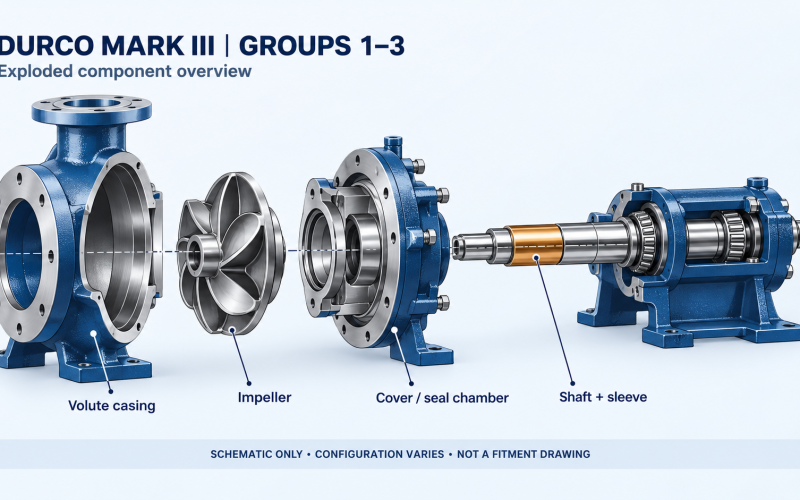
This guide helps you navigate Durco Mark III replacement parts across Groups 1, 2 and 3. Identify the component family, choose the relevant guide, and prepare the installed-pump information needed for review. Record the configuration as well as the Group designation.
Find a Part Reference · Send a Nameplate or Drawing
Start With the Installed Mark III Configuration
Record the pump size and type, serial number, Group, and available nameplate information. Identify the component you need and retain any drawing, parts list or previous order reference that helps describe the installed assembly.
Configuration matters. A shared Group designation does not establish that every impeller, shaft, cover, bearing arrangement or seal component will fit. Record known modifications and identify the mating parts that will remain in service.
This overview focuses on Group 1–3 parts identification. Specialized Mark III configurations and other Groups require their own documentation. For a detailed verification sequence, use the Durco Mark III parts fitment guide.
Group 1, 2 & 3 Parts Coverage at a Glance
Use the following table to choose a starting point. It maps topics and component guides; it does not confirm stock or approve a particular replacement.
| Installed Group | Information to retain | Useful next guide |
|---|---|---|
| Group 1 | Full size/type, shaft arrangement and the component being requested | Group 1 shaft and sleeve identification |
| Group 2 | Full size/type and suffix, component reference and installed configuration | Group 2 size, part and fitment guide |
| Group 3 | Full size/type, component reference and the retained assembly | Group 3 casing fitment guide |
This table is for identification and navigation; it is not a claim that every listed component is offered individually. Current standalone supply is limited to approved casings, covers, impellers, shafts and selected drawing-based metallic mechanical-seal components, subject to configuration review. Other items may appear in an IOM or parts list without being available as standalone supply.
The linked guides cover specific subjects within each Group. For another component, begin with the Mark III STD parts directory or send the available pump information through the existing contact route. Confirm support for the exact component and configuration during the quotation review.
Which Component Are You Trying to Identify?
A component name helps locate a drawing or parts list. It still needs the installed pump context before it can support an order.
| Component family | Identification information | Next reference |
|---|---|---|
| Casing | Pump size/type, casing identification, material record and connection details | Group 2 casing guide or the Group 3 casing guide above |
| Impeller | Pump identity, impeller style, diameter/trim and available part reference | Reverse-vane impeller guide |
| Shaft and optional sleeve | Installed shaft arrangement, component reference and sealing arrangement | The Group 1 shaft/sleeve guide above, or the installed assembly documentation for another Group |
| Cover or seal chamber | Cover identification, chamber arrangement and mating components | Mark III STD parts directory |
| Bearing housing or associated components | Installed power-end identification and relevant parts list | The installed IOM and OEM part-reference lookup |
Impeller style is an important identification detail. The reverse-vane design uses a clearance relationship with the rear cover. Other arrangements must be identified from their applicable instructions. This overview does not provide a universal clearance or adjustment procedure; see the impeller adjustment comparison for that topic.
A sleeve is also configuration dependent. Identify whether the installed shaft is sleeved or solid before requesting a replacement.
Keep IOM Items, POS Codes and OEM Part Numbers Separate
An RFQ may contain several reference systems. Preserve the source of each reference so the supplier can interpret it correctly.
| Reference | What it helps identify | What to include |
|---|---|---|
| IOM item | A component position in a particular manual or drawing | Manual number, revision and the relevant drawing |
| Supplier or catalog POS code | A position in that supplier’s parts scheme | Catalog/page and the associated component description |
| OEM part number | A specific part reference requiring configuration review | Number as recorded, source document and installed pump identity |
Do not assume that a position number uniquely identifies the correct size, material or revision. If you have a POS reference, use the Mark III POS breakdown with its associated documentation. For a recorded OEM number, use the existing lookup and retain the original source.
For the engineering meaning and limits of a match, read the Durco Mark III cross-reference guide.
Confirm the Material and Documentation Scope
Identify the specified alloy, its product form, and the applicable material specification. A familiar alloy family name should not replace an exact purchasing requirement.
If a material change is being considered, provide the liquid composition, concentration, temperature, relevant contaminants and solids, and any available service history. The impeller material-selection guide explains the service information needed for that review. Resolve the exact casting or wrought grade against the approved specification and material records.
State documentation requirements in the RFQ. Depending on the component and purchase scope, these may include material records, traceability, dimensional inspection, and specified pressure or balance testing. Confirm applicability, acceptance criteria and the records to be supplied before placing the order.
For receipt and installation checks, use the separate ANSI replacement-parts inspection guide.
Choose the Next Step for Your Parts Request
You have a part reference
Start with the OEM part-number lookup. Retain the pump identity, reference source, material and quantity with the request. A lookup result is a starting point for review; unresolved configuration details still need confirmation.
You have a nameplate, drawing or photograph
Use the existing contact route and prepare:
- Pump size/type, serial number and Group, where known.
- Component name, quantity and any recorded references.
- Available nameplate, component photographs, drawings or previous order information.
- Required material and the components that will remain installed.
- Service conditions, required date and requested inspection records.
Record missing information clearly. Availability and delivery need confirmation for the verified part, material, quantity and agreed documentation scope.
If the scope has expanded to an assembly or complete pump, use the Mark III replacement solution and its existing enquiry route. If you are still deciding whether a removed component should be reused, repaired or replaced, use the overhaul inspection and disposition guide.
Frequently Asked Questions
Is the Group enough to identify a replacement part?
No. Keep the full pump identity, component reference and installed configuration together. The Group narrows the search but does not establish every mating interface or material requirement.
Does every Mark III shaft use a separate sleeve?
The shaft arrangement is configuration dependent. Confirm the installed assembly and relevant documentation before requesting either a sleeve or a shaft replacement.
Can I start a request without an OEM part number?
Yes. Prepare the available nameplate information, component description, photographs and drawings. The review will need to identify what remains unknown before a replacement can be confirmed.
Technical References
- Flowserve Durco Mark 3 product information.
- Flowserve Mark 3 User Instructions, PCN 71569102, 03-17, manufacturer document hosted by OTC Industrial. Use the instructions applicable to the installed pump.
- ASME B73.1 scope. Standardized external dimensions do not by themselves approve internal replacement parts.
ANSI Pumps Pro is an independent aftermarket supplier and is not affiliated with or endorsed by Flowserve. Durco and Mark III names are used for identification and replacement-reference purposes.