
Quick Answer: Start With the Installed Pump, Not “Group 2” Alone
Group 2 narrows the pump family and power-frame range, but it does not approve an individual replacement part. Final fitment still depends on the installed size, component identity, material, impeller/cover arrangement, shaft and seal interfaces, and the drawing or BOM that controls the actual pump.
Use Group 2 as a first filter
- Confirm the installed pump size and family.
- Identify whether the request is wet end, power end or one component.
- Match the component to the current IOM item or installed drawing.
- Verify all mating interfaces before release.
Do not approve from “Group 2” alone
- Do not assume one impeller or cover fits every Group 2 size.
- Do not mix Mark 3 ISO frame data with ASME/ANSI Group 2 data.
- Do not treat an IOM item number as a unique OEM part number.
- Do not use one fixed impeller clearance for every temperature.
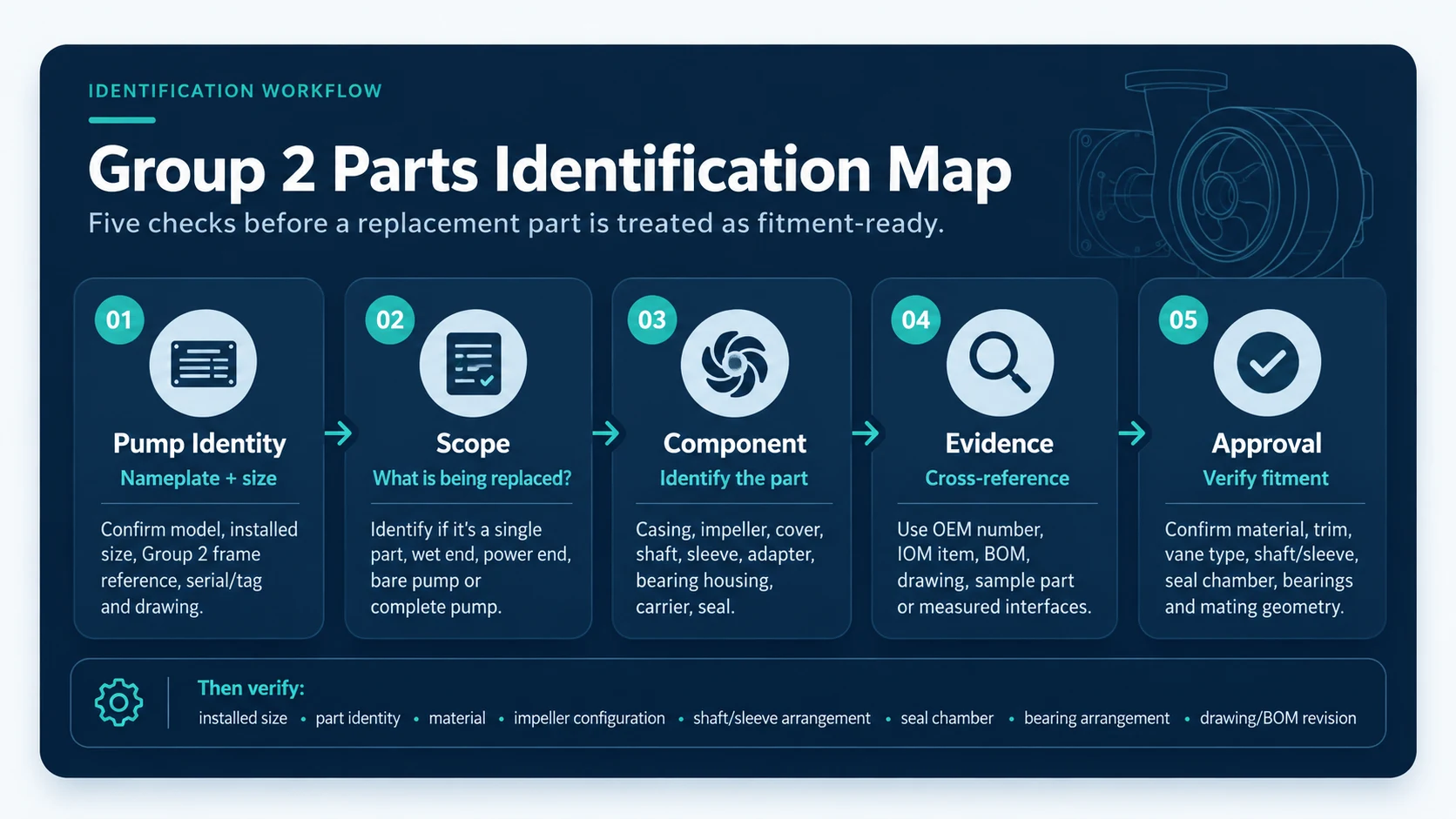
Group 2 Parts Identification Map
This workflow turns an incomplete “Group 2 part needed” request into a fitment-ready RFQ. Read left to right; each step removes a different source of ambiguity.
Which Pump Sizes Are in Mark 3 Standard Group 2?
Current Flowserve Mark 3 ASME literature lists the following sizes under Mark 3 Standard Group 2. This is useful for family identification, but legacy Mark III Group II drawings and installed configurations should still be checked before ordering parts.
Parts Breakdown: Use the IOM Item to Identify the Component, Then Cross-Reference the Actual Part
The current Mark 3 user documentation uses four-digit item identifiers for component location. These are useful for reading a sectional drawing, but they are not a substitute for an installed OEM part number or a pump-specific BOM.
| Current IOM item | Component | Fitment evidence to confirm |
|---|---|---|
| 1100 | Casing | Installed size, flange/nozzle interfaces, pressure requirement, metallurgy and mating cover. |
| 1220 | Cover / rear cover | Seal-chamber configuration, gasket/O-ring interface, material and impeller relationship. |
| 1340 | Bearing-housing adapter | Group 2 power-end interface, pilot/register dimensions and installed generation. |
| 2100 | Shaft | Shaft/sleeve arrangement, bearing fits, seal interface, coupling end and material. |
| 2200 | Impeller | Pump size, reverse-vane/open style, trim diameter, material and shaft connection. |
| 2400 | Sleeve optional | Sleeved versus solid-shaft configuration, seal running surface and axial location. |
| 3011 | Inboard bearing | Group, lubrication arrangement and bearing variant. |
| 3013 | Outboard bearing | Single/double-row or duplex arrangement, lubrication and retaining details. |
| 3200 | Bearing housing | Group 2 housing, lubrication configuration, ports and adapter interface. |
| 3240 | Bearing carrier | Adjustment mechanism, threads, locking hardware and housing compatibility. |
| 4200 | Mechanical seal | Seal chamber, shaft/sleeve diameter, faces, elastomers and service conditions. |
Three different references may appear in one RFQ
Installed/OEM part number: pump-specific identifier from the existing BOM, drawing or part. IOM item: component-location identifier such as 1100 or 2200. ANSI Pumps Pro replacement reference: the cross-reference used to identify the aftermarket replacement. Keep these fields separate so one number is not mistaken for another.
Use the Durco Mark III Parts Breakdown & POS Code Finder →
Search the Durco Mark III OEM Part Number Cross-Reference →
Reverse-Vane Impeller Clearance Is Set to the Cover—and Changes With Temperature
For Mark 3 reverse-vane and recessed impellers, Flowserve instructions set clearance to the cover. For an open impeller, clearance is set to the casing. That distinction matters when a Group 2 impeller, cover, shaft or power-end component is replaced.
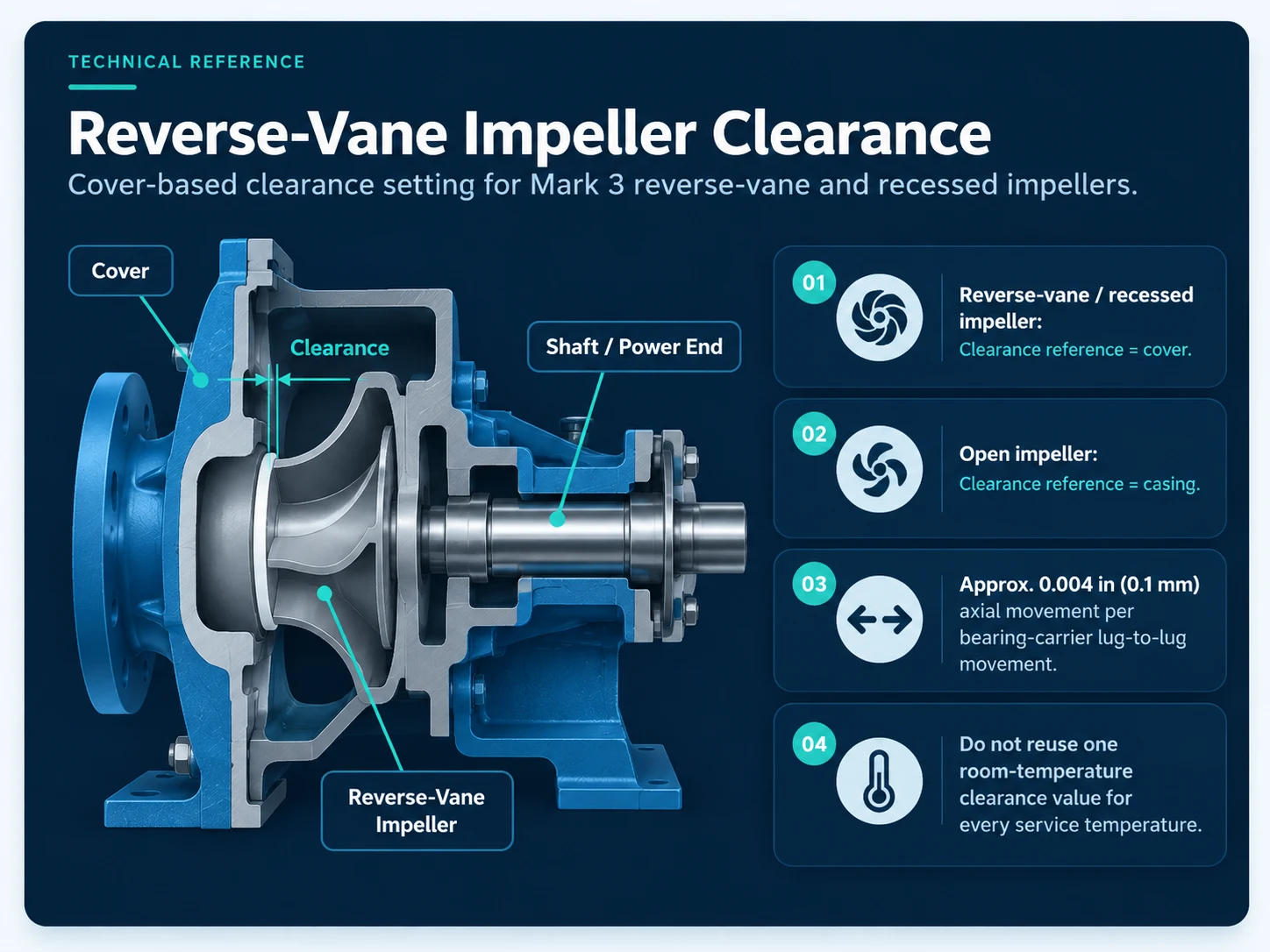
Flowserve Mark 3 clearance reference
| Process temperature | Clearance | Fitment note |
|---|---|---|
| < 93°C (< 200°F) | 0.46 ± 0.08 mm (0.018 ± 0.003 in) | Baseline room/moderate-temperature setting. |
| 93–121°C (200–250°F) | 0.53 mm (0.021 in) | Temperature-adjusted setting. |
| 122–149°C (251–300°F) | 0.61 mm (0.024 in) | Temperature-adjusted setting. |
| 150–176°C (301–350°F) | 0.69 mm (0.027 in) | Temperature-adjusted setting. |
| 177–204°C (351–400°F) | 0.76 mm (0.030 in) | Temperature-adjusted setting. |
| 205–232°C (401–450°F) | 0.84 mm (0.033 in) | Temperature-adjusted setting. |
| > 232°C (> 450°F) | 0.91 mm (0.036 in) | Use the project/IOM procedure for the installed configuration. |
Review the dedicated Mark III Reverse-Vane Impeller Fitment Guide →
Group 2 Bearing References: Confirm the Lubrication Configuration Before Ordering
The current Mark 3 IOM distinguishes Group 2 bearings by lubrication arrangement. For the oil-bath/oil-mist open-bearing configuration, the reference set below is a useful identification check—not a substitute for confirming what is actually installed.
6310-C3
Single-row deep-groove bearing in the open oil-bath/mist configuration.
5310-AC3 / 3310-AC3
Double-row angular-contact reference in the open oil-bath/mist configuration.
7310-BECBY
Duplex angular-contact option shown by the Mark 3 bearing table.
Shielded, sealed and regreasable variants use different suffixes/configurations. Verify the lubrication method, bearing markings, housing and BOM before releasing a replacement.
What Can Be Used as an Interchangeability Clue—and What Still Needs Verification?
Flowserve literature emphasizes a high degree of parts interchangeability across the Mark 3 family. For an aftermarket replacement, that should be treated as a structured verification path rather than a blanket assumption.
| Item | Useful first clue | Still verify before quote/release |
|---|---|---|
| Power end | Group 2 family | Generation, lubrication, bearing arrangement, adapter and shaft configuration. |
| Casing | Installed pump size | Nozzle/flange, pressure requirement, material, cover interface and project dimensions. |
| Impeller | Group + hydraulic size | Reverse-vane/open style, trim, material, rotation and shaft interface. |
| Cover / seal chamber | Group and casing family | Seal chamber design, material, gasket/O-ring and impeller-clearance relationship. |
| Shaft / sleeve | Power-end family | Solid vs sleeved, bearing fits, seal surface, coupling interface and material. |
| Complete wet end | Size-family match | Hydraulic duty, trim, materials, seal chamber, NPSH and all mating interfaces. |
Compare Goulds 3196 and Durco Mark III replacement architecture →
Material Names Are Cross-Reference Clues, Not Chemical-Service Approvals
Keep casting designations, wrought grades and commercial alloy-family names separate. A material family can help identify an existing part, but service suitability still depends on concentration, temperature, contaminants, solids, corrosion history and the project specification.
| Common family | Cast designation example | Wrought reference example | Use in this article |
|---|---|---|---|
| 316 stainless family | CF8M / CF3M | 316 / 316L | Designation cross-reference only; verify product form and project spec. |
| Alloy 20 family | CN7M / cast UNS N08007 where specified | Alloy 20 / UNS N08020 (wrought reference) | Related alloy-family references, but different product-form designations; do not treat them as identical procurement grades. |
| Duplex family | CD4MCu / CD4MCuN | Project-specific wrought grade | Do not force a one-to-one wrought mapping without the material specification. |
| C-type nickel alloy family | CW2M and related cast grades | C-276 / UNS N10276 where specified | Cast and wrought designations must be kept distinct. |
This table is intentionally a designation reference, not a chemical-resistance recommendation.
Already Have a Part Number—or Only a Nameplate?
You do not need a perfect data package to start. Use the path that matches what is available, then add the remaining fitment evidence during review.
I have an OEM part number
Search the existing cross-reference by OEM number, replacement reference, pump size, Group 2 or part type. Final fit is still verified against the installed configuration.
I only have a nameplate, drawing or photo
Start with what you have. Send the installed pump size, component photo, material, seal information and any drawing/BOM reference available.
Minimum data that improves a Group 2 parts quote
| Data | Why it matters |
|---|---|
| Nameplate + complete-pump photo | Establishes model/size identity and catches obvious field modifications. |
| Existing OEM/reference number | Speeds cross-reference but still requires configuration verification. |
| Component photo + mating part | Shows wear, machining, seal-chamber and interface details. |
| Material + fluid + temperature | Separates fitment from service/material approval. |
| Impeller trim / vane type | Critical for hydraulic performance and clearance procedure. |
| Shaft/sleeve + seal chamber | Controls seal and power-end interface fit. |
| Drawing/BOM revision | Helps resolve legacy Mark III versus later Mark 3 configuration differences. |
Frequently Asked Questions
Is “Group 2” enough information to order a Durco Mark III replacement part?
No. It narrows the family, but a controlled replacement still needs the installed size, exact component, material and relevant mating interfaces. For impellers, covers, shafts and power-end parts, the installed drawing/BOM is especially useful.
Are Mark III Group II and Mark 3 Group 2 exactly the same thing?
They are related family terms that appear in Flowserve interchangeability literature, but legacy and later configurations should not be treated as universally identical. Verify the installed drawing, power end and component interfaces.
Can I order a part using only item 1100 or 2200?
No. Those are component item identifiers used in the IOM/sectional drawing. They identify “casing” or “impeller,” not a unique pump-specific OEM part number.
Is reverse-vane impeller clearance always 0.018 in?
No. 0.018 ± 0.003 in applies below 200°F / 93°C in the cited Mark 3 instructions. The specified clearance increases with operating temperature, and two 13-inch sizes have an additional high-speed note.
What should be checked for a Group 2 power-end bearing request?
Confirm the installed lubrication arrangement, bearing markings, housing/carrier configuration, shaft and BOM. The Mark 3 IOM lists 6310-series inboard and 5310/3310-series outboard references for Group 2, with different suffixes/options depending on configuration.
Can a parts request be converted into a complete replacement-pump review?
Yes. If the installed pump has extensive wear or the outage scope has expanded, review the hydraulic duty, materials, seal, motor and dimensional interfaces as a complete-pump replacement rather than approving individual parts in isolation.
Separate Group 2 Identification from Supply Approval
An IOM item identifies a component position. It is not a unique part number and does not prove that the component is offered separately. Keep identification status, interface review and supply confirmation as separate fields in the RFQ.
| Component / scope | How to use the reference | Quotation status |
|---|---|---|
| Casings, impellers and applicable covers | Start with Group, exact installed size, component position, material, part reference and mating drawing. | Candidate component enquiry; fitment and supply need exact-reference review. |
| Shafts and selected metallic seal components | Identify the shaft/seal arrangement and the retained mating parts; include controlled dimensions where available. | Availability depends on the exact supported configuration. |
| Bearings, bearing carriers and housings | Use the IOM references to identify the installed power-end arrangement. | Technical reference; this guide does not confirm standalone supply. |
| Complete pump replacement | Record retained piping, base/driver, hydraulic duty, material and project requirements. | Use a complete-pump enquiry rather than approving individual parts from the Group name. |
If a part number is available, keep its original spelling and suffix and use the OEM cross-reference lookup. If it is missing, use the Durco POS breakdown and supply nameplate and component photos. For POS 103, continue to the reverse-vane impeller fitment guide; confirm vane style instead of inferring it from the item number.
Open the copyable review worksheet
Edit the known fields, leave missing information marked as pending, and copy the text into your maintenance record or enquiry. This worksheet does not submit data.
Send the Group 2 component details
Sources Used for the Added Engineering Notes
- Flowserve — Durco Mark 3 Sealed ASME/ANSI Chemical Process Pump product page (features, specifications and official document library).
- Flowserve — Durco Mark 3 ASME (ANSI) Chemical Process Pump brochure, current Group 2 size range and component-parts item list.
- Flowserve Mark 3 User Instructions 71569102 (bearing table, impeller-clearance procedure and temperature-based settings).
- ANSI Pumps Pro — OEM Part Number Cross-Reference (aftermarket replacement-reference workflow).
Have a Group 2 Pump, Part Number or Drawing to Review?
Send the installed size, part reference, material and available nameplate/drawing. The first step is to identify the component and the interfaces that must be confirmed before quotation.