
What a Damage Pattern Can — and Cannot — Tell You
Corrosion failure analysis begins with the damaged component, but visual appearance is evidence rather than a complete diagnosis. A casing, impeller or cover can show broad wall loss, isolated pits, attack around deposits or joints, directional wear, or impact-like surface damage. Those patterns help narrow the investigation; they do not by themselves prove the chemistry, corrosion rate, root cause or correct replacement alloy.
The most useful first question is not “Which alloy should replace this part?” It is “What mechanism is the evidence consistent with, and what information is still missing?”
A photograph is not a root-cause report
Use photographs to preserve morphology and location. Confirm the interpretation against process chemistry, operating data, material identity and, where necessary, further examination.
Corrosion, Erosion-Corrosion and Cavitation Can Look Similar
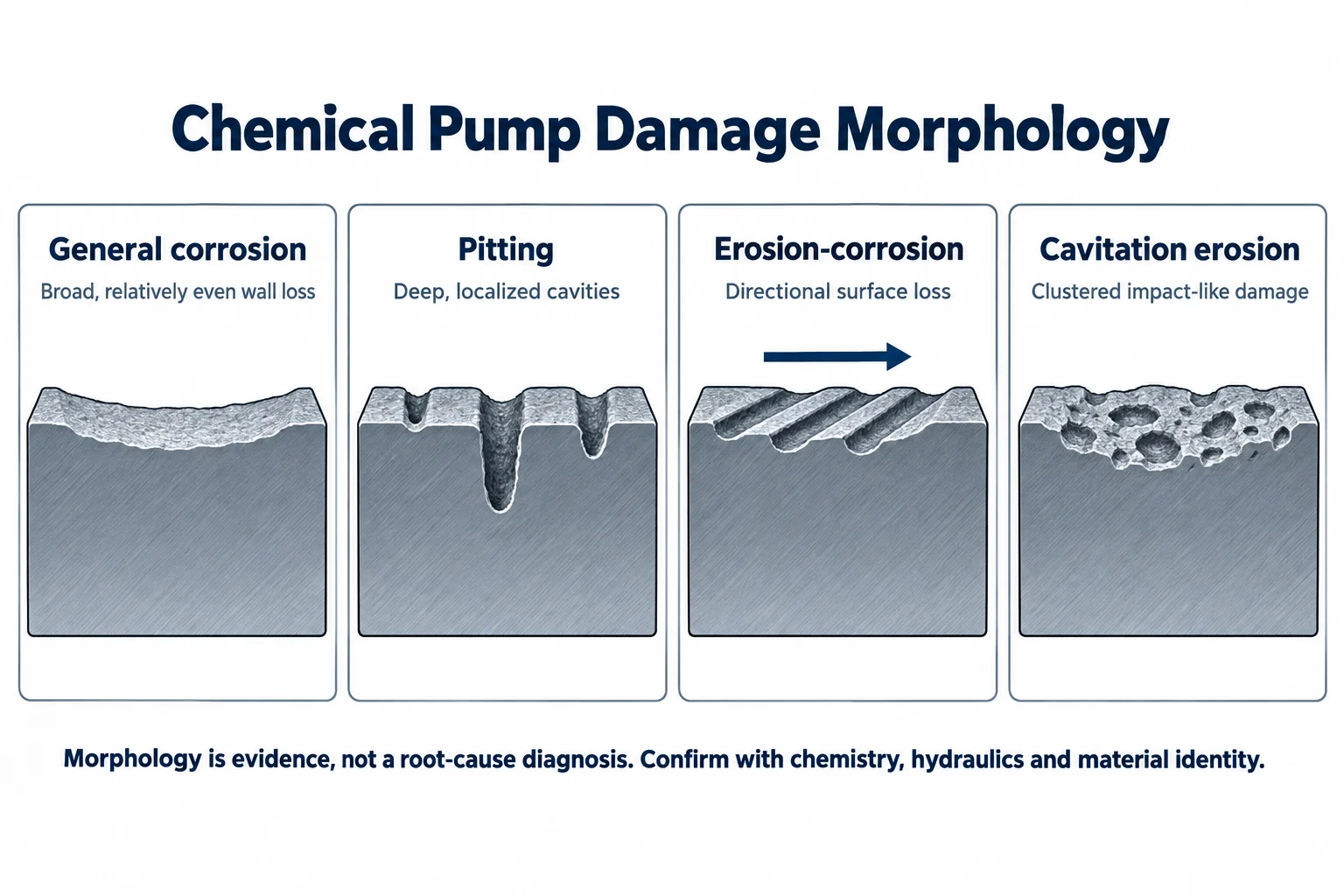
Real pump failures may involve more than one mechanism. Chemical attack may weaken a passive surface while solids, local velocity or cavitation accelerate material removal. The comparison below is a diagnostic starting point, not a laboratory determination.
Typical Damage Morphology
The illustrations show diagnostic patterns, not actual metallography.
Pitting, Crevice and Galvanic Attack: What to Look For
Pitting
Pitting is a highly localized form of attack that can produce deep cavities while the surrounding surface appears relatively intact. On stainless and other passive alloys, local passive-film breakdown can be influenced by aggressive ions, deposits, temperature and surface condition.
Crevice corrosion
Crevice corrosion develops in shielded regions where the local environment differs from the bulk liquid. Gasket interfaces, deposits, narrow joints, threads and sheltered regions deserve attention when damage is concentrated near a crevice rather than distributed across the entire wetted surface.
Galvanic corrosion
Galvanic attack requires more than “two different alloys.” The actual materials must be electrically connected and exposed to a conductive electrolyte. Potential difference, passive behavior, exposed-area ratio and service chemistry all influence which component is preferentially attacked.
PREN is a comparison tool, not a universal material-selection score
Pitting Resistance Equivalent Number can help compare localized-pitting resistance among stainless and duplex grades, but it does not replace service-specific corrosion data for acids, caustics, mixed chemicals, erosion-corrosion or galvanic conditions.
Preserve the Evidence Before the Failed Part Is Cleaned
The failure investigation becomes harder once deposits, residues and surface features have been removed. Follow plant safety and decontamination procedures first, then preserve as much useful engineering evidence as practical.
Make the equipment safe
Follow plant isolation, decontamination and handling procedures before inspection.
Photograph before cleaning
Record overall component condition, close-up morphology, flow direction and a dimensional reference.
Map the damage
Mark the exact location, depth, area, deposits, interfaces and relationship to the flow path.
Preserve relevant samples
Retain residue, deposits or process samples where site procedures and the investigation justify it.
Measure remaining geometry
Use suitable wall-thickness, pit-depth or dimensional checks where they can answer a defined question.
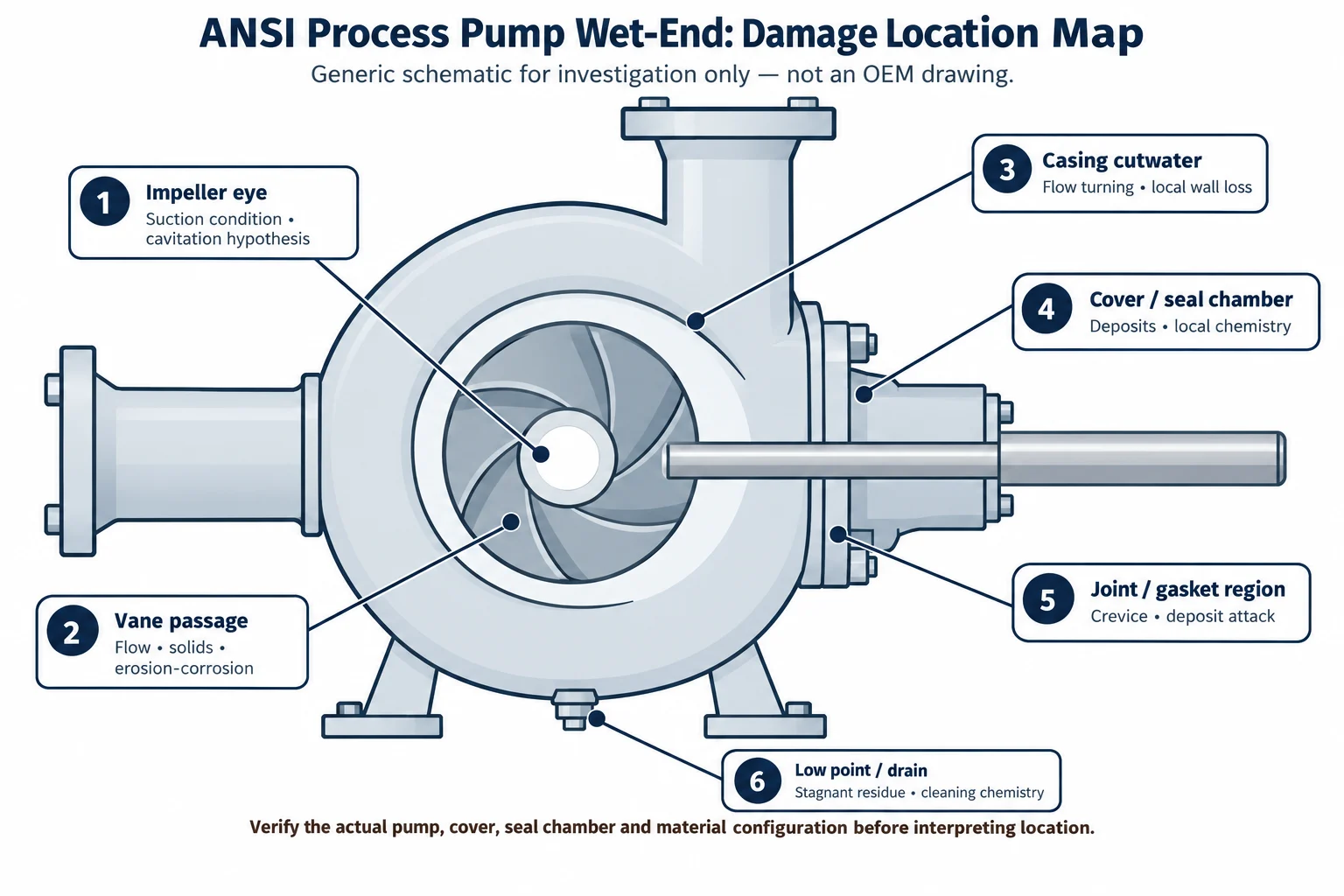
Map Damage Location to the Pump Wet End
The same visual morphology can mean something different at the impeller eye, casing cutwater, drain area or gasket interface. Identify the actual impeller, cover/seal-chamber and material configuration before interpreting the location.
Generic ANSI Wet-End Damage Location Map
Use the installed pump drawing and actual component geometry for the final investigation.
Reconstruct the Process and Hydraulic History
Material compatibility cannot be reviewed from the fluid name alone. Corrosion behavior may change with concentration, temperature, contaminants, oxidizing/reducing conditions, solids, cleaning chemistry and upset conditions. Hydraulic operation can also change where damage appears and how quickly it progresses.
Do not apply one universal percentage of BEP
Compare the failure event with the actual pump operating point and the applicable preferred/allowable operating region from the manufacturer or project basis. Off-design hydraulic contribution is pump- and application-specific.
Verify the Actual Material Before Upgrading It
A nameplate, purchase description or trade name does not always prove the exposed casting or component is exactly what the investigation assumes. Material verification should answer a defined question: Was the correct grade specified, supplied and exposed to the process?
When Material Selection Is — and Is Not — the Corrective Action
A higher-alloy material may be justified when the verified service condition is outside the existing material’s acceptable corrosion envelope. But a material upgrade alone will not correct every failure mechanism.
For service-condition screening, use the Chemical Resistance Guide rather than copying a universal acid/caustic table into a failure-analysis article. For alloy-comparison context, use the relevant material guides such as Alloy 20 vs C-type alloy selection and the CD4MCuN duplex stainless guide.
Build the Failure Case Before Choosing the Corrective Path
Corrosion Failure Investigation Workflow
The sequence separates observation from diagnosis and diagnosis from material or replacement decisions.
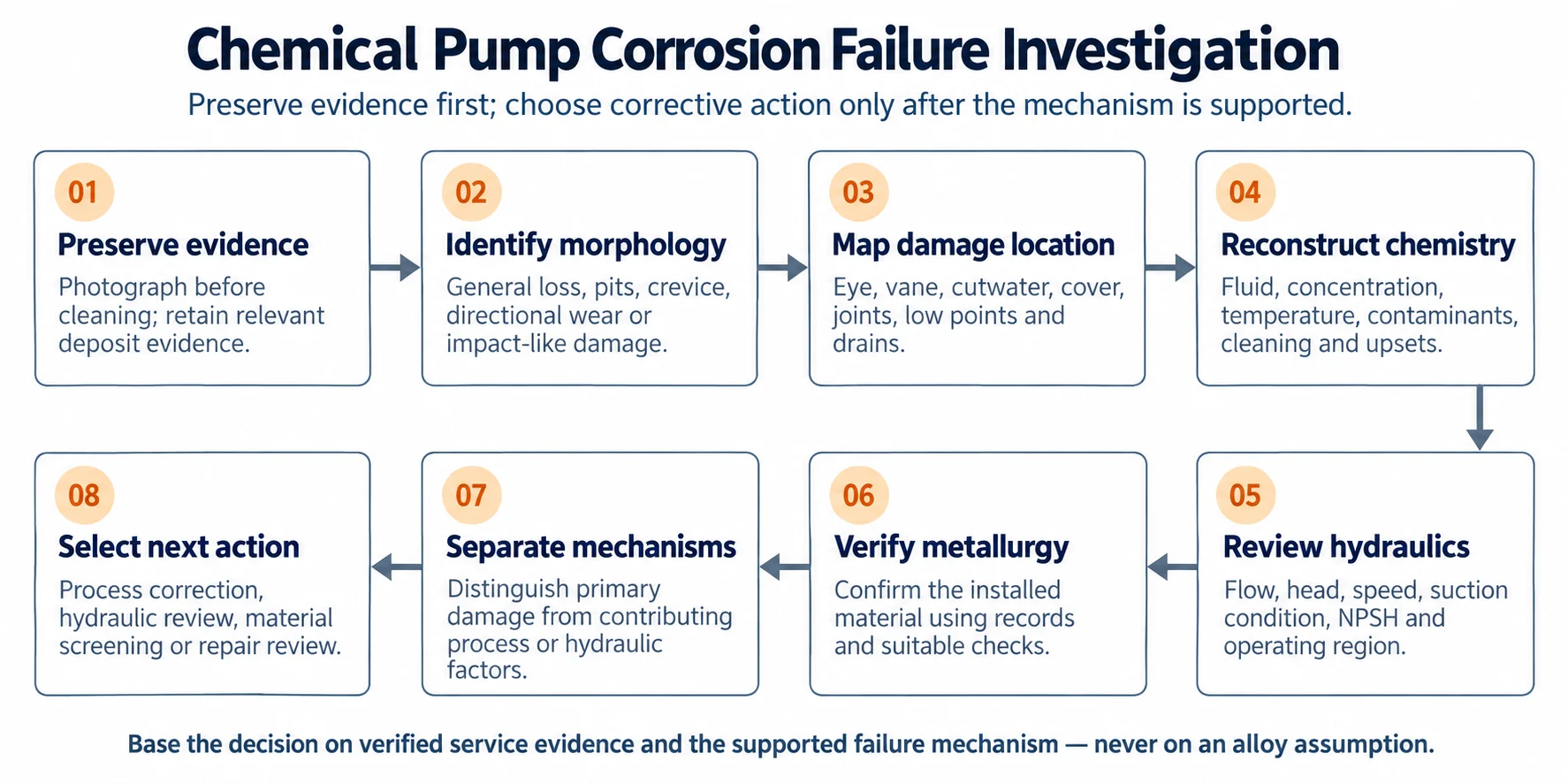
If the evidence points to a hydraulic contribution, use the Pump System Fundamentals guide and the applicable pump curve before escalating metallurgy. If the evidence points to material compatibility, move into service-specific corrosion screening rather than assuming one alloy is universally superior.
What to Send for a Corrosion Failure Review
The first review should determine what evidence is still missing before a material or replacement decision is made.
Before changing the alloy, confirm the failure mechanism.
Send the damaged-part photographs, current material, process chemistry, operating temperature, pump model and duty. Start with what you have; the first step is to identify the missing evidence and the next engineering check.
Chemical Pump Corrosion Failure FAQ
Can a photograph prove a pump failed from corrosion?
No. A photograph can preserve damage morphology and location, but the root cause should be checked against chemistry, operating conditions and material identity.
How can I distinguish corrosion from cavitation damage?
Compare the morphology and location with suction/NPSH evidence, operating point, chemistry and material condition. Cavitation is a hydraulic vapor-bubble-collapse mechanism; corrosion is an electrochemical or chemical material-degradation mechanism, and both can contribute to the same failure.
What does pitting corrosion look like on a pump impeller?
Pitting appears as discrete localized cavities or holes rather than relatively even wall loss. Visual appearance is only the starting clue; verify service chemistry, deposits, temperature and material before concluding why the pits formed.
Why can an impeller and casing fail at different rates?
The components may experience different velocity, turbulence, deposits, local pressure, solids exposure, crevices and even different material grades. Review the actual configuration and service condition instead of assuming both wetted parts see the same environment.
Does a higher-alloy material always solve corrosion failure?
No. A material upgrade cannot correct cavitation, poor suction conditions, destructive solids/turbulence, crevice geometry or an operating problem by itself.
Should PREN be used to choose a chemical pump material?
PREN can help compare localized-pitting resistance among stainless and duplex grades, but it is not a universal chemical-compatibility score and should not replace service-specific corrosion data.
What data should I collect before replacing a corroded casing or impeller?
Collect damage photographs, exact pump identification, existing material, fluid/concentration, temperature, contaminants, solids, operating duty, suction conditions, cleaning chemistry and failure history.
Engineering Sources
- AMPP — Forms of Corrosion.
- AMPP — Pitting Corrosion.
- AMPP — Crevice Corrosion.
- ASME B73.1-2026 — Specification for Horizontal End Suction Centrifugal Pumps for Chemical Process.
- ANSI/HI 9.6.3-2024 — Rotodynamic Pumps, Guideline for Operating Regions.
- Applicable ASTM casting specifications, manufacturer corrosion data, MTRs/PMI records and project-specific process information should be used for the actual material review.